
What hanakotoba is, and how firm the meanings are
Hanakotoba joins hana (花), flower, and kotoba (言葉), word. Every well-known flower has at least one meaning attached, and many have several: one for the flower in general and others for each colour. Florists, seed companies and calendar makers publish their own lists, and they do not always agree.
So nobody will be offended because a flower has an obscure negative meaning on one website. What people do notice are the handful of strong associations in this article: funerals, graves and illness. Learn those and you are safe.
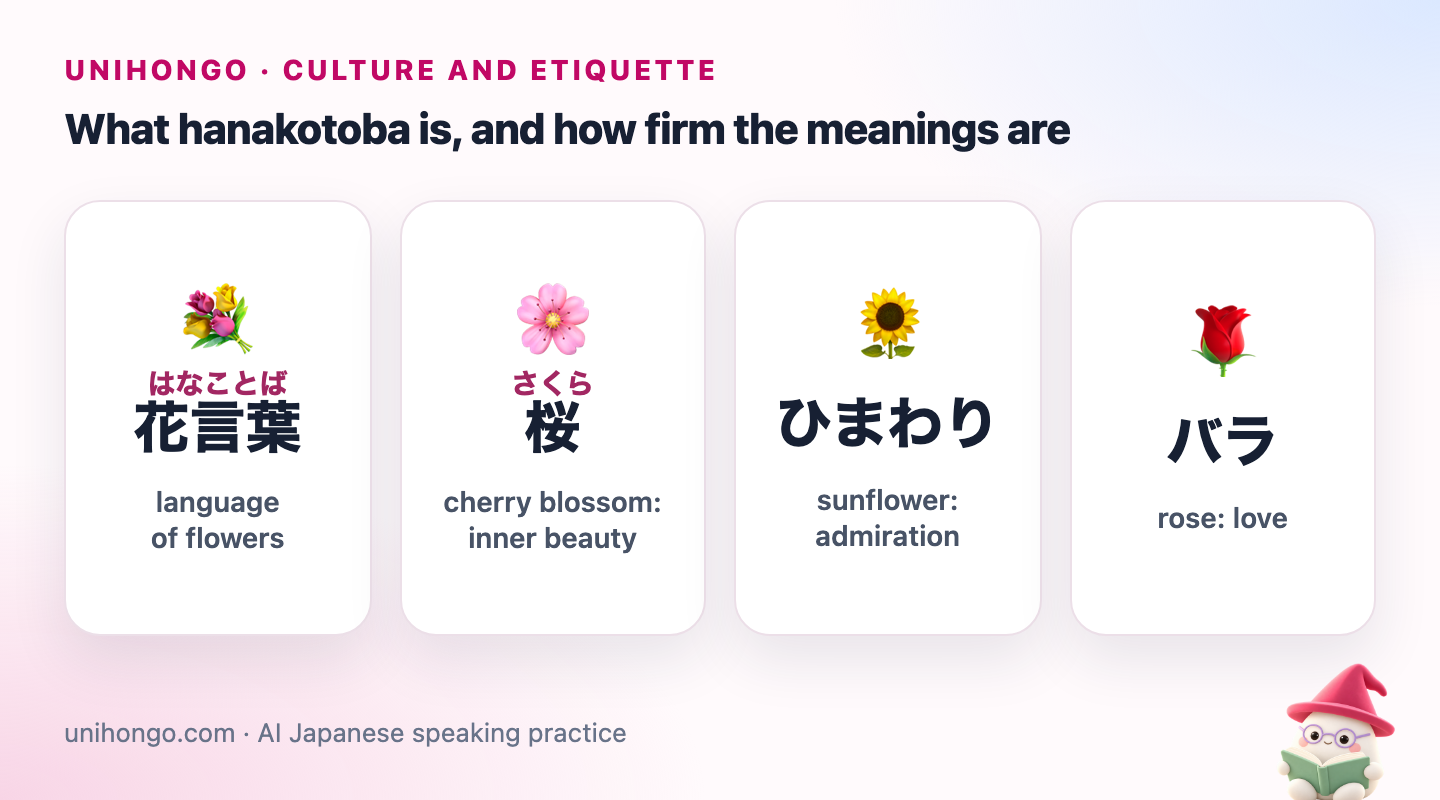
| Japanese | Romaji | Meaning |
|---|---|---|
| 花言葉 | hanakotoba | language of flowers |
| 桜 | sakura | cherry blossom: inner beauty |
| ひまわり | himawari | sunflower: admiration |
| バラ | bara | rose: love |
| 菊 | kiku | chrysanthemum |
| 花束 | hanataba | bouquet |
Common flowers and the meanings usually listed
| Flower | Reading | Commonly listed meanings | Good to know |
|---|---|---|---|
| Cherry blossom | sakura | Spiritual or inner beauty, grace | The symbol of spring; falls within about a week |
| Plum blossom | ume | Nobility, perseverance | Blooms in the cold of late winter, before the cherry |
| Chrysanthemum | kiku | Nobility, purity | Imperial crest, but also the funeral flower |
| Sunflower | himawari | Admiration, I look only at you | A cheerful summer gift |
| Hydrangea | ajisai | Fickleness; also family togetherness | Its colour shifts as it blooms in the rainy season |
| Camellia | tsubaki | Modest kindness, pride | The whole flower drops at once |
| Red spider lily | higanbana | Sad memories, passion, reunion | Blooms near graves at the autumn equinox |
The sunflower is written 向日葵 in kanji, literally the flower that faces the sun, though most people write it in hiragana. The hydrangea shows why lists vary: the older meaning, fickleness, comes from its changing colour, while the newer, warmer meaning comes from the way its small flowers cluster together.
Saying a flower's meaning in Japanese
One pattern covers everything: the flower, no hanakotoba wa, the meaning, desu. The meaning words are worth learning for their own sake, because akogare, kansha and jōnetsu turn up in songs, speeches and cards.
| Japanese | Romaji | Meaning |
|---|---|---|
| 桜の花言葉は「精神の美」です。 | Sakura no hanakotoba wa seishin no bi desu. | The cherry blossom means spiritual beauty. |
| 梅の花言葉は「忍耐」です。 | Ume no hanakotoba wa nintai desu. | The plum blossom means perseverance. |
| ひまわりの花言葉は「憧れ」です。 | Himawari no hanakotoba wa akogare desu. | The sunflower means admiration. |
| 紫陽花の花言葉は「移り気」です。 | Ajisai no hanakotoba wa utsurigi desu. | The hydrangea means fickleness. |
| 椿 | tsubaki | camellia |
| 彼岸花 | higanbana | red spider lily |
Kiku and higanbana: beautiful, but handle with care
The chrysanthemum, kiku (菊), has two faces. A stylised chrysanthemum with sixteen petals is the crest of the Imperial family, and a similar design appears on the cover of a Japanese passport. Autumn brings chrysanthemum shows with huge, carefully trained blooms. Yet white and yellow chrysanthemums are also the standard flowers for funerals, graves and household altars. A bunch of white kiku handed over as a cheerful present sends the wrong message.
Higanbana (彼岸花), the red spider lily, blooms around the autumn equinox, a week called higan when families visit graves. It often grows along the edges of rice fields and in graveyards, and its bulb is poisonous. Its listed meanings include sad memories and reunion. Japanese people travel to see whole fields turn red, but they do not usually pick it or give it.
The camellia, tsubaki (椿), is loved in gardens, but its flower falls whole instead of petal by petal. Many people say this looks like a head dropping, which is why it is avoided for sick visits.
Roses by colour
The rose is usually written in katakana, bara (バラ). Its meanings follow the colour, and the yellow rose is the one to watch: lists give it both friendship and jealousy.
| Japanese | Romaji | Meaning |
|---|---|---|
| 赤いバラ | akai bara | red rose: love, passion |
| 白いバラ | shiroi bara | white rose: purity, respect |
| ピンクのバラ | pinku no bara | pink rose: gratitude, grace |
| 黄色いバラ | kiiroi bara | yellow rose: friendship, also jealousy |
| 青いバラ | aoi bara | blue rose: dreams come true |
The blue rose has a story people enjoy telling. Roses have no natural blue pigment, so the blue rose long stood for the impossible. After a Japanese company developed a blue rose through biotechnology, the meaning commonly listed for it became dreams come true.
Carnations follow a similar colour logic on Mother's Day: red is the classic choice, while white carnations are often associated with a mother who has died.
Flowers to avoid for a hospital visit
A visit to someone who is ill is called omimai (お見舞い). The taboos are mostly word play and association, and older people take them more seriously than younger ones.
- Potted plants, hachiue (鉢植え): a plant in a pot takes root, nezuku (根付く), which sounds like netsuku (寝付く), to be laid up in bed. It suggests a long illness.
- Chrysanthemums: they suggest a funeral.
- Camellias: the flower drops whole.
- Cyclamen: the sounds shi and ku in the name echo the words for death and suffering.
- Flowers with a strong scent or a lot of pollen: a practical problem in a shared room.
- Bunches of four or nine stems: the numbers can be read shi and ku again.
Asking about meanings and giving flowers
The most useful habit is to tell the florist the occasion. Add yō (用), for the purpose of, to the occasion: omimai-yō for a sick visit, oiwai-yō for a celebration. The florist will then steer you away from anything awkward.
| Japanese | Romaji | Meaning |
|---|---|---|
| この花の花言葉は何ですか。 | Kono hana no hanakotoba wa nan desu ka. | What does this flower mean? |
| お祝いの花束をお願いします。 | Oiwai no hanataba o onegai shimasu. | A bouquet for a celebration, please. |
| お見舞い用でお願いします。 | Omimai-yō de onegai shimasu. | It's for visiting someone who is ill, please. |
| 避けたほうがいい花はありますか。 | Saketa hō ga ii hana wa arimasu ka. | Are there flowers I should avoid? |
| 気持ちばかりですが、どうぞ。 | Kimochi bakari desu ga, dōzo. | It's only a small token, but please accept it. |
| きれいな花をありがとうございます。 | Kirei na hana o arigatō gozaimasu. | Thank you for the beautiful flowers. |
Kimochi bakari desu ga is a modest set phrase for handing over any small gift. With a close friend, a simple kore, dōzo is enough.