
The year-end email in four lines
Every year-end email, short or long, is built around four ideas. A subject that says what it is. Thanks for the year. The closure, if you are announcing one. And the wish for a good new year. The lines below are the simplest version of each; the sections after them show the formal variants and where they go.
If you remember nothing else, remember the order. Japanese readers expect thanks before practical information and the good wishes at the very end, after the dates.
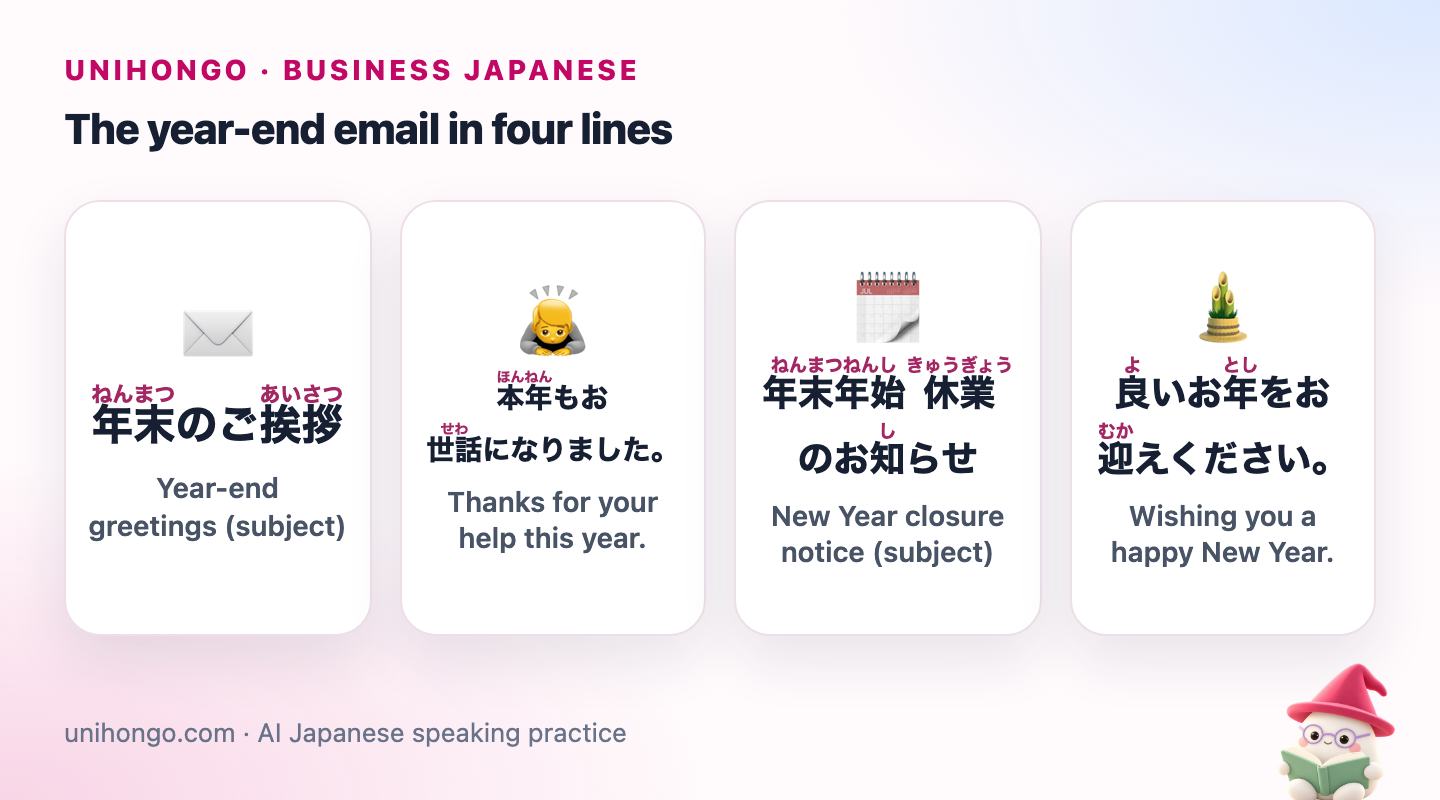
| Japanese | Romaji | Meaning |
|---|---|---|
| 年末のご挨拶 | Nenmatsu no goaisatsu | Year-end greetings (subject) |
| 本年もお世話になりました。 | Honnen mo osewa ni narimashita. | Thanks for your help this year. |
| 年末年始休業のお知らせ | Nenmatsu nenshi kyūgyō no oshirase | New Year closure notice (subject) |
| 良いお年をお迎えください。 | Yoi otoshi o omukae kudasai. | Wishing you a happy New Year. |
Two kinds of year-end email
Decide first which email you are writing. A personal greeting goes from you to a contact and sounds like you: it mentions the work you did together this year. A closure notice goes from the company to everyone and sounds like the company: it is formal, factual and the same for every reader. Small companies and freelancers often combine them, adding a personal line to the notice.
| Point | Personal year-end greeting | Holiday closure notice |
|---|---|---|
| Sender | You, to a contact | The company, to all customers |
| Subject | Nenmatsu no goaisatsu | Nenmatsu nenshi kyūgyō no oshirase |
| Tone | Warm, polite | Formal, factual |
| Key content | Thanks for this year's work together | Closure dates and how enquiries are handled |
| Length | Five to eight lines | Short, often with a dates block |
If you send both, the notice can be a plain announcement and the greeting can mention the closure dates in one line. Readers do not need the dates twice in full.
Who sends what also depends on your role. Sales staff and account managers usually send personal greetings to their own contacts, while the closure notice often comes from an administrator or appears on the company website. If you are not sure, ask your team how it was done last year: zennen wa dō shimashita ka is a perfectly natural question in early December.
Subject lines that are easy to find
Japanese business subjects are short labels, not sentences. Square brackets 【】 are often used to make a notice stand out in a busy inbox, and many people add their company and name in round brackets so the email can be found later. For the closure notice, the dates can go in the subject too, which saves the reader from opening it.
| Japanese | Romaji | Meaning |
|---|---|---|
| 【年末年始休業のお知らせ】 | Nenmatsu nenshi kyūgyō no oshirase | [Notice of New Year holiday closure] |
| 年末のご挨拶(さくら物産 佐藤) | Nenmatsu no goaisatsu (Sakura Bussan Satō) | Year-end greetings (Sato, Sakura Bussan) |
| 年末のご挨拶と休業日のご案内 | Nenmatsu no goaisatsu to kyūgyōbi no goannai | Year-end greetings and our closure days |
Thanking the reader for the year
After the usual opener, itsumo osewa ni natte orimasu, the email thanks the reader for the year. There are three common levels. The most formal, used in company notices, speaks of the reader's special consideration, gokōhai, and offers deep thanks. The middle level is the standard choice in personal greetings to clients. The lightest level suits contacts you work with every week.
In a personal email, add one concrete sentence after the set line: the project you finished, the event you ran together. That single line is what makes a template feel like a real message.
| Japanese | Romaji | Meaning |
|---|---|---|
| 本年も格別のご高配を賜り、厚く御礼申し上げます。 | Honnen mo kakubetsu no gokōhai o tamawari, atsuku onrei mōshiagemasu. | We are deeply grateful for your special support this year. (very formal) |
| 本年は大変お世話になり、誠にありがとうございました。 | Honnen wa taihen osewa ni nari, makoto ni arigatō gozaimashita. | Thank you very much for all your help this year. (standard) |
| 今年も一年、大変お世話になりました。 | Kotoshi mo ichinen, taihen osewa ni narimashita. | Thank you for another year of support. (warmer) |
| 秋のイベントでは大変お世話になりました。 | Aki no ibento de wa taihen osewa ni narimashita. | Thank you so much for your help with the autumn event. |
The closure notice: dates and enquiries
The closure part starts with a humble set phrase, makoto ni katte nagara, which literally means it is very selfish of us, but. It softens the fact that you will be unavailable. Then come the dates, usually as a separate line or block with the weekday in brackets, then what happens to enquiries, and finally an apology for the inconvenience.
A typical block looks like this: 休業期間:2026年12月29日(火)〜2027年1月4日(月). Many offices close somewhere between 28 or 29 December and 3 or 4 January, but dates vary by company and industry, so always check your own calendar and give the first day back clearly.
| Japanese | Romaji | Meaning |
|---|---|---|
| 誠に勝手ながら、下記の期間を年末年始休業とさせていただきます。 | Makoto ni katte nagara, kaki no kikan o nenmatsu nenshi kyūgyō to sasete itadakimasu. | We will be closed for the New Year holidays during the period below. |
| 休業期間中にいただいたお問い合わせは、年明けより順次対応いたします。 | Kyūgyō kikanchū ni itadaita otoiawase wa, toshiake yori junji taiō itashimasu. | Enquiries received during the closure will be answered in order in the new year. |
| ご不便をおかけいたしますが、何卒ご了承ください。 | Gofuben o okake itashimasu ga, nanitozo goryōshō kudasai. | We apologise for the inconvenience and ask for your understanding. |
| 新年は一月五日より通常営業いたします。 | Shinnen wa ichigatsu itsuka yori tsūjō eigyō itashimasu. | We will reopen as usual on 5 January. |
Ending the email: next year and good wishes
The last lines look forward. First, a request to continue the relationship next year, then the wish for a good new year, and often a line about taking care in the cold. In company notices you will see the reader addressed as minasama, everyone. In personal emails, the reader's name or no title at all is fine.
| Japanese | Romaji | Meaning |
|---|---|---|
| 来年も変わらぬご愛顧を賜りますよう、お願い申し上げます。 | Rainen mo kawaranu goaiko o tamawarimasu yō, onegai mōshiagemasu. | We hope for your continued patronage next year. (very formal) |
| 来年もどうぞよろしくお願いいたします。 | Rainen mo dōzo yoroshiku onegai itashimasu. | We look forward to working with you next year. |
| 寒さ厳しき折、どうぞご自愛ください。 | Samusa kibishiki ori, dōzo gojiai kudasai. | Please take care of yourself in this cold season. |
| 皆様どうぞ良いお年をお迎えください。 | Minasama dōzo yoi otoshi o omukae kudasai. | We wish you all a happy New Year. |
A short sample to a client you know
Here is a complete personal greeting with the closure mentioned in one line. It is polite but not stiff, the right level for a client you have worked with all year. Read it top to bottom as one email; each row is one line of the body.
| Japanese | Romaji | Meaning |
|---|---|---|
| 山田様 | Yamada sama | Dear Mr or Ms Yamada, |
| いつもお世話になっております。さくら物産の佐藤です。 | Itsumo osewa ni natte orimasu. Sakura Bussan no Satō desu. | Thank you for your support. This is Sato from Sakura Bussan. |
| 本年は大変お世話になり、誠にありがとうございました。 | Honnen wa taihen osewa ni nari, makoto ni arigatō gozaimashita. | Thank you very much for all your help this year. |
| 新商品の発売では、多くのご協力をいただきました。 | Shinshōhin no hatsubai de wa, ōku no gokyōryoku o itadakimashita. | You helped us greatly with the new product launch. |
| 弊社は十二月二十九日から一月四日まで休業いたします。 | Heisha wa jūnigatsu nijūkunichi kara ichigatsu yokka made kyūgyō itashimasu. | Our office will be closed from 29 December to 4 January. |
| 来年もどうぞよろしくお願いいたします。 | Rainen mo dōzo yoroshiku onegai itashimasu. | We look forward to working with you next year. |
| どうぞ良いお年をお迎えください。 | Dōzo yoi otoshi o omukae kudasai. | Wishing you a happy New Year. |
Timing and other common mistakes
- Sending the greeting after your office has closed. The closure notice is useless if it arrives on the first day of the closure.
- Using kyūka instead of kyūgyō in a notice to customers. The company is closing, not taking a holiday.
- Writing kyūnenchū or akemashite in December. Those belong to the New Year email, not the year-end one.
- Putting the wish before the dates. Practical information first, then the good wishes at the very end.
- Mixing formal and casual levels: kakubetsu no gokōhai in one line and kotoshi mo arigatō ne in the next.
- Forgetting the first day back. Readers care most about when you will answer again.
Let Mocchi check your draft before it goes out
Write your real year-end email first, then open Mocchi and type /correct followed by your draft and one line about the reader, such as a client of two years. Mocchi corrects the Japanese, flags any line in the wrong register, and explains why. If you want to understand one of the formal set phrases rather than copy it, use /explain on it and Mocchi breaks it into parts. Mocchi keeps a note of the expressions you found hard, so the New Year email in January starts from there.
For the set phrases themselves, make a small deck with /create-flashcards and review it with spaced repetition for a week before you send.