
Two calendars, one country
Japan uses the Western calendar and the Japanese era calendar at the same time, and which one appears depends on the setting rather than on the speaker. A train timetable, a supermarket receipt and a conversation about your holiday plans normally use the Western year. A city hall application, a bank account form, an insurance certificate, a driving licence and a school record often use the era year, because that is the system the record was designed around.
The Western calendar is called seireki and the era calendar is called wareki. The era name itself is the gengo, sometimes written nengo on older forms. Neither system is more correct than the other, and no one will think less of you for asking which is wanted. What causes real friction is guessing wrong on a form that has to be resubmitted, so treat the question as part of the procedure rather than as an admission of weak Japanese.
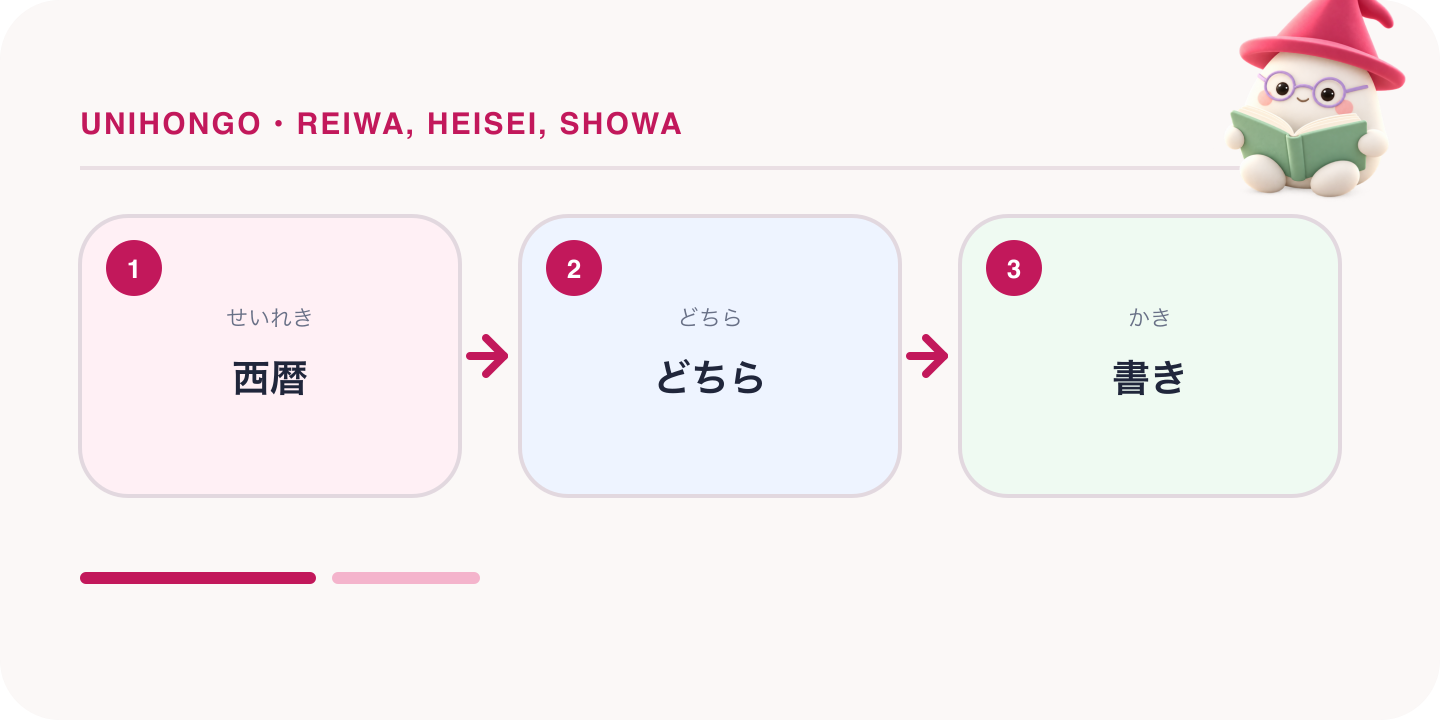
| Japanese | Romaji | Meaning |
|---|---|---|
| 西暦と和暦、どちらで書きますか? | Seireki to wareki, dochira de kakimasu ka? | Should I write it in the Western calendar or the Japanese era calendar? |
| 元号で書いてください。 | Gengō de kaite kudasai. | Please write it with the era name. (staff line) |
| 西暦でも大丈夫です。 | Seireki demo daijōbu desu. | The Western calendar is fine too. (staff line) |
The three eras you will actually meet
Almost every era date a foreign resident handles falls into one of three eras. The current era is Reiwa, which began in 2019. Before it came Heisei, which began in 1989, and before that Showa, which began in 1926. Older documents and the birth dates of elderly people can reach further back into Taisho and Meiji, whose initials T and M still appear in the row of options printed on some forms, but you will rarely need to write one yourself.
| Era | Kanji | Initial | Began | To get the Western year |
|---|---|---|---|---|
| Reiwa | 令和 | R | 2019 | Add 2018 |
| Heisei | 平成 | H | 1989 | Add 1988 |
| Showa | 昭和 | S | 1926 | Add 1925 |
| Taisho | 大正 | T | Before Showa | Rare on new forms |
| Meiji | 明治 | M | Before Taisho | Rare on new forms |
The offset is always one less than the era's first Western year, because the era's first year is year one rather than year zero. That single sentence is worth memorising, since it lets you rebuild any offset you have forgotten instead of looking it up.
Converting a year in your head
Going from an era year to a Western year is addition and going back is subtraction. Reiwa 7 plus 2018 gives 2025. Heisei 12 plus 1988 gives 2000. Showa 60 plus 1925 gives 1985. In the other direction, 1975 minus 1925 gives Showa 50, and 2018 minus 1988 gives Heisei 30. Practise with three numbers you already know by heart, because familiar anchors are far faster to recall under counter pressure than a rule you have only read.
One caution matters more than the arithmetic. An era begins partway through a calendar year, so the year in which an era changes maps to two different era years depending on the month. A document dated in the changeover year should be read with its month and day, not with the year alone. If a date sits on a boundary and the outcome matters, ask the office to confirm rather than assuming.
- Memorise three anchors: your birth year, the year you arrived in Japan, and this year.
- Say the sum out loud in Japanese, not in your first language, so the number words come with it.
- Write both versions side by side in your notebook the first few times, then cover one.
- Treat any changeover year as needing the month checked before you convert it.
- Keep your own birth date written in era form in your phone for the days your mind goes blank.
A conversion table for recent years
| Western year | Era year | Spoken form |
|---|---|---|
| 2026 | 令和8年 | Reiwa hachi-nen |
| 2025 | 令和7年 | Reiwa nana-nen |
| 2024 | 令和6年 | Reiwa roku-nen |
| 2023 | 令和5年 | Reiwa go-nen |
| 2022 | 令和4年 | Reiwa yo-nen |
| 2021 | 令和3年 | Reiwa san-nen |
| 2020 | 令和2年 | Reiwa ni-nen |
| 2019 | 令和元年 | Reiwa gannen |
| 2018 | 平成30年 | Heisei sanjū-nen |
| 2015 | 平成27年 | Heisei nijūnana-nen |
| 2010 | 平成22年 | Heisei nijūni-nen |
| 2005 | 平成17年 | Heisei jūnana-nen |
| 2000 | 平成12年 | Heisei jūni-nen |
| 1995 | 平成7年 | Heisei nana-nen |
| 1989 | 平成元年 | Heisei gannen |
| 1985 | 昭和60年 | Shōwa rokujū-nen |
| 1980 | 昭和55年 | Shōwa gojūgo-nen |
| 1975 | 昭和50年 | Shōwa gojū-nen |
| 1970 | 昭和45年 | Shōwa yonjūgo-nen |
| 1965 | 昭和40年 | Shōwa yonjū-nen |
The two changeover years in this table, 1989 and 2019, each belong to the outgoing era for part of the year and the incoming era for the rest, so a document from one of those years needs its month read before you convert it.
Note the readings for four and seven. Reiwa 4 is Reiwa yo-nen, not yon-nen, and 7年 is usually nana-nen rather than shichi-nen. Nine years is kyū-nen. These readings are fixed, and getting them right instantly marks you as someone who has handled Japanese paperwork before.
Gannen: the first year of an era
The first year of an era is written 元年 and read gannen. You will see Reiwa gannen for 2019 and Heisei gannen for 1989 on certificates, contracts and stamps. Learners very often say Reiwa ichinen instead, which will be understood but marks the sentence as non-native, and a form that has 1年 written where 元年 belongs may be sent back. There is only ever one gannen per era, so once you have met it the word costs nothing to remember.
| Japanese | Romaji | Meaning |
|---|---|---|
| 令和元年に日本に来ました。 | Reiwa gannen ni Nihon ni kimashita. | I came to Japan in the first year of Reiwa. |
| 平成元年生まれです。 | Heisei gannen umare desu. | I was born in the first year of Heisei. |
| ここは元年と書いてください。 | Koko wa gannen to kaite kudasai. | Please write gannen here. (staff line) |
| 一年ではなく元年ですね。 | Ichi-nen de wa naku gannen desu ne. | It is gannen rather than ichinen, isn't it. |
How dates are written on documents
| Written form | Reading | What it is |
|---|---|---|
| 令和8年9月7日 | Reiwa hachi-nen ku-gatsu nanoka | A full date in era form |
| R8.9.7 | Reiwa hachi-nen ku-gatsu nanoka | The initial-and-dots abbreviation |
| 2026年9月7日 | Nisen nijūroku-nen ku-gatsu nanoka | The same date in the Western calendar |
| 昭和60年3月5日 | Shōwa rokujū-nen san-gatsu itsuka | A birth date in era form |
| S60.3.5 | Shōwa rokujū-nen san-gatsu itsuka | The same birth date, abbreviated |
| 明・大・昭・平・令 | Mei, Tai, Shō, Hei, Rei | Era initials printed for you to circle |
| 生年月日 | Seinengappi | The birth-date field |
| 西暦 | Seireki | The Western calendar |
| 和暦 | Wareki | The Japanese era calendar |
| 元号 | Gengō | The era name itself |
| 発行日 | Hakkōbi | Date of issue |
| 有効期限 | Yūkō kigen | Expiry date |
| 記入日 | Kinyūbi | The date you filled the form in |
| 年月日 | Nengappi | Year, month, day, printed as field labels |
The 年月日 label deserves a second look. On many forms the kanji for year, month and day are already printed in small boxes and you write only the numbers between them, which is why a date can look like three loose numerals on the page. Fill each box with the number alone and do not repeat the kanji.
Where a row of era initials is printed, the expected action is usually to circle yours rather than to write the era name in full. If nothing is printed, write the era name or its initial in front of the year so the reader is never guessing.
Saying and writing your birth date
Your birth date is the single era date you will be asked for most, at city hall, at a clinic, at a bank, at a phone shop and whenever someone verifies your identity over the phone. Learn one fluent sentence for it in each calendar and you have covered the majority of cases. Remember that the order is always year, month, day, which is the reverse of the order many learners are used to.
| Japanese | Romaji | Meaning |
|---|---|---|
| 生年月日をお願いします。 | Seinengappi o onegai shimasu. | Your date of birth, please. (staff line) |
| 昭和六十年三月五日です。 | Shōwa rokujū-nen san-gatsu itsuka desu. | It is the fifth of March, Showa 60. |
| 平成七年十一月二十日です。 | Heisei nana-nen jūichi-gatsu hatsuka desu. | It is the twentieth of November, Heisei 7. |
| 西暦で言ってもいいですか? | Seireki de itte mo ii desu ka? | May I say it in the Western calendar? |
| はい、大丈夫ですよ。 | Hai, daijōbu desu yo. | Yes, that is fine. (staff line) |
| 一九九五年十一月二十日です。 | Sen kyūhyaku kyūjūgo-nen jūichi-gatsu hatsuka desu. | It is the twentieth of November, 1995. |
| 和暦だと平成七年になります。 | Wareki da to Heisei nana-nen ni narimasu. | In the era calendar that comes out as Heisei 7. |
| すみません、もう一度お願いします。 | Sumimasen, mō ichido onegai shimasu. | Sorry, could you say that once more. |
Two day readings trip people up in birth dates. The first ten days of the month have special readings, so the fifth is itsuka and the eighth is yōka, and the twentieth is hatsuka rather than nijū-nichi. If your birth date includes one of these, drill that single word until it is automatic, because it is the part a clerk listens for.
Asking staff which format they want
The question that saves the most time is asked before you pick up the pen, not after. Staff at a counter expect it and answer in one word, and a short polite question also signals that you intend to fill the form correctly rather than approximately. If the answer is fast and you miss it, the follow-up below asks them to point at the box instead of repeating the word.
| Japanese | Romaji | Meaning |
|---|---|---|
| ここは和暦で書きますか? | Koko wa wareki de kakimasu ka? | Should I write this part in the era calendar? |
| 西暦で書いてもいいですか? | Seireki de kaite mo ii desu ka? | Is it all right if I write the Western year? |
| どちらでも構いません。 | Dochira demo kamaimasen. | Either is fine. (staff line) |
| 和暦でお願いします。 | Wareki de onegai shimasu. | In the era calendar, please. (staff line) |
| すみません、どこに書けばいいですか? | Sumimasen, doko ni kakeba ii desu ka? | Excuse me, where should I write it? |
| ここに丸をつけてください。 | Koko ni maru o tsukete kudasai. | Please circle it here. (staff line) |
| 書き方が分からないので、教えてください。 | Kakikata ga wakaranai node, oshiete kudasai. | I am not sure how to fill this in, so please show me. |
| 間違えました。書き直してもいいですか? | Machigaemashita. Kakinaoshite mo ii desu ka? | I made a mistake. May I write it again? |
Reading era dates aloud
Reading a date out loud is a different skill from recognising it on paper, and it is the one that fails at a counter. The pattern is fixed: era name, number, nen, month number, gatsu, day number, nichi or its irregular reading. Practise with dates you can check, such as the issue date on a card in your wallet or the expiry date on a document you already hold.
| Japanese | Romaji | Meaning |
|---|---|---|
| 今年は令和何年ですか? | Kotoshi wa Reiwa nan-nen desu ka? | Which year of Reiwa is this year? |
| 令和八年です。 | Reiwa hachi-nen desu. | It is Reiwa 8. |
| この書類の日付を読んでもらえますか? | Kono shorui no hizuke o yonde moraemasu ka? | Could you read the date on this document for me? |
| 有効期限は令和十年七月までです。 | Yūkō kigen wa Reiwa jū-nen shichi-gatsu made desu. | It is valid until July of Reiwa 10. |
| 発行日はいつですか? | Hakkōbi wa itsu desu ka? | What is the date of issue? |
| 平成三十年四月一日です。 | Heisei sanjū-nen shi-gatsu tsuitachi desu. | It is the first of April, Heisei 30. |
| 昭和の書類も使えますか? | Shōwa no shorui mo tsukaemasu ka? | Can a document from the Showa era still be used? |
| この年は西暦だと何年ですか? | Kono toshi wa seireki da to nan-nen desu ka? | What year is this in the Western calendar? |
Notice that April is shi-gatsu and July is shichi-gatsu, while the year counter prefers yo-nen and nana-nen. The same digits change reading depending on whether they count years or name months, and mixing the two is the most common slip once the arithmetic itself is solid.
Where era dates catch people out
- Writing 1年 where the form wants 元年 for the first year of an era.
- Converting a changeover year without checking the month on the document.
- Reading 令和4年 as Reiwa yon-nen instead of Reiwa yo-nen.
- Filling the printed 年月日 boxes with both the number and the kanji.
- Assuming the abbreviation R, H or S is optional when the year alone could belong to two eras.
- Giving day, month, year order out of habit when the counter expects year, month, day.
- Guessing which calendar a form wants instead of asking before writing anything.
A five-minute drill you can repeat
- Read five dates from cards and letters in your own home aloud, era form first.
- Convert each one to the Western calendar out loud, then back again without pausing.
- Say your birth date twice, once in each calendar, at ordinary speaking speed.
- Answer the question seinengappi o onegai shimasu from a standing start, with no run-up.
- Finish by asking one of the counter questions from this post, so the drill ends with a question rather than an answer.