
Yōkai, obake, yūrei: three words for the uncanny
English uses "ghost" and "monster" loosely, and Japanese has its own set of words. Yōkai are creatures: they have bodies, habits and favourite foods. Yūrei are the spirits of dead people. Obake comes from the verb bakeru, "to change shape", and is the friendly word that children use for anything spooky.
| Japanese | Romaji | Meaning |
|---|---|---|
| 妖怪 | yōkai | supernatural creature |
| お化け | obake | spook, monster (everyday word) |
| 幽霊 | yūrei | ghost of a dead person |
| 化ける | bakeru | to change shape, to transform |
The big four: kappa, tengu, oni, kitsune
These four appear so often that every Japanese child can draw them. The kappa is a river creature with a dish of water on its head. The tengu is a mountain goblin with a red face and a long nose. The oni is a horned ogre, usually red or blue, carrying an iron club. The kitsune is a real animal, the fox, which in stories gains magical powers with age and can take human form.
Read the kanji and the names open up. Kappa is river plus child. Tengu is heaven plus dog, a name that came from China. A fox that transforms is a bakegitsune, where kitsune becomes gitsune inside the compound.
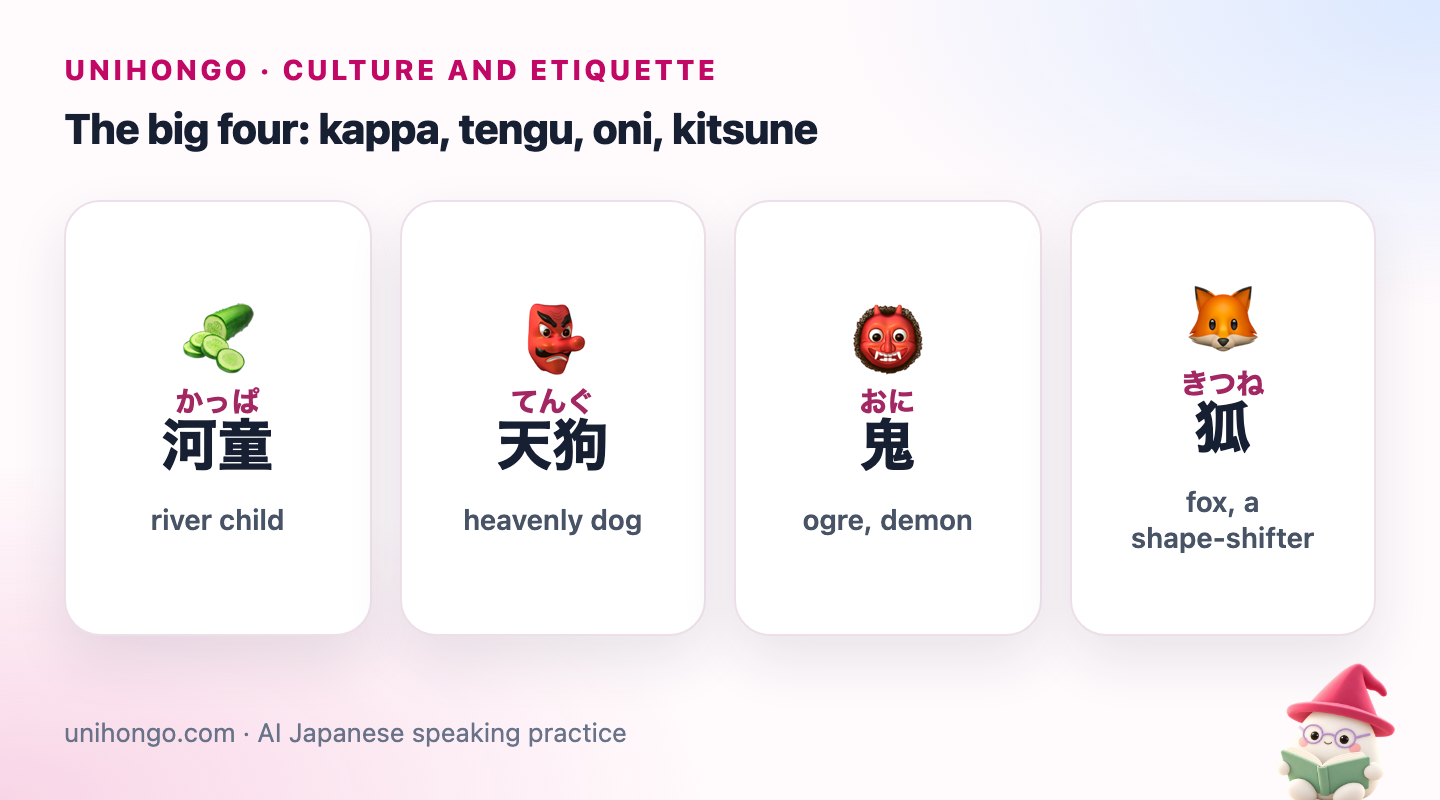
| Japanese | Romaji | Meaning |
|---|---|---|
| 河童 | kappa | river child |
| 天狗 | tengu | heavenly dog |
| 鬼 | oni | ogre, demon |
| 狐 | kitsune | fox, a shape-shifter |
| 化け狐 | bakegitsune | shape-shifting fox |
| 狸 | tanuki | raccoon dog, a trickster |
The tanuki deserves its place beside the fox. It is a real animal, the raccoon dog, and in folklore it is a jolly trickster that changes shape with a leaf on its head. Pottery tanuki statues stand outside many restaurants in Japan.
Names that describe: read the kanji, see the creature
Many yōkai names are plain descriptions. If you know a few basic kanji, you can guess the creature before you see the picture.
| Japanese | Romaji | Meaning |
|---|---|---|
| 雪女 | yuki onna | snow woman |
| ろくろ首 | rokurokubi | woman with a stretching neck |
| 座敷童 | zashiki warashi | child spirit of the house |
| 一つ目小僧 | hitotsume kozō | one-eyed boy |
| からかさ小僧 | karakasa kozō | paper-umbrella boy |
Yuki-onna is yuki, "snow", plus onna, "woman": a pale figure who appears in snowstorms. Rokurokubi joins kubi, "neck", to rokuro, a word for a pulley or a potter's wheel, which is the usual explanation for a neck that winds out to a great length.
Zashiki-warashi is zashiki, a tatami guest room, plus warashi, a regional word for a child. It comes from the folklore of northern Japan, and a house where one lives is said to prosper. Hitotsume-kozō is "one eye" plus kozō, a young monk or simply a boy. Karakasa-kozō is an old oiled-paper umbrella, karakasa, that has come to life with one eye and one leg.
Yōkai words in everyday Japanese
This is where folklore turns into useful vocabulary. Japanese people use these expressions without thinking about monsters at all.
| Japanese | Romaji | Meaning |
|---|---|---|
| 鬼ごっこ | onigokko | tag, the chasing game |
| 鬼のように | oni no yō ni | like a demon: extremely |
| かっぱ巻き | kappamaki | cucumber sushi roll |
| 天狗になる | tengu ni naru | to get conceited |
| 狐につままれる | kitsune ni tsumamareru | to be completely baffled |
| 狸寝入り | tanuki neiri | pretending to be asleep |
| 鬼に金棒 | oni ni kanabō | making the strong even stronger |
| 河童の川流れ | kappa no kawanagare | even experts make mistakes |
In onigokko, the player who chases the others is the oni, just as English says "it". Oni no yō ni makes any description extreme, and young people shorten it further and put oni in front of an adjective as slang for "super".
Kitsune ni tsumamareru literally means "to be pinched by a fox", that is, to feel as if a fox has bewitched you. Oni ni kanabō is "an iron club for an ogre": giving an advantage to someone who was already strong. Kappa no kawanagare is "a kappa carried off by the river": even the best swimmer can slip.
Sentences you can actually say
Here are the idioms in sentences at a polite or friendly level. The first line is the chant from Setsubun in early February, when families throw beans to drive bad luck out of the house.
| Japanese | Romaji | Meaning |
|---|---|---|
| 鬼は外、福は内。 | Oni wa soto, fuku wa uchi. | Demons out, good luck in. |
| 今日は鬼のように忙しいです。 | Kyō wa oni no yō ni isogashii desu. | I'm insanely busy today. |
| かっぱ巻きを一つください。 | Kappamaki o hitotsu kudasai. | One cucumber roll, please. |
| 天狗にならないでね。 | Tengu ni naranaide ne. | Don't let it go to your head. |
| 誰が鬼? | Dare ga oni? | Who's "it"? (casual) |
| 好きな妖怪は何ですか。 | Suki na yōkai wa nan desu ka. | What's your favourite yokai? |
Foxes and tanuki on the menu
Two yōkai animals appear on noodle shop menus all over Japan. Kitsune udon is udon topped with sweet fried tofu, which is said to be the fox's favourite food. Tanuki udon or tanuki soba usually comes with crunchy bits of tempura batter, though what the name means changes from region to region.
Foxes also have a serious side. They are the messengers of Inari, the deity of rice and business, and stone foxes guard Inari shrines across the country. So the same word, kitsune, can point to a trickster in a story, a statue at a shrine or a bowl of noodles.
Where you will meet yōkai in anime and games
The classic yōkai manga is GeGeGe no Kitarō by Shigeru Mizuki, which made many old creatures familiar to modern children, and Yo-kai Watch did the same for a later generation. In Demon Slayer, known in Japan as Kimetsu no Yaiba, the enemies are oni. Naruto is built around a fox with nine tails.
Games are full of them, too. In Animal Crossing, the shopkeeper Tom Nook is a tanuki and the boatman Kapp'n is a kappa. Mario's Tanooki Suit is named after the tanuki. Several Pokémon are commonly linked to yōkai, such as the fox with many tails. Once you know the originals, you will notice the references everywhere.