

How birthdays change with age
The first thing to know is that the size of a Japanese birthday shrinks as a person grows up. A young child's birthday is a real event: a whole cake from the cake shop, candles blown out while the family sings Happy Birthday in English, presents from parents and grandparents, and often a photo session in front of a decorated wall. Primary school children may invite a few friends for a small party at home, though large hired-venue parties are less common than in some countries.
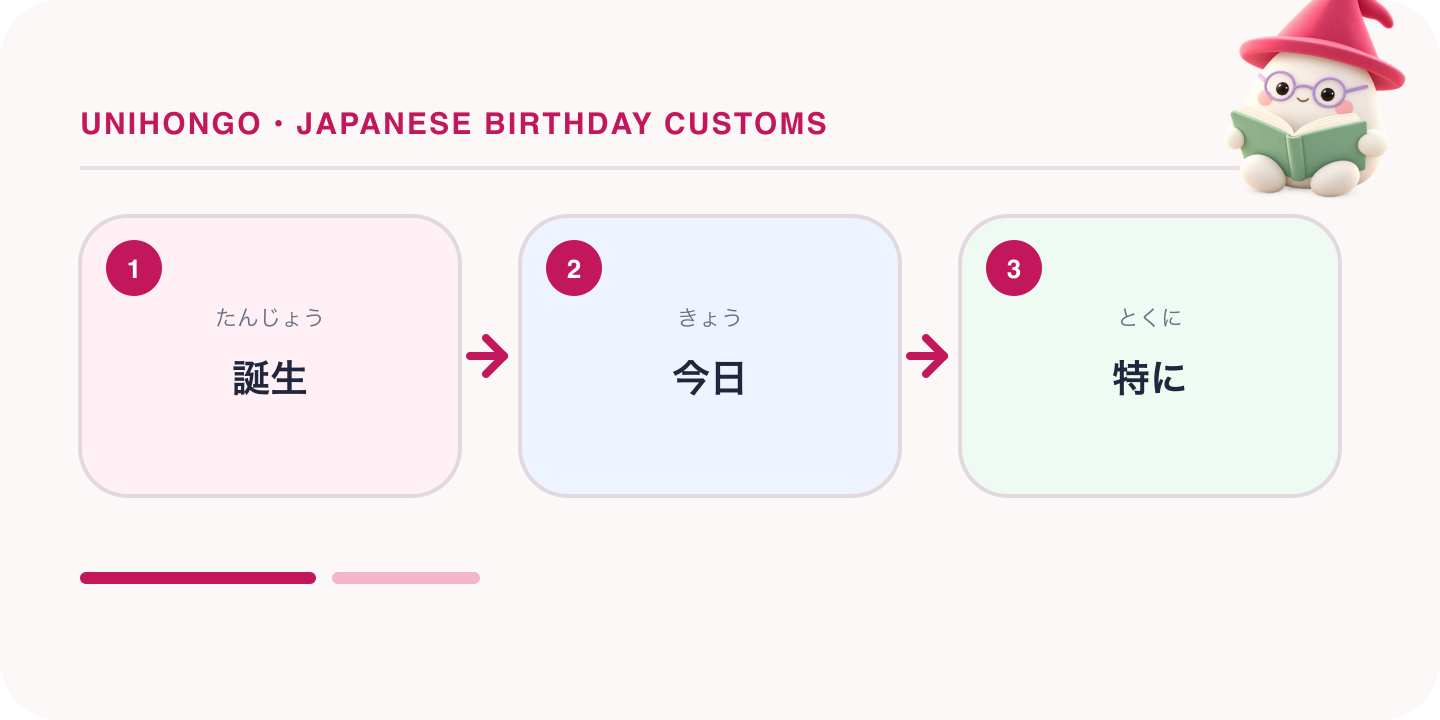
From the teenage years, birthdays move outside the family. For adults the pattern settles into a dinner or drinks with close friends, a date with a partner, a call from parents and a wave of messages on the day. Many adults will tell you they do nothing at all, toku ni nani mo shinai, and mean it. Nobody is being cold; the day is simply private, and the whole family gathers only at the milestone ages covered later in this guide.
| Japanese | Romaji | Meaning |
|---|---|---|
| お誕生日おめでとうございます。 | O-tanjōbi omedetō gozaimasu. | Happy birthday (polite). |
| 誕生日おめでとう! | Tanjōbi omedetō! | Happy birthday (casual). |
| 誕生日はいつですか。 | Tanjōbi wa itsu desu ka. | When is your birthday? |
| 今日、誕生日なんです。 | Kyō, tanjōbi nan desu. | It's my birthday today. |
| 誕生日は特に何もしないです。 | Tanjōbi wa toku ni nani mo shinai desu. | I don't do anything in particular for my birthday. |
Who pays and who organises
On an ordinary night out, Japanese friends split the bill, warikan, sometimes to the yen. A birthday is the day that rule is suspended. The friends treat the birthday person, and the verb is ogoru, to treat someone. You will hear kyō wa ogoru yo, today it's on me, or the birthday person being told saifu wa shimatte, put your wallet away. Announcing that you expect to be treated would be thought pushy, so the graceful move is to offer once and then accept with gochisōsama deshita.
Organising follows the same logic. Friends do not usually throw a party for themselves; someone else books the restaurant and, if there is a cake, arranges for it to appear. Between couples, the non-birthday partner plans the day, and among colleagues the senior person tends to pay whatever the occasion, which is a separate custom altogether.
| Japanese | Romaji | Meaning |
|---|---|---|
| 今日は私がおごるよ。 | Kyō wa watashi ga ogoru yo. | Today it's on me. |
| 誕生日だから、ここは任せて。 | Tanjōbi da kara, koko wa makasete. | It's your birthday, so leave this to me. |
| いいの?ありがとう、ごちそうさま。 | Ii no? Arigatō, gochisōsama. | Are you sure? Thanks, that was lovely. |
| 週末、誕生日会をやるんだけど、来られる? | Shūmatsu, tanjōbikai o yaru n da kedo, korareru? | I'm doing a birthday get-together at the weekend, can you come? |
| お祝いしてくれてありがとう。 | O-iwai shite kurete arigatō. | Thank you for celebrating with me. |
Presents and cake
Birthday presents among adults are modest and practical: a bottle of something, cosmetics, a scarf or a small item from a brand the person likes. Wrapping matters more than the price tag, so most people have the shop wrap it. When you hand a present over, the modest line is hon no kimochi desu, it's just a small token, and the receiver may ask akete mo ii, may I open it, because opening a gift in front of the giver is not automatic in Japan. Asking a friend directly what they want, nani ga hoshii, is common and not considered unromantic.
The typical Japanese birthday cake is a round sponge with whipped cream and strawberries, bought from a cake shop rather than baked at home and reserved a few days ahead. The shop asks the size in gō, a unit used for round cakes, and offers a chocolate plate with a message and the person's name. Candles, rōsoku, are included on request. Convenience stores and supermarkets sell smaller cakes for last-minute birthdays.
| Japanese | Romaji | Meaning |
|---|---|---|
| 何が欲しい? | Nani ga hoshii? | What would you like? |
| ほんの気持ちです。 | Hon no kimochi desu. | It's just a small token. |
| 開けてもいい? | Akete mo ii? | May I open it? |
| 誕生日ケーキを予約したいんですが。 | Tanjōbi kēki o yoyaku shitai n desu ga. | I'd like to reserve a birthday cake. |
| プレートに名前を入れてもらえますか。 | Purēto ni namae o irete moraemasu ka. | Could you put a name on the plate? |
Birthdays at work
If you come from a workplace culture of office cakes and group cards, Japanese offices can feel indifferent. In many companies a birthday passes without mention, and colleagues may not know when yours is. Where something does happen, it is small: a card passed around the team, a box of sweets on the desk, or a round of applause at the morning meeting. Some companies offer a day of birthday leave, tanjōbi kyūka, but this is a company policy, not a national custom, so check your own employment rules.
It is unusual to bring your own cake in to celebrate yourself; if you want to share something, a box of individually wrapped sweets left in the shared space with a note is the office-friendly form. A boss's birthday is not an occasion for a present from a subordinate, though a spoken o-tanjōbi omedetō gozaimasu is always welcome.
| Japanese | Romaji | Meaning |
|---|---|---|
| 課長、お誕生日おめでとうございます。 | Kachō, o-tanjōbi omedetō gozaimasu. | Happy birthday, section chief. |
| 皆さんからのお祝いです。 | Minasan kara no o-iwai desu. | This is from everyone. |
| お心遣い、ありがとうございます。 | O-kokorozukai, arigatō gozaimasu. | Thank you for your thoughtfulness. |
| 今日は誕生日休暇を取ります。 | Kyō wa tanjōbi kyūka o torimasu. | I'm taking my birthday leave today. |
Milestone ages from birth to ninety-nine
Where Japan puts its celebration energy is into age milestones. Babies are taken to a shrine about a month after birth and given a symbolic first meal at a hundred days. Children of three, five and seven dress up for shichi-go-san in November, and twenty-year-olds attend Coming of Age Day. From sixty, a series of long-life birthdays follows, each named after the shape of a kanji. The table gives the ones you are most likely to hear.
| Japanese | Romaji | Meaning |
|---|---|---|
| 七五三のお参りに行ってきました。 | Shichi-go-san no o-mairi ni itte kimashita. | We went to the shrine for shichi-go-san. |
| 成人おめでとうございます。 | Seijin omedetō gozaimasu. | Congratulations on coming of age. |
| 還暦おめでとうございます。 | Kanreki omedetō gozaimasu. | Congratulations on your sixtieth. |
| 来月、祖母の米寿のお祝いをします。 | Raigetsu, sobo no beiju no o-iwai o shimasu. | Next month we're celebrating my grandmother's eighty-eighth. |
| 今年、厄年なんです。 | Kotoshi, yakudoshi nan desu. | This is an unlucky year for me. |
| Milestone | Reading | What it marks |
|---|---|---|
| お宮参り | o-miyamairi | First shrine visit, about one month after birth |
| お食い初め | o-kuizome | Symbolic first meal at around a hundred days |
| 初誕生 | hatsu-tanjō | First birthday, often with a heavy isshō mochi rice cake |
| 七五三 | shichi-go-san | Shrine visit for children aged three, five and seven in November |
| 十三参り | jūsan mairi | Temple visit at thirteen, mainly in the Kansai region |
| 成人の日 | seijin no hi | Coming of Age Day ceremonies for twenty-year-olds in January |
| 厄年 | yakudoshi | Unlucky years, with a shrine purification rather than a party |
| 還暦 | kanreki | Sixty: the calendar cycle completes, red clothing is given |
| 古希 | koki | Seventy, celebrated with purple |
| 喜寿 | kiju | Seventy-seven, from the cursive form of the kanji for joy |
| 傘寿 | sanju | Eighty, from the shape of the kanji for umbrella |
| 米寿 | beiju | Eighty-eight, because the kanji for rice splits into eight, ten, eight |
| 白寿 | hakuju | Ninety-nine, because taking one from a hundred leaves white |
The long-life birthdays are family occasions: a meal at a restaurant or a hot spring inn, a group photo, and a present in the colour of the age. If you are invited, ask what colour the celebration uses and bring something small in that colour.
Regional and generational variation
Older Japanese people grew up with a different idea of age. Under the traditional kazoedoshi counting, a baby was one at birth and everyone became a year older together at New Year, so personal birthdays hardly mattered. Individual birthday parties spread after the counting system changed in the mid-twentieth century, which is why a grandparent may treat a birthday cake as a pleasant novelty while their grandchildren plan a photo-friendly party.
Regions keep their own traditions. Jūsan mairi at thirteen is strongest around Kyoto. Okinawa has its own long-life celebrations, including tōkachi at eighty-eight and kajimayā at ninety-seven, where the celebrated person is paraded through the neighbourhood. At the first birthday, some families have the child carry a heavy isshō mochi rice cake, while others lay out objects for the child to choose from, erabitori, said to hint at a future career.
Among younger adults, birthdays have moved online and towards friends: group chats fill with messages at midnight, cafés offer birthday plates for photos, and friends may organise a surprise, sapuraizu. Asking a woman's age is still considered impolite by many, so if you need the number, ask about the animal year, eto, and work it out.
| Japanese | Romaji | Meaning |
|---|---|---|
| 昔は正月にみんな一つ年を取ったんだよ。 | Mukashi wa shōgatsu ni minna hitotsu toshi o totta n da yo. | In the old days everyone got a year older at New Year. |
| 誕生日は家族で祝うくらいです。 | Tanjōbi wa kazoku de iwau kurai desu. | We only really celebrate birthdays with family. |
| サプライズで祝ってもらいました。 | Sapuraizu de iwatte moraimashita. | They surprised me with a celebration. |
| 失礼ですが、何年生まれですか。 | Shitsurei desu ga, nan-nen umare desu ka. | If you don't mind me asking, what year were you born? |
What to do when you are invited
- Reply promptly and say whether you are coming, since the organiser is booking a table
- Bring a small wrapped present and hand it over with hon no kimochi desu
- Let the group treat the birthday person; offer once to contribute, then accept the decision
- Send a short message the next day thanking the organiser, not only the birthday person
If you are the one being celebrated, accept the treat gracefully and say gochisōsama deshita at the end. A thank-you message to the group the same night is normal and appreciated.
Mistakes foreigners make
The commonest mistake is expecting a big celebration for an adult birthday and being hurt when it does not come. Colleagues who say nothing are not being unfriendly; birthdays are simply not office business. The reverse mistake is organising a loud surprise for someone who would have preferred a quiet dinner, so ask a close friend of theirs first.
Money causes the next set of errors. Insisting on paying for your own birthday dinner leaves the friends who planned to treat you feeling awkward. Gift mistakes are milder: an unwrapped present, a very expensive one that creates an obligation, or a set of four items, which some people avoid because shi, four, sounds like death. Finally, omedetō on its own is fine among friends but too casual for a boss or an older person, where the full o-tanjōbi omedetō gozaimasu is expected.
| Japanese | Romaji | Meaning |
|---|---|---|
| サプライズは苦手なんです。 | Sapuraizu wa nigate nan desu. | I'm not good with surprises. |
| 無理に払わなくて大丈夫ですよ。 | Muri ni harawanakute daijōbu desu yo. | You really don't need to pay. |
| 気を遣わせてしまってすみません。 | Ki o tsukawasete shimatte sumimasen. | Sorry to have made you go to the trouble. |