
Three kanji, one dragon
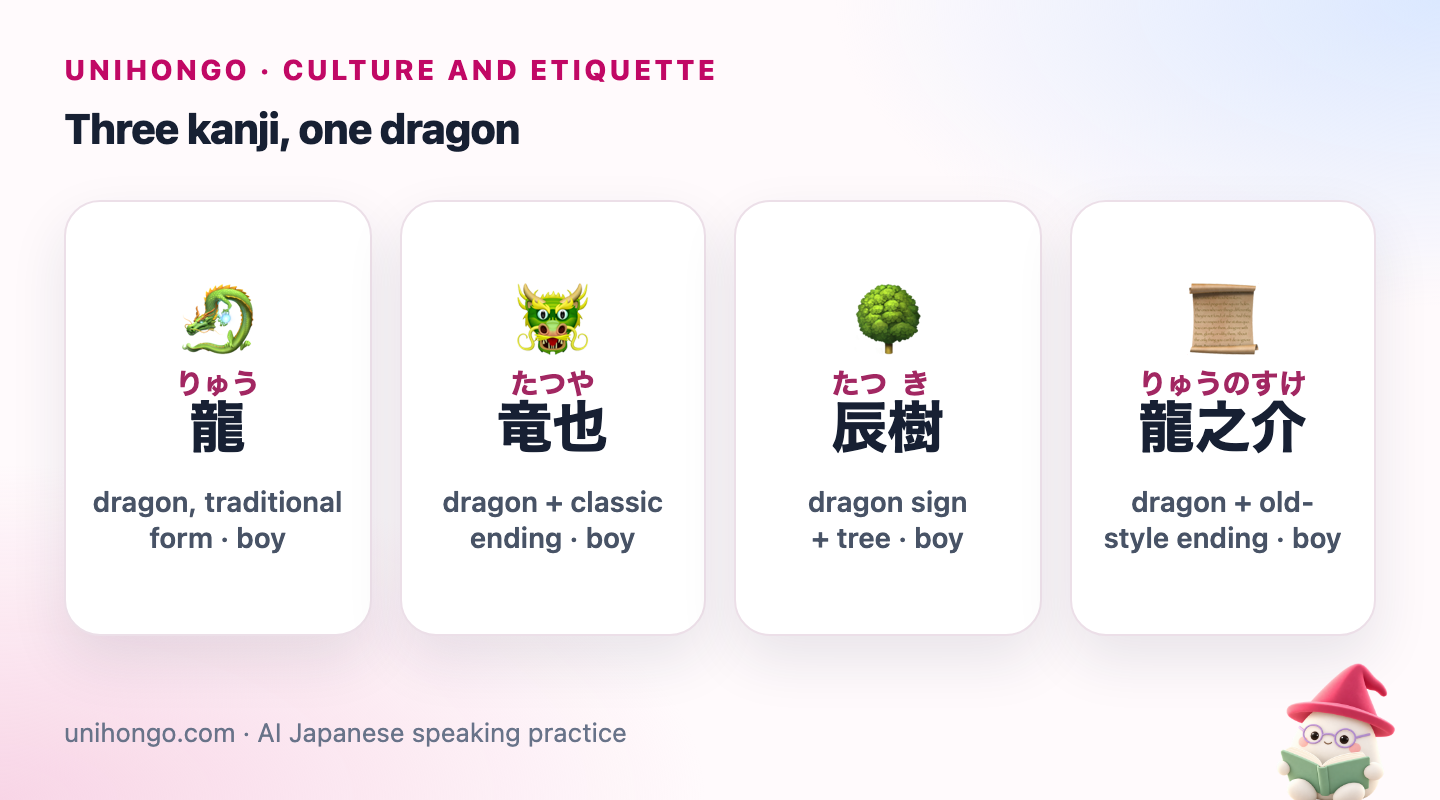
These names show the three dragon kanji at work, and the two main readings, ryū and tatsu. Notice that all four are boys' names: that is typical.
| Japanese | Romaji | Meaning |
|---|---|---|
| 龍 | Ryū | dragon, traditional form · boy |
| 竜也 | Tatsuya | dragon + classic ending · boy |
| 辰樹 | Tatsuki | dragon sign + tree · boy |
| 龍之介 | Ryūnosuke | dragon + old-style ending · boy |
The ending -nosuke in 龍之介 is an old-fashioned boys' ending that came back into fashion in recent decades, so Ryūnosuke sounds both classic and current. 也 in 竜也 is a common final kanji in boys' names such as Tatsuya, Takuya and Kazuya. 辰樹 joins the zodiac dragon to 樹, a tall tree, an image of steady growth.
龍 or 竜: the traditional and the simplified form
竜 is the form taught in school and used in everyday words such as 恐竜 (dinosaur). 龍 is the older, more complex form, and Japanese law allows both in names. Because it looks richer and more powerful, 龍 is very popular with parents and with writers, and you will see it on temple buildings, in martial arts clubs and on traditional crafts.
| Japanese | Romaji | Meaning |
|---|---|---|
| 龍一 | Ryūichi | dragon + first son · boy |
| 竜二 | Ryūji | dragon + second son · boy |
| 龍太 | Ryūta | dragon + big · boy |
| 龍斗 | Ryūto | dragon + the Big Dipper · boy |
| 龍生 | Ryūsei | dragon + life · boy |
| Kanji | Strokes | Use | Readings in names |
|---|---|---|---|
| 竜 | 10 | Everyday simplified form, taught in school | ryū, tatsu |
| 龍 | 16 | Traditional form, common in names and decoration | ryū, ryō, tatsu |
| 辰 | 7 | The zodiac dragon, also an old time of day | tatsu, shin |
Endings like 一 (first) and 二 (second) once showed birth order, so Ryūichi suggests a first son and Ryūji a second son, although modern parents do not always follow that logic. Ryūsei is also commonly written 流星, shooting star, so the same sound can be a dragon or a star.
辰: the dragon of the zodiac
The Chinese zodiac is part of everyday life in Japan: New Year cards often show the animal of the coming year, and people ask each other's zodiac sign, called eto (干支). The dragon year is 辰年 (tatsudoshi). The most recent was 2024, and the next one is 2036. Some parents give a child born in a dragon year a name with 辰 or 龍, but it is a personal choice, not a custom everyone follows.
In the old way of telling time, 辰 was also the hour around eight in the morning, and in the old compass it marked a direction. That is why it appears in place names and surnames as well.
| Japanese | Romaji | Meaning |
|---|---|---|
| 辰年生まれです。 | Tatsudoshi umare desu. | I was born in the year of the dragon. |
| 干支は何ですか。 | Eto wa nan desu ka. | What's your zodiac sign? |
| 辰也 | Tatsuya | dragon sign + classic ending · boy |
| 辰巳 | Tatsumi | dragon + snake signs · boy; also a surname |
| 辰子 | Tatsuko | dragon sign child · girl, old-fashioned |
辰巳 combines the dragon and the snake, the fifth and sixth signs, and also names the south-east in the old compass. Asking Eto wa nan desu ka is a light, friendly way of asking someone's age without asking it directly, and people usually answer with a smile.
Dragon names in fiction, and in real life
If you are naming a character for a novel, a manga or a game, dragon kanji are a gift: they look dramatic and every Japanese reader knows them. Fiction often uses compounds that real parents would hesitate to choose, because they sound like a title rather than a name.
| Japanese | Romaji | Meaning |
|---|---|---|
| 青龍 | Seiryū | the Azure Dragon of the east |
| 昇龍 | shōryū | a rising dragon |
| 龍神 | ryūjin | dragon god |
| 蒼龍 | Sōryū | blue-green dragon |
青龍 is one of the four guardian creatures of the four directions, together with a tiger, a phoenix-like bird and a black tortoise, and it appears in shrines, games and fantasy stories. 昇龍 is a common image of success and rising fortune. Real names usually avoid 神 (god) and these grand compounds, but a character called Seiryū or Sōryū will sound natural in a fantasy world. For a realistic modern character, Ryūta, Tatsuya or Ryūnosuke sounds more believable.
Dragon words and idioms you will actually hear
Dragon kanji appear in plenty of everyday words, and a few idioms are worth learning because they come up in speeches, news and school. Notice that the dragon is always about power, water or success.
| Japanese | Romaji | Meaning |
|---|---|---|
| 恐竜 | kyōryū | dinosaur |
| 竜巻 | tatsumaki | tornado, a whirlwind |
| 登竜門 | tōryūmon | gateway to success |
| 竜宮城 | Ryūgūjō | the Dragon Palace under the sea |
| 画竜点睛 | garyō tensei | the finishing touch |
| 竜頭蛇尾 | ryūtō dabi | a strong start, a weak finish |
登竜門 comes from a Chinese legend about a waterfall called the Dragon Gate: a carp that swims up it becomes a dragon. In Japan it is used for exams, contests and prizes that launch a career. This legend is also linked to the carp streamers of Children's Day in May. 竜宮城 is the undersea palace in the old tale of Urashima Tarō. In 画竜点睛, 竜 is read ryō, not ryū, which surprises many learners.
Mini dialogue: the dragon at the shrine water basin
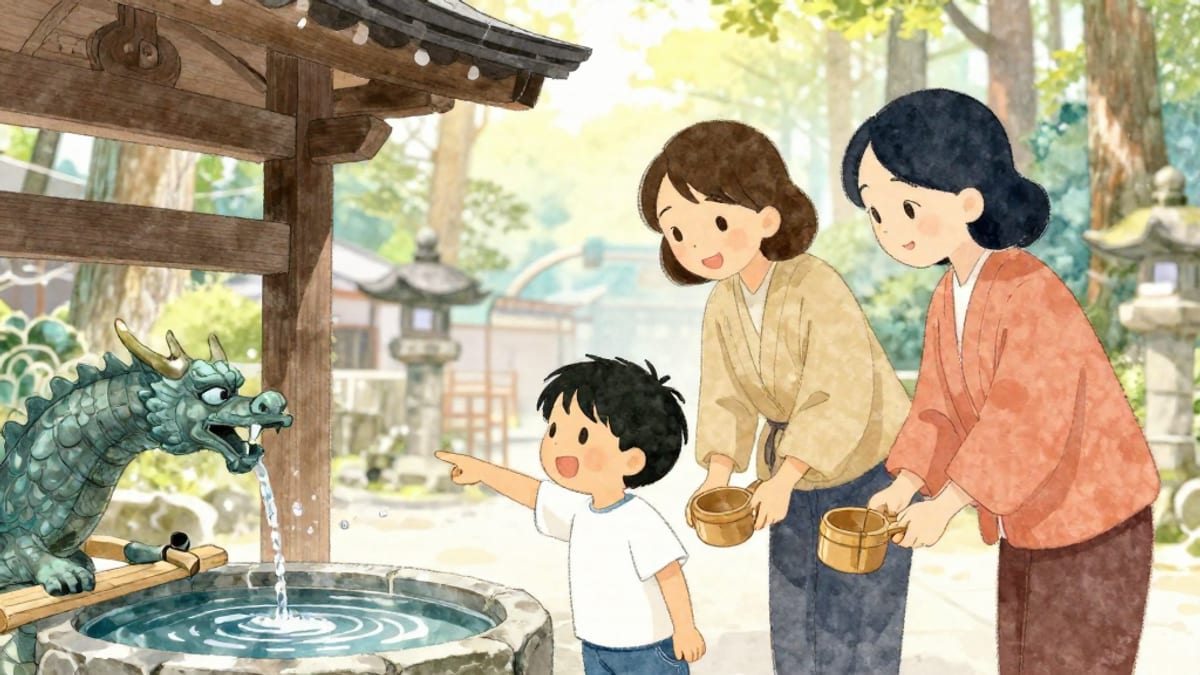
You visit a local shrine with a Japanese friend and her small son. At the water basin where visitors rinse their hands, water pours from the mouth of a bronze dragon. The friends speak casually.
| Japanese | Romaji | Meaning |
|---|---|---|
| 見て、竜の口から水が出てる! | Mite, ryū no kuchi kara mizu ga deteru! | Child: Look, water's coming out of the dragon's mouth! |
| この子、龍之介っていうの。 | Kono ko, Ryūnosuke tte iu no. | Friend: This is Ryūnosuke. |
| 辰年生まれだから? | Tatsudoshi umare dakara? | You: Because he was born in a dragon year? |
| そう。竜は水の神様なんだって。 | Sō. Ryū wa mizu no kamisama na n datte. | Friend: Yes. They say dragons are water gods. |
| だから手水舎にいるんだね。 | Dakara chōzuya ni iru n da ne. | You: So that's why one is at the water basin. |
手水舎 (chōzuya, also read temizuya) is the water pavilion where you rinse your hands and mouth before praying. Many have a dragon spout, because the dragon has long been linked to water and rain. Nan datte at the end of a sentence means they say or apparently, a soft way of passing on what you have heard.
Turn the dragon idioms into a game
Type a sentence into Mocchi with /explain, for example 新人賞は作家の登竜門だ. Mocchi splits it into pieces, names each particle, explains 登竜門 and gives you the meaning. Ask for /create-flashcards with the dragon words from this post, pick a photo for each card, and Mocchi will keep track of which ones you still hesitate on.
Then play Kotoba Tank with that flashcard set: you hear a word such as tatsumaki or kyōryū and hit the right one. It is a quick way to test whether you really recognise ryū and tatsu by ear.
Dragon-name mistakes to avoid
- Writing 竜 when the person's name uses 龍, or the other way round. Use the exact registered form.
- Reading every dragon kanji as ryū. Tatsu is just as common in names, and 龍 can be ryō in some names and idioms.
- Imagining a fire-breathing European dragon. In Japanese the dragon is mainly linked to water, rain and good fortune, and that is what parents mean.
- Using 龍神 or 青龍 as a realistic modern name. They work for fantasy characters, but would sound grand and unusual for a real person.
- Assuming tatsu always means dragon. 達, 竜, 龍 and 辰 can all be read tatsu, and only some of them are dragons.