
The handkerchief habit at a glance
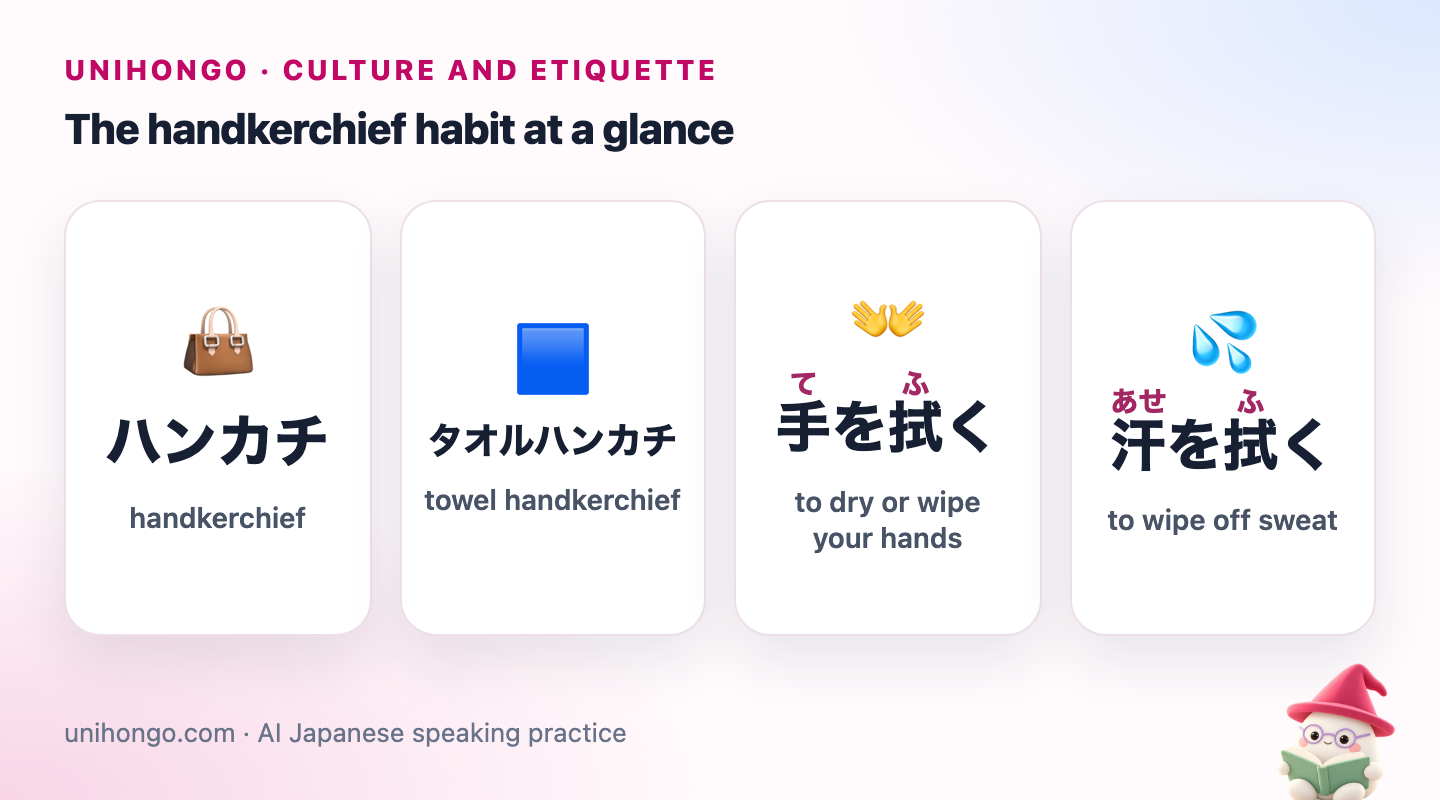
Hankachi is a shortened loanword from handkerchief. In Japan it means the small square of cloth that many adults and children carry in a pocket or bag every day. The most common type today is the taoru hankachi, a towel handkerchief: a small, thick square of terry cloth that absorbs water and sweat well.
Ask people why they carry one and the first answer is usually practical: to dry their hands after washing them. The second is summer: Japanese summers are hot and humid, and a towel to wipe your forehead and neck is a real comfort.
| Japanese | Romaji | Meaning |
|---|---|---|
| ハンカチ | hankachi | handkerchief |
| タオルハンカチ | taoru hankachi | towel handkerchief |
| 手を拭く | te o fuku | to dry or wipe your hands |
| 汗を拭く | ase o fuku | to wipe off sweat |
| ハンカチ持ってる? | Hankachi motteru? | Have you got a handkerchief? (casual) |
Reason one: restrooms without paper towels
Japanese public restrooms are famous for being clean and well equipped, so visitors are often surprised that many have no paper towels. Stations, parks, schools and older buildings frequently provide soap and water but nothing to dry your hands with. Many places have hand dryers, but not all, and during the pandemic years many dryers were switched off; most are back in use now, but you cannot rely on finding one.
The explanations people give are mostly about cost and tidiness: paper towels are expensive to supply and create a lot of rubbish in busy public places. Whatever the reason, the result is the same, and many people carry their own towel so they never have to shake their hands dry or wipe them on their clothes.
| Japanese | Romaji | Meaning |
|---|---|---|
| ペーパータオルがない。 | Pēpā taoru ga nai. | There are no paper towels. (casual) |
| ハンドドライヤーが止まっている。 | Hando doraiyā ga tomatte iru. | The hand dryer is switched off. |
| 手を拭くものを持っていますか。 | Te o fuku mono o motte imasu ka. | Do you have something to dry your hands with? |
| ハンカチを忘れちゃった。 | Hankachi o wasurechatta. | I forgot my handkerchief. (casual) |
Reason two: summer heat and sweat
From June to September, much of Japan is hot and very humid. On a crowded platform or after a walk uphill to a shrine, people pat their foreheads with a towel handkerchief again and again. Office workers in suits carry one in a pocket; students keep one in their bag. Some people carry two: one for hands and one for sweat. In the hottest weeks you may also see people press a damp or chilled towel to the back of the neck, and some towels are sold as cooling towels that feel cold when wet. Larger towels, called hando taoru or even fēsu taoru, are also common in summer and at outdoor events.
The gesture is usually a gentle pat rather than a vigorous wipe, especially for people wearing makeup. In polite company, people turn slightly away or step aside to do it.
| Japanese | Romaji | Meaning |
|---|---|---|
| 汗をかく | ase o kaku | to sweat |
| 汗だくです。 | Asedaku desu. | I'm drenched in sweat. |
| ハンドタオル | hando taoru | hand towel (loanword) |
| 今日は蒸し暑くて、ハンカチが手放せない。 | Kyō wa mushiatsukute, hankachi ga tebanasenai. | It's so humid today, I can't put my handkerchief down. |
Reason three: a habit from childhood
Many Japanese adults learned to carry a handkerchief before they could read. Nursery schools and elementary schools commonly ask children to bring a handkerchief and a packet of tissues every day, and some schools have checked them, sometimes in a regular belongings check. Parents ask hankachi motta? at the door almost as often as they say itte rasshai.
Children's handkerchiefs are often clipped to their clothes or kept in a pocket on a little bag. By the time they grow up, the habit is automatic, and many adults feel strangely unprepared without one.
| Japanese | Romaji | Meaning |
|---|---|---|
| ハンカチとティッシュを持ってきてください。 | Hankachi to tisshu o motte kite kudasai. | Please bring a handkerchief and tissues. |
| ハンカチ持った?ティッシュは? | Hankachi motta? Tisshu wa? | Got your handkerchief? And tissues? (parent to child) |
| 持ち物検査 | mochimono kensa | belongings check |
Types of handkerchiefs and cloths
Thin ironed handkerchiefs are still used for formal events, and a black or white plain handkerchief is common at funerals. For everyday life, though, the towel type has largely won, and shops sell hundreds of designs, from plain colours to characters and seasonal patterns.
| Japanese | Romaji | Meaning |
|---|---|---|
| 手ぬぐい | tenugui | printed cotton cloth |
| ポケットティッシュ | poketto tisshu | pocket tissues |
| アイロンをかける | airon o kakeru | to iron |
| Name | What it is | Typical use |
|---|---|---|
| タオルハンカチ (taoru hankachi) | Small, thick terry square | Drying hands, wiping sweat; the daily favourite |
| ガーゼハンカチ (gāze hankachi) | Soft layered gauze | Light and gentle, popular for children |
| 綿のハンカチ (men no hankachi) | Thin cotton or linen square | Formal occasions, a suit pocket, ironed |
| 手ぬぐい (tenugui) | Long, thin printed cotton cloth | Towel, headband, wrapping, souvenir |
| ポケットティッシュ (poketto tisshu) | Small packet of tissues | Often handed out free on streets as advertising |
Lending, returning and finding a handkerchief
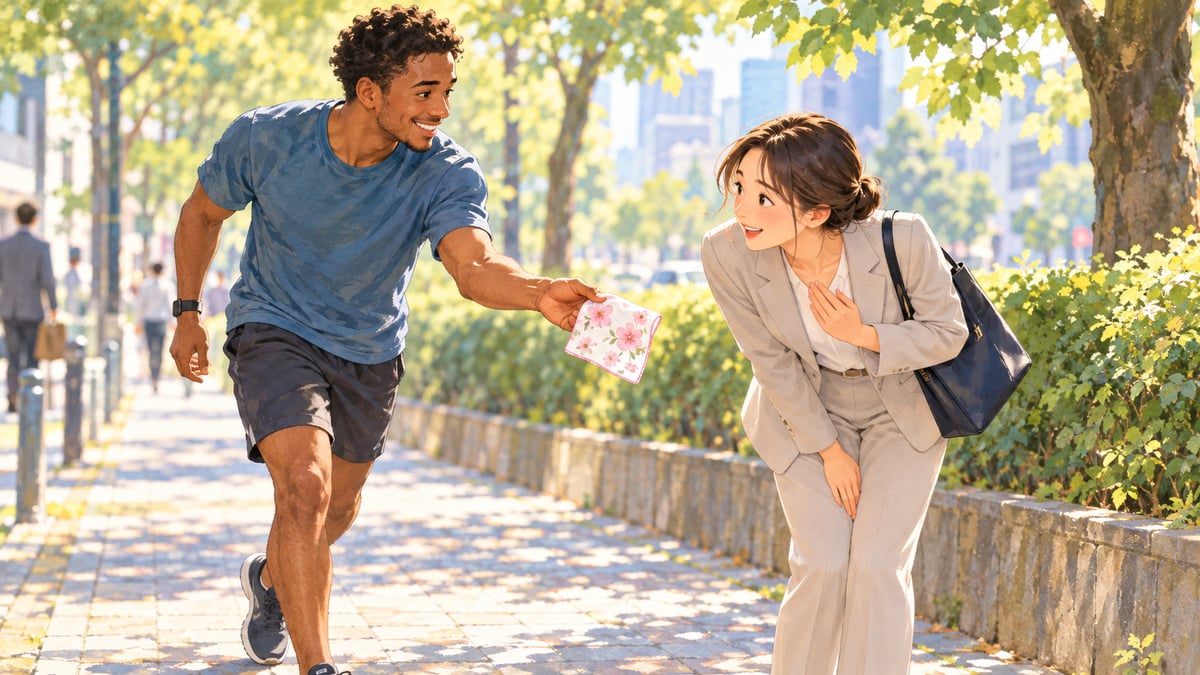
If you spill something on a friend or see someone with wet hands and nothing to dry them with, offering your handkerchief is kind. If you borrow one, the polite thing is to wash it before returning it, rather than handing it straight back. Dropped handkerchiefs are common on trains and pavements, and calling out to the owner is a small, welcome kindness.
| Japanese | Romaji | Meaning |
|---|---|---|
| すみません、ハンカチ、落としましたよ。 | Sumimasen, hankachi, otoshimashita yo. | Excuse me, you dropped your handkerchief. |
| あ、ありがとうございます。 | A, arigatō gozaimasu. | Oh, thank you very much. |
| よかったら使ってください。 | Yokattara tsukatte kudasai. | Please use this if you like. |
| 洗って返しますね。 | Aratte kaeshimasu ne. | I'll wash it and give it back. |
| 気にしないで。そのままでいいよ。 | Ki ni shinaide. Sono mama de ii yo. | Don't worry, just give it back as it is. (casual) |
Handkerchiefs as gifts, and an old superstition
A good handkerchief is one of the most common small gifts in Japan: light, useful and easy to choose. People give them as thank-you gifts, as souvenirs, and as return gifts on White Day in March. Department stores have whole handkerchief corners, often with famous designers' brands, and they will gift-wrap one for you.
There is an old superstition some people know: the word for handkerchief can be written 手巾, which can be read tegire, a sound shared with 手切れ, cutting ties. A white handkerchief has also been linked with funerals. Because of this, some people avoid giving handkerchiefs to a partner or at sensitive times. Most people today do not worry about it, but if in doubt, choose a coloured one.
| Japanese | Romaji | Meaning |
|---|---|---|
| ハンカチ売り場はどこですか。 | Hankachi uriba wa doko desu ka. | Where is the handkerchief section? |
| プレゼント用に包んでいただけますか。 | Purezento yō ni tsutsunde itadakemasu ka. | Could you gift-wrap it, please? |
| ちょっとしたお礼です。 | Chotto shita orei desu. | It's just a small thank-you. |
| ホワイトデーのお返し | howaito dē no okaeshi | a White Day return gift |
Common learner mistakes
- Expecting paper towels everywhere. Pack a small towel handkerchief before a day out, especially for stations and parks.
- Shaking wet hands dry at the sink or wiping them on your trousers. It is not a crime, but it looks careless and splashes the next person.
- Saying hankachīfu. The full loanword exists but sounds old-fashioned; hankachi is the everyday word.
- Handing back a borrowed handkerchief straight after using it. Offer to wash it first: aratte kaeshimasu.
- Blowing your nose loudly into a cloth handkerchief at the table. In Japan, people usually use tissues for that, and step away to do it.
- Mixing up fuku (to wipe) and fuku (clothes) or fuku (to blow). The kanji differ: 拭く, 服 and 吹く, and context makes the meaning clear.
A handkerchief deck you review on the go
Ask Mocchi: make flashcards for hankachi, taoru hankachi, tenugui, ase o fuku, otosu and tsutsumu, and pick a photo for each card. Then use /review-flashcards on the train; the spaced repetition brings back the words you find hard sooner, and Mocchi remembers which ones gave you trouble.
When you are ready to say the gift lines aloud, open AI Sensei, choose Yamada-sensei and ask him to play a department store clerk while you look for a handkerchief, choose a colour and ask for gift wrapping.