
What the two phrases express, and who they are aimed at
Itadakimasu is the polite form of itadaku, the humble verb for receiving, and also the humble verb for eating and drinking. Said at the table it means something close to I gratefully receive this. It is not a translation of bon appétit, which is a wish directed at other people; itadakimasu is about the speaker accepting what is in front of them, which is why one person alone can say it and mean it fully.
Gochisōsama deshita is built on gochisō, a feast or a fine spread, with the polite -sama and the past form deshita. Together it reads as roughly that was a feast, thank you. The past tense matters: it is said when you have finished, not while you are still eating. Because it thanks someone for something already received, it also works hours later, when you see the person who fed you the previous evening.
Ask a room of Japanese speakers who itadakimasu is addressed to and you will get several answers, all of them reasonable: the person who cooked, the person paying, the farmers and workers behind the ingredients, and the plants and animals that became the meal. Nobody has to choose. In practice the phrase gathers all of that into one word, and the person sitting opposite you receives whatever part of it applies to them.
That breadth explains a few things learners find puzzling. It explains why you say it with nobody else present, why a guest says it to a host who cooked nothing, and why children are taught it as a matter of gratitude rather than manners. When the meal is clearly a gift from one person, adding a direct thank you afterwards makes the target explicit, which is what the gochisō ni narimashita line does.
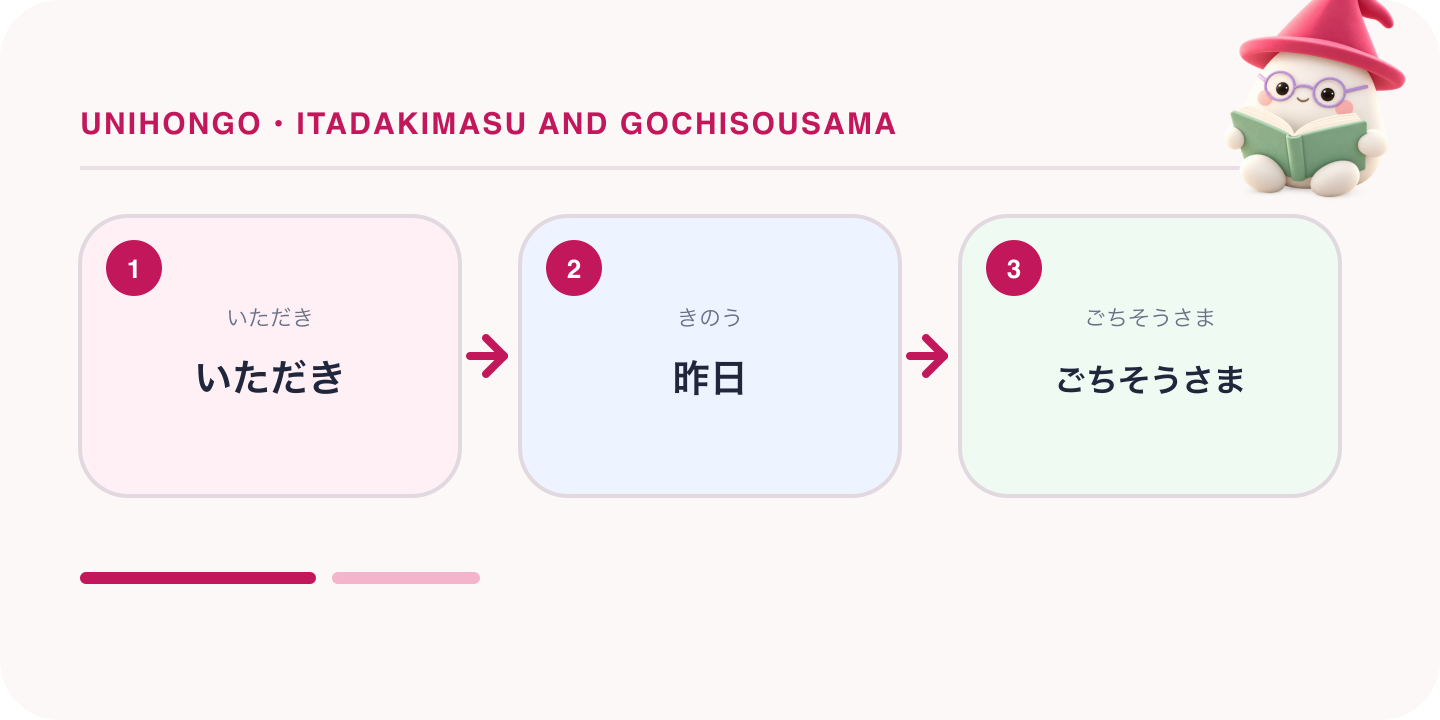
| Japanese | Romaji | Meaning |
|---|---|---|
| いただきます。 | Itadakimasu. | Thank you for this food. (before eating) |
| ごちそうさまでした。 | Gochisōsama deshita. | Thank you for the meal. (after eating) |
| ごちそうさま。 | Gochisōsama. | Thanks for the food. (casual) |
| 昨日はごちそうさまでした。 | Kinō wa gochisōsama deshita. | Thank you again for the meal yesterday. |
| ごちそうになりました。 | Gochisō ni narimashita. | Thank you for treating me. |
The gesture and the timing
Many people put their palms together in front of the chest for a moment as they say itadakimasu, and again for gochisōsama deshita. Others give a small bow of the head, and plenty of adults do nothing at all beyond saying the words. It varies by household, by region and by generation, so copy the table you are at rather than assuming one correct movement. In a company canteen, a quiet phrase with no gesture is the common version.
Timing is the part worth getting right. Itadakimasu comes after everyone has been served and after the host has invited you to start, not the moment your own plate lands. If the food will go cold, the host will say dōzo or samenai uchi ni dōzo, and that is your signal. If you genuinely must start first, o-saki ni itadakimasu acknowledges it. Gochisōsama deshita comes when you have finished, usually as you set your chopsticks down.
- Wait until everyone is served, unless the host tells you to begin.
- Watch the host's hands: if they put their palms together, do the same.
- Say it at a normal volume, not a whisper, when eating with others.
- Set your chopsticks down on the rest before saying gochisōsama deshita.
- Do not say gochisōsama deshita mid-meal; it signals that you have finished.
Which version to use where
| Situation | Before eating | After eating |
|---|---|---|
| Family or close friends | いただきまーす Itadakimāsu | ごちそうさま Gochisōsama |
| A friend's home as a guest | いただきます Itadakimasu | ごちそうさまでした Gochisōsama deshita |
| Company canteen with colleagues | いただきます Itadakimasu | ごちそうさまでした Gochisōsama deshita |
| Formal dinner with a superior | いただきます Itadakimasu | ごちそうさまでした。ありがとうございました Gochisōsama deshita. Arigatō gozaimashita |
| Restaurant, paying at the till | Nothing said aloud | ごちそうさまでした Gochisōsama deshita |
| Eating alone at home | いただきます Itadakimasu | ごちそうさま Gochisōsama |
| Accepting a snack at your desk | いただきます Itadakimasu | ごちそうさまでした Gochisōsama deshita |
| Someone else paid for the meal | いただきます Itadakimasu | ごちそうになりました Gochisō ni narimashita |
| Small child at home or school | 手を合わせて、いただきます Te o awasete, itadakimasu | ごちそうさまでした Gochisōsama deshita |
The drawn-out itadakimāsu in the first row is a spoken habit rather than a different word, and it sounds warm among people you know well. Keep the clean itadakimasu anywhere you would use polite -masu speech generally.
A meal at someone's home, start to finish
This is the exchange you are most likely to need. Notice how much of it is the host offering and the guest accepting rather than the guest praising unprompted. Enryo naku itadakimasu, meaning I will accept without holding back, is the polite way to take a second helping when it is pressed on you, and it is heard far more often than a flat yes.
| Japanese | Romaji | Meaning |
|---|---|---|
| どうぞ召し上がってください。 | Dōzo meshiagatte kudasai. | Please help yourself. (host) |
| 冷めないうちにどうぞ。 | Samenai uchi ni dōzo. | Please start before it gets cold. (host) |
| では、いただきます。 | De wa, itadakimasu. | Then I will start. Thank you. |
| お先にいただきます。 | O-saki ni itadakimasu. | Excuse me for starting before you. |
| わあ、おいしそうですね。 | Wā, oishisō desu ne. | This looks delicious. |
| これ、何ですか。 | Kore, nan desu ka? | What is this dish? |
| とてもおいしいです。 | Totemo oishii desu. | It is really good. |
| お口に合いますか。 | O-kuchi ni aimasu ka? | Is it to your taste? (host) |
| はい、大好きです。 | Hai, daisuki desu. | Yes, I love it. |
| おかわりはいかがですか。 | Okawari wa ikaga desu ka? | Would you like a second helping? (host) |
| では、遠慮なくいただきます。 | De wa, enryo naku itadakimasu. | Then I will gladly have some more. |
| おかわりお願いします。 | Okawari o-negai shimasu. | Another helping, please. |
| もう十分です。ありがとうございます。 | Mō jūbun desu. Arigatō gozaimasu. | That is plenty, thank you. |
| お腹がいっぱいです。 | Onaka ga ippai desu. | I am full. |
| ごちそうさまでした。おいしかったです。 | Gochisōsama deshita. Oishikatta desu. | Thank you for the meal. It was delicious. |
| お粗末さまでした。 | O-somatsu-sama deshita. | It was nothing special. (modest reply from the cook) |
O-somatsu-sama deshita is the traditional modest answer to gochisōsama deshita, and you will hear it mostly from older cooks and in restaurants. Younger hosts often just say ie ie or yokatta instead, so do not be thrown when the set reply does not come.
Saying them when nobody is listening
Plenty of people say itadakimasu quietly to a convenience store rice ball at their desk and gochisōsama when the wrapper goes in the bin. It is not performance for an audience; it is a habit of framing the meal. For a learner this is useful, because it gives you two guaranteed daily repetitions of a phrase you will otherwise only say in front of people who make you nervous.
The same reflex extends to small gifts of food. If a colleague hands round sweets, itadakimasu is what you say as you take one, and gochisōsama deshita or a plain arigatō gozaimasu when you have eaten it. Used this way, itadakimasu is closer to thank you, I will take one than to a mealtime announcement.
| Japanese | Romaji | Meaning |
|---|---|---|
| よかったら、どうぞ。 | Yokattara, dōzo. | Have one if you like. (colleague) |
| ありがとうございます。いただきます。 | Arigatō gozaimasu. Itadakimasu. | Thank you, I will take one. |
| 一ついただいてもいいですか。 | Hitotsu itadaite mo ii desu ka? | May I take one? |
| おいしかったです。ごちそうさまでした。 | Oishikatta desu. Gochisōsama deshita. | That was good. Thank you. |
| お土産、ありがとうございます。 | O-miyage, arigatō gozaimasu. | Thank you for the souvenir sweets. |
In a restaurant and at the till
In a restaurant, itadakimasu is said quietly at your own table when the food arrives; it is not directed at staff. Gochisōsama deshita is the one that travels. Said towards the counter as you pay or on your way out, it functions as thank you, that was good, and the standard reply is arigatō gozaimashita. In a small ramen shop or a counter restaurant it is close to expected; in a large chain it is simply pleasant.
Ordering itself belongs to a different set of phrases, and the food-ordering post covers that ground. What matters here is the exit line, which many learners skip because nobody has told them it exists. The table manners post covers chopsticks and the rest of the meal in detail; this one stays on the two bookend phrases and their close relatives.
| Japanese | Romaji | Meaning |
|---|---|---|
| お会計お願いします。 | O-kaikei o-negai shimasu. | The bill, please. |
| ごちそうさまでした。 | Gochisōsama deshita. | Thank you, that was a good meal. (to staff) |
| ありがとうございました。 | Arigatō gozaimashita. | Thank you very much. (staff reply) |
| とてもおいしかったです。また来ます。 | Totemo oishikatta desu. Mata kimasu. | It was delicious. I will come again. |
| 持ち帰りできますか。 | Mochikaeri dekimasu ka? | Can I take the rest away? |
| ご馳走様です。 | Gochisōsama desu. | Thanks for the meal. (brisk, on the way out) |
When someone else is paying
If a senior colleague, a client or an older relative pays, the thanks are said twice: gochisōsama deshita at the end of the meal, and a second thank you the next time you meet them. Gochisō ni narimashita names what happened more explicitly and is the safer choice with a superior. The offer and refusal that come before it are largely fixed, so learning them as a block saves you from freezing at the till.
| Japanese | Romaji | Meaning |
|---|---|---|
| 今日は私が払います。 | Kyō wa watashi ga haraimasu. | I will pay today. |
| ここは私が。 | Koko wa watashi ga. | This one is on me. |
| いえ、そんな。半分出します。 | Ie, sonna. Hanbun dashimasu. | Oh no, please. Let me pay half. |
| いいから、いいから。 | Ii kara, ii kara. | It is fine, really. (insisting) |
| では、お言葉に甘えて。 | De wa, o-kotoba ni amaete. | Then I will take you up on it. |
| ごちそうさまでした。ありがとうございました。 | Gochisōsama deshita. Arigatō gozaimashita. | Thank you for the meal and for treating me. |
| 昨日はごちそうになりまして、ありがとうございました。 | Kinō wa gochisō ni narimashite, arigatō gozaimashita. | Thank you for treating me yesterday. |
| 次は私に出させてください。 | Tsugi wa watashi ni dasasete kudasai. | Please let me pay next time. |
What children are taught
The version taught at home and in school lunch adds an instruction and a chorus. A teacher or parent tells the children to put their hands together, then everyone says the phrase at the same time. School lunch usually ends with the same chorus. Knowing this pattern is useful for adult learners too, because it is what you will hear if you eat with a family that has small children, and joining in is the friendliest thing you can do.
| Japanese | Romaji | Meaning |
|---|---|---|
| 手を合わせてください。 | Te o awasete kudasai. | Put your hands together, please. |
| みなさん、ご一緒に。 | Minasan, go-issho ni. | Everyone, all together. |
| いただきます。 | Itadakimasu. | Thank you for this food. (in chorus) |
| いただきまーす。 | Itadakimāsu. | Let's eat. (drawn out, casual) |
| 残さずに食べようね。 | Nokosazu ni tabeyō ne. | Let's try not to leave anything. (casual) |
| お母さん、ごちそうさま。 | Okāsan, gochisōsama. | Thanks for the food, Mum. (casual) |
When you cannot eat something
Say what you cannot eat, not what you dislike. An allergy, a religious restriction or a medical reason is accepted immediately and without fuss, whereas kirai desu, I hate it, sounds like a verdict on the cook's work. If you can, tell the host before the meal is planned rather than at the table, and offer something you can eat so the conversation ends on a solution.
Leaving food is treated as a small waste rather than an offence, but it is worth acknowledging. A short apology plus a reason, usually that you are full, closes it cleanly. In a restaurant, asking whether you can take the rest away is possible in some places and not others, so ask rather than assume.
| Japanese | Romaji | Meaning |
|---|---|---|
| すみません、卵アレルギーがあります。 | Sumimasen, tamago arerugī ga arimasu. | Sorry, I have an egg allergy. |
| 宗教上の理由で豚肉は食べられません。 | Shūkyō-jō no riyū de butaniku wa taberaremasen. | For religious reasons I cannot eat pork. |
| 生ものは少し苦手なんです。 | Namamono wa sukoshi nigate nan desu. | I am not very good with raw food. |
| これは食べられますか、教えていただけますか。 | Kore wa taberaremasu ka, oshiete itadakemasu ka? | Could you tell me what is in this? |
| 少なめにしていただけますか。 | Sukuname ni shite itadakemasu ka? | Could I have a smaller portion? |
| すみません、少し残してしまいました。 | Sumimasen, sukoshi nokoshite shimaimashita. | Sorry, I have left a little. |
| お腹がいっぱいで、食べきれませんでした。 | Onaka ga ippai de, tabekiremasen deshita. | I was too full to finish it. |
| でも、こちらはとてもおいしかったです。 | Demo, kochira wa totemo oishikatta desu. | But this one was really good. |
Thanking the person who cooked
Gochisōsama deshita already thanks the cook, but naming the dish makes it land. Japanese praise of food tends to be specific and understated rather than effusive, so one concrete comment beats three superlatives. If you want to ask for the recipe, that is taken as high praise in itself, and it gives the conversation somewhere to go after the meal.
| Japanese | Romaji | Meaning |
|---|---|---|
| 作ってくださって、ありがとうございます。 | Tsukutte kudasatte, arigatō gozaimasu. | Thank you for cooking for me. |
| 作ってくれてありがとう。 | Tsukutte kurete arigatō. | Thanks for cooking. (casual) |
| この味噌汁、本当においしかったです。 | Kono misoshiru, hontō ni oishikatta desu. | This miso soup was really good. |
| 料理がお上手ですね。 | Ryōri ga o-jōzu desu ne. | You are a very good cook. |
| 作り方を教えていただけますか。 | Tsukurikata o oshiete itadakemasu ka? | Could you teach me how to make it? |
| また食べたいです。 | Mata tabetai desu. | I would love to eat it again. |
| 片付け、手伝います。 | Katazuke, tetsudaimasu. | Let me help clear up. |
| また誘ってください。 | Mata sasotte kudasai. | Please invite me again. |
Mistakes learners make
- Translating itadakimasu as bon appétit and saying it to other people instead of about the food.
- Starting to eat the moment your own plate arrives, before the host invites everyone to begin.
- Saying gochisōsama deshita halfway through, which tells the table you have finished.
- Using the present gochisōsama desu with a superior when the past deshita is warmer and more complete.
- Refusing a dish with kirai desu rather than naming an allergy or restriction.
- Skipping the phrase entirely when eating alone, which is the cheapest daily practice available.