
The single underlying idea
Almost every rule in this area derives from avoiding imposition on strangers. Noise imposes, blocking imposes, mess imposes, and forcing others to work around you imposes.
Once you hold that, the specific rules stop needing memorisation and become predictions you can make. Would this make a stranger adjust for me? Then it is probably not done.
It also explains where the rules are looser than expected. Things that feel informal to a visitor but impose on nobody, like sleeping on a train or eating on a long-distance service, are entirely accepted.
Queues
Queuing is precise. Platforms are marked with door positions, and people form lines at those marks and stand aside to let passengers off before boarding.
The same applies at shop tills, lifts, bus stops and taxi ranks. Where a line exists it will be a line rather than a cluster, and joining it in the right place is expected.
| Place | Convention | Common visitor error |
|---|---|---|
| Train platform | Line up at door marks | Standing in front of the doors |
| Escalator | One side standing | Standing on the walking side |
| Shop till | Single line, marked | Joining the nearest till |
| Lift | Let people out first | Entering as doors open |
| Bus | Board in order | Boarding as a group |
| Restaurant | Wait to be seated | Choosing your own table |
The platform rule is the one to learn first because it is the most visible. Standing directly in front of the doors is the single most noticeable thing a visitor does.
On trains
Phones are used constantly on trains, but silently. Messaging and reading are normal; calls are not, and phones are kept on silent.
Backpacks come off in crowded carriages and are held in front or placed on the rack. Priority seats have their own conventions, and while enforcement is loose, giving them up when someone needs them is expected.
| Japanese | Romaji | Meaning |
|---|---|---|
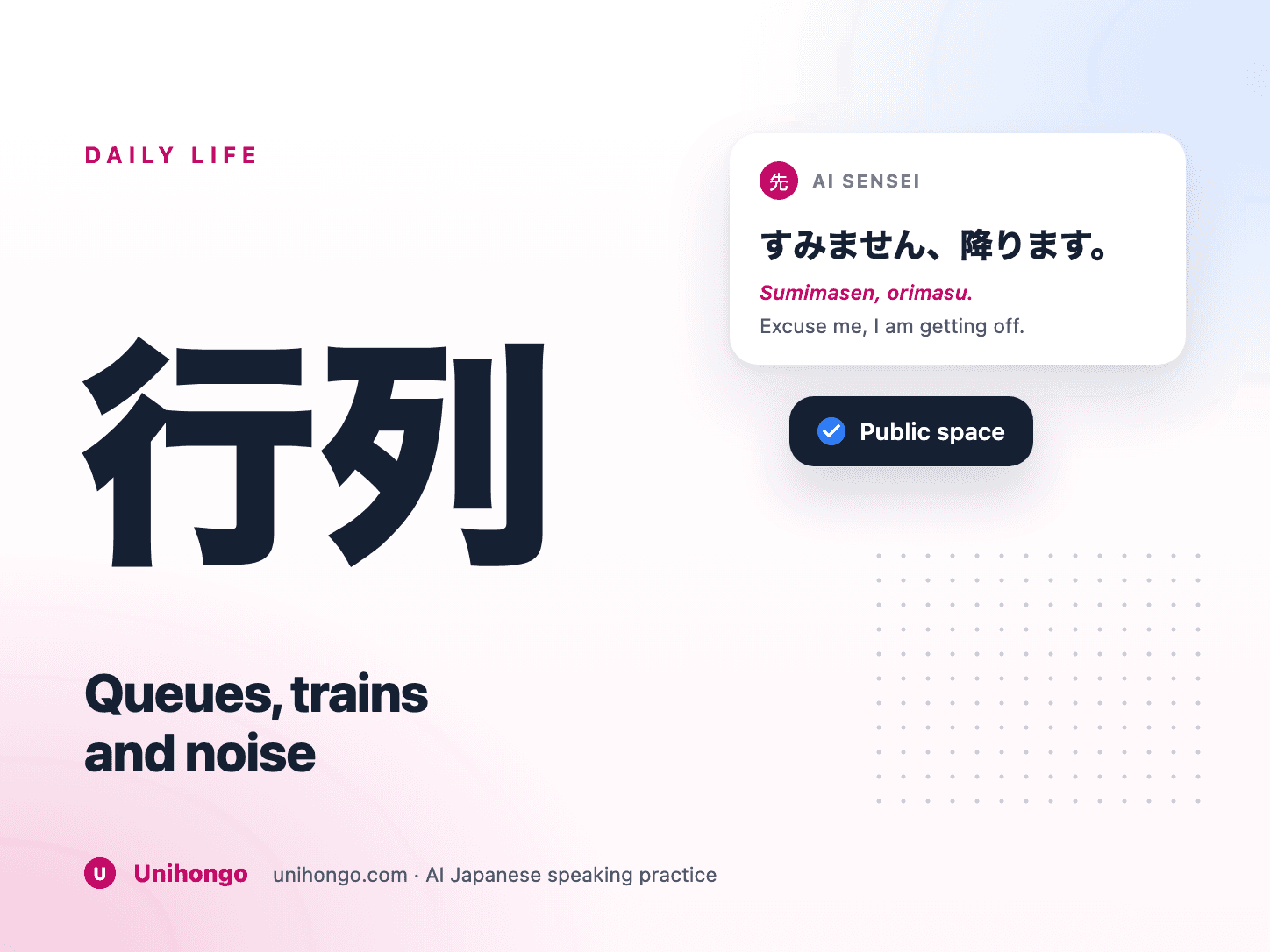
| すみません、降ります。 | Sumimasen, orimasu. | Excuse me, I am getting off. |
| どうぞ。 | Dōzo. | Please, go ahead. (offering a seat) |
| 座りませんか。 | Suwarimasen ka. | Would you like to sit? |
| 少し詰めていただけますか。 | Sukoshi tsumete itadakemasu ka. | Could you move along slightly? |
| この席、空いていますか。 | Kono seki, aite imasu ka. | Is this seat free? |
| 失礼します。 | Shitsurei shimasu. | Excuse me. (passing through) |
Rubbish
Public bins are scarce, and the normal behaviour is to carry rubbish until you find one or reach home. Convenience stores have bins intended for items bought there, and stations have limited ones.
Household sorting is separate and stricter, with categories and collection days set by each municipality. Getting this wrong produces a note on the bag rather than a fine, but it is worth learning the local scheme in your first week.
| Japanese | Romaji | Meaning |
|---|---|---|
| ゴミ箱はどこですか。 | Gomibako wa doko desu ka. | Where is a rubbish bin? |
| 燃えるゴミ | moeru gomi | Burnable rubbish |
| 燃えないゴミ | moenai gomi | Non-burnable rubbish |
| 資源ゴミ | shigen gomi | Recyclable rubbish |
| 粗大ゴミ | sodai gomi | Large items, collected by appointment |
| 収集日 | shūshūbi | Collection day |
Your local ward office publishes a sorting calendar, usually in several languages. It is the most useful piece of paper in a new flat.
Noise and space
Volume expectations in public are lower than in most countries, and this is the adjustment visitors notice most. Conversations happen; they happen quietly.
The same applies to flats, where footsteps, late-night washing machines and music carry through thin walls and are the most common source of neighbour complaints.
- Keep phone calls off trains and out of waiting rooms.
- Match the volume of the room rather than your habit.
- Avoid laundry and vacuuming late at night in a flat.
- Greet neighbours; it makes any future problem easier.
- Take shoes off where there is a step or a rack.
Where the rules relax
It is easy to overcorrect and become anxious about ordinary behaviour, which is its own kind of conspicuousness. Plenty of things visitors worry about are simply not issues.
Sleeping on trains is normal. Eating on long-distance services is expected and there is an entire food culture built around it. Drinking in public is legal and common at festivals and parks. Laughing with friends in a restaurant is not a problem.
The conventions target imposition on strangers, not enjoyment. Applying them beyond that scope produces stiffness rather than politeness.
If you find yourself whispering in an empty park, you have overshot. Copy the people around you; they are the standard.