
Four names from the woods
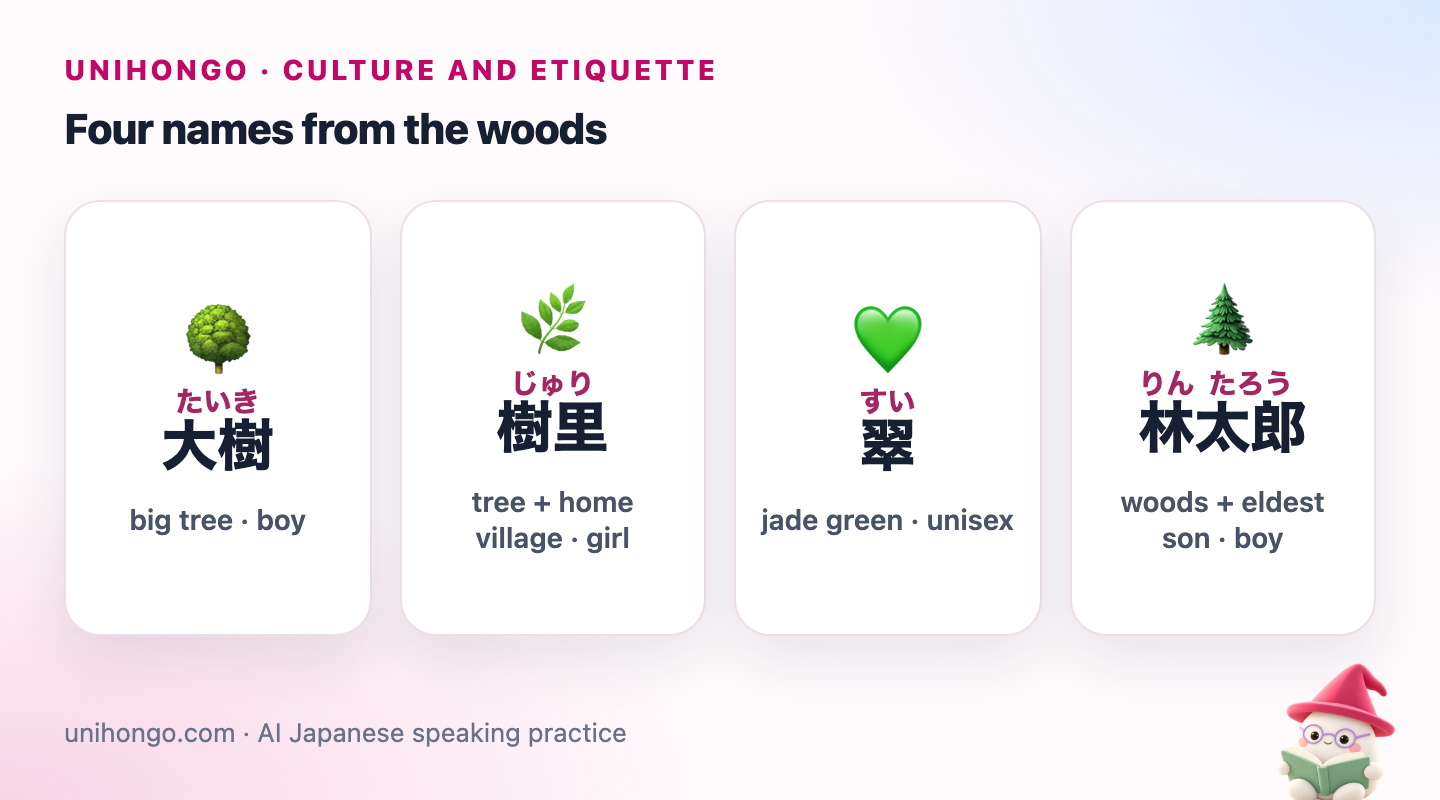
These four names show the main ways the forest enters a given name: a tree, a tree with a softer partner, the colour green and the woods themselves.
| Japanese | Romaji | Meaning |
|---|---|---|
| 大樹 | Taiki | big tree · boy |
| 樹里 | Juri | tree + home village · girl |
| 翠 | Sui | jade green · unisex |
| 林太郎 | Rintarō | woods + eldest son · boy |
大樹 can be read Taiki or Daiki, and the word 大樹 (taiju) means a great tree. 里 in 樹里 is a village or hometown, and it is a common soft ending for girls' names. 翠 is the deep green of jade and kingfisher feathers. 林太郎 joins 林 (woods) to 太郎, the classic ending for an eldest son, and it has a warm, slightly old-fashioned charm that has come back into fashion with some families.
木, 林, 森: from one tree to a forest
This is one of the best-known patterns in kanji: one tree 木 (ki) is a tree, two trees 林 (hayashi) are woods, three trees 森 (mori) are a forest. Children learn it in their first years of school, and it is a good way to remember the three kanji.
Because these kanji describe the landscape, they fill Japanese surnames. Most surnames were taken from places, so a family that lived by the woods or near a forest could become 林 or 森. As given names, the same kanji are much rarer, partly because they would sound like a surname.
| Japanese | Romaji | Meaning |
|---|---|---|
| 森 | Mori | forest · surname |
| 林 | Hayashi | woods · surname |
| 小林 | Kobayashi | small woods · surname |
| 森田 | Morita | forest + rice field · surname |
小林 is one of the most familiar surnames in Japan. In a given name, 林 usually takes its on'yomi, rin, as in Rintarō, which helps it sound like a first name rather than a family name. 森 in given names is uncommon; if a parent wants a forest feeling, 樹 is the usual choice.
Tree names: 樹 and the trees themselves
樹 means a living, standing tree, and parents love it because it suggests a child who grows tall, straight and strong. It takes several readings in names: ki, ju, and itsuki on its own. Other names use the image of a specific part of a tree or a particular species.
| Japanese | Romaji | Meaning |
|---|---|---|
| 直樹 | Naoki | straight, honest + tree · boy |
| 茂 | Shigeru | lush, thick growth · boy, classic |
| 梢 | Kozue | the treetop, top twigs · girl |
| 柚 | Yuzu | yuzu citrus tree · girl |
| 桂 | Kei | katsura tree · boy |
梢 is the very top of a tree, the thin twigs reaching for the sky, and it makes a quiet, elegant girl's name. 茂 means to grow thick and lush, and as Shigeru it was a very common boy's name in earlier generations. 柚 is the fragrant citrus used in winter baths, and Yuzu sounds bright and modern. 桂 is the katsura, a tree with heart-shaped leaves that turn yellow and smell sweet in autumn. 樹 on its own is usually read Itsuki.
Green and growing: leaves, colour and harvest
Some nature names are about the colour of plants or the way they grow and ripen. They feel fresh and gentle, and several of them are classic girls' names.
| Japanese | Romaji | Meaning |
|---|---|---|
| 緑 | Midori | green, fresh greenery · girl |
| 茜 | Akane | madder plant, deep red · girl |
| 実 | Minori | fruit, ripening · girl |
| 稔 | Minoru | a ripe harvest · boy |
| 野乃花 | Nonoka | a wildflower of the fields · girl |
緑 and 翠 are both read midori in some names. 緑 is the everyday green of leaves, while 翠 is a deeper, jewel-like green and feels more refined. 茜 is a plant whose roots were used to make red dye, and 茜色 (akaneiro) is the deep red of a sunset sky. 実 and 稔 both wish for a fruitful life; 稔 has the grain radical 禾 on its left, the image of ripened rice.
Mountains, earth and open land
Beyond the woods, Japanese names reach for the land itself. These names are mostly boys' names and suggest a broad, steady, grounded personality.
| Japanese | Romaji | Meaning |
|---|---|---|
| 大地 | Daichi | the great earth · boy |
| 陸 | Riku | land · boy |
| 岳 | Gaku | mountain peak · boy |
| 拓真 | Takuma | open up land + truth · boy |
大地 is also the everyday word for the earth beneath your feet, so the name is instantly clear. 陸 is the land as opposed to the sea, and Riku is short and modern. 岳 is a high mountain peak and appears in many mountain names. 拓 means to clear and open up land, and by extension to open up a new path in life.
Explaining a nature name
Nature names come with easy reference words, so they are simple to explain. People often add the wish behind the name, using hoshikute, because we wanted, or yō ni, so that.
| Japanese | Romaji | Meaning |
|---|---|---|
| 樹木の樹に、里です。 | Jumoku no ju ni, sato desu. | The ju of trees, and sato for village. |
| 大きな木のように、まっすぐ育ってほしくて。 | Ōkina ki no yō ni, massugu sodatte hoshikute. | We wanted him to grow straight, like a big tree. |
| 自然が好きな両親なんです。 | Shizen ga suki na ryōshin na n desu. | My parents love nature. |
| 森の中にいるような名前ですね。 | Mori no naka ni iru yō na namae desu ne. | Your name feels like being in a forest. |
樹木 (jumoku) means trees and shrubs, and it is the most natural reference word for the ju in Juri. If you explain a name with a wish, ending the sentence with hoshikute and no verb after it sounds soft and natural, as if the rest is understood.
Mini dialogue: Sui on a forest trail
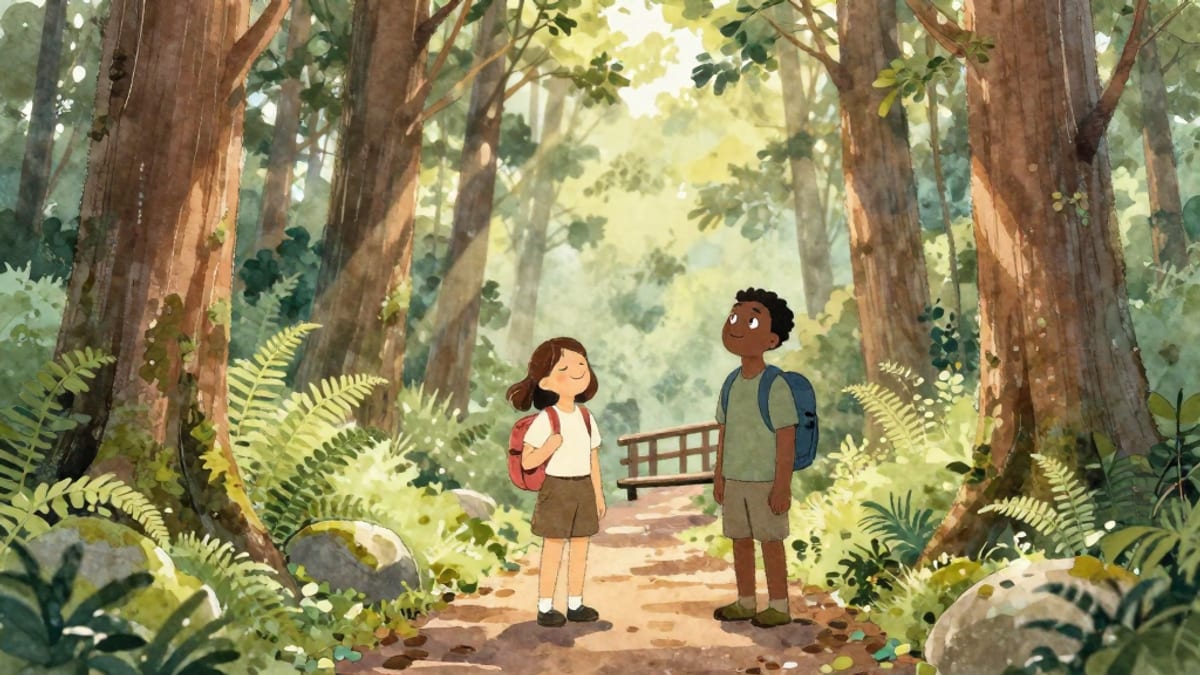
You are walking a forest trail with your friend Sui on a cool morning. Tall cedars line the path. You are good friends and speak casually.
| Japanese | Romaji | Meaning |
|---|---|---|
| 空気がおいしいね。 | Kūki ga oishii ne. | You: The air is so fresh. |
| うん。森に来ると落ち着く。 | Un. Mori ni kuru to ochitsuku. | Sui: Yeah. Coming to the forest calms me down. |
| すいって名前も、森っぽいよね。 | Sui tte namae mo, mori ppoi yo ne. | You: Your name sounds kind of foresty too. |
| 翡翠の翠だから、緑色なんだ。 | Hisui no sui dakara, midoriiro nan da. | Sui: It's the sui of jade, so it's green. |
| いい名前だなあ。 | Ii namae da nā. | You: What a nice name. |
Kūki ga oishii, literally the air is delicious, is the everyday way to say the air is fresh and clean, and you will hear it whenever people leave the city. ~ppoi means -ish or kind of like, and is casual. 翡翠 (hisui) is jade, and the same word is also used for the kingfisher.
A forest of flashcards with Mocchi
Ask Mocchi: /create-flashcards for the nature names in this post, one card per name with its meaning. For each card you pick a photo, a cedar forest for 森, a treetop against the sky for 梢, a field of wildflowers for 野乃花, and Mocchi reviews the deck with you using spaced repetition, so the names you hesitate on come back sooner.
Once the deck is ready, open Kotoba Stack with your own flashcards and build a tower word by word. Mocchi keeps track of how your reviews go and can add a short nature-word task to your plan.
Mistakes with nature and forest names
- Choosing 森 or 林 alone as a given name for a Japanese character. Most readers will take it as a surname.
- Reading every 樹 as ki. It is ju in Juri, ki in Naoki and Taiki, and usually Itsuki on its own.
- Treating 緑 and 翠 as the same. Both are green, but 翠 is deeper and more jewel-like.
- Translating nature as shizen and using it as a name. It is a word, not a name; choose a concrete image.
- Forgetting that 大樹 can be Taiki or Daiki. Ask which reading the person uses.