
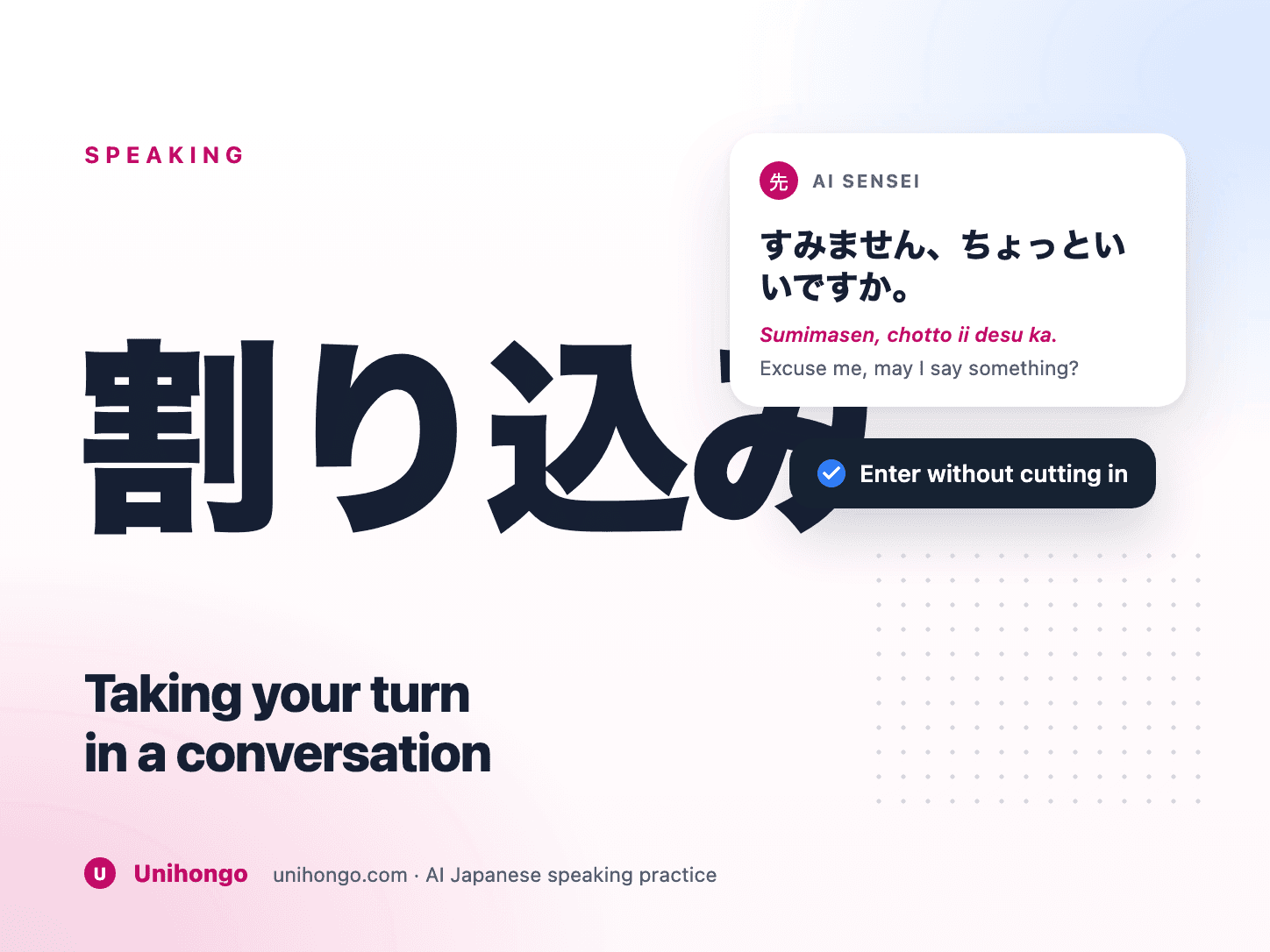
Why the gap never seems to come
Three features of Japanese conversation combine against a learner. First, the verb comes last, so you cannot tell whether a sentence is a statement, a question, a negative or a suggestion until the final syllables. An English speaker can often predict the end of a sentence halfway through and start their own; in Japanese that guess is unreliable.
Second, the gaps are filled. Listeners produce aizuchi such as hai, ee, sō desu ne and naruhodo continuously, which occupies the space an English speaker would take as an opening. Third, several endings signal explicitly that the speaker intends to continue: a trailing kedo, ga, or a te-form left hanging. To a learner these sound like the sentence stopping. To a Japanese listener they mean keep listening.
- The verb, and therefore the meaning, arrives last
- Backchannel fills the pauses you were waiting for
- Trailing kedo, ga and te-forms mean more is coming
- Group settings often follow seniority, and juniors speak later
- Silence itself can be a turn, and is not always an invitation
The signals that a turn is actually ending
Turns do end, and they end with recognisable markers. The most reliable is a full sentence-final form with a falling pitch: desu, masu, da, or a plain-form verb followed by a pitch drop. Add a sentence-final particle such as ne or yo and the speaker is usually handing over.
Content markers help too. A summarising phrase such as to iu koto desu, that is what it comes down to, or tsumari, in other words, almost always precedes the end of a turn. So does a question directed at anyone, and so does the speaker's gaze moving across the group. Learn these and the conversation stops feeling like a wall.
| Signal | Sounds like | Means |
|---|---|---|
| Falling sentence-final form | …です。/ …ました。 | Turn probably ending, you may enter |
| Final particle with a fall | …ですね。/ …だよ。 | Handing over, often to a specific person |
| Summary phrase | つまり… / ということです | Wrapping up, the end is close |
| Trailing connector | …ですけど / …ですが / …して | Continuing, do not enter |
| Rising trail-off | …かなあ / …でしょうか | Thinking aloud, may or may not continue |
| A question to the group | どう思いますか | Explicit invitation, take it |
The single most useful distinction is the last two rows of the first column against the trailing connector. Falling means finished; trailing means wait.
The phrases that buy you a turn
Entering a conversation politely is a two-part move: a marker that signals you are about to speak, then a reason or a frame for what you are about to say. The marker alone can sound abrupt; the frame alone arrives too late. Together they take about a second and a half and are completely unremarkable in any Japanese meeting.
The register scale runs from chotto ii among friends through sumimasen in most situations to osoreirimasu ga in formal or client-facing settings. Yokoyari o ireru yō de sumimasen, sorry to cut across, exists but is heavier than most situations need.
| Japanese | Romaji | Meaning |
|---|---|---|
| すみません、ちょっといいですか。 | Sumimasen, chotto ii desu ka. | Excuse me, may I say something? |
| あの、一つだけよろしいでしょうか。 | Ano, hitotsu dake yoroshii deshō ka. | Er, may I just say one thing? |
| お話の途中ですみません。 | Ohanashi no tochū de sumimasen. | Sorry to break in mid-conversation. |
| 関連して、一点だけ。 | Kanren shite, itten dake. | On a related note, just one point. |
| ちょっと確認してもいいですか。 | Chotto kakunin shite mo ii desu ka. | May I just check something? |
| ちょっといい? | Chotto ii? | Can I jump in? (casual) |
| あ、それで思い出したんだけど。 | A, sore de omoidashita n da kedo. | Oh, that reminds me. (casual) |
| 恐れ入りますが、一点だけ補足させてください。 | Osoreirimasu ga, itten dake hosoku sasete kudasai. | Excuse me, but please let me add one point. (formal) |
Meetings run on different rules from friends
In a work meeting, order often follows seniority, and a junior person who speaks first may be seen as jumping ahead. That does not mean staying silent, which is read as having no view. It means using a frame that positions your comment as a contribution rather than a challenge: agreeing first, then adding, is the standard shape.
Among friends, overlap is normal and enthusiastic interruption is a sign of engagement rather than rudeness. The same phrase that is polite in a meeting sounds oddly stiff at an izakaya. Match the setting, and when in doubt in a work setting, wait for a falling ending and open with sumimasen.
| Setting | How turns are taken | Your opening |
|---|---|---|
| Formal meeting | In order, often by seniority | 恐れ入りますが / お話の途中ですみません |
| Team discussion | Freer, but marked entries | すみません、一点だけ / 関連して |
| Client call | Very marked, wait for a full stop | 失礼いたします。一点確認させてください |
| Friends at dinner | Overlap is normal | あ、それでさ / ちょっとちょっと |
| Class or lesson | Raise a hand or use ano | あの、質問なんですが |
Holding the floor once you have it
Getting the turn is half the job; keeping it while you assemble the sentence is the other half. Silence in the middle of your turn is read as finished, and someone else will take it. Japanese has a full set of hold signals for exactly this, and using them is not a sign of weak language but of a competent speaker thinking.
Announce the shape of what you are about to say. Futatsu arimashite, there are two things, buys you the whole time you need for both. So does a filler that carries structure, such as nan te iu ka or dō ieba ii ka, both of which mean you are still composing rather than finished.
| Japanese | Romaji | Meaning |
|---|---|---|
| 理由は二つあって、まず一つ目は… | Riyū wa futatsu atte, mazu hitotsume wa... | There are two reasons, and the first is... |
| えーと、なんて言うか… | Ēto, nan te iu ka... | Er, how should I put it... |
| ちょっと長くなるんですが、 | Chotto nagaku naru n desu ga, | This will take a moment, but |
| 最後まで言わせてください。 | Saigo made iwasete kudasai. | Please let me finish. |
| もう少しだけ続けますね。 | Mō sukoshi dake tsuzukemasu ne. | I will continue just a little longer. |
| つまり、言いたいのは… | Tsumari, iitai no wa... | In other words, what I want to say is... |
Being interrupted, and getting back in
When someone takes your turn, the graceful move is to yield instantly with dōzo and then reclaim later. Fighting for a turn is uncomfortable in most Japanese settings and rarely wins you anything. Reclaiming, on the other hand, is easy and completely standard: refer back to what you were saying, and everyone will recognise the move.
The phrase to have ready is sakki no hanashi ni modorimasu ga, returning to what I was saying earlier. Deployed at the next falling ending, it recovers your point without any friction and makes you look organised rather than pushy.
| Japanese | Romaji | Meaning |
|---|---|---|
| あ、どうぞ。 | A, dōzo. | Oh, go ahead. |
| さっきの話に戻りますが、 | Sakki no hanashi ni modorimasu ga, | Returning to what I was saying earlier, |
| 先ほどの件ですが、一つだけ。 | Sakihodo no ken desu ga, hitotsu dake. | About the earlier point, just one thing. |
| 言いかけたことがあるんですが。 | Iikaketa koto ga aru n desu ga. | There was something I started to say. |
| すみません、途中で終わってしまって。 | Sumimasen, tochū de owatte shimatte. | Sorry, I got cut off part way through. |
Online meetings and the lag problem
Video calls break every timing signal described above. The delay is long enough that two people regularly start at once, and the video makes the gaze cues unreliable. Japanese online meetings therefore lean harder on explicit turn allocation: the chair names the next speaker, and people announce themselves before speaking.
Adapt by being more explicit than you would be in a room. Say your name before your comment, use the chat to signal that you have something to add, and leave a longer pause than feels natural after someone finishes. If you do collide, the standard recovery is a fast dōzo followed by silence.
| Japanese | Romaji | Meaning |
|---|---|---|
| 田中ですが、よろしいでしょうか。 | Tanaka desu ga, yoroshii deshō ka. | This is Tanaka, may I? |
| 音声、大丈夫でしょうか。 | Onsei, daijōbu deshō ka. | Is my audio coming through all right? |
| あ、失礼しました。どうぞ。 | A, shitsurei shimashita. Dōzo. | Oh, excuse me. Please go ahead. |
| チャットに書いておきます。 | Chatto ni kaite okimasu. | I will write it in the chat. |
| 後ほどコメントさせていただきます。 | Nochihodo komento sasete itadakimasu. | I will comment afterwards. |
Announcing your name before speaking feels excessive at first and is entirely normal on a Japanese call with more than three people.