

Finding a shop and reading the price board
Look for the katakana クリーニング on a shop sign, often with a picture of a shirt or hanger. Many neighbourhood shops are simple drop-off counters, toritsugiten, where clothes are collected and sent to a factory, so pickup times depend on the delivery schedule rather than on the shop itself.
Prices are usually displayed per item type on a board by the counter. They vary a lot between shops and areas, and many shops run discount days, membership cards or point cards. The words below will help you read the board.
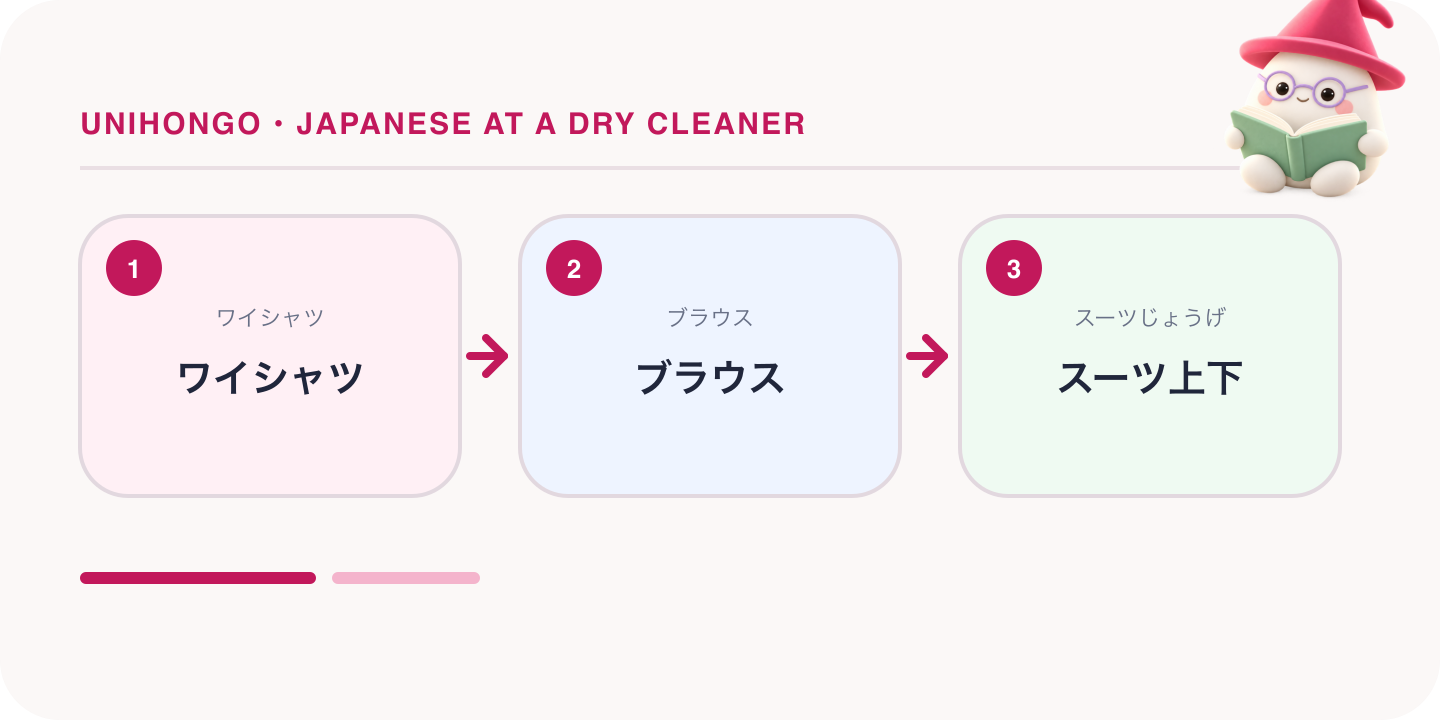
| Item | Reading | English |
|---|---|---|
| ワイシャツ | waishatsu | Business shirt |
| ブラウス | burausu | Blouse |
| スーツ上下 | sūtsu jōge | Two-piece suit |
| ズボン / スラックス | zubon / surakkusu | Trousers |
| スカート | sukāto | Skirt |
| コート | kōto | Coat |
| ダウンジャケット | daun jaketto | Down jacket |
| セーター | sētā | Jumper |
| ネクタイ | nekutai | Tie |
| 毛布 | mōfu | Blanket |
Dropping off: the item check
At the counter, put your clothes down and say kurīningu o onegai shimasu. The staff will go through each item, counting them, checking pockets, and looking for stains, tears, loose buttons and fading. This check is called kenpin, and it protects both you and the shop, so it is worth pointing out anything you already know about.
They may ask whether there is anything in the pockets, and whether a stain is something specific, such as coffee, oil or wine, because different stains need different treatments. If a garment has a care label saying it cannot be dry cleaned, they may explain the options or decline to take it.
| Japanese | Romaji | Meaning |
|---|---|---|
| クリーニングをお願いします。 | Kurīningu o onegai shimasu. | I'd like these cleaned, please. |
| 全部で五点ですね。 | Zenbu de goten desu ne. | That's five items in total. |
| ポケットの中は大丈夫ですか。 | Poketto no naka wa daijōbu desu ka. | Is there anything in the pockets? |
| ここにコーヒーのしみがあります。 | Koko ni kōhī no shimi ga arimasu. | There's a coffee stain here. |
| このボタンが取れかけています。 | Kono botan ga torekakete imasu. | This button is coming loose. |
| この服はドライクリーニングできますか。 | Kono fuku wa dorai kurīningu dekimasu ka. | Can this be dry cleaned? |
Shirts: hanger or folded, and how much starch
Shirts are the most common item at a kurīningu shop, and there are two small choices. The first is the finish, shiage: on a hanger, hangā, or folded, tatami. Hanger finish is common for work shirts you will hang in a wardrobe; folded is handy for packing.
The second is starch, nori. You can ask for more, tsuyome, or less, yowame, or none at all, nori nashi. If you do not say anything, the shop will use its standard setting, which varies between shops.
| Japanese | Romaji | Meaning |
|---|---|---|
| ハンガー仕上げでお願いします。 | Hangā shiage de onegai shimasu. | On hangers, please. |
| たたみでお願いします。 | Tatami de onegai shimasu. | Folded, please. |
| のりは弱めでお願いします。 | Nori wa yowame de onegai shimasu. | Light starch, please. |
| のりは強めにしてください。 | Nori wa tsuyome ni shite kudasai. | Heavy starch, please. |
| のりなしでお願いします。 | Nori nashi de onegai shimasu. | No starch, please. |
Stains and optional treatments
Stain removal is shimi-nuki. Some shops include simple treatment in the normal price, while stubborn, old or unusual stains may cost extra. Staff will often be honest that a stain may not come out completely, saying something like ochinai kamo shiremasen, it might not come out. That is not a refusal, just a warning before you agree.
Other common extras include water repellent treatment, bassui kakō, popular for coats and down jackets, anti-bobbling care for knitwear and small repairs. Some shops offer alterations and hemming, called sunpō naoshi or suso age, while others pass them to a partner. Ask what is available at your shop.
| Japanese | Romaji | Meaning |
|---|---|---|
| このしみは落ちますか。 | Kono shimi wa ochimasu ka. | Will this stain come out? |
| しみ抜きは別料金ですか。 | Shimi-nuki wa betsu ryōkin desu ka. | Is stain removal charged separately? |
| 完全には落ちないかもしれません。 | Kanzen ni wa ochinai kamo shiremasen. | It may not come out completely. |
| それでもお願いします。 | Soredemo onegai shimasu. | Please go ahead anyway. |
| Japanese | Reading | Meaning |
|---|---|---|
| しみ抜き | shimi-nuki | Stain removal |
| 撥水加工 | bassui kakō | Water repellent treatment |
| 防虫加工 | bōchū kakō | Moth-proofing |
| ボタン付け | botan tsuke | Sewing on a button |
| ほつれ直し | hotsure naoshi | Repairing loose stitching |
| 裾上げ | suso age | Hemming trousers |
| 保管サービス | hokan sābisu | Seasonal storage service |
Pickup dates and express service
Before you leave, the staff will tell you when your clothes will be ready, the shiagari-bi or pickup date, and write it on the ticket. If you need clothes by a certain day, for an interview or a wedding, say so at drop-off, not afterwards.
Many shops offer a faster option, often called tokkyū or kyūkō, sometimes same-day, sokujitsu, if you drop off before a cut-off time. It usually costs extra and may not apply to every item, and it can be unavailable at busy times such as the change of seasons, when many people clean their winter or summer clothes at once.
| Japanese | Romaji | Meaning |
|---|---|---|
| いつ仕上がりますか。 | Itsu shiagarimasu ka. | When will it be ready? |
| 金曜日までに必要なんですが。 | Kin'yōbi made ni hitsuyō nan desu ga. | I need it by Friday. |
| 特急でお願いできますか。 | Tokkyū de onegai dekimasu ka. | Can I have express service? |
| 即日仕上げは何時までに出せばいいですか。 | Sokujitsu shiage wa nanji made ni daseba ii desu ka. | What time do I need to drop off for same-day service? |
| お仕上がりは木曜日の午後になります。 | Oshiagari wa mokuyōbi no gogo ni narimasu. | It'll be ready on Thursday afternoon. |
The claim ticket and collecting your clothes
When you pay or drop off, you receive a claim ticket, hikikaeken, sometimes just called the hikae, the stub. It shows your number, the items and the pickup date. Some shops take payment at drop-off, maeharai, and some at collection, so do not be surprised by either.
When you collect, hand over the ticket and the staff will bring your clothes, usually in plastic covers. It is sensible to check the items at the counter, especially stain treatment. Many people remove the plastic covers at home so that clothes can breathe in the wardrobe.
| Japanese | Romaji | Meaning |
|---|---|---|
| 引き換え券をお持ちですか。 | Hikikaeken o omochi desu ka. | Do you have your claim ticket? |
| 受け取りに来ました。 | Uketori ni kimashita. | I've come to collect my clothes. |
| お会計は先でしょうか、後でしょうか。 | Okaikei wa saki deshō ka, ato deshō ka. | Do I pay now or at collection? |
| ここで確認してもいいですか。 | Koko de kakunin shite mo ii desu ka. | May I check them here? |
| ハンガーはお返しいただけます。 | Hangā wa okaeshi itadakemasu. | You can return the hangers to us. |
When something goes wrong: lost tickets, missing items and damage
If you lose the claim ticket, go to the shop and explain. Most shops can find your order by name, phone number or membership card, though they may ask for ID first. If you find something missing when you collect, say so at the counter straight away, before you leave.
Damage such as shrinking, chijimi, colour running, iro ochi, or a missing button should also be raised at the counter as soon as you notice it. Shops follow their own procedures for complaints and compensation, and staff will usually take the item back to check. Stay calm and specific: which item, what changed, and when you noticed. The same applies if you left something in a pocket; ask the shop to check, since staff often find and keep items.
| Japanese | Romaji | Meaning |
|---|---|---|
| 引き換え券をなくしてしまいました。 | Hikikaeken o nakushite shimaimashita. | I've lost my claim ticket. |
| 名前は丸山で、先週の月曜日に出しました。 | Namae wa Maruyama de, senshū no getsuyōbi ni dashimashita. | My name is Maruyama, and I dropped it off last Monday. |
| シャツが一枚足りないようです。 | Shatsu ga ichimai tarinai yō desu. | It seems one shirt is missing. |
| セーターが縮んでしまったようなんですが。 | Sētā ga chijinde shimatta yō nan desu ga. | It seems my jumper has shrunk. |
| ポケットに鍵を入れたままでした。 | Poketto ni kagi o ireta mama deshita. | I left a key in the pocket. |
| 確認していただけますか。 | Kakunin shite itadakemasu ka. | Could you check for me? |
Swap Maruyama for your own name, and keep your ticket and any receipts together. With those in hand, even a tricky conversation usually ends quickly.