
How a Japanese girl name is built
A Japanese given name, namae (名前) or shita no namae, follows the family name: Tanaka Himari, not Himari Tanaka, when written in Japanese order. Parents usually choose the name in the first week or two after the birth, because the birth has to be registered with the town office within fourteen days.
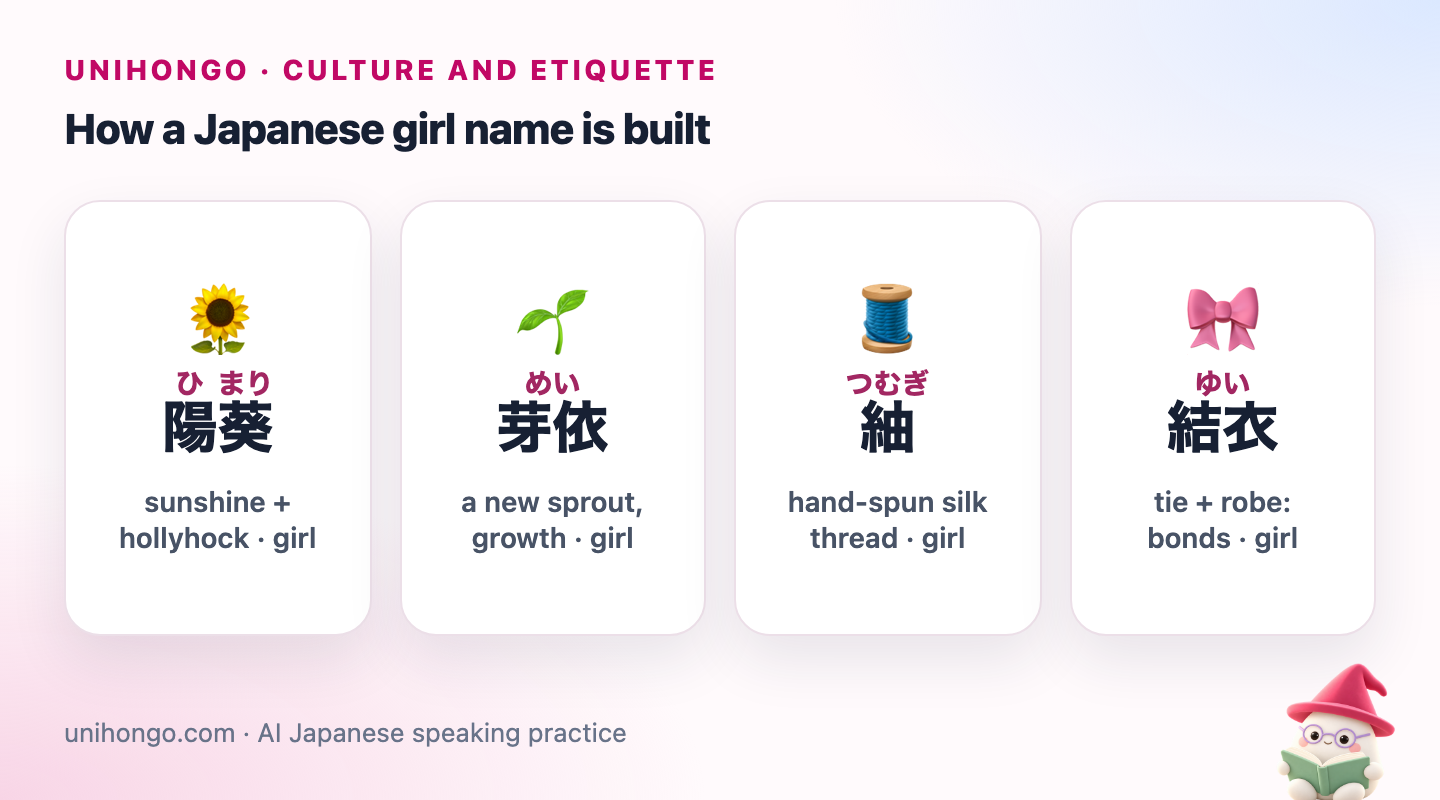
Most girl names have two kanji, some have one or three, and some are written only in hiragana. Parents pick the kanji for three things at once: the meaning (a wish for the child), the sound (how the name feels when spoken) and the look (how balanced and pretty it is when written). Here are four names that show the idea.
| Japanese | Romaji | Meaning |
|---|---|---|
| 陽葵 | Himari | sunshine + hollyhock · girl |
| 芽依 | Mei | a new sprout, growth · girl |
| 紬 | Tsumugi | hand-spun silk thread · girl |
| 結衣 | Yui | tie + robe: bonds · girl |
Himari uses 陽, sunshine, and 葵, the hollyhock, which also appears in 向日葵, himawari, the sunflower. Tsumugi is a kind of sturdy silk woven from hand-spun thread, and parents like the image of a life spun carefully, thread by thread. Yui uses 結, to tie, a popular kanji for names because it suggests bonds with other people.
One name, many spellings
The most important thing to know about Japanese names is that the sound does not tell you the kanji. When a Japanese person hears a new name, the natural next question is how it is written. The table shows common spellings for a few well-known girl names; there are many more.
| Japanese | Romaji | Meaning |
|---|---|---|
| 桜 | Sakura | cherry blossom · girl |
| 咲良 | Sakura | bloom + good · girl |
| さくら | Sakura | Sakura in soft hiragana · girl |
| 陽菜 | Hina | sunshine + greens · girl |
| Name | Common spellings | What changes |
|---|---|---|
| Himari | 陽葵, 日葵, ひまり | Sunshine or the sun itself; hiragana feels soft |
| Yui | 結衣, 唯, 由衣, ゆい | Bonds, being the only one, or mainly the sound |
| Sakura | 桜, 咲良, さくら | The tree itself, or bloom + good |
| Mei | 芽依, 芽衣, めい | A sprout with different second kanji |
| Hina | 陽菜, 日菜, ひな | Sun + greens, a bright and fresh image |
It also works the other way: one kanji can be read in several ways in names. 陽 is hi in Himari, haru in Haruna (陽菜, which can also be Hina) and yō in everyday words like taiyō, the sun. Name readings, called nanori, include readings you will not find in everyday words, which is why even Japanese people sometimes have to ask how to read a name.
Names from flowers, plants and the seasons
Nature is the richest source of girl names. Flowers, trees, the sea and the seasons all appear, often combined with a second kanji that adds beauty, hope or sound.
| Japanese | Romaji | Meaning |
|---|---|---|
| 美咲 | Misaki | beauty + bloom · girl |
| 楓 | Kaede | maple tree · mostly girl |
| 杏 | An | apricot · girl |
| 心春 | Koharu | heart + spring · girl |
| 澪 | Mio | a channel of water, a boat's wake · girl |
| 凛 | Rin | dignified, crisp and clear · girl or unisex |
| 葵 | Aoi | hollyhock · unisex |
Rin, 凛, is a good example of a name chosen for its feel: the kanji suggests the clean, upright air of a cold morning and a person with quiet dignity. Aoi is used for both girls and boys, which surprises learners who expect every name to be clearly one or the other.
Names of feeling, virtue and wishes
Many parents choose a kanji that expresses the kind of person they hope the child will become: kind, loved, beautiful, hopeful. These kanji are often combined with nature kanji or with a soft final syllable.
| Japanese | Romaji | Meaning |
|---|---|---|
| 愛 | Ai | love · girl |
| 美羽 | Miu | beauty + feather · girl |
| 優花 | Yūka | gentle + flower · girl |
| 結愛 | Yua | tie + love · girl |
| 希 | Nozomi | hope, a rare wish · girl |
| 千尋 | Chihiro | a thousand fathoms, deep · mostly girl |
Kanji such as 美 (beauty), 愛 (love), 優 (gentle) and 結 (bond) appear again and again in girl names, so learning them helps you read many names at once. Notice the long vowel in Yūka: Yuka with a short u is a different name, often written 由佳 or 結花.
Classic, retro and modern endings
Endings give a name much of its gender and its age. A name ending in -ko (子, child) sounds like a grandmother or a mother of a certain age; it was very common a few generations ago. -mi (美, beauty) and -e (恵, blessing) feel classic too. Modern names lean towards -na, -ka, -ri, -o and short one-kanji names.
| Japanese | Romaji | Meaning |
|---|---|---|
| 花子 | Hanako | flower + child · girl (classic) |
| 恵子 | Keiko | blessing + child · girl (classic) |
| 莉子 | Riko | jasmine + child · girl |
| 結菜 | Yuna | tie + greens · girl |
| Ending | Common kanji | Feel today |
|---|---|---|
| -ko | 子 | Classic, often a mother's or grandmother's generation |
| -mi | 美, 実 | Classic and gentle |
| -ka | 花, 香, 華 | Fresh and still very common |
| -na | 菜, 奈 | Bright and modern |
| -ri | 莉, 里 | Soft and modern, as in Akari or Mari |
Riko shows that -ko has not disappeared; it is simply chosen less often and tends to be paired with a modern first kanji. Some parents also like short, classic-sounding names again, so treat these as tendencies, not rules.
How to ask about someone's name
Asking how a name is written is not nosy in Japan; it is the normal way to show interest and to make sure you remember it correctly. Use polite Japanese with adults you have just met, and casual speech with friends. A compliment on the name is a warm way to finish.
| Japanese | Romaji | Meaning |
|---|---|---|
| お名前はどう書きますか。 | Onamae wa dō kakimasu ka. | How do you write your name? (polite) |
| 太陽の「陽」を使っています。 | Taiyō no "yō" o tsukatte imasu. | It uses the yō of taiyō, the sun. |
| どんな意味がありますか。 | Donna imi ga arimasu ka. | What does it mean? |
| 名前の由来は何ですか。 | Namae no yurai wa nan desu ka. | Where does your name come from? |
| 素敵なお名前ですね。 | Suteki na onamae desu ne. | What a lovely name. |
| 両親がつけてくれました。 | Ryōshin ga tsukete kuremashita. | My parents gave it to me. |
When people explain a kanji, they name a familiar word that contains it, like taiyō no yō, the yō of taiyō. Learning to understand this pattern helps you a lot at town offices, banks and doctors' receptions too.
Mini dialogue: meeting a new baby
| Japanese | Romaji | Meaning |
|---|---|---|
| わあ、かわいい!お名前は? | Wā, kawaii! Onamae wa? | You: Oh, so cute! What's her name? |
| ひまりです。 | Himari desu. | Mother: It's Himari. |
| 漢字はどう書くんですか。 | Kanji wa dō kaku n desu ka. | You: How is it written in kanji? |
| 太陽の「陽」に、葵の花の「葵」です。 | Taiyō no "yō" ni, aoi no hana no "aoi" desu. | Mother: The yō of taiyō, and aoi, the hollyhock. |
| 明るくて素敵な名前ですね。 | Akarukute suteki na namae desu ne. | You: What a bright, lovely name. |
Turn these names into a picture deck with Mocchi
Sign in to Unihongo with a free account and ask Mocchi, the study assistant on the home page: /create-flashcards Japanese girl names Himari, Mei, Tsumugi, Yui, Misaki and Koharu with their kanji and meanings. Mocchi makes a card for each name and lets you pick a photo, such as a sunflower for Himari or a spool of thread for Tsumugi, so the meaning has a picture to hang on.
Then type /review-flashcards whenever you have a spare moment. The cards you get wrong come back sooner, and Mocchi keeps note of the kanji you confuse, like 結 and 紬, so later quizzes return to them. If you want a quick game, load the same deck into Kotoba Tank and hit the right name when you hear it.
Mistakes to avoid with girl names
- Treating a name list as a dictionary. The meaning depends on the kanji, so Yui does not simply mean bond; only 結衣 or 結 does.
- Guessing a reading from kanji alone. Ask: Nan to oyomi sureba ii desu ka, how should I read it?
- Using kanji with a gloomy or unlucky meaning because they look nice. 死 (death) or 苦 (suffering) would never be chosen, and some others feel heavy; check with a native speaker.
- Mixing a girl's sound with a boy's ending. Names ending in -tarō, -suke or -ta usually sound like boys' names.
- Expecting any kanji to be allowed. Names in Japan must use the official lists of kanji for daily use and for names, plus hiragana and katakana.