

The shape of workplace feedback in Japan
Feedback in a Japanese office follows a shape that is easy to learn once you see it: a cushion, a specific observation, a suggestion, and a forward-looking close. The cushion signals that something delicate is coming. The observation is about the work, not the person. The suggestion is offered as a possibility. The close returns the relationship to normal. Miss any one and the comment lands harder than you meant.
Timing and place matter as much as words. Critical comments are given one to one, not in front of the team, and soon after the event rather than saved for a review. Positive comments can be public, but even those are kept short. A private chat message with one point is now the most common feedback channel in many companies.
| Japanese | Romaji | Meaning |
|---|---|---|
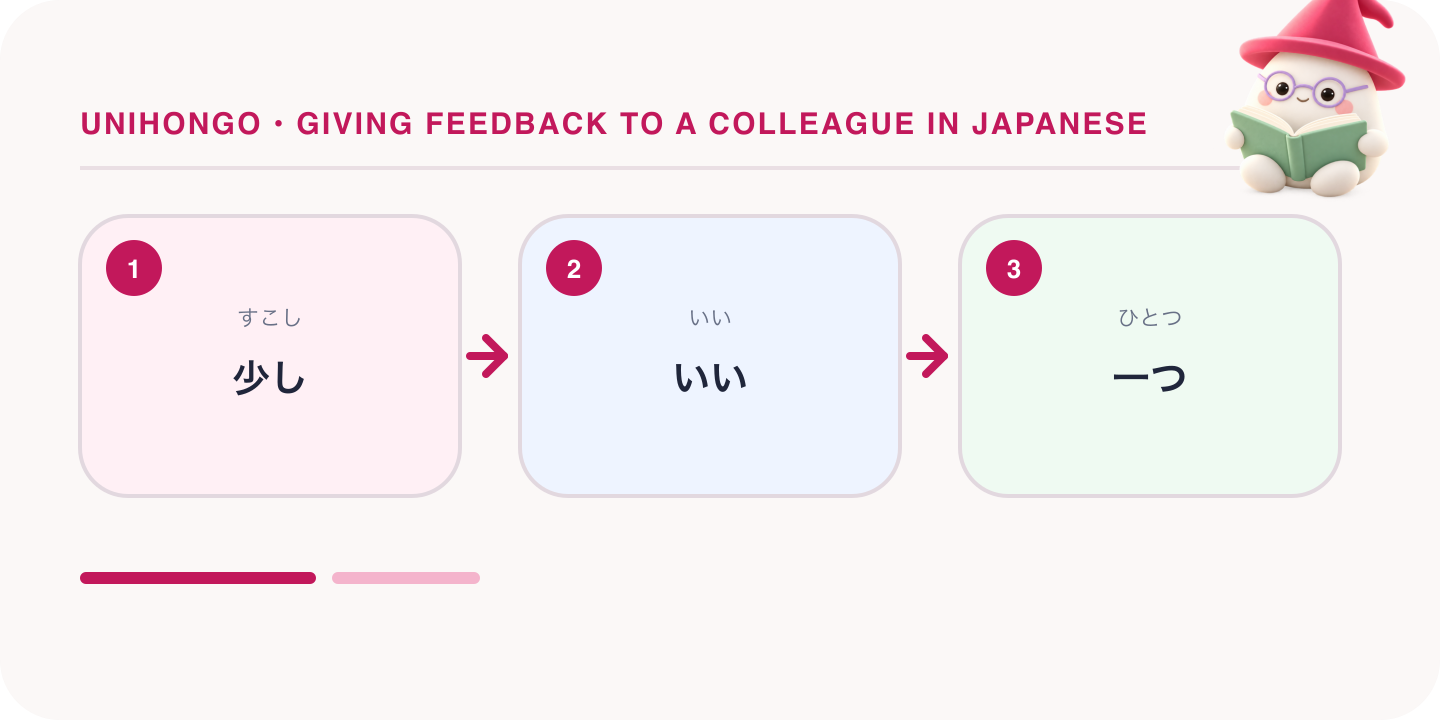
| 今、少しいいですか。 | Ima, sukoshi ii desu ka. | Do you have a moment now? |
| 一つだけ気になった点があるのですが。 | Hitotsu dake ki ni natta ten ga aru no desu ga. | There's just one thing I noticed. |
| 資料のことで、ちょっとお話ししてもいいですか。 | Shiryō no koto de, chotto o-hanashi shite mo ii desu ka. | Could I talk to you briefly about the document? |
| 差し支えなければ、一つ提案があります。 | Sashitsukae nakereba, hitotsu teian ga arimasu. | If you don't mind, I have one suggestion. |
Cushion words that open a comment
Kusshon kotoba, cushion words, are the small phrases that go before anything awkward. They do not change the content; they change how it is received. The most useful for feedback are hitotsu ki ni natta no desu ga, one thing caught my attention; osore-irimasu ga, excuse me but; and, to a senior, sashidegamashii no desu ga, at the risk of overstepping. In chat, a lighter chotto ii desu ka or ichiten dake, just one point, does the same job.
The observation then follows in neutral language. Describe what you saw: sūji ga chigatte iru yō desu, the figures seem to differ, rather than machigatte imasu, it is wrong. Yō desu, it seems, and mitai desu, it looks like, keep the observation tentative even when you are sure.
| Japanese | Romaji | Meaning |
|---|---|---|
| 恐れ入りますが、一点確認させてください。 | Osore-irimasu ga, itten kakunin sasete kudasai. | Excuse me, but let me check one point. |
| 気になったので共有しますね。 | Ki ni natta node kyōyū shimasu ne. | It caught my attention, so I'll share it. |
| 私の見落としかもしれませんが、二ページ目の数字が違うようです。 | Watashi no miotoshi kamo shiremasen ga, nipēji-me no sūji ga chigau yō desu. | I may be missing something, but the figure on page two seems different. |
| 細かい点で恐縮ですが、日付が先月のままになっています。 | Komakai ten de kyōshuku desu ga, hizuke ga sengetsu no mama ni natte imasu. | Sorry to be picky, but the date is still last month's. |
| 念のためですが、送付先はこちらで合っていますか。 | Nen no tame desu ga, sōfu-saki wa kochira de atte imasu ka. | Just to be safe, is this the right recipient? |
Positive feedback that does not sound condescending
Praise is trickier than criticism in Japanese, because evaluating someone is itself a senior's act. Jōzu desu ne or yoku dekimashita, well done, sound natural from a manager to a new hire and patronising between peers. The safe pattern is to praise the work and its effect on you. Tasukarimashita, that helped me, is the most useful single word here, because it puts you in the position of the person who benefited.
To a senior, avoid evaluating altogether. Benkyō ni narimashita, I learned from that, and sankō ni narimashita, that was a useful reference, express appreciation without judging. Keep praise short; a long compliment makes colleagues uncomfortable and invites a wave of denial.
| Japanese | Romaji | Meaning |
|---|---|---|
| 資料、とても分かりやすかったです。助かりました。 | Shiryō, totemo wakariyasukatta desu. Tasukarimashita. | The document was very easy to follow. That helped a lot. |
| 先方への返信、早くて助かりました。 | Senpō e no henshin, hayakute tasukarimashita. | Your quick reply to the client really helped. |
| あのまとめ方、参考になりました。 | Ano matomekata, sankō ni narimashita. | The way you summarised that was useful to me. |
| 昨日のプレゼン、とても勉強になりました。 | Kinō no purezen, totemo benkyō ni narimashita. | I learned a lot from yesterday's presentation. |
| この部分、いいですね。このまま進めましょう。 | Kono bubun, ii desu ne. Kono mama susumemashō. | This part is good. Let's go ahead as it is. |
Pointing out an error and suggesting a change
Once the observation is on the table, the suggestion follows. The core form is shita hō ga ii kamo shiremasen, it might be better to, which turns an instruction into a possibility. To a kōhai you can drop to shita hō ga ii yo; to a senior, use ikaga deshō ka, what would you think, and let them decide. If there are several problems, choose the one that matters and offer to send the rest in writing.
Give a reason with the suggestion. Colleagues accept a change much more readily when they can see why: the client uses the old format, the numbers must match the report. A reason also shows the comment is about the work, not about them.
| Japanese | Romaji | Meaning |
|---|---|---|
| ここは表にした方が見やすいかもしれません。 | Koko wa hyō ni shita hō ga miyasui kamo shiremasen. | This might be easier to read as a table. |
| 先方は旧フォーマットを使っているので、合わせた方がいいと思います。 | Senpō wa kyū fōmatto o tsukatte iru node, awaseta hō ga ii to omoimasu. | The client uses the old format, so I think we should match it. |
| 結論を先に書くと、もっと伝わりやすくなると思います。 | Ketsuron o saki ni kaku to, motto tsutawariyasuku naru to omoimasu. | If you put the conclusion first, I think it will come across better. |
| 他にも二、三点あるので、後でチャットで送りますね。 | Hoka ni mo ni-san ten aru node, ato de chatto de okurimasu ne. | There are two or three other points, so I'll send them in chat later. |
| もしよければ、私の方で直しておきましょうか。 | Moshi yokereba, watashi no hō de naoshite okimashō ka. | If you like, shall I fix it on my side? |
Shifting register: kōhai, dōryō and jōshi
The same comment changes shape with rank. To a kōhai, a junior, you can be plainer and more directive, but the cushion and the reason still matter, because juniors remember how they were corrected for years. To a dōryō, a peer, keep everything as a suggestion between equals and avoid anything that sounds like grading. To a jōshi, your manager, you are raising a question for your own understanding, privately, once, and letting it go if it is not taken up.
The table shows the same moves at each level. Which level fits a senpai who is not your manager depends on your relationship and your office; when in doubt, use the dōryō forms.
| Move | To a kōhai | To a dōryō | To a jōshi |
|---|---|---|---|
| Opening | Chotto ii? | Ima sukoshi ii desu ka. | Sashidegamashii no desu ga. |
| Observation | Koko, sūji ga chigau yo. | Koko no sūji, chigau yō desu. | Koko no sūji, watashi no rikai de wa kotoshi no bun ka to. |
| Suggestion | Naoshita hō ga ii yo. | Naoshita hō ga ii kamo shiremasen. | Kakunin itadakemasu deshō ka. |
| Reason | Hōkokusho to awaseru kara. | Hōkokusho to awaseru hitsuyō ga aru node. | Hōkokusho to no seigōsei ga ki ni narimashite. |
| Praise | Ii ne, tasukatta yo. | Wakariyasukatta desu. Tasukarimashita. | Taihen benkyō ni narimashita. |
| Close | Kore kara mo yoroshiku ne. | Kongo mo yoroshiku onegai shimasu. | O-isogashii tokoro shitsurei itashimashita. |
Sashidegamashii no desu ga literally means I am being forward, but, and it is the standard opener for a junior raising something with a senior. Use it once; repeating it sounds anxious.
Feedback in chat and email
Written feedback loses tone, so it needs more cushioning, not less. A chat message with a correction should have a greeting, the cushion, one point, the suggestion and a soft close, even if that makes it five lines. Emoji are fine in chat in many teams and out of place in email; copy your team's habits. Email feedback on a document usually goes as a numbered list after a line giving the overall impression.
The rows below are reusable pieces for a chat message and an email. Replace the details, keep the order.
| Japanese | Romaji | Meaning |
|---|---|---|
| お疲れさまです。資料、拝見しました。 | O-tsukaresama desu. Shiryō, haiken shimashita. | Hello. I've had a look at the document. |
| 全体的にとても分かりやすいと思います。 | Zentai-teki ni totemo wakariyasui to omoimasu. | Overall I think it's very easy to follow. |
| 一点だけ、三ページ目のグラフの単位をご確認いただけますか。 | Itten dake, sanpēji-me no gurafu no tan'i o go-kakunin itadakemasu ka. | Just one point, could you check the units on the page-three chart? |
| 以下、気づいた点をまとめました。ご参考まで。 | Ika, kizuita ten o matomemashita. Go-sankō made. | I've listed the points I noticed below, for reference. |
| 引き続きよろしくお願いいたします。 | Hikitsuzuki yoroshiku onegai itashimasu. | Thank you for your continued help. |
Following up
Feedback that is never revisited teaches nothing. A short follow-up a day or two later closes the loop: check whether the change was made, thank the person if it was, and offer help if it was not. Keep the follow-up lighter than the original comment; the point is to show you noticed, not to chase.
- Give the comment privately, one point at a time, with a reason
- Offer to fix small things yourself where that is quicker
- Check the result a day or two later, without making it a second correction
- Thank the person specifically for the change: naoshite kurete arigatō
- If nothing changed, ask whether something was unclear rather than repeating
- For a kōhai, note the point for their next one-to-one instead of repeating it
A follow-up can be as short as sakki no ken, arigatō, tasukarimashita, about the earlier thing, thanks, that helped. Colleagues who are thanked for changes make more of them.
Mistakes to avoid
The first mistake is skipping the cushion. Machigatte imasu, that is wrong, with no lead-in sounds like a teacher, even to a junior. The second is praising a peer or senior with evaluative words such as jōzu or erai, which position you above them. The third is giving several corrections at once in front of others. The fourth is using the kōhai register with a peer who happens to be younger; age matters less than role.
The fifth is following up too hard, turning a suggestion into a demand by repeating it. The last is giving feedback to a manager in public or in a group chat. Raise it once, privately, with sashidegamashii no desu ga, and accept whatever they decide.
| Japanese | Romaji | Meaning |
|---|---|---|
| それ、間違っています。 | Sore, machigatte imasu. | That's wrong. (No cushion; avoid.) |
| ここ、少し違っているかもしれません。 | Koko, sukoshi chigatte iru kamo shiremasen. | This may be slightly off. (The softened version.) |
| 部長、上手ですね。 | Buchō, jōzu desu ne. | You're skilful, sir. (Evaluates a senior; avoid.) |
| 部長のご説明、大変勉強になりました。 | Buchō no go-setsumei, taihen benkyō ni narimashita. | I learned a great deal from your explanation. (Appreciates instead.) |
| 先日の件、何か分かりにくい点はありましたか。 | Senjitsu no ken, nanika wakarinikui ten wa arimashita ka. | About the other day, was anything unclear? (A better follow-up.) |