

The verb hikikomoru and its parts
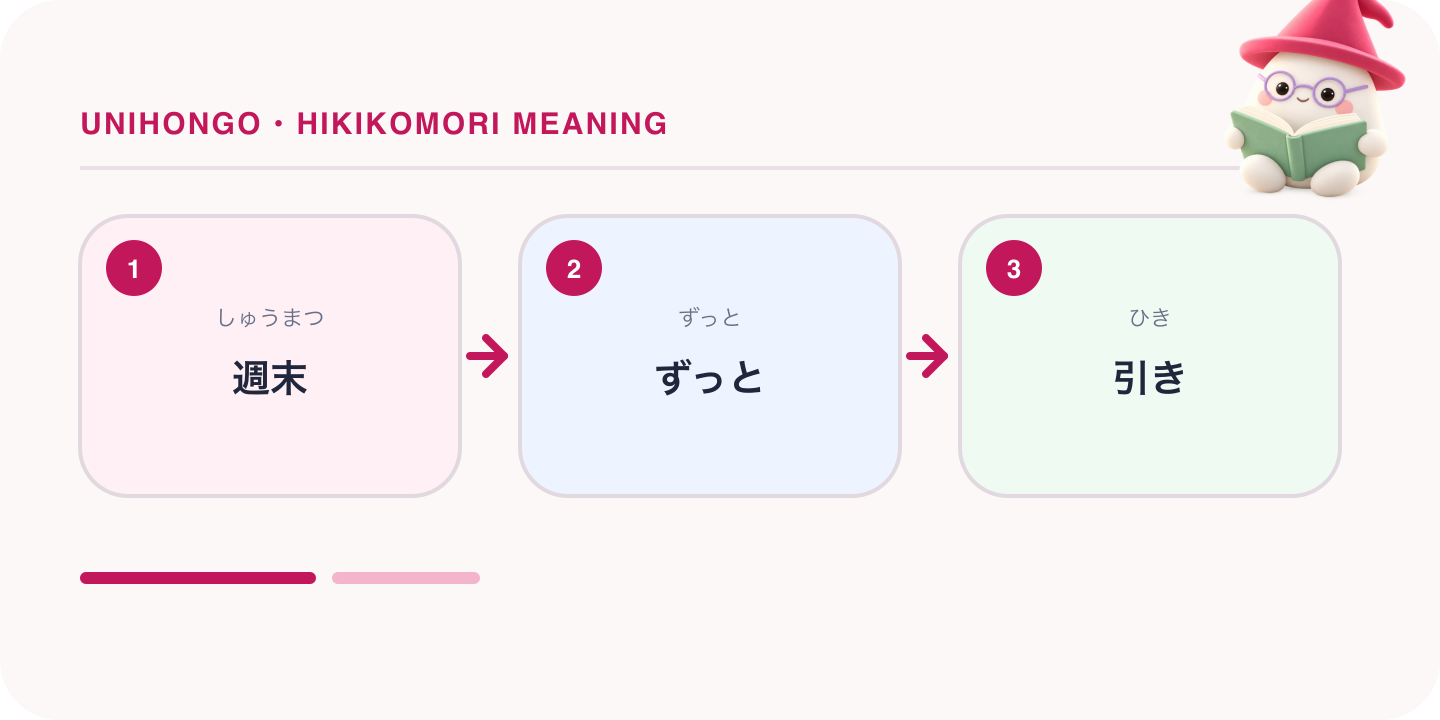
Hikikomoru, 引きこもる, joins hiku, to pull or draw, and komoru, to shut oneself in or stay inside. Komoru on its own is a useful word: you can komoru in a temple to pray, in a study to write, or at home with a cold. Adding hiki gives a sense of drawing back or retreating, so hikikomoru means to withdraw indoors. It is an ordinary verb and conjugates normally: hikikomorimasu, hikikomotte iru, hikikomotta.
The noun hikikomori is the stem of the verb, and Japanese nouns made this way can name either the act or the person. That is the source of the confusion for learners. Hikikomori as an act is just staying in; hikikomori as a person, or as a state lasting months or years, is the serious meaning. Context and grammar usually make the difference clear, and the next sections show how.
| Japanese | Romaji | Meaning |
|---|---|---|
| 週末はずっと家に引きこもっていました。 | Shūmatsu wa zutto ie ni hikikomotte imashita. | I was holed up at home all weekend. |
| 寒いので、こたつにこもっています。 | Samui node, kotatsu ni komotte imasu. | It's cold, so I'm holed up in the kotatsu. |
| 締め切り前は部屋にこもって書きます。 | Shimekiri mae wa heya ni komotte kakimasu. | Before a deadline I shut myself in my room and write. |
| 引きこもるは引くとこもるからできた言葉です。 | Hikikomoru wa hiku to komoru kara dekita kotoba desu. | Hikikomoru is a word made from hiku and komoru. |
| 風邪で三日間引きこもっていました。 | Kaze de mikkakan hikikomotte imashita. | I stayed shut in for three days with a cold. |
Hikikomori as a serious word
In its serious sense, hikikomori describes a person who has withdrawn from school, work and almost all social contact outside the family for an extended period, typically staying at home. Support services describe it as a state rather than a diagnosis: it can be connected with anxiety, depression, bullying, a failed job hunt or nothing that can be named, and it affects people of many ages. Families often describe years of worry and the person concerned often describes shame, which is why the subject is treated with care.
Because the word can attach to a person as a label, careful speakers prefer descriptions. Hikikomori no jōtai ni aru, to be in a state of withdrawal, or hikikomori-gimi, tending to withdraw, keep the focus on the situation, which can change. Support is described with shien, support; sōdan, consultation; and ibasho, a place where one belongs. In support contexts the word is often written in hiragana, ひきこもり, which softens its look.
| Japanese | Romaji | Meaning |
|---|---|---|
| 弟が数年前から引きこもりの状態にあります。 | Otōto ga sūnen mae kara hikikomori no jōtai ni arimasu. | My younger brother has been in a state of withdrawal for several years. |
| 本人も家族も悩んでいます。 | Honnin mo kazoku mo nayande imasu. | Both the person and the family are struggling. |
| 市の相談窓口に相談してみました。 | Shi no sōdan madoguchi ni sōdan shite mimashita. | We tried talking to the city consultation desk. |
| 少しずつ外に出られるようになりました。 | Sukoshi zutsu soto ni derareru yō ni narimashita. | Little by little they've become able to go outside. |
| 居場所があることが大事だと言われています。 | Ibasho ga aru koto ga daiji da to iwarete imasu. | Having a place where you belong is said to be important. |
Related words: futōkō, nīto and hikikomori-gachi
Several words sit near hikikomori and are easily confused with it. Futōkō, 不登校, is non-attendance at school: a child who does not go, for whatever reason, and who may be perfectly active at home. Nīto is a young person not in education, employment or training, a description of position, not of sociability. Hikikomori-gachi adds the suffix -gachi, tending to, and is the mild everyday form: someone who tends to stay in. Indoa-ha, the indoor type, is a cheerful label for people who prefer home to hiking.
| Word | Reading | Meaning |
|---|---|---|
| 引きこもる | hikikomoru | To withdraw indoors, to shut oneself in |
| 引きこもり | hikikomori | Social withdrawal; the person or the state |
| 引きこもりがち | hikikomori-gachi | Tending to stay in; mild, everyday |
| こもる | komoru | To stay shut inside a place |
| 不登校 | futōkō | Not attending school |
| ニート | nīto | Young person not in education, employment or training |
| インドア派 | indoa-ha | Indoor type; prefers staying home |
| 出不精 | debushō | Reluctance to go out; a homebody |
| 居場所 | ibasho | A place where one belongs |
| 支援 | shien | Support |
| 社会復帰 | shakai fukki | Returning to society or work |
| 自宅療養 | jitaku ryōyō | Recuperating at home |
Debushō, reluctance to go out, is worth learning because it is a light, self-deprecating word with none of the weight of hikikomori. Watashi wa debushō de, I'm a bit of a homebody, is a friendly way to explain why you skipped the trip.
The casual use: I stayed home all weekend
Japanese speakers use the verb hikikomoru lightly all the time. Shūmatsu wa hikikomotte ita, I hid away at home over the weekend, is a normal thing to say on Monday morning, and nobody hears it as a confession. The signals that mark the casual use are a short time frame, a light tone and a reason: it rained, it was cold, there was a series to watch. The -gachi form does the same job: saikin hikikomori-gachi de, I've been staying in a lot lately, is a mild comment on habits.
What tips the word into its serious meaning is the bare noun applied to a person, especially with desu or with a long time expression: ano hito wa hikikomori desu is not a joke. The rule of thumb is that the verb is light, the noun is heavy, and the suffix -gachi is somewhere gentle in between. If you are ever unsure, the plain expressions in the next section describe a weekend at home with no risk at all.
| Japanese | Romaji | Meaning |
|---|---|---|
| 雨だったので、週末は引きこもっていました。 | Ame datta node, shūmatsu wa hikikomotte imashita. | It rained, so I stayed holed up at home over the weekend. |
| 最近引きこもりがちで、運動不足です。 | Saikin hikikomori-gachi de, undō busoku desu. | I've been staying in a lot lately and not getting enough exercise. |
| 連休は家でドラマを見て引きこもります。 | Renkyū wa ie de dorama o mite hikikomorimasu. | Over the long weekend I'll hole up at home watching dramas. |
| たまには引きこもるのもいいよね。 | Tama ni wa hikikomoru no mo ii yo ne. | Hiding away at home once in a while is nice, isn't it? |
| 私は完全にインドア派です。 | Watashi wa kanzen ni indoa-ha desu. | I'm a total indoor type. |
Everyday expressions for staying in
Most of the time, you do not need hikikomoru at all. Japanese has a full set of relaxed, neutral ways to say that you stayed home or did not go out. Gorogoro suru, to laze about, is the friendliest; ie ni iru, to be at home, is the plainest; dekakenai, not to go out, states the fact.
- Zutto ie ni imashita: I was at home the whole time
- Dekakemasen deshita: I didn't go out
- Ie de gorogoro shite imashita: I lazed around at home
- Ie de yukkuri shimashita: I took it easy at home
- Doko ni mo ikimasen deshita: I didn't go anywhere
- Ie de nonbiri sugoshimashita: I spent it relaxing at home
- Ichinichijū neteimashita: I slept all day
- Kyō wa ie ni iru tsumori desu: I plan to stay home today
These are also the expressions for declining an invitation politely: kyō wa ie de yukkuri shitai node, I want to take it easy at home today, needs no further excuse. Adding mata kondo sasotte kudasai, please invite me again, keeps the friendship warm.
Talking about it sensitively
Sooner or later, someone will tell you about a family member or friend who has withdrawn. The most important thing is what you do not say. Avoid offering causes or quick solutions, because the family has almost certainly tried them, and avoid the bare noun as a label unless the speaker uses it first. The response people value is quiet acknowledgement: sō desu ka, taihen desu ne, I see, that must be hard, followed by an open question that lets them continue or stop.
If you are the one with something to share, the gentle framings in this guide help: jōtai, state, and -gimi, tending to, describe without labelling. If you want to mention your own past experience, hikikomotte ita jiki ga arimasu, there was a period when I withdrew, is a calm way to say it. The subject is discussed openly in Japan today, and speaking about it plainly and kindly is entirely acceptable.
| Japanese | Romaji | Meaning |
|---|---|---|
| そうですか。大変ですね。 | Sō desu ka. Taihen desu ne. | I see. That must be hard. |
| 最近はどう過ごしていますか。 | Saikin wa dō sugoshite imasu ka. | How are they spending their days lately? |
| 無理に外に出さないほうがいいと聞きました。 | Muri ni soto ni dasanai hō ga ii to kikimashita. | I've heard it's better not to force them to go out. |
| 何かできることがあれば言ってください。 | Nanika dekiru koto ga areba itte kudasai. | If there's anything I can do, please tell me. |
| 私にも引きこもっていた時期があります。 | Watashi ni mo hikikomotte ita jiki ga arimasu. | I also went through a period of withdrawing. |
| ゆっくりでいいと思います。 | Yukkuri de ii to omoimasu. | I think taking it slowly is fine. |
Mistakes learners make with hikikomori
The first mistake is using the noun as a casual joke about someone else. Kare wa hikikomori da ne, said about a colleague who skipped the party, is the kind of remark that makes a room go quiet, because the word may be true of someone the listeners know. Keep jokes to yourself and to the verb. The second mistake is the reverse: hearing hikikomotte ita from a friend and responding with concern when they only meant a lazy Sunday.
A third is treating hikikomori, nīto and futōkō as interchangeable; using the wrong one can misdescribe a person's situation in a way that stings. Finally, social withdrawal is not unique to Japan; what is Japanese is the word and the public conversation around it. Treat it as vocabulary for a real human situation, and it will serve you well.
| Japanese | Romaji | Meaning |
|---|---|---|
| 冗談でも人に引きこもりとは言わないほうがいいです。 | Jōdan de mo hito ni hikikomori to wa iwanai hō ga ii desu. | Even as a joke, it's better not to call someone a hikikomori. |
| ニートと引きこもりは別の意味です。 | Nīto to hikikomori wa betsu no imi desu. | Nīto and hikikomori have different meanings. |
| ただ家でゆっくりしていただけです。 | Tada ie de yukkuri shite ita dake desu. | I was just taking it easy at home, that's all. |
| 言葉の使い方に気をつけたいです。 | Kotoba no tsukaikata ni ki o tsuketai desu. | I want to be careful how I use the word. |