

Furītā: the word and where it came from
Furītā is a Japanese coinage of the 1980s, built from English free and the loanword arubaito, which itself came from the German word for work. Originally it had a slightly glamorous sound, describing young people who chose freedom over the company career ladder. Over the following decades the tone shifted, as more people found themselves in casual work without choosing it, and the word came to carry a note of insecurity as well.
Today furītā is understood everywhere and is mainly a self-description. A person who works several baito shifts might say ima wa furītā desu, and it is neither shocking nor shameful, though older relatives may worry aloud. Surveys define it in various ways; the everyday sense is simply someone living on non-regular work.
| Japanese | Romaji | Meaning |
|---|---|---|
| 今はフリーターをしています。 | Ima wa furītā o shite imasu. | Right now I'm working casual jobs. |
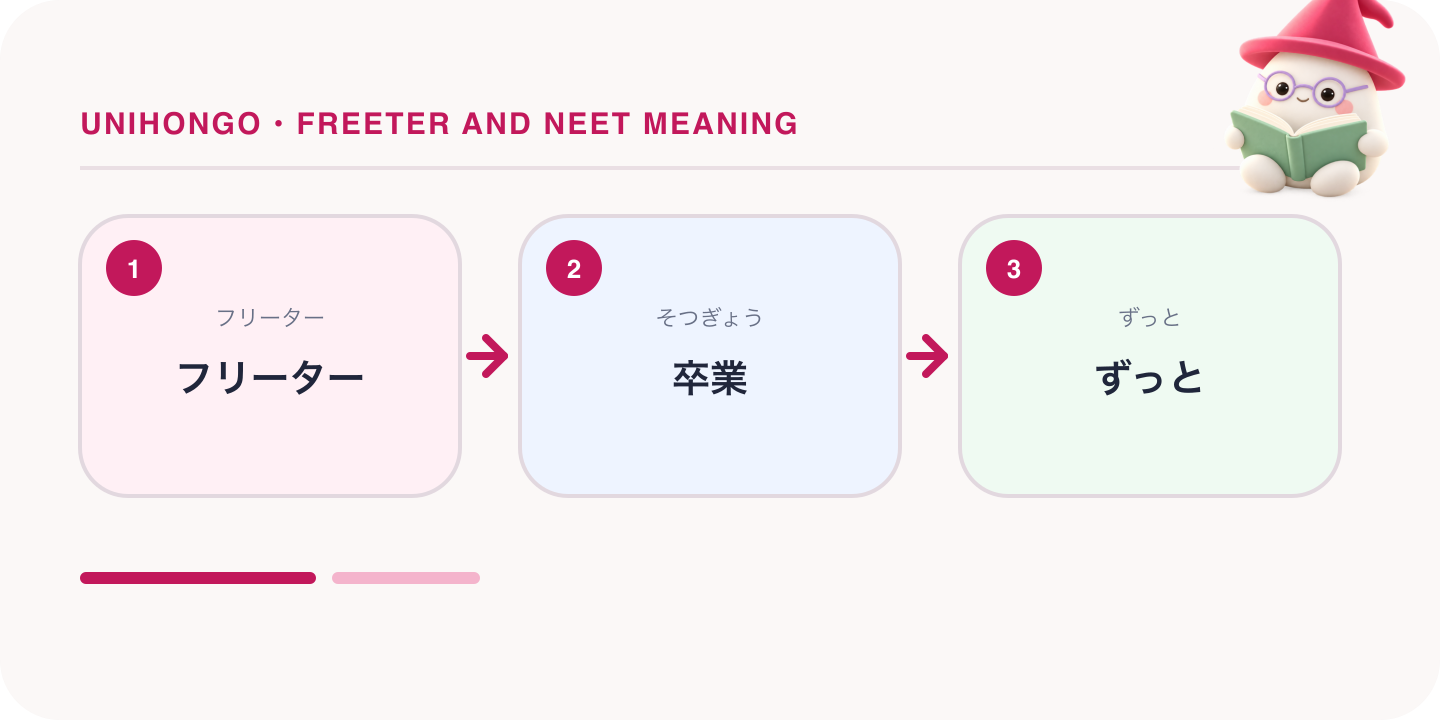
| 卒業してからずっとフリーターです。 | Sotsugyō shite kara zutto furītā desu. | I've been a freeter ever since graduating. |
| フリーターというのは、正社員ではない人のことです。 | Furītā to iu no wa, seishain de wa nai hito no koto desu. | A freeter is someone who is not a regular employee. |
| バイトを二つ掛け持ちしています。 | Baito o futatsu kakemochi shite imasu. | I'm juggling two part-time jobs. |
| いずれは正社員になりたいです。 | Izure wa seishain ni naritai desu. | Eventually I'd like to become a regular employee. |
Nīto: a policy term that became a label
Nīto is the English acronym NEET, not in education, employment or training, borrowed into Japanese in the early 2000s from British policy language. In Japan it came to refer mainly to young adults who are not working, not studying and not looking for work, and it quickly picked up a negative tone in the media. Unlike furītā, it is rarely a self-description; people are far more likely to say ima wa nani mo shite imasen, I am not doing anything at the moment, than to call themselves a nīto.
A related word is hikikomori, someone who withdraws from society and stays at home for a long period. The two overlap but are not the same: hikikomori describes social withdrawal, nīto describes employment status, and many people who are not working are neither withdrawn nor unwilling. Using either word about a real person in their hearing is unkind, and using them about someone's family member is a serious misstep.
| Japanese | Romaji | Meaning |
|---|---|---|
| ニートは英語のNEETから来た言葉です。 | Nīto wa eigo no NEET kara kita kotoba desu. | Nīto comes from the English word NEET. |
| 今は何もしていません。 | Ima wa nani mo shite imasen. | I'm not doing anything at the moment. |
| ちょっと休んでいる時期です。 | Chotto yasunde iru jiki desu. | I'm taking a bit of a break at the moment. |
| 弟は今、仕事を探しているところです。 | Otōto wa ima, shigoto o sagashite iru tokoro desu. | My younger brother is looking for work right now. |
| その言葉はあまり使わないほうがいいです。 | Sono kotoba wa amari tsukawanai hō ga ii desu. | It's better not to use that word much. |
The employment ladder in one table
Japanese divides workers into seiki, regular, and hiseiki, non-regular. The words below are the ones you meet on forms, in job adverts and in conversation. Legal definitions and benefits differ by contract and change over time, so treat the notes as everyday meanings and check the details with an employer or the local labour office when it matters.
| Word | Reading | Everyday meaning |
|---|---|---|
| 正社員 | seishain | Regular, permanent employee with no fixed end date |
| 契約社員 | keiyaku shain | Employee on a fixed-term contract, directly with the company |
| 派遣社員 | haken shain | Employee of a staffing agency, sent to work at a client company |
| パート | pāto | Part-time worker, typically an adult on set daytime hours |
| アルバイト | arubaito | Casual or part-time job, typically students; shortened to baito |
| フリーター | furītā | Person living on part-time or casual work instead of a regular job |
| ニート | nīto | Young person not in work, education or training; usually said of others |
| 自営業 | jieigyō | Self-employed, running one's own business |
| フリーランス | furīransu | Freelancer; common in creative and IT work |
| 無職 | mushoku | Without a job; correct on forms, blunt in speech |
| 求職中 | kyūshokuchū | Currently looking for work |
| 専業主婦 | sengyō shufu | Full-time homemaker (shufu for a wife, shufu written 主夫 for a husband) |
Seishain, keiyaku shain and haken shain all contain shain, company employee, and differ in who employs you and for how long. Pāto and arubaito are both hourly, non-regular work, and the difference is mostly the image of who does them. Furītā and nīto are not contract types at all; they are labels for a life situation.
Filling in the employment box on a form
Japanese forms ask for shokugyō, occupation, and sometimes for koyō keitai, employment type. The occupation box usually offers set choices: kaishain, company employee; kōmuin, public servant; jieigyō, self-employed; gakusei, student; pāto arubaito; mushoku, no job; and sono ta, other. Furītā is not usually an option; a furītā ticks pāto arubaito. Someone not working ticks mushoku, which is neutral on paper even though it sounds harsh aloud.
If the form asks for koyō keitai, choose from seishain, keiyaku shain, haken shain, pāto or arubaito as your contract states. Rental applications and credit forms may also ask for kinmusaki, the employer, and kinzoku nensū, years with the employer. Haken workers write the agency as employer, not the client company, unless the form says otherwise.
| Japanese | Romaji | Meaning |
|---|---|---|
| 職業の欄には何と書けばいいですか。 | Shokugyō no ran ni wa nan to kakeba ii desu ka. | What should I write in the occupation box? |
| 雇用形態は契約社員です。 | Koyō keitai wa keiyaku shain desu. | My employment type is fixed-term contract employee. |
| 勤務先は派遣会社の名前でいいですか。 | Kinmusaki wa hakengaisha no namae de ii desu ka. | Is the agency's name fine for the employer field? |
| アルバイトの場合はどこにチェックしますか。 | Arubaito no baai wa doko ni chekku shimasu ka. | Where do I tick if I work part-time? |
| 今は無職ですが、来月から働きます。 | Ima wa mushoku desu ga, raigetsu kara hatarakimasu. | I'm not employed now, but I start work next month. |
Answering o-shigoto wa in conversation
The polite question is o-shigoto wa nani o sarete imasu ka, or simply o-shigoto wa, and the answer normally names the field, the employer type or the role rather than the contract. Kaisha-in desu, I am a company employee, covers seishain, keiyaku and haken alike, which is convenient. If you want to be precise, add the contract type: haken de jimu o shite imasu, I do office work through an agency.
For non-regular work, the natural answers are baito o shite imasu, or the specific place, konbini de hataraite imasu, I work at a convenience store. Furītā desu is fine among people your own age. With an older person or in a first meeting with a client's family, most Japanese speakers prefer to describe what they do rather than reach for a label.
If you are not working, you have soft options: ima wa shigoto o sagashite imasu, I am looking for work; ima wa ie no koto o shite imasu, I am looking after things at home; or chotto yasunde imasu, I am taking a break.
| Japanese | Romaji | Meaning |
|---|---|---|
| お仕事は何をされていますか。 | O-shigoto wa nani o sarete imasu ka. | What do you do for work? |
| 会社員です。メーカーで働いています。 | Kaishain desu. Mēkā de hataraite imasu. | I'm a company employee. I work for a manufacturer. |
| 派遣で事務の仕事をしています。 | Haken de jimu no shigoto o shite imasu. | I do office work through a staffing agency. |
| カフェでバイトをしながら、勉強しています。 | Kafe de baito o shinagara, benkyō shite imasu. | I'm studying while working part-time at a café. |
| 今は仕事を探しているところです。 | Ima wa shigoto o sagashite iru tokoro desu. | I'm looking for work at the moment. |
| フリーランスで翻訳をしています。 | Furīransu de hon'yaku o shite imasu. | I work freelance as a translator. |
The social tone of each word and how to be respectful
Japanese employment words carry status in a way learners can miss. Seishain still sounds like security and adulthood to many people, and parents may ask when a child in casual work will settle into it. Haken and keiyaku are neutral descriptions of common arrangements, but some people feel they mark a lower rung. Furītā is accepted from the speaker and slightly pointed from a listener. Nīto and mushoku are close to insults when said about someone rather than by them.
Respectful conversation follows a simple rule: let the other person choose their own words, and echo what they said. If they say baito, say baito. If they say iroiro, various things, do not dig. Avoid the question shūshoku wa, have you found a proper job, which implies that what they do now does not count, and avoid comparing anyone with a sibling or classmate who became a seishain.
- Say furītā about yourself freely, but avoid saying it about others
- Never call someone nīto or mushoku to their face or in front of their family
- Use sarete imasu when asking, and accept vague answers as complete
- Do not ask when someone will get a proper job, even kindly
- Talk about work content, kaisha no naiyō, rather than contract type
- When someone is between jobs, ask about plans only if they raise the subject
If you do want to know more, because you are helping a friend look for work or renting them a room, explain why: keiyaku no shurui o kiite mo ii desu ka, may I ask about the type of contract. Framing the question with a reason removes the sting.
Talking about work changes and the future
Changing status has its own vocabulary. Tenshoku is changing jobs, shūshoku is getting a job after school or a gap, and taishoku is leaving a job. Seishain ni naru, to become a regular employee, is the goal many furītā name, and the reverse, seishain o yameru, is increasingly common as people move into freelance work.
| Japanese | Romaji | Meaning |
|---|---|---|
| 来年、転職しようと思っています。 | Rainen, tenshoku shiyō to omotte imasu. | I'm thinking of changing jobs next year. |
| 契約社員から正社員になりました。 | Keiyaku shain kara seishain ni narimashita. | I went from a contract employee to a regular employee. |
| 会社を辞めてフリーランスになりました。 | Kaisha o yamete furīransu ni narimashita. | I left the company and went freelance. |
| 今の働き方が自分に合っています。 | Ima no hatarakikata ga jibun ni atte imasu. | My current way of working suits me. |
| 就職活動は大変ですか。 | Shūshoku katsudō wa taihen desu ka. | Is the job hunt tough? |
When the conversation goes wrong
The most common slip is asking a blunt question and getting a short answer and a change of subject. Do not press; a quick sō desu ka and a new topic repairs it. If you have used nīto or mushoku about someone and see a reaction, apologise for the word rather than for the fact: iikata ga yokunakatta desu, that was not a good way to put it.
If you are on the receiving end of an awkward question, you do not owe an explanation. A cheerful ima wa iroiro yatte imasu and a question back about their work keeps the conversation friendly and moves it on.
| Japanese | Romaji | Meaning |
|---|---|---|
| すみません、言い方がよくなかったです。 | Sumimasen, iikata ga yokunakatta desu. | Sorry, that wasn't a good way to put it. |
| 今はいろいろやっています。そちらは? | Ima wa iroiro yatte imasu. Sochira wa? | I'm doing various things right now. How about you? |
| そうですか。無理に聞いてすみません。 | Sō desu ka. Muri ni kiite sumimasen. | I see. Sorry for pressing. |
| 仕事の話はまた今度にしましょう。 | Shigoto no hanashi wa mata kondo ni shimashō. | Let's leave work talk for another time. |