

The word parts: ka, rō and shi
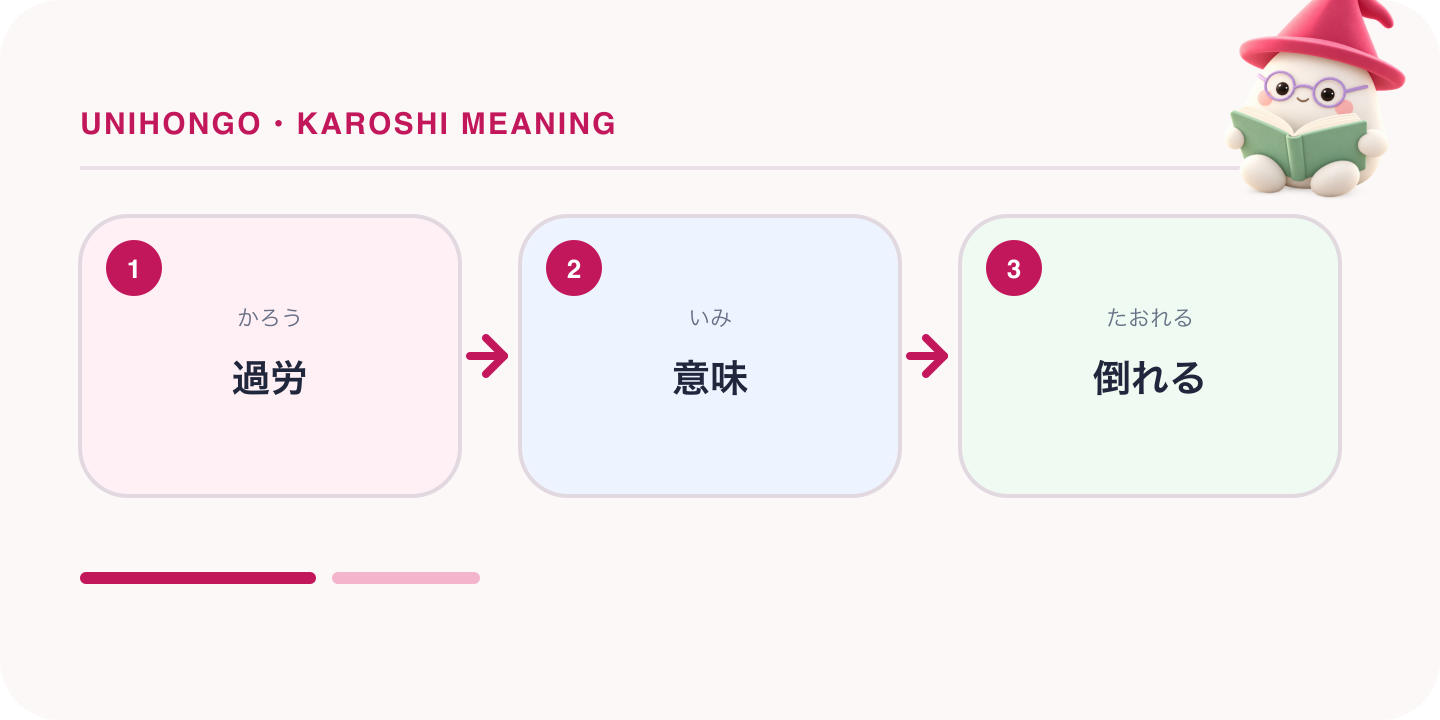
Karōshi is three kanji. Ka, 過, means to exceed or to go too far, and appears in words such as kado, excessive, and kashoku, overeating. Rō, 労, means labour, the same character as in rōdō, work, and rōdōsha, worker. Together they form karō, overwork, a word that stands on its own: karō de taoreru means to collapse from overwork. Shi, 死, is death. The whole compound therefore reads very plainly, death from excessive labour, and Japanese speakers hear it as literally as that.
The word spread when doctors and lawyers began to link sudden deaths of working-age employees to extreme hours, and it is now a recognised category in the compensation system, with a related term, karō jisatsu, for suicide linked to overwork. Because of this, karōshi is not used loosely or as a joke in the way English speakers say this job is killing me. For exaggeration, people use shinu hodo isogashii, busy enough to die, which is casual and safe.
| Japanese | Romaji | Meaning |
|---|---|---|
| 過労死は過労による死という意味です。 | Karōshi wa karō ni yoru shi to iu imi desu. | Karōshi means death caused by overwork. |
| 過労で倒れる人が出てはいけません。 | Karō de taoreru hito ga dete wa ikemasen. | We must not have anyone collapse from overwork. |
| 過労死は労災として認められることがあります。 | Karōshi wa rōsai to shite mitomerareru koto ga arimasu. | Karōshi can be recognised as a work-related injury. |
| 今週は死ぬほど忙しいです。 | Konshū wa shinu hodo isogashii desu. | This week I'm busy enough to die. (casual exaggeration) |
| 過労死という言葉は冗談では使いません。 | Karōshi to iu kotoba wa jōdan de wa tsukaimasen. | The word karōshi is not used as a joke. |
Overtime words: zangyō, sābisu zangyō and teiji
Zangyō, 残業, is overtime, literally remaining work. It is the most common workplace word in this whole area: zangyō suru, to work overtime; zangyō ga ōi, there is a lot of overtime; zangyō-dai, overtime pay. Teiji, 定時, is the fixed finishing time, and teiji de kaeru, going home at the fixed time, is the phrase for leaving on time. Many companies also hold a weekly nō zangyō dē, a no-overtime day.
Sābisu zangyō, service overtime, is unpaid overtime: hours worked but not recorded or paid. The word sābisu here is bitter, as in a free extra thrown in. Whether it is legal depends on the contract and the situation, and it is one of the practices most associated with the word burakku. Related words are mochikaeri zangyō, taking work home, and zangyō jikan no jōgen, the cap on overtime hours, which appears constantly in company notices.
| Japanese | Romaji | Meaning |
|---|---|---|
| 今日は残業しないで定時で帰ります。 | Kyō wa zangyō shinai de teiji de kaerimasu. | Today I'll go home on time without doing overtime. |
| 先月の残業は四十時間を超えました。 | Sengetsu no zangyō wa yonjū-jikan o koemashita. | Last month's overtime went over forty hours. |
| サービス残業はしないようにしています。 | Sābisu zangyō wa shinai yō ni shite imasu. | I make sure not to do unpaid overtime. |
| 水曜日はノー残業デーです。 | Suiyōbi wa nō zangyō dē desu. | Wednesday is no-overtime day. |
| 残業代はきちんと出ますか。 | Zangyō-dai wa kichinto demasu ka. | Is overtime pay properly paid? |
| 持ち帰り残業は禁止されています。 | Mochikaeri zangyō wa kinshi sarete imasu. | Taking work home is prohibited. |
Burakku kigyō, hatarakikata kaikaku and the reform vocabulary
Burakku kigyō, black company, is the everyday label for employers that overwork and mistreat staff: unpaid overtime, harassment, unrealistic quotas, pressure not to use leave. The opposite, howaito kigyō, praises decent conditions. Both are informal judgements, so treat them as opinion rather than fact when you hear them about a specific employer.
Hatarakikata kaikaku, working style reform, is the name of a government policy programme and of the wider cultural shift around it: caps on overtime, encouragement to take paid leave, flexible hours and remote work. In offices the phrase now describes any change to hours or workflow, and hatarakikata kaikaku no ikkan de, as part of working style reform, is how a manager introduces a new rule. Related words are furekkusu, flexitime; zaitaku kinmu, working from home; and wāku raifu baransu. The table collects the vocabulary in one place.
| Word | Reading | Meaning |
|---|---|---|
| 過労死 | karōshi | Death from overwork |
| 過労 | karō | Overwork, excessive labour |
| 残業 | zangyō | Overtime |
| サービス残業 | sābisu zangyō | Unpaid overtime |
| 定時 | teiji | Fixed finishing time |
| 有給休暇 | yūkyū kyūka | Paid leave, often shortened to yūkyū |
| ブラック企業 | burakku kigyō | Exploitative employer, black company |
| 働き方改革 | hatarakikata kaikaku | Working style reform |
| パワハラ | pawahara | Power harassment by a superior |
| 労働基準法 | rōdō kijunhō | Labour Standards Act |
| 労働組合 | rōdō kumiai | Labour union |
| 有休消化 | yūkyū shōka | Using up one's paid leave |
Legal limits on overtime, the rules for paid leave and what counts as harassment are set by law and by each company's rules, and they change. If a question matters to you, check your employment contract, your company's shūgyō kisoku, work regulations, or the labour standards office, rōdō kijun kantokusho, rather than a colleague's memory.
Yūkyū: taking paid leave without guilt
Yūkyū kyūka, paid leave, is usually shortened to yūkyū, and yūkyū o toru is to take it. The culture of actually using it varies enormously from one workplace to another, and many people describe feeling awkward about asking. That is exactly why the phrasing is worth learning: a smooth, standard request is easy to say yes to.
The standard form gives the date, states that you would like to take leave, and shows that you have thought about coverage. Managers rarely refuse a request that arrives early and comes with a plan. Note the difference between yūkyū and kekkin, an absence without leave, and between yūkyū and daikyū, a substitute day off for working on a holiday. If you are ill, you say byōketsu, sick absence, though many companies simply use yūkyū for that too.
| Japanese | Romaji | Meaning |
|---|---|---|
| 来週の金曜日に有給を取りたいのですが。 | Raishū no kin'yōbi ni yūkyū o toritai no desu ga. | I'd like to take paid leave next Friday. |
| その日の対応は山田さんにお願いしてあります。 | Sono hi no taiō wa Yamada-san ni onegai shite arimasu. | I've asked Yamada to cover that day. |
| 有給の残りは何日ありますか。 | Yūkyū no nokori wa nan-nichi arimasu ka. | How many days of paid leave do I have left? |
| 有休消化のために一週間休みます。 | Yūkyū shōka no tame ni isshūkan yasumimasu. | I'm taking a week off to use up my paid leave. |
| 体調が悪いので、今日は病欠にさせてください。 | Taichō ga warui node, kyō wa byōketsu ni sasete kudasai. | I'm unwell, so please let me take today as sick leave. |
Telling a manager you are overloaded, politely
The hardest conversation is the one where you say you have too much work. Said badly, it sounds like a complaint; said well, it sounds like professionalism. The key move is to turn a feeling into a scheduling problem: instead of isogashisugimasu, I am too busy, present the tasks and deadlines and ask the manager to decide the priority. That way the manager is helping you solve a problem, not defending an assignment.
Openers matter. Sōdan ga aru n desu ga, I have something to consult you about, signals a serious but calm conversation. State the facts, use the softener chotto before the difficulty, and end with a question that hands the decision to the manager: dochira o yūsen subeki deshō ka. If everything is declared urgent, kono mama da to hinshitsu ga sagaru osore ga arimasu, as it stands, quality may suffer, gives a company-minded reason rather than a personal one.
| Japanese | Romaji | Meaning |
|---|---|---|
| 少しご相談したいことがあるのですが、お時間いいですか。 | Sukoshi go-sōdan shitai koto ga aru no desu ga, o-jikan ii desu ka. | There's something I'd like to consult you about; do you have a moment? |
| 今、A案件とB案件の締め切りが同じ週に重なっています。 | Ima, Ē anken to Bī anken no shimekiri ga onaji shū ni kasanatte imasu. | Right now the deadlines for project A and project B fall in the same week. |
| どちらを優先すべきでしょうか。 | Dochira o yūsen subeki deshō ka. | Which should I prioritise? |
| このままだと品質が下がる恐れがあります。 | Kono mama da to hinshitsu ga sagaru osore ga arimasu. | As things stand, there's a risk that quality will drop. |
| Bの締め切りを来週に延ばしていただけないでしょうか。 | Bī no shimekiri o raishū ni nobashite itadakenai deshō ka. | Could the deadline for B be pushed to next week? |
| 最近残業が続いていて、少し体力的に厳しいです。 | Saikin zangyō ga tsuzuite ite, sukoshi tairyokuteki ni kibishii desu. | The overtime has been continuous lately and it's getting physically hard. |
Phrases for setting limits with colleagues
Limits with colleagues are set in smaller moments: leaving on time while others stay, declining a task that lands at six o'clock, or saying no to a third nomikai in a week. The tone is friendly and matter-of-fact, and a short forward-looking phrase softens each one.
- O-saki ni shitsurei shimasu: Excuse me for leaving before you (the standard exit)
- Kyō wa teiji de agarimasu: I'm finishing at the normal time today
- Sore wa ashita no asa ichi de taiō shimasu: I'll deal with that first thing tomorrow
- Ima wa te ga ippai na node, raishū de mo ii desu ka: I'm fully booked now; is next week all right?
- Kyō wa yōji ga aru node, nomikai wa enryo shimasu: I have something on today, so I'll pass on the drinks
- Shūmatsu wa mēru o mimasen node, getsuyōbi ni henji shimasu: I don't check email at the weekend, so I'll reply on Monday
- Muri no nai hani de yarasete kudasai: Please let me do it within reasonable limits
Consistency is what makes these phrases work. A colleague who leaves at teiji every day with a cheerful o-saki ni is quickly accepted; someone who leaves early once with a long apology invites questions.
When the situation is serious
Sometimes a workload conversation is not enough. If you are regularly working far beyond the fixed hours, being pressured to work unpaid, or being shouted at, that is the territory of pawahara, power harassment, and of the labour law rather than of politeness. Larger companies have a sōdan madoguchi, a consultation desk, and there are public consultation services for workers. Keep records: dates, hours, what was said.
It also helps to know the words for stepping back. Kyūshoku is taking leave of absence, often with a doctor's note, shindansho. Taishoku is resignation, and tenshoku is changing jobs, a normal step. None of these are failures. The word karōshi exists because people kept going when they should have stopped; use the vocabulary in this guide early, calmly and in your own interest.
| Japanese | Romaji | Meaning |
|---|---|---|
| 上司からのパワハラで悩んでいます。 | Jōshi kara no pawahara de nayande imasu. | I'm struggling with harassment from my boss. |
| 相談窓口はどこですか。 | Sōdan madoguchi wa doko desu ka. | Where is the consultation desk? |
| 医師の診断書を提出して、休職したいです。 | Ishi no shindansho o teishutsu shite, kyūshoku shitai desu. | I'd like to submit a doctor's note and take leave of absence. |
| 残業時間の記録を取っています。 | Zangyō jikan no kiroku o totte imasu. | I'm keeping a record of my overtime hours. |
| 転職を考え始めました。 | Tenshoku o kangaehajimemashita. | I've started to think about changing jobs. |