

What gaijin actually means
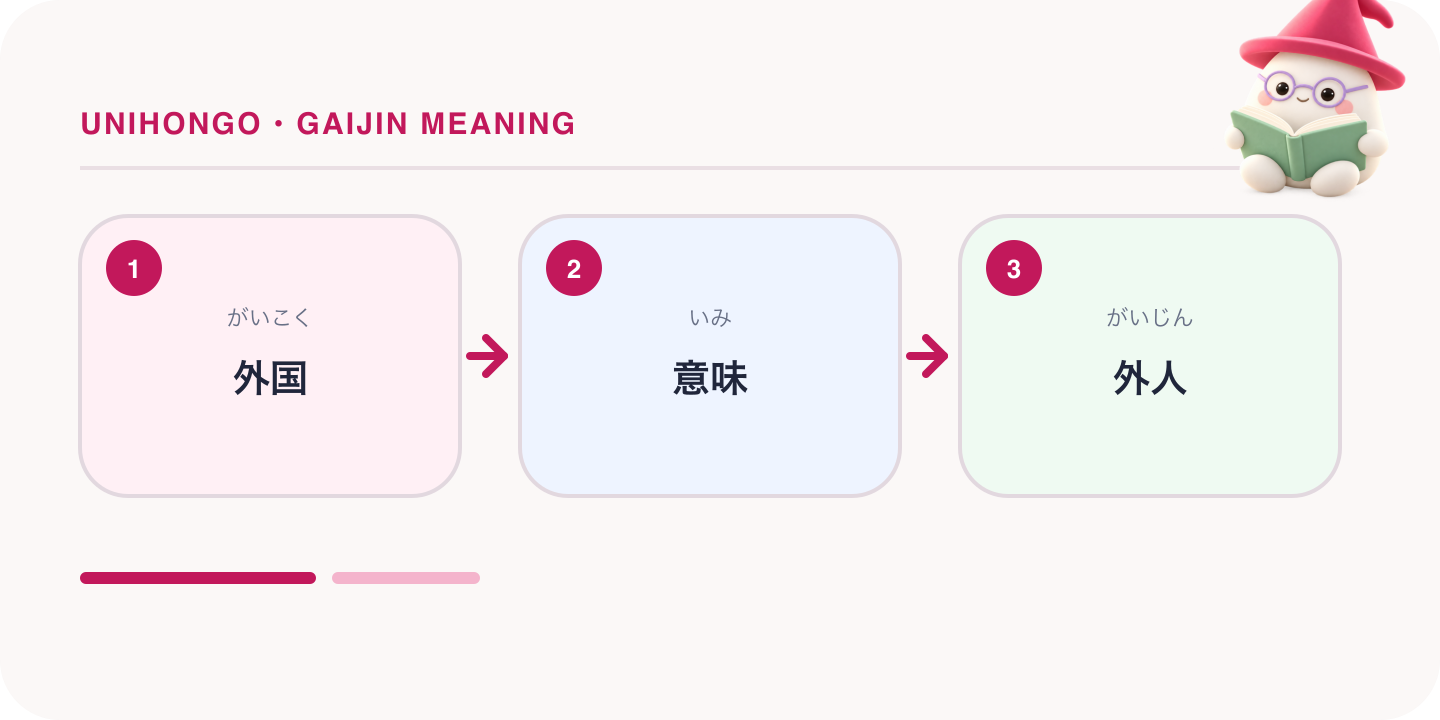
The full word is gaikokujin, written 外国人. It is built from three kanji: gai, outside; koku, country; and jin, person. Put together, it means a person from a foreign country, and it is the word used on official forms, in the news and in polite conversation. Gaijin, written 外人, is the same word with the middle character removed. Japanese shortens long words all the time, so on its own the clipping is not unusual.
The trouble is what the shortened version looks like. Without koku, the word reads as outside person, and that is how many non-Japanese residents experience it: not as someone from another country, but as someone who does not belong. Most Japanese speakers are not thinking of this when they say it, but it explains why the word can land harder than it is meant.
In everyday use, gaijin is casual: friends use it among themselves and children say it because it is short. On a form, in a business email or from a receptionist, you will almost always hear gaikokujin or gaikoku no kata instead. The word tells you about the register, not necessarily about the speaker's feelings.
| Japanese | Romaji | Meaning |
|---|---|---|
| 外国人は外国から来た人という意味です。 | Gaikokujin wa gaikoku kara kita hito to iu imi desu. | Gaikokujin means a person who came from a foreign country. |
| 外人は外国人を短くした言い方です。 | Gaijin wa gaikokujin o mijikaku shita iikata desu. | Gaijin is a shortened way of saying gaikokujin. |
| ちょっとくだけた言い方ですね。 | Chotto kudaketa iikata desu ne. | It's a rather casual way of saying it. |
| 書類には外国人と書いてあります。 | Shorui ni wa gaikokujin to kaite arimasu. | The documents say gaikokujin. |
| 外国人の友達がたくさんいます。 | Gaikokujin no tomodachi ga takusan imasu. | I have a lot of foreign friends. |
Gaijin, gaikokujin and gaikoku no kata compared
Think of the three words as steps on a politeness ladder. Gaijin is at the bottom: short, informal and sometimes blunt. Gaikokujin is the middle: neutral, correct everywhere, your default. Gaikoku no kata is at the top: it uses kata, the respectful word for person, and it is what staff say about customers and what you hear in polite announcements.
You will also meet compound forms such as gaikokujin kankōkyaku, foreign tourists, and gaikokujin jūmin, foreign residents. A gentler recent phrase is gaikoku ni rūtsu no aru hito, people with roots abroad, used in schools to include children born in Japan to a foreign parent. Kaigai no kata, people from overseas, is another soft option in service settings.
| Japanese | Romaji | Meaning |
|---|---|---|
| 外国の方はこちらにお並びください。 | Gaikoku no kata wa kochira ni o-narabi kudasai. | Visitors from abroad, please queue here. |
| 海外の方も多く来られます。 | Kaigai no kata mo ōku koraremasu. | Many people from overseas come here too. |
| 外国人観光客が増えましたね。 | Gaikokujin kankōkyaku ga fuemashita ne. | The number of foreign tourists has grown, hasn't it? |
| 外国にルーツのある子どもたちです。 | Gaikoku ni rūtsu no aru kodomotachi desu. | They are children with roots abroad. |
| 外国人の同僚と一緒に働いています。 | Gaikokujin no dōryō to issho ni hataraite imasu. | I work together with foreign colleagues. |
Why some people find gaijin rude
Whether gaijin feels rude depends less on the dictionary and more on the moment. The same word can be warm from a friend and cold when a stranger says it about you to a third person as though you were not there. Long-term residents often describe a particular sting when they have lived in Japan for years, speak the language well and are still described with a word that means, in effect, outsider.
Context also matters. Being spoken about in the third person while standing right there, hearing the word shouted by a group of teenagers, or being called gaijin when you have just introduced yourself by name, are the situations people remember. None of this means the word is always hostile, but it explains why many residents ask their friends to use gaikokujin instead.
| Japanese | Romaji | Meaning |
|---|---|---|
| 外人という言葉が気になる人もいます。 | Gaijin to iu kotoba ga ki ni naru hito mo imasu. | Some people are bothered by the word gaijin. |
| 悪気はないと思いますよ。 | Warugi wa nai to omoimasu yo. | I don't think they meant anything by it. |
| 言い方によっては失礼に聞こえます。 | Iikata ni yotte wa shitsurei ni kikoemasu. | Depending on how it's said, it can sound rude. |
| 本人の前で言うのはちょっと。 | Honnin no mae de iu no wa chotto. | Saying it in front of the person is a bit much. |
| 名前で呼んでもらえるとうれしいです。 | Namae de yonde moraeru to ureshii desu. | I'd be happy if you called me by my name. |
How to talk about yourself as a foreigner
The easiest way to avoid the whole question is to introduce yourself by nationality. Country plus jin gives you the word: Amerika-jin, Furansu-jin, Betonamu-jin. The pattern kuni kara kimashita, I came from a country, answers the question people actually want to ask, and Nihon ni sunde imasu with a length of time shows that you belong here.
With officials you will sometimes need the neutral word for yourself. Watashi wa gaikokujin na node, because I am a foreigner, is a normal way to begin a question about paperwork or a bank account; it simply tells the clerk which procedure applies. Gaikoku shusshin desu, I am originally from abroad, is softer and works well if you have Japanese nationality or a mixed background.
Two more words often come up. Hāfu, from the English half, is the common everyday word for a person with one Japanese and one non-Japanese parent. Many people use it about themselves without any problem; others prefer daburu, double, or mikkusu, mixed, and some dislike being labelled at all. Follow the person's own choice.
| Japanese | Romaji | Meaning |
|---|---|---|
| カナダから来ました。 | Kanada kara kimashita. | I'm from Canada. |
| 日本に住んで三年になります。 | Nihon ni sunde san-nen ni narimasu. | I've been living in Japan for three years. |
| 外国人なので、手続きについて教えてください。 | Gaikokujin na node, tetsuzuki ni tsuite oshiete kudasai. | As I'm a foreigner, could you explain the procedure? |
| 外国出身ですが、国籍は日本です。 | Gaikoku shusshin desu ga, kokuseki wa Nihon desu. | I'm originally from abroad, but my nationality is Japanese. |
| 父が日本人で、母がブラジル人です。 | Chichi ga Nihonjin de, haha ga Burajiru-jin desu. | My father is Japanese and my mother is Brazilian. |
| 日本語はまだ勉強中です。 | Nihongo wa mada benkyōchū desu. | My Japanese is still a work in progress. |
Related words: gaikoku, kaigai, zairyū kādo and more
Gai, outside, gives you gaikoku, foreign country, and kaigai, overseas, which literally means beyond the sea. Kaigai is the everyday word for abroad, as in kaigai ryokō, overseas travel. Gaikoku is slightly more formal and appears in gaikokugo, foreign language. The table gathers the words you will meet on forms, in shops and in conversation.
| Word | Reading | Meaning |
|---|---|---|
| 外国人 | gaikokujin | Foreigner; the neutral word |
| 外人 | gaijin | Foreigner; casual shortening, sometimes felt as rude |
| 外国の方 | gaikoku no kata | Person from abroad; polite |
| 外国 | gaikoku | Foreign country |
| 海外 | kaigai | Overseas, abroad |
| 外国語 | gaikokugo | Foreign language |
| 在留カード | zairyū kādo | Residence card for mid- to long-term residents |
| 在留資格 | zairyū shikaku | Status of residence, often called a visa |
| 国籍 | kokuseki | Nationality |
| ハーフ | hāfu | Person with one Japanese and one non-Japanese parent |
| 帰国子女 | kikokushijo | Japanese child raised abroad who returned |
| 日系人 | nikkeijin | Person of Japanese descent living abroad |
| 留学生 | ryūgakusei | International student |
The zairyū kādo, residence card, is what a police officer or clerk means when they ask for your card. Who needs one depends on your status, so check the Immigration Services Agency's own guidance. The older nickname gaijin kādo is still heard casually but is not the name on the document.
When someone calls you gaijin
Decide first whether to respond to the word or to the meaning behind it. Most of the time the meaning is curiosity: where are you from, do you speak Japanese. Answering that directly, with a smile and your nationality, usually dissolves the moment. A child who points and says gaijin is best met with konnichiwa; a shopkeeper who says gaijin-san can be met with your name.
If the person is someone you will see again and the word grates, ask for a change without making a scene: gaikokujin no hō ga ureshii desu, I'd prefer gaikokujin. Among friends, a joking correction works: gaijin ja nakute, gaikokujin ne, said with a grin. If someone refuses you a service because you are foreign, that is a different matter from a word; ask calmly for the reason and, if needed, speak to the manager.
| Japanese | Romaji | Meaning |
|---|---|---|
| はい、イギリスから来ました。 | Hai, Igirisu kara kimashita. | Yes, I'm from Britain. |
| 外国人のほうがうれしいです。 | Gaikokujin no hō ga ureshii desu. | I'd prefer gaikokujin. |
| 外人じゃなくて、外国人ね。 | Gaijin ja nakute, gaikokujin ne. | Not gaijin, gaikokujin, right? (joking, among friends) |
| 日本語、大丈夫ですよ。 | Nihongo, daijōbu desu yo. | Japanese is fine, don't worry. |
| 理由を教えていただけますか。 | Riyū o oshiete itadakemasu ka. | Could you tell me the reason? |
Talking about foreigners politely in Japanese
You will also need to speak about other foreign people: colleagues, your partner's family, tourists in your town. The rule is the same as for yourself. Use gaikokujin in ordinary conversation, gaikoku no kata when being polite or speaking in front of the person, and a nationality whenever you know it. A name is always better than a category.
A few habits make you sound considerate. Avoid guessing nationality from appearance; ask dochira no go-shusshin desu ka if it matters. Do not switch to English unasked with someone who has addressed you in Japanese, and avoid describing a person's Japanese as surprising: Nihongo o-jōzu desu ne is meant kindly but many residents hear it as a reminder that they were expected to be bad at it.
- Say gaikokujin, not gaijin, when speaking about others
- Use gaikoku no kata in front of the person or in formal settings
- Prefer a nationality or a name to the label foreigner
- Ask where someone is from rather than guessing
- Keep speaking Japanese to someone who addresses you in Japanese
- Skip comments on how good or surprising someone's Japanese is
Common mistakes with gaijin and gaikokujin
The most frequent mistake is learners using gaijin themselves because they have heard it so often. Japanese listeners may assume you do not know the word is informal, or may feel uncomfortable using a word you have just used. Stick to gaikokujin and let others make their own choices.
A second mistake is treating gaijin as though it referred only to Western-looking people. Gaikokujin covers everyone from outside Japan, including people from China, Korea, the Philippines, Brazil and Nepal, who make up a large share of the foreign residents you will meet.
Finally, do not tense up every time you hear the word. A relaxed reply in Japanese does more for how you are seen than any objection.
| Japanese | Romaji | Meaning |
|---|---|---|
| 外国人という言葉を使うようにしています。 | Gaikokujin to iu kotoba o tsukau yō ni shite imasu. | I make a point of using the word gaikokujin. |
| 外国人と言っても、いろいろな国の人がいます。 | Gaikokujin to itte mo, iroiro na kuni no hito ga imasu. | Even if you say foreigners, there are people from many countries. |
| どちらのご出身ですか。 | Dochira no go-shusshin desu ka. | Where are you from? |
| 失礼しました。 | Shitsurei shimashita. | Sorry, that was rude of me. |