
Why a recording is harder than a conversation
In conversation the other person carries half the load. They confirm, they prompt, they finish your sentence when you stall, and their aizuchi tells you every two seconds that you are being followed. A recording removes all of it. You speak into silence, with a timer running, and any hesitation stays in the message permanently.
That is precisely why it is worth practising deliberately. The skill it trains, delivering a planned sequence of sentences without support, is the same skill you need for a self-introduction, a presentation opening and an answer in a job interview. Voicemail is a compact, high-pressure version of all three.
The four parts, in order
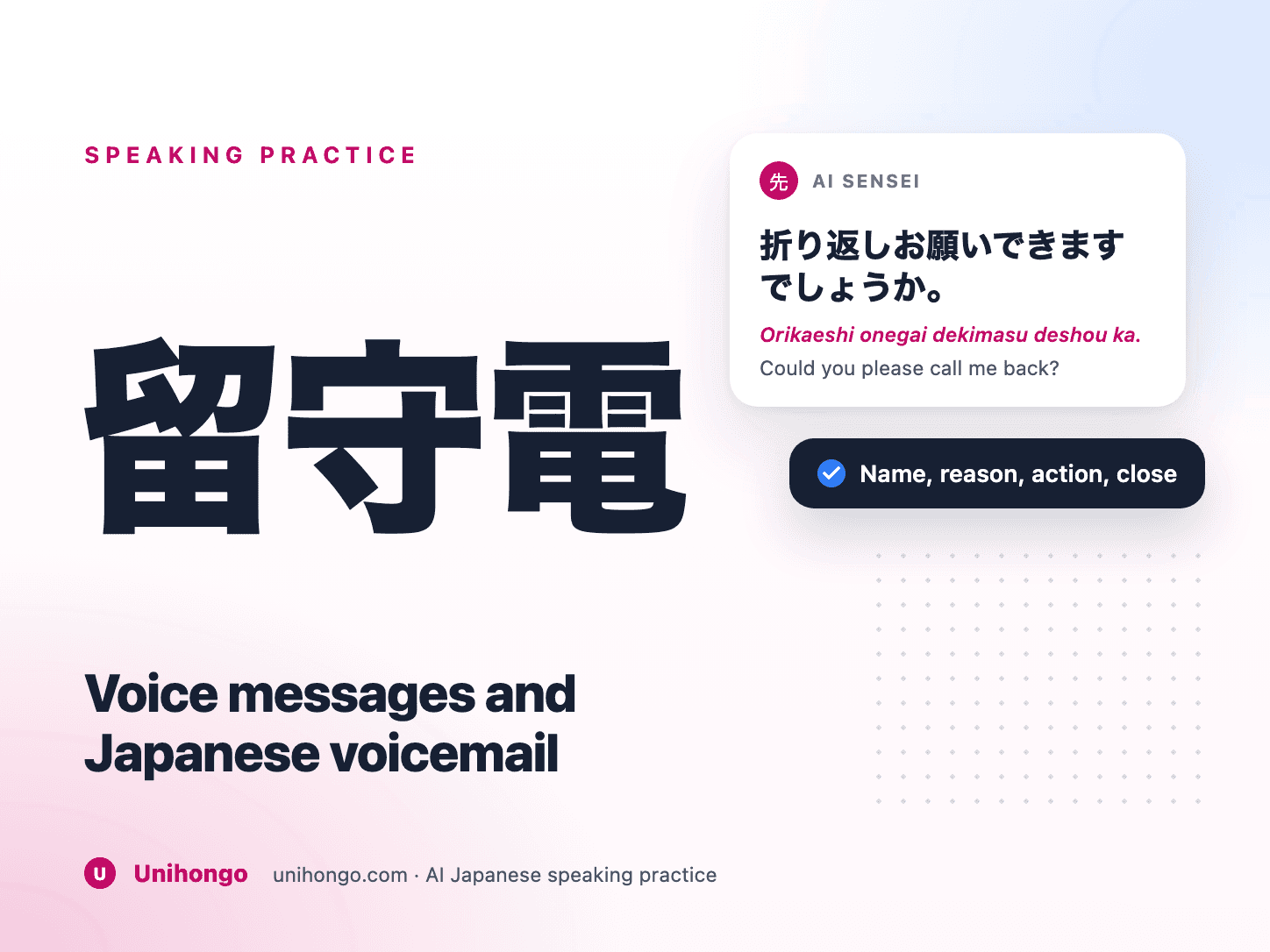
Japanese business voicemail is close to fixed, and the order is not negotiable. Identify yourself, state the reason, state the action you want, then close. Learners commonly invert the first two, giving a long explanation before saying who they are, which forces the listener to replay the message.
| Part | Content | Typical wording |
|---|---|---|
| 1. Identify | Company, then your name, then the greeting | お世話になっております。株式会社Xの田中です Osewa ni natte orimasu. Kabushikigaisha X no Tanaka desu |
| 2. Reason | One sentence, the headline only | 先日の見積もりの件でお電話しました Senjitsu no mitsumori no ken de odenwa shimashita |
| 3. Action | What you want to happen next | お手数ですが、折り返しお願いできますでしょうか Otesū desu ga, orikaeshi onegai dekimasu deshō ka |
| 4. Close | Number, repeated, then a closing line | 番号は… もう一度申し上げます… 失礼いたします Bangō wa... Mō ichido mōshiagemasu... Shitsurei itashimasu |
Say the number twice, digit by digit, more slowly than feels natural. It is the one piece of information that cannot be guessed from context.
A business message you can memorise
This is the whole thing as one script. Learn it as a unit and swap the middle sentence for whatever your reason happens to be. Note that Japanese phone numbers are read digit by digit, with no is often pronounced as the connector for the hyphen, and that zero is usually rei or zero rather than maru in formal speech.
| Japanese | Romaji | Meaning |
|---|---|---|
| お世話になっております。株式会社山田の田中です。 | Osewa ni natte orimasu. Kabushikigaisha Yamada no Tanaka desu. | Thank you for your continued support. This is Tanaka from Yamada Corporation. |
| 先日お送りした資料の件でお電話いたしました。 | Senjitsu ookuri shita shiryō no ken de odenwa itashimashita. | I am calling about the documents I sent the other day. |
| ご確認いただけましたら、ご連絡いただけますでしょうか。 | Gokakunin itadakemashitara, gorenraku itadakemasu deshō ka. | Once you have checked them, could you get in touch? |
| お手数ですが、折り返しお願いできますでしょうか。 | Otesū desu ga, orikaeshi onegai dekimasu deshō ka. | Sorry to trouble you, but could you call me back? |
| 番号は、090の1234の5678です。 | Bangō wa, zero-kyū-zero no ichi-ni-san-yon no go-roku-nana-hachi desu. | My number is 090-1234-5678. |
| もう一度申し上げます。090の1234の5678です。 | Mō ichido mōshiagemasu. Zero-kyū-zero no ichi-ni-san-yon no go-roku-nana-hachi desu. | I will say it once more. 090-1234-5678. |
| よろしくお願いいたします。失礼いたします。 | Yoroshiku onegaiitashimasu. Shitsurei itashimasu. | Thank you very much. Goodbye. |
Cancelling, apologising and urgent messages
Three situations account for most difficult voicemails: you cannot make an appointment, you are apologising for something, and you need an answer today. Each has a conventional opening that sets expectations in the first three seconds, and using it is what separates a message that gets acted on from one that sits in a queue.
For urgency, say so at the top rather than at the end. Isogi no ken de, on an urgent matter, placed immediately after your name, tells the listener how to prioritise before they have heard the detail.
| Japanese | Romaji | Meaning |
|---|---|---|
| 急ぎの件でご連絡しました。 | Isogi no ken de gorenraku shimashita. | I am contacting you about an urgent matter. |
| 申し訳ありませんが、明日の打ち合わせを変更させていただきたく… | Mōshiwake arimasen ga, ashita no uchiawase o henkō sasete itadakitaku... | I am very sorry, but I would like to change tomorrow's meeting... |
| 体調不良のため、本日お休みをいただきます。 | Taichō furyō no tame, honjitsu oyasumi o itadakimasu. | Due to feeling unwell, I will take today off. |
| ご迷惑をおかけして申し訳ございません。 | Gomeiwaku o okake shite mōshiwake gozaimasen. | I am very sorry for the inconvenience caused. |
| 本日中にご連絡いただけると助かります。 | Honjitsu-chū ni gorenraku itadakeru to tasukarimasu. | It would help if you could contact me sometime today. |
| たびたび失礼いたします。先ほどの件の続きです。 | Tabitabi shitsurei itashimasu. Sakihodo no ken no tsuzuki desu. | Apologies for calling again. This continues my earlier message. |
Casual voice notes are the opposite
Voice messages on LINE follow none of the rules above. They are short, unplanned and warm, and the structure that makes a business voicemail good makes a casual one sound cold. Nobody states their name, because the app already did, and nobody gives a reason before speaking.
The register is plain form, with fillers left in. A little hesitation actually sounds friendly here, since a perfectly polished thirty seconds reads as a recording rather than a message. If you find business voicemail intimidating, casual voice notes are the low-pressure way to build the same delivery skill.
| Japanese | Romaji | Meaning |
|---|---|---|
| もしもし、今大丈夫? | Moshi moshi, ima daijōbu? | Hey, is now okay? |
| さっきの話なんだけどさ、 | Sakki no hanashi na n da kedo sa, | About what we were talking about earlier, |
| 今日ちょっと遅れそう。ごめん。 | Kyō chotto okuresō. Gomen. | Looks like I will be a bit late today. Sorry. |
| 時間あったら電話ちょうだい。 | Jikan attara denwa chōdai. | Give me a call if you have time. |
| ま、そんな感じ。またね。 | Ma, sonna kanji. Mata ne. | Anyway, that is about it. See you. |
Recording your own outgoing greeting
If you live or work in Japan, the greeting on your own line matters. The convention is short and slightly impersonal: state that you cannot take the call, ask for a message after the tone, and stop. Many people do not state their name on a personal line for privacy reasons, and that is entirely normal.
Speak more slowly than you would in conversation and leave a clear pause before the closing line. The most common flaw in a learner's outgoing message is speed, not grammar.
| Japanese | Romaji | Meaning |
|---|---|---|
| ただいま電話に出ることができません。 | Tadaima denwa ni deru koto ga dekimasen. | I cannot come to the phone right now. |
| 発信音の後に、ご用件をお話しください。 | Hasshin-on no ato ni, goyōken o ohanashi kudasai. | Please leave your message after the tone. |
| 折り返しご連絡いたします。 | Orikaeshi gorenraku itashimasu. | I will get back to you. |
| 田中です。ただいま留守にしております。 | Tanaka desu. Tadaima rusu ni shite orimasu. | This is Tanaka. I am not available at the moment. |
Rusuban denwa is the answering machine itself, and rusuden is the everyday shortening. Rusuden ni irete oita yo means I left it on your voicemail.
A practice loop with a recorder
This is one of the few speaking skills you can grade yourself on, because the output is a file. Record, listen, and count only two things: how many seconds you spoke and how many hesitations landed inside the four parts. Then record again immediately, because a second take with the structure fresh is where the improvement happens.
Three takes is the sweet spot. The first exposes the problem, the second fixes the structure, and the third gets the delivery. After that, change the scenario rather than doing a fourth take, or you start polishing a performance instead of building a skill.
| Take | Focus | What to check on playback |
|---|---|---|
| 1 | Just get through it | Did all four parts appear, and in order? |
| 2 | Cut what is not needed | Is anything said twice? Is the reason one sentence? |
| 3 | Delivery | Is the number slow and clear? Is the ending clean? |
| Next day | New scenario | Does the structure survive without notes? |