
Bidakuon in four words
The whole topic fits into four words: the name of the sound, a word with g in the middle, the particle ga, and a word that starts with g. In traditional standard pronunciation, the middle two have the soft nasal g and the last one keeps a hard g.
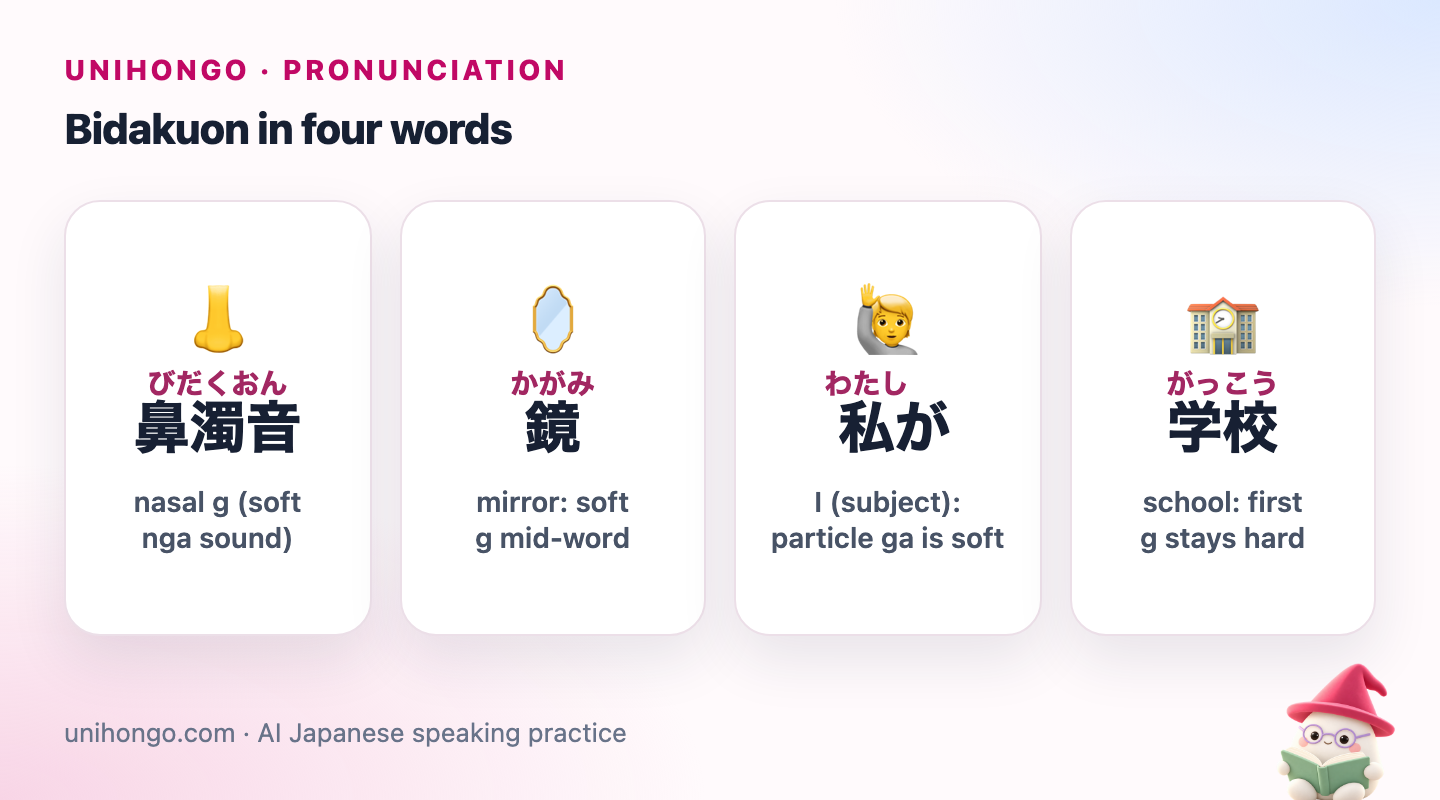
| Japanese | Romaji | Meaning |
|---|---|---|
| 鼻濁音 | bidakuon | nasal g (soft nga sound) |
| 鏡 | kagami | mirror: soft g mid-word |
| 私が | watashi ga | I (subject): particle ga is soft |
| 学校 | gakkō | school: first g stays hard |
What the nasal g sounds like
Say the English word singer slowly. The ng in the middle is a single sound made with the back of the tongue against the soft palate while air flows through the nose. There is no hard g in it, unlike finger. Bidakuon is that same sound, followed by a vowel: nga, ngi, ngu, nge, ngo.
Two cautions. First, it is one sound, not n plus g: kagami still has three beats (ka-ga-mi), not four. Second, it is soft and quick, so in fast speech it can be hard to tell from a light g. In dictionaries and pronunciation guides, it is sometimes marked by writing the kana with a small circle, like the handakuten in pa, instead of the two dots.
| Japanese | Romaji | Meaning |
|---|---|---|
| かがみ | kagami | mirror: three beats, the middle g is soft |
| ながい | nagai | long: three beats, soft g |
| ありがとう | arigatō | thank you: soft g, traditionally |
Where it appears: the traditional rule
The traditional rule, as taught to announcers and in pronunciation dictionaries, is simple at its core: g at the very start of a word is hard, and g anywhere else is soft. The subject particle ga, because it always follows another word, is soft too.
| Japanese | Romaji | Meaning |
|---|---|---|
| 誰が行きますか。 | Dare ga ikimasu ka. | Who is going? (ga is soft) |
| 私が行きます。 | Watashi ga ikimasu. | I'll go. (ga is soft) |
| 午後 | gogo | afternoon: hard first g, soft second g |
| Position | Traditional sound | Examples |
|---|---|---|
| Start of a word | Hard g | gakkō (school), ginkō (bank), gohan (rice) |
| Middle or end of a word | Nasal ng | kagami (mirror), nagai (long), kagi (key) |
| Particle ga | Nasal ng | watashi ga, ame ga |
| Conjunction ga (but) | Nasal ng | takai desu ga |
Gogo is a neat test word because it shows both rules at once: the first go starts the word and stays hard, and the second sits inside it and turns soft.
Where the g stays hard: the main exceptions
Real speech is messier than any rule, and pronunciation guides list a number of exceptions. The ones below are those most often mentioned. Dictionaries sometimes disagree about individual compound words, so treat this as a guide to what you are likely to hear, not a law.
| Japanese | Romaji | Meaning |
|---|---|---|
| 十五 | jūgo | fifteen: g usually hard |
| ゴロゴロ | gorogoro | rumbling, lazing about: both g hard |
| 高等学校 | kōtō gakkō | senior high school: g often hard |
- The number five, go, usually keeps a hard g even inside a number: jūgo (15).
- Many loanwords keep a hard g, because they come from languages without this pattern.
- Doubled sound words keep the hard g in the repeated part: gorogoro, gatagata.
- In many compounds where the second part still feels like its own word, its first g often stays hard: kōtō gakkō (senior high school).
Who uses it today
Bidakuon is a sound in retreat. It is widely described as more common among older speakers and in parts of eastern and northern Japan, and as rare in much of western Japan, including the Kansai area. In Tokyo, many younger people use a hard g everywhere and may not even know the word bidakuon. Usage varies a great deal from person to person, so you will hear both in the same family.
At the same time, it is still cultivated in a few places. Broadcast announcers have traditionally been trained in it, choirs often teach it because the softer g blends better in singing, and you can hear it clearly in many older popular songs and in enka. Some people find it elegant and gentle; others find it old-fashioned.
Hearing it in songs and choirs
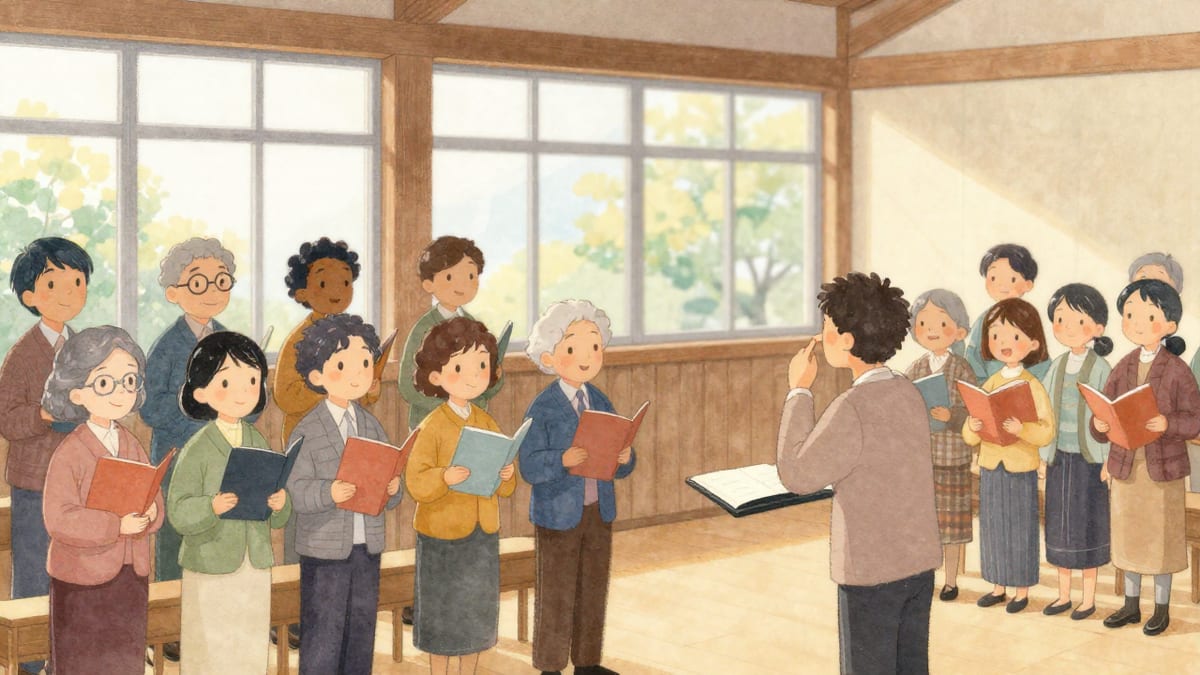
Singing is the best place to hear bidakuon, because long notes stretch the consonant. In a choir rehearsal, a conductor may stop the singers to soften a ga that sounds too hard, and in a classic ballad the ga at the end of a phrase often melts into the vowel before it.
When you listen, pick one word and follow it. Particle ga after a long vowel is easiest: words like kimi ga or yume ga in a slow song. If the g sounds hummed rather than popped, you are hearing bidakuon.
| Japanese | Romaji | Meaning |
|---|---|---|
| 君が | kimi ga | you (subject): listen for a soft ga |
| 夢が | yume ga | a dream (subject): soft ga |
Should learners use it? A practical answer
For most learners, the honest answer is: learn to hear it, and use it only if you enjoy it. A hard g everywhere is completely standard for millions of native speakers, and nobody will judge your Japanese for it. Your time is better spent on long vowels, small tsu and pitch, which affect meaning.
If you do want the soft g, perhaps because you sing, or because you love the sound of older Tokyo speech, the key is consistency. Use it for particle ga and inside words, keep word-initial g hard, and keep the timing of each word unchanged.
| Japanese | Romaji | Meaning |
|---|---|---|
| 鏡がほしいです。 | Kagami ga hoshii desu. | I'd like a mirror. (two soft g) |
| 学校が近いです。 | Gakkō ga chikai desu. | The school is close. (hard, then soft) |
| ありがとうございます。 | Arigatō gozaimasu. | Thank you. (soft, then hard) |
Common confusions
If you are a singer, it is worth asking your choir director or vocal teacher how they want ga pronounced, because choirs differ. For everyday conversation, clear timing and the right long vowels will do far more for how natural you sound than any choice about g.
- Hearing nga as two sounds: it is one consonant, so do not add an extra n beat. Kagami never becomes kan-ga-mi.
- Thinking it is a dialect or an error: it is part of traditional standard pronunciation, though not required.
- Making word-initial g soft: gakkō, gohan and ginkō keep a hard g even for speakers who use bidakuon.
- Mishearing a soft particle ga as na: in fast speech the nasal ga can sound close to na. Context almost always tells you which it is.
- Worrying about mixing: most speakers who use bidakuon do not use it every time, so a mix of soft and hard g is normal.