
Four names of blessing
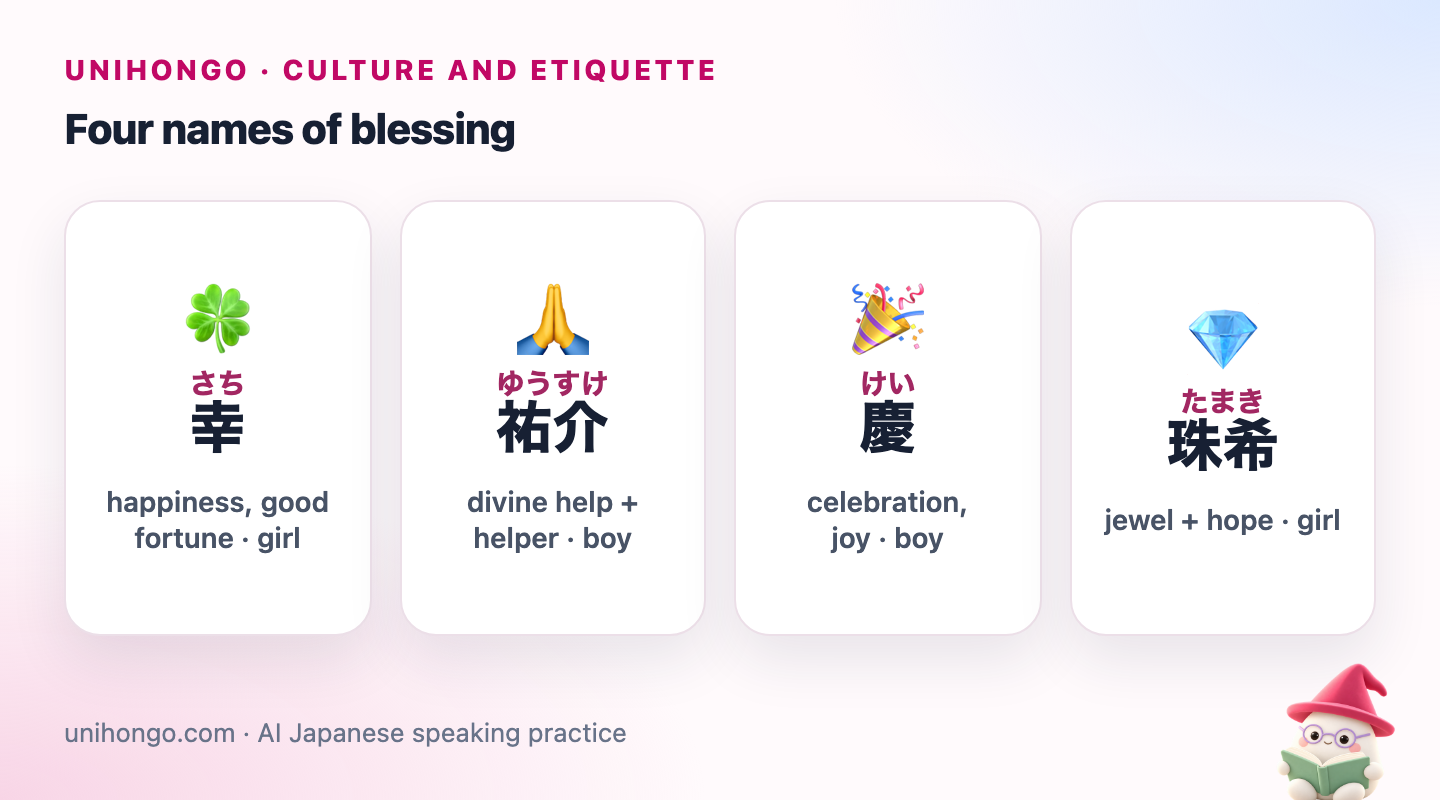
These four names show four ways of saying a child is a blessing: happiness itself, help from the gods, joyful celebration and a precious jewel.
| Japanese | Romaji | Meaning |
|---|---|---|
| 幸 | Sachi | happiness, good fortune · girl |
| 祐介 | Yūsuke | divine help + helper · boy |
| 慶 | Kei | celebration, joy · boy |
| 珠希 | Tamaki | jewel + hope · girl |
慶 appears in words such as 慶事 (keiji), a happy event, and in names it wishes for a life full of celebrations. 珠 is a round jewel or pearl, as in 真珠 (shinju, pearl), and 希 is hope, so 珠希 suggests a precious, hoped-for child. 介 in 祐介 is a classic boys' ending that once meant someone who helps or assists.
The radical 礻: names touched by the gods
Many blessing kanji share a radical on their left side, 礻, a compressed form of 示. It is called shimesuhen, and it originally showed an altar for offerings. Kanji with this radical, or with 示 itself at the bottom, are about gods, rituals and divine favour: 神 (god), 社 (shrine), 祈 (pray) and 祭 (festival). In names, the most common ones are 祐 (divine help), 祥 (good omen) and 禎 (auspicious, happy sign).
| Japanese | Romaji | Meaning |
|---|---|---|
| 祐希 | Yūki | divine help + hope · unisex |
| 祥太 | Shōta | good omen + big · boy |
| 祥子 | Shōko | good omen child · girl, classic |
| 禎 | Tadashi | an auspicious sign · boy |
Knowing the radical helps you guess the feeling of an unfamiliar name kanji: if it has 礻 on the left, it is likely to be about good fortune or the gods. Be careful with look-alikes: 衤, with one extra stroke, is the clothing radical, as in 袖 (sleeve), and has nothing to do with blessings.
Shōta is a good example of a name with many spellings: 翔太 (soaring), 将太 (leader) and 祥太 (good omen) all sound the same, and only the last carries the blessing meaning.
Happiness and good fortune: 幸, 福 and 寿
Happiness is a wish almost every parent shares, and 幸 is the kanji for it. It has several name readings: sachi, yuki, kō and sometimes miyuki. 福 means fortune and luck; it was used in some old given names but is now mostly seen in surnames such as 福田 (Fukuda) and in words like 幸福 (kōfuku, happiness). 寿 means long life and congratulations, and it decorates wedding and New Year gifts.
| Japanese | Romaji | Meaning |
|---|---|---|
| 幸子 | Sachiko | happy child · girl, classic |
| 美幸 | Miyuki | beautiful + happiness · girl |
| 幸也 | Yukiya | happiness + classic ending · boy |
| 寿 | Hisashi | long life, congratulations · boy |
| 福田 | Fukuda | fortune + rice field · surname |
Sachiko was one of the most common girls' names of the mid twentieth century, so it now sounds like a grandmother's name. Miyuki is often written 美雪 (beautiful snow) too, so the same sound can be snow or happiness. 寿 read kotobuki is the word for celebration that you see printed on gift envelopes and on wedding sweets.
A child as a gift: treasure words and 授かる
The feeling that a child is a gift shows up more in everyday language than in any single name. Parents say they were granted a child, using the verb 授かる (sazukaru), which is also used for receiving something precious from above, such as a blessing or a talent. A family with many children is described as blessed with child-treasures. These phrases are warm and polite, and they are mostly used by the parents themselves or by people congratulating them.
| Japanese | Romaji | Meaning |
|---|---|---|
| 子どもを授かりました。 | Kodomo o sazukarimashita. | We have been blessed with a child. |
| 子宝に恵まれる | kodakara ni megumareru | to be blessed with children |
| 宝物 | takaramono | a treasure, something precious |
| 贈り物 | okurimono | a gift, a present |
| 宝 | Takara | treasure · unisex, rare |
子宝 (kodakara) literally means child-treasure, and parents may tell their child, Anata wa uchi no takaramono da yo, you are our family's treasure. Takara as a name exists but is uncommon; most parents put the treasure feeling into a kanji like 珠 instead. If a coworker tells you they are expecting, Omedetō gozaimasu is the safe, warm reply.
The wish behind the name: ~ yō ni
When Japanese parents explain a name, they almost always use the pattern ~ yō ni, so that or may it be. Attached to the polite form of a verb and said on its own, it becomes a wish or a prayer, the same form people write on wooden wish plaques at shrines. Attached to a plain verb in the middle of a sentence, it explains the purpose of the name.
| Japanese | Romaji | Meaning |
|---|---|---|
| 幸せになりますように。 | Shiawase ni narimasu yō ni. | May she be happy. |
| 健康に育ちますように。 | Kenkō ni sodachimasu yō ni. | May he grow up healthy. |
| いい人に出会えますように。 | Ii hito ni deaemasu yō ni. | May she meet good people. |
| 幸せになれるように、幸と名付けました。 | Shiawase ni nareru yō ni, Sachi to nazukemashita. | We named her Sachi so that she can be happy. |
| 名前に願いを込めました。 | Namae ni negai o komemashita. | We put our wish into her name. |
Nazukeru means to name, and 名付け (nazuke) is the act of naming a child. Negai o komeru, to put a wish into something, is the usual phrase for the feelings inside a name, a gift or a letter.
Shrine customs around a new baby
Several traditional customs surround a birth in Japan, and many families still follow at least some of them, though the details vary by region and family. On the seventh night after the birth, some families hold お七夜 (oshichiya), a small naming celebration, and display the baby's name written on a sheet of paper called a 命名書 (meimeisho). About a month after the birth, families often take the baby to a local shrine for お宮参り (omiyamairi), the first shrine visit, to give thanks and pray for the child's health.
| Japanese | Romaji | Meaning |
|---|---|---|
| お七夜 | oshichiya | seventh-night naming celebration |
| 命名書 | meimeisho | the paper announcing the name |
| お宮参り | omiyamairi | the baby's first shrine visit |
| 安産祈願 | anzan kigan | a prayer for a safe birth |
| お守り | omamori | a protective charm |
安産祈願 is often made during pregnancy, and many people choose a day of the dog in the old calendar, because dogs are associated with easy births. Customs such as which relatives attend and what the baby wears differ from place to place, so if you are invited, simply ask the family what to expect.
Mini dialogue: meeting baby Sachi at the shrine
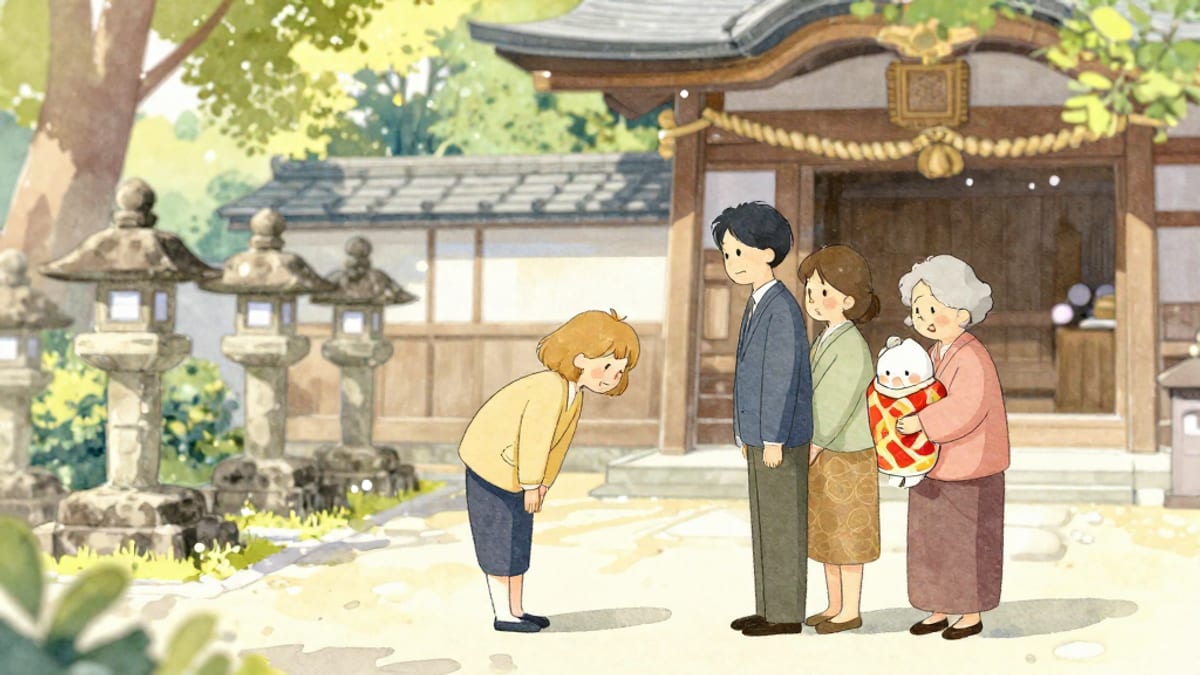
On a Sunday morning you visit a shrine and meet your coworker with his wife, his mother and their new baby, who is wrapped in a bright ceremonial cloth for the first shrine visit. You speak politely.
| Japanese | Romaji | Meaning |
|---|---|---|
| お宮参りですか。おめでとうございます。 | Omiyamairi desu ka. Omedetō gozaimasu. | You: Is it the first shrine visit? Congratulations. |
| ありがとうございます。幸といいます。 | Arigatō gozaimasu. Sachi to iimasu. | Coworker: Thank you. Her name is Sachi. |
| 幸せの幸ですか。 | Shiawase no sachi desu ka. | You: The sachi of happiness? |
| はい。幸せな人生を送れるように。 | Hai. Shiawase na jinsei o okureru yō ni. | Coworker: Yes. So she can live a happy life. |
| お二人の気持ちが伝わる名前ですね。 | Ofutari no kimochi ga tsutawaru namae desu ne. | You: The name really shows how you both feel. |
Shiawase no sachi desu ka is a natural way to check a kanji: you name a common word that contains it. Ofutari, the polite word for the two of you, refers to the parents together, and it is a gentle way to praise their choice.
Learn the wish pattern with Mocchi and Haru-sensei
Type /grammar ように into Mocchi. You get a clear explanation of both uses, the wish on its own and the purpose in a sentence, with examples. Then ask Mocchi to quiz you with five sentences to complete. It keeps track of the form you get wrong, such as forgetting the potential verb in nareru yō ni, and returns to it in a later review.
To say it out loud, choose Haru-sensei in AI Sensei and ask the Sensei to play a shrine attendant. Ask for a charm for a newborn, explain the baby's name and its wish, and check the session report for the vocabulary you used.
Blessing-name mistakes to avoid
- Mixing up 祐 and 佑. Both are read yū, but 祐 suggests help from the gods and 佑 help from people.
- Reading every 幸 as sachi. It is yuki in Miyuki and Yukiya, and kō in names like Kōta.
- Using sazukaru freely about other people's babies. It is mostly the parents' own word; when you congratulate them, omedetō gozaimasu is enough.
- Confusing the god radical 礻 with the clothing radical 衤. One extra stroke changes the meaning completely.
- Thinking 福 is a common modern given name. It is mostly found in surnames and old names.