

Wakarimasen, wakaranai and chotto wakaranai
The verb is wakaru, which means to understand, to be able to tell, or to work something out. In the polite negative it is wakarimasen, and in the plain negative it is wakaranai. Both are correct; the difference is register. Wakarimasen is what you say to a shop assistant, a station worker, a teacher or anyone you would address with desu and masu. Wakaranai is for friends, family and people you are on casual terms with, and among them it is completely normal, not rude.
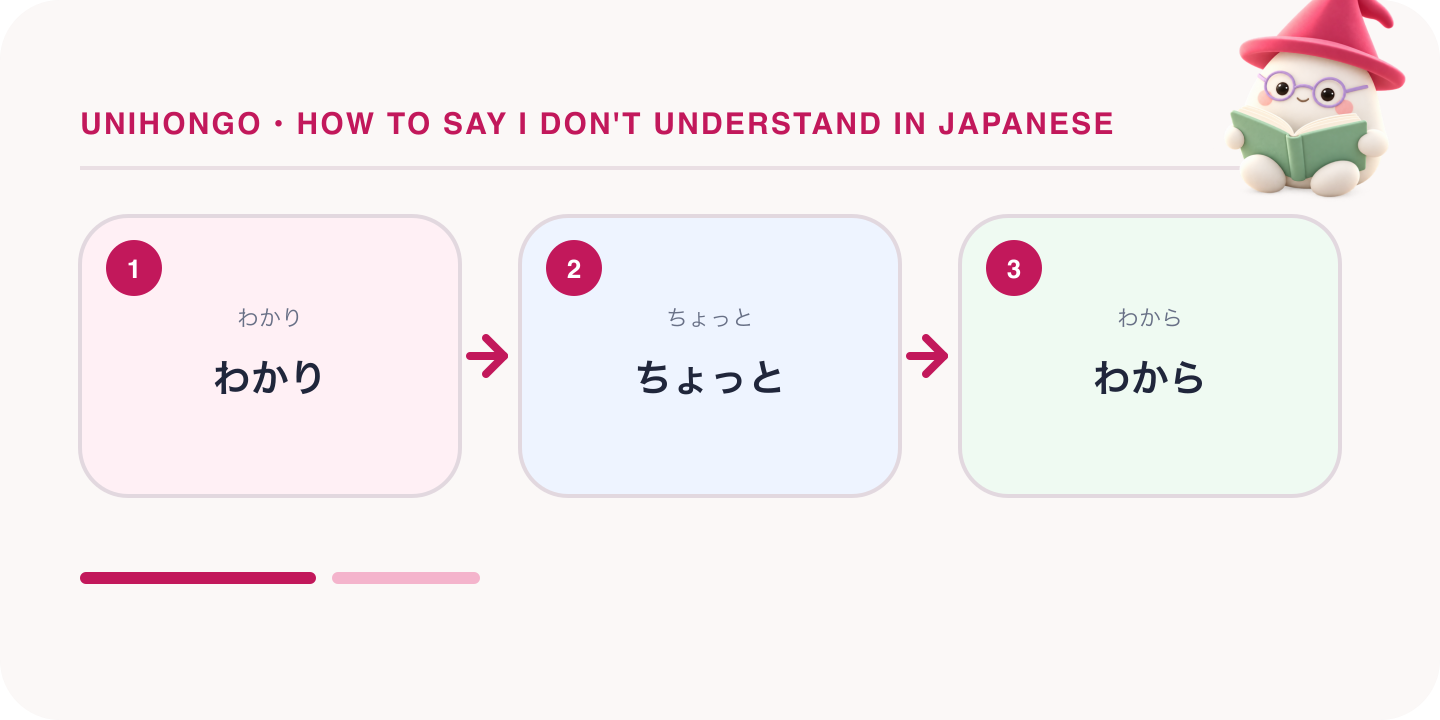
The word that changes the feel of both is chotto, a little. Chotto wakaranai does not really mean you understand a little; it is a softener, the same one used in chotto muzukashii to turn down a request. It signals that you are not shutting the conversation down, just flagging a gap. In polite speech the common shape is sumimasen, chotto wakaranai n desu ga, with the n desu ga ending leaving the sentence open so the other person naturally offers help.
The past tense, wakarimasen deshita, is for after the fact: yoku wakarimasen deshita, I did not really follow, is honest without being dramatic.
| Japanese | Romaji | Meaning |
|---|---|---|
| すみません、わかりません。 | Sumimasen, wakarimasen. | Sorry, I don't understand. |
| ちょっとわからないんですが。 | Chotto wakaranai n desu ga. | I'm not quite following, I'm afraid. |
| ごめん、わからない。 | Gomen, wakaranai. | Sorry, I don't get it. |
| よくわかりませんでした。 | Yoku wakarimasen deshita. | I didn't really follow that. |
| まだよくわかっていません。 | Mada yoku wakatte imasen. | I still don't quite understand. |
| 今のところはわかりました。 | Ima no tokoro wa wakarimashita. | I understood that part. |
Saying what you did not understand
A bare wakarimasen leaves the other person guessing. Did you miss one word, or all of it? Was it too fast, or was the topic itself unfamiliar? Japanese speakers, like anyone, respond best to a specific request, so the most useful habit is to name the problem in the same breath.
If the issue is meaning, use imi ga wakarimasen, I do not understand the meaning, and point to the word: sono kotoba no imi ga wakarimasen. If you heard it but could not separate the sounds, the verb is kikitoru, to catch by ear, so kikitoremasen deshita, I could not catch that. If the trouble is speed, hayasugite wakarimasen deshita, it was too fast to follow. If you are staring at a document, it is reading rather than hearing: kono kanji ga yomemasen, I cannot read this kanji, or koko no bubun ga wakarimasen, this part is unclear.
Each of these opens a different door: an explanation, a slower repeat, or the reading written down. Choosing the right one saves a whole round of back and forth.
| Japanese | Romaji | Meaning |
|---|---|---|
| その言葉の意味がわかりません。 | Sono kotoba no imi ga wakarimasen. | I don't understand what that word means. |
| 最後の部分が聞き取れませんでした。 | Saigo no bubun ga kikitoremasen deshita. | I couldn't catch the last part. |
| ちょっと速すぎてわかりませんでした。 | Chotto hayasugite wakarimasen deshita. | It was a bit too fast for me to follow. |
| この漢字が読めません。 | Kono kanji ga yomemasen. | I can't read this kanji. |
| ここの部分の意味がわかりません。 | Koko no bubun no imi ga wakarimasen. | I don't understand this part here. |
| 日本語がまだあまりわからないんです。 | Nihongo ga mada amari wakaranai n desu. | My Japanese is still quite limited. |
Asking for a repeat, a slowdown or a rephrase
Once you have said what went wrong, ask for what would fix it. There are three basic requests, and it helps to think of them as separate tools. Mō ichido onegai shimasu asks for a repeat, which is right when you missed a sound. Mō sukoshi yukkuri onegai shimasu asks for slower speech, which is right when you could not keep up. Betsu no iikata de onegai dekimasu ka asks for a rephrase, which is right when you heard every word and still did not understand, because the same sentence repeated slowly will not help.
Two more requests are useful for vocabulary. Kantan na kotoba de itte moraemasu ka asks for simpler words. Kaite moraemasu ka asks the person to write it down, which is often the fastest fix for a name, a station or a number, and Japanese speakers will happily write on a receipt or show you their phone.
| Japanese | Romaji | Meaning |
|---|---|---|
| もう一度お願いします。 | Mō ichido onegai shimasu. | Once more, please. |
| もう少しゆっくりお願いします。 | Mō sukoshi yukkuri onegai shimasu. | A little more slowly, please. |
| 別の言い方でお願いできますか。 | Betsu no iikata de onegai dekimasu ka. | Could you say it a different way? |
| 簡単な言葉で言ってもらえますか。 | Kantan na kotoba de itte moraemasu ka. | Could you say it in simpler words? |
| 書いてもらえますか。 | Kaite moraemasu ka. | Could you write it down? |
| 英語で言うと何ですか。 | Eigo de iu to nan desu ka. | What is it in English? |
| つまり、明日でいいということですか。 | Tsumari, ashita de ii to iu koto desu ka. | So you mean tomorrow is fine? |
At work: sumimasen and mō ichido yoroshii desu ka
In an office, a customer call or a job interview, the same gap in understanding needs a more careful frame. Start with sumimasen or the more formal mōshiwake arimasen ga, and switch onegai shimasu for yoroshii desu ka, which asks whether it would be all right. Sumimasen, mō ichido yoroshii desu ka is the standard sentence, and osore irimasu ga in front makes it suitable for a client.
It is also normal at work to blame the line rather than your Japanese. Sukoshi kikitorinikukatta no desu ga, it was a little hard to catch, or o-denwa ga tōi yō desu, the line seems faint, are polite fictions everyone recognises. Then confirm what you heard: ... to iu koto de yoroshii deshō ka. Managers prefer this to a silent nod, because a misheard deadline costs far more than a repeated one.
| Japanese | Romaji | Meaning |
|---|---|---|
| すみません、もう一度よろしいですか。 | Sumimasen, mō ichido yoroshii desu ka. | Sorry, could you say that once more? |
| 恐れ入りますが、もう一度お願いできますでしょうか。 | Osore irimasu ga, mō ichido onegai dekimasu deshō ka. | I'm terribly sorry, but could I ask you to repeat that? |
| 少し聞き取りにくかったのですが。 | Sukoshi kikitorinikukatta no desu ga. | It was a little hard to catch, I'm afraid. |
| 金曜までということでよろしいでしょうか。 | Kin'yō made to iu koto de yoroshii deshō ka. | Am I right that it's by Friday? |
| 確認させてください。 | Kakunin sasete kudasai. | Let me confirm. |
| この点についてご説明いただいてもよろしいですか。 | Kono ten ni tsuite go-setsumei itadaitemo yoroshii desu ka. | Could you explain this point for me? |
Wakaranai or shiranai: a brief contrast
This site has a full guide on saying I don't know, so here is only the distinction that matters for comprehension. Shiru is about possessing information: a fact, a name, a place. Wakaru is about grasping something: a meaning, a situation, a decision. When you did not understand what someone said, the verb is always wakaru. Shirimasen would mean you have no knowledge of the topic, which is a different claim.
This is why shiranai can sound cold: it suggests the matter is not your concern, while wakaranai sounds like you tried and could not tell.
| Japanese | Romaji | Meaning |
|---|---|---|
| 今の話、意味がわからなかった。 | Ima no hanashi, imi ga wakaranakatta. | I didn't get what you just said. |
| その人は知りません。 | Sono hito wa shirimasen. | I don't know that person. |
| どっちがいいか、わからない。 | Dotchi ga ii ka, wakaranai. | I can't tell which is better. |
| それは聞いたことがないです。 | Sore wa kiita koto ga nai desu. | I've never heard of that. |
Quick reference: which phrase for which problem
Use this table to match the kind of gap to the sentence that fixes it. The polite column works with strangers, staff and colleagues; the casual column is for friends. In both cases, follow the sentence with a request, such as mō ichido onegai shimasu, so the listener knows what to do next.
| Problem | Reading | What to say |
|---|---|---|
| 全部わからない | zenbu wakaranai | Sumimasen, wakarimasen deshita, then ask for a repeat |
| 一つの言葉 | hitotsu no kotoba | Sono kotoba no imi ga wakarimasen, name the word |
| 速すぎる | hayasugiru | Mō sukoshi yukkuri onegai shimasu |
| 聞き取れない | kikitorenai | Kikitoremasen deshita, mō ichido onegai shimasu |
| 漢字が読めない | kanji ga yomenai | Kono kanji wa nan to yomimasu ka |
| 言い方が難しい | iikata ga muzukashii | Betsu no iikata de onegai dekimasu ka |
| 数字や名前 | sūji ya namae | Kaite moraemasu ka, ask them to write it |
| 専門用語 | senmon yōgo | Kantan na kotoba de itte moraemasu ka |
| 自信がない | jishin ga nai | Tsumari ... to iu koto desu ka, check back |
| 電話で | denwa de | O-denwa ga tōi yō desu, mō ichido yoroshii desu ka |
Keeping the conversation going after you say it
Saying you did not understand is a pause, not an ending. Show what you did catch: eki made wa wakarimashita ga, sono ato ga, I got as far as the station, but after that... This tells them where to restart. Repeat a fragment as a question: nijikan? A single word with rising intonation is one of the most natural ways to ask for confirmation in Japanese. Then close the gap with arigatō gozaimasu, wakarimashita.
- Show the part you did understand so the speaker knows where to restart
- Echo one word with rising intonation to check it
- Ask for slower speech once, early, rather than repeats every sentence
- Confirm the outcome with tsumari ... desu ne before acting on it
- Close with wakarimashita, arigatō gozaimasu when the gap is fixed
- If it still fails, ask them to write it or show it on a map or phone
Mistakes that make the gap feel bigger
The most common mistake is nodding. Japanese listening involves a lot of aizuchi, the small hai and ee sounds that show you are following, and learners copy them so well that speakers assume the message landed. If you say hai and then do the wrong thing, the mismatch is more embarrassing than a wakarimasen would have been. Reserve hai for things you actually understood.
The second mistake is saying wakarimasen and stopping, so the speaker simply repeats the same sentence. Add mō ichido, yukkuri or betsu no iikata every time. The third is apologising too much: one sumimasen is polite, a string of them turns a small pause into an incident. The fourth is answering nihongo ga wakarimasen when you understand a good deal of it. That sentence switches the whole exchange to gestures or English, and you lose the practice. Chotto wakaranai n desu ga keeps you in Japanese.
| Japanese | Romaji | Meaning |
|---|---|---|
| はい、大丈夫です。わかりました。 | Hai, daijōbu desu. Wakarimashita. | Yes, that's fine. Understood. |
| すみません、そこだけもう一度いいですか。 | Sumimasen, soko dake mō ichido ii desu ka. | Sorry, could you do just that part again? |
| ええと、二時間ですか。 | Ēto, nijikan desu ka. | Um, two hours, is it? |
| ゆっくりなら大丈夫です。 | Yukkuri nara daijōbu desu. | If it's slow, I'm fine. |
| ありがとうございます、よくわかりました。 | Arigatō gozaimasu, yoku wakarimashita. | Thank you, that's clear now. |