
The New Year decorations in four words
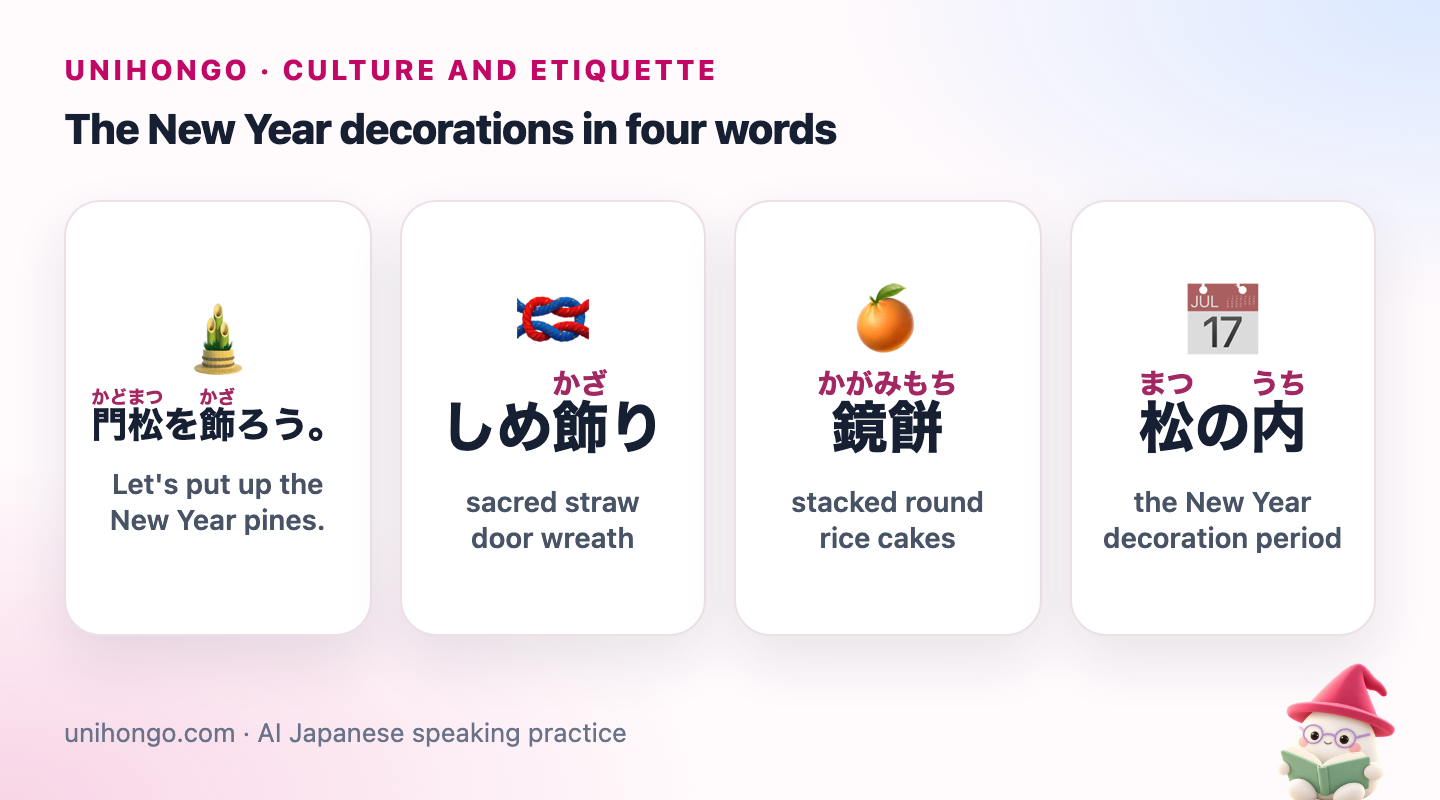
Japanese New Year decorations are called shōgatsu kazari (正月飾り). There are three main ones: kadomatsu outside the entrance, shimekazari on the door and kagami mochi inside the home. The fourth word is the period they stay up, matsu no uchi, literally within the pine.
| Japanese | Romaji | Meaning |
|---|---|---|
| 門松を飾ろう。 | Kadomatsu o kazarō. | Let's put up the New Year pines. |
| しめ飾り | shimekazari | sacred straw door wreath |
| 鏡餅 | kagami mochi | stacked round rice cakes |
| 松の内 | matsu no uchi | the New Year decoration period |
| 正月飾り | shōgatsu kazari | New Year decorations |
The verb is kazaru, to decorate or display. You kazaru a kadomatsu, a shimekazari or flowers, and the noun kazari means a decoration.
Kadomatsu: the gate pines
Kadomatsu (門松) are written with 門, gate, and 松, pine. A typical large one has three thick bamboo stems cut at an angle, surrounded by pine branches and often plum twigs, with a base wrapped in straw mat. They stand as a pair, one on each side of the entrance. The bamboo cut at a slant, called sogi, is the most common style; some regions use a flat cut.
Traditionally the kadomatsu is a yorishiro, a place where a god comes to rest, so it guides Toshigami to the home. Large kadomatsu are now seen mostly at shops, offices, hotels and big houses. Many families with smaller entrances use a mini kadomatsu, or just a shimekazari.
| Japanese | Romaji | Meaning |
|---|---|---|
| 門松は二つで一対です。 | Kadomatsu wa futatsu de ittsui desu. | Kadomatsu come as a pair of two. |
| 竹を斜めに切ります。 | Take o naname ni kirimasu. | The bamboo is cut at a slant. |
| 松は冬でも緑です。 | Matsu wa fuyu demo midori desu. | Pine stays green even in winter. |
| 年神様の目印だと言われています。 | Toshigamisama no mejirushi da to iwarete imasu. | It's said to be a landmark for the New Year god. |
| 玄関の両側に置きます。 | Genkan no ryōgawa ni okimasu. | You place them on both sides of the entrance. |
Shimekazari: what each part stands for
Shimekazari grows out of shimenawa (しめ縄), the straw rope that marks sacred places at shrines. On a front door it marks the home as purified for the New Year and is said to keep misfortune out. Designs vary hugely by region, from simple loops to elaborate cranes and fans. The meanings below are the ones most often given, usually based on wordplay or the look of each plant.
| Japanese | Romaji | Meaning |
|---|---|---|
| しめ縄 | shimenawa | sacred straw rope |
| 橙 | daidai | bitter orange |
| 裏白 | urajiro | white-backed fern |
| この飾りにはどんな意味がありますか。 | Kono kazari ni wa donna imi ga arimasu ka. | What does this decoration mean? |
| Part | What it is | Meaning often given |
|---|---|---|
| shimenawa | Twisted straw rope | Marks a pure space and keeps bad things out |
| daidai | Small bitter orange | Daidai also means generation after generation: a wish for family prosperity |
| urajiro | Fern with white undersides | A pure heart and growing old together |
| yuzuriha | Leaves that fall as new ones grow | Passing the family on to the next generation |
| shide | Zigzag white paper strips | Purity, as at a shrine |
When to put them up
Many people begin New Year preparations from 13 December, and decorations go up any time from then. The most common choice is the 28th, because eight, hachi, is a lucky number whose shape widens towards the bottom like a growing fortune. The 30th is also fine for most families. These are customs, not rules, and plenty of busy families decorate whenever they can.
| Japanese | Romaji | Meaning |
|---|---|---|
| いつ飾ればいいですか。 | Itsu kazareba ii desu ka. | When should I put them up? |
| 二十八日に飾るのがいいそうです。 | Nijūhachinichi ni kazaru no ga ii sō desu. | Apparently the 28th is a good day. |
| 二十九日は避ける人が多いです。 | Nijūkunichi wa sakeru hito ga ōi desu. | Many people avoid the 29th. |
| 一夜飾りはよくないと言われています。 | Ichiya kazari wa yoku nai to iwarete imasu. | Decorating on the last night is said to be bad. |
| Date | What many people say | Why |
|---|---|---|
| 13 to 27 December | Fine, if a little early | New Year preparations traditionally begin on the 13th |
| 28 December | The most popular day | Eight is considered a lucky number |
| 29 December | Often avoided | Ku, nine, sounds like the word for suffering |
| 30 December | Generally fine | No special association in most areas |
| 31 December | Avoided | Ichiya kazari, one-night decorating, seems discourteous to the god |
Buying and hanging a door decoration
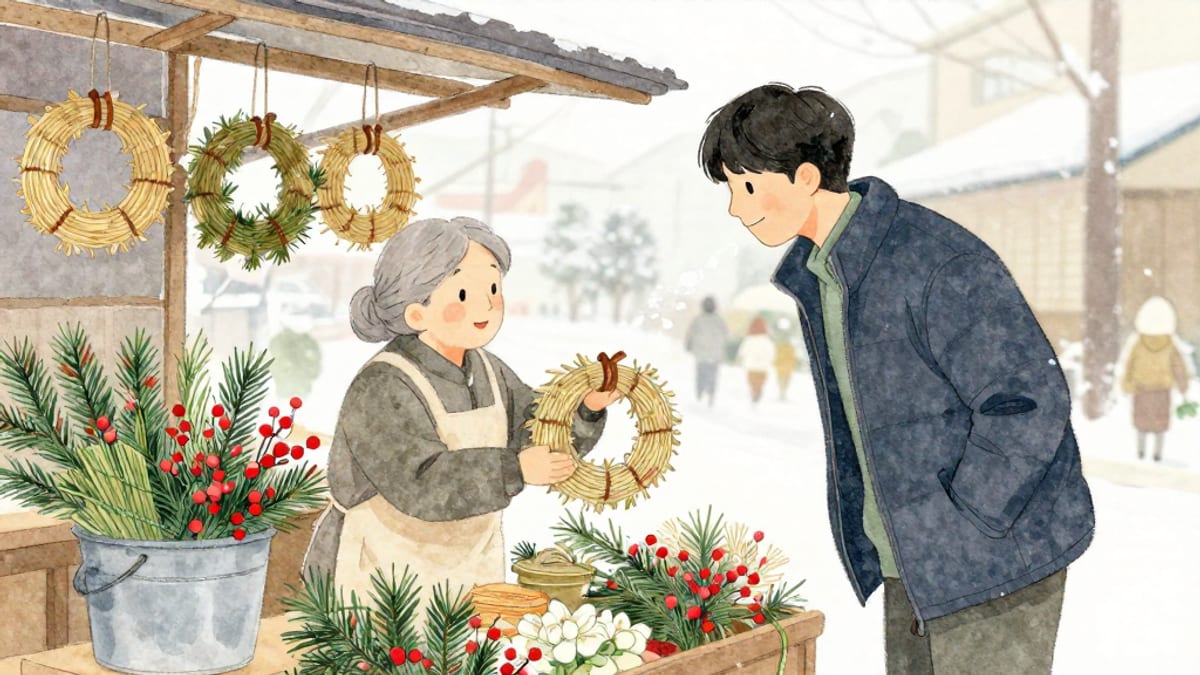
Supermarkets, home centres, florists and year-end markets sell shimekazari from early December, from simple straw loops to modern designs with dried flowers. For an apartment door, a small one on a hook or with a magnet is common; check whether your building has rules about the shared corridor. Large kadomatsu are often ordered from a florist or a gardener.
| Japanese | Romaji | Meaning |
|---|---|---|
| しめ飾りはどこで売っていますか。 | Shimekazari wa doko de utte imasu ka. | Where do they sell shimekazari? |
| ドアに飾る小さいのをください。 | Doa ni kazaru chiisai no o kudasai. | A small one for a door, please. |
| マンションのドアに飾ってもいいですか。 | Manshon no doa ni kazatte mo ii desu ka. | Can I hang one on my apartment door? |
| 門松の予約はできますか。 | Kadomatsu no yoyaku wa dekimasu ka. | Can I order a kadomatsu in advance? |
Taking them down, and the dondo-yaki fire
Decorations come down when matsu no uchi ends, a moment people call matsu ga toreru, the pines come off. In much of eastern Japan, including Tokyo, that is 7 January; in parts of the Kansai region and elsewhere it is the 15th. Ask locally, because neighbouring towns can differ.
Many shrines and neighbourhoods then hold a fire, often called dondo-yaki (どんど焼き) or sagichō, around 15 January, where people burn their decorations, calligraphy from kakizome and old charms. Some roast mochi over the embers for good health. If there is no fire near you, many people wrap the decoration in paper and dispose of it separately from other rubbish; follow your city's rules.
| Japanese | Romaji | Meaning |
|---|---|---|
| 松の内はいつまでですか。 | Matsu no uchi wa itsu made desu ka. | Until when is the decoration period? |
| 七日に片付けます。 | Nanoka ni katazukemasu. | We take them down on the 7th. |
| 地域によって違います。 | Chiiki ni yotte chigaimasu. | It differs by area. |
| どんど焼きで燃やしてもらいます。 | Dondoyaki de moyashite moraimasu. | We have them burned at the dondo-yaki fire. |
Mini dialogue: asking a neighbour
| Japanese | Romaji | Meaning |
|---|---|---|
| すてきなしめ飾りですね。 | Suteki na shimekazari desu ne. | You: What a lovely shimekazari. |
| ありがとうございます。毎年二十八日に飾るんです。 | Arigatō gozaimasu. Mainen nijūhachinichi ni kazaru n desu. | Neighbour: Thank you. We put it up on the 28th every year. |
| いつ片付けるんですか。 | Itsu katazukeru n desu ka. | You: When do you take it down? |
| この辺は七日ですね。神社に持っていきます。 | Kono hen wa nanoka desu ne. Jinja ni motte ikimasu. | Neighbour: Around here it's the 7th. We take it to the shrine. |
| そうなんですね。私も真似してみます。 | Sō nan desu ne. Watashi mo mane shite mimasu. | You: I see. I'll try doing the same. |
Kono hen wa, around here, is how locals signal that a custom is regional. It is a good phrase to copy when you share what you know: kono hen de wa jūgonichi made kazaru mitai desu, around here people seem to keep them up until the 15th.
Learn the kanji behind the decorations
Type /kanji 松 to Mocchi for the meaning, readings and common words of pine, then do the same with 門 and 飾. Ask Mocchi to quiz you on the shimekazari parts and their meanings; it keeps track of which ones you miss and folds them into your next review.
Save the words as flashcards and fly through them in Mocchi Flight, guiding Mocchi through the gate with the right word, which is a fitting game for a post about gates.
Common learner mistakes
- Calling a shimekazari a Christmas wreath. It looks similar, but it has a different meaning; call it shimekazari or shōgatsu kazari.
- Putting decorations up on 31 December without knowing the custom. Many people avoid ichiya kazari, so aim for the 28th or 30th.
- Leaving them up until February. Take them down at the end of matsu no uchi in your area.
- Throwing them in the ordinary rubbish without thought. Many people take them to a shrine fire, or wrap them separately; follow local rules.
- Presenting meanings as facts. Use to iwarete imasu, because the wordplay explanations vary.