
The morning assembly and the safety call
Most sites begin with a chōrei, the morning assembly. Everyone stands in lines, does the radio exercises, hears the day's plan and the hazard points, and finishes with a safety call. The words are the same every morning, so within a week you will know them, but on the first day you need to know what to shout back and when. The site greeting is not only ohayō gozaimasu; it is often go-anzen ni, a wish for a safe day, and it is used at any hour, on arrival and on leaving.
The safety call usually follows a fixed pattern. The leader shouts a slogan, the crew answers yoshi, and everyone points at the hazard being named. This pointing and calling, yubisashi koshō, is not theatre. You point at the thing, look at it, name it, and confirm it, because saying it aloud stops your hands from moving on habit. Do it with full voice from day one. A quiet yoshi is read as a worker who is not paying attention, and the foreman will say so in front of everyone.
| Japanese | Romaji | Meaning |
|---|---|---|
| ご安全に。 | Go-anzen ni. | Safe work today. (the site greeting) |
| 今日も一日、ご安全に。 | Kyō mo ichinichi, go-anzen ni. | Another safe day today, everyone. |
| ゼロ災でいこう、ヨシ。 | Zero-sai de ikō, yoshi. | Zero accidents today, right. |
| 本日の作業内容を確認します。 | Honjitsu no sagyō naiyō o kakunin shimasu. | We will confirm today's work. |
| ヘルメット、ヨシ。安全帯、ヨシ。 | Herumetto, yoshi. Anzentai, yoshi. | Helmet, check. Harness, check. |
| 足元、ヨシ。 | Ashimoto, yoshi. | Footing, check. |
| よろしくお願いします。 | Yoroshiku onegai shimasu. | Let's have a good day. (closing the assembly) |
The words that stop an accident
These are not vocabulary in the usual sense. They are reflexes. When someone shouts abunai you freeze or move away before you know why, and when someone shouts tomare you stop the machine, the load, or your feet. The trap for a learner is the half-second of translation, so practise these until the meaning arrives with the sound. Say them yourself too: if you see a hazard, a shouted abunai from you is as valid as one from the foreman, and nobody will tell you off for a false alarm.
| Japanese | Reading | Meaning | What to do |
|---|---|---|---|
| 危ない | abunai | Danger, look out | Freeze, then move away from the hazard |
| 止まれ | tomare | Stop | Stop the machine, load, or your feet at once |
| 下がって | sagatte | Step back | Move back from the load or the edge |
| 上注意 | ue chūi | Watch above | Look up, move out from under |
| 頭上注意 | zujō chūi | Watch your head | Duck or move out from under |
| 足元注意 | ashimoto chūi | Watch your step | Look down before the next step |
| 落ちる | ochiru | It is falling | Get clear, do not try to catch it |
| どいて | doite | Move, out of the way | Step aside immediately |
| 触るな | sawaru na | Do not touch | Hands off, it may be live or unstable |
| 入るな | hairu na | Do not enter | Stay outside the marked area |
| 感電 | kanden | Electric shock | Do not touch the person or the line, call for help |
| 火気厳禁 | kaki genkin | No open flames | No smoking, no cutting, no sparks here |
Sawaru na and hairu na are plain negative commands. A foreman shouts them because there is no time for kudasai, and you should not read them as anger. When you warn someone else, you can use the same short forms in an emergency and the polite forms otherwise: sawaranaide kudasai, hairanaide kudasai. Chūi on its own means caution, and you will hear it as a prefix to almost any hazard.
Shouted confirmations and their replies
Sites run on call and response across distance, and the reply is not optional. When a crane operator or the person guiding a lorry shouts, silence means you did not hear, and the whole movement stops until you answer. Learn the pairs as pairs. Yoshi is the all-purpose confirmation, ōrai means keep coming when guiding a vehicle, and ryōkai is the crisp acknowledgement of an instruction. Say them loud, short, and with a raised hand, because the person shouting is often looking at your hand rather than your mouth.
| Japanese | Romaji | Meaning |
|---|---|---|
| はい、聞こえます。 | Hai, kikoemasu. | Yes, I can hear you. |
| こっちはヨシです。 | Kotchi wa yoshi desu. | This side is clear. |
| まだです。待ってください。 | Mada desu. Matte kudasai. | Not yet. Please wait. |
| 準備できました。 | Junbi dekimashita. | Ready. |
| You hear | Reading | Meaning | You shout back |
|---|---|---|---|
| いいか。 | Ii ka. | Ready? Is it clear? | ヨシ。 Yoshi. (Clear.) |
| ヨシ。 | Yoshi. | Confirmed, clear | ヨシ。 Yoshi. (repeat it) |
| オーライ。 | Ōrai. | Keep coming (guiding a vehicle or load) | オーライ。 Ōrai. (if you are also guiding) |
| ストップ。 | Sutoppu. | Stop the vehicle or load | 止まりました。 Tomarimashita. (Stopped.) |
| 上げて。 | Agete. | Raise it | 上げます。 Agemasu. (Raising.) |
| 下げて。 | Sagete. | Lower it | 下げます。 Sagemasu. (Lowering.) |
| ゆっくり。 | Yukkuri. | Slowly | ゆっくり。 Yukkuri. (Slowly.) |
| 合図お願い。 | Aizu onegai. | Give me the signal | はい、合図します。 Hai, aizu shimasu. (I will signal.) |
| 聞こえるか。 | Kikoeru ka. | Can you hear me? | 聞こえます。 Kikoemasu. (I can hear you.) |
| 了解。 | Ryōkai. | Understood | 了解です。 Ryōkai desu. (Understood.) |
Tools and materials you will be sent for
The most common instruction a new worker receives is fetch that. You do not need the full technical vocabulary of your trade in the first month, but you need the general names for tools, materials, and machines, because every one of them will be shouted at you with a pointing finger. Many are loanwords, which helps, but the loanword often carries a Japanese pronunciation you will not recognise at first: doraibā for a screwdriver, supana for a spanner, mejā for a tape measure. Repeat the word back when you fetch the thing, and the name will stick with the object.
| Japanese | Romaji | Meaning |
|---|---|---|
| スパナを持ってきます。 | Supana o motte kimasu. | I will bring the spanner. |
| ビスは何本ですか。 | Bisu wa nan-bon desu ka. | How many screws? |
| これでいいですか。 | Kore de ii desu ka. | Is this the right one? |
| どこに置きますか。 | Doko ni okimasu ka. | Where should I put it? |
| Japanese | Reading | English |
|---|---|---|
| 工具 | kōgu | tools |
| 資材 | shizai | materials |
| ハンマー | hanmā | hammer |
| ドライバー | doraibā | screwdriver |
| スパナ | supana | spanner |
| メジャー | mejā | tape measure |
| 水平器 | suiheiki | spirit level |
| 電動ドリル | dendō doriru | power drill |
| 丸ノコ | marunoko | circular saw |
| 脚立 | kyatatsu | stepladder |
| 足場 | ashiba | scaffolding |
| 単管 | tankan | scaffold pipe |
| 鉄筋 | tekkin | rebar |
| 型枠 | katawaku | formwork |
| 生コン | namakon | ready-mixed concrete |
| 木材 | mokuzai | timber |
| ボルト | boruto | bolt |
| ビス | bisu | screw |
| 釘 | kugi | nail |
| 番線 | bansen | tie wire |
| 養生シート | yōjō shīto | protective sheeting |
| 重機 | jūki | heavy machinery |
| クレーン | kurēn | crane |
| ネコ | neko | wheelbarrow (site slang) |
Neko is a joke that has become a real word. It means cat, and on most sites it also means the one-wheeled barrow; if a senior shouts neko motte koi, he wants the barrow, not an animal. Counting matters when you fetch materials, so review the counters for long things (hon) and flat things (mai) from the numbers and counters guide before your first week.
Asking for an instruction again or shown
Every foreman has watched a new worker nod, walk away, and do the wrong thing for an hour. That is why asking for a repeat is respected and guessing is not. The phrases below are polite but quick. Use mō ichido when you missed the words, yukkuri when the speed was the problem, and yatte misete when you need to see the movement, which is often the honest answer for a technique. Then confirm back in your own words; the foreman hears whether you understood, and you both know before the work starts.
| Japanese | Romaji | Meaning |
|---|---|---|
| すみません、もう一度お願いします。 | Sumimasen, mō ichido onegai shimasu. | Sorry, once more please. |
| ゆっくり言ってもらえますか。 | Yukkuri itte moraemasu ka. | Could you say it slowly? |
| 聞き取れませんでした。 | Kikitoremasen deshita. | I could not catch that. |
| やって見せてもらえますか。 | Yatte misete moraemasu ka. | Could you show me how? |
| ここを切ればいいですか。 | Koko o kireba ii desu ka. | So I cut here, is that right? |
| 先にこっちですか。 | Saki ni kotchi desu ka. | This one first? |
| はい、わかりました。ここに三本ですね。 | Hai, wakarimashita. Koko ni san-bon desu ne. | Understood. Three of them here, right? |
| 一回やってみます。見てもらえますか。 | Ikkai yatte mimasu. Mite moraemasu ka. | I will try once. Could you watch? |
A typical reply to yatte misete moraemasu ka is a short mite te, watch, followed by the demonstration, and then yatte mite, you try. When you confirm with desu ne, the foreman answers sō or chigau, so listen for that single syllable rather than waiting for a full sentence. If the reply is chigau, ask again; the second question is far cheaper than the redo.
Reporting a hazard or an injury at once
Report in three parts: where, what, and who, in that order, because the listener needs the place first to look or run. You do not need perfect grammar. Ashiba, yurunde imasu, ni-kai, said loudly with a pointed arm, is a complete and excellent report. For an injury, the critical words are kega, blood, cannot move, and hit the head, plus the name of the person. If in doubt, call for the supervisor first and let them decide about an ambulance, unless someone is unconscious or bleeding heavily, in which case say kyūkyūsha first.
| Japanese | Romaji | Meaning |
|---|---|---|
| 足場が緩んでいます。 | Ashiba ga yurunde imasu. | The scaffolding is loose. |
| 二階の板が外れています。 | Ni-kai no ita ga hazurete imasu. | A board on the second level has come off. |
| 穴が開いています。危ないです。 | Ana ga aite imasu. Abunai desu. | There is an open hole. It is dangerous. |
| ケーブルが切れています。 | Kēburu ga kirete imasu. | The cable is cut. |
| 資材が落ちそうです。 | Shizai ga ochisō desu. | The materials look like they will fall. |
| ボルトが緩んでいます。 | Boruto ga yurunde imasu. | A bolt is loose. |
| グエンさんが怪我をしました。 | Guen-san ga kega o shimashita. | Nguyen is injured. |
| 血が出ています。 | Chi ga dete imasu. | He is bleeding. |
| 頭を打ちました。動けません。 | Atama o uchimashita. Ugokemasen. | He hit his head. He cannot move. |
| 熱中症かもしれません。 | Necchūshō kamo shiremasen. | It may be heatstroke. |
| 救急車を呼んでください。 | Kyūkyūsha o yonde kudasai. | Please call an ambulance. |
| 監督を呼んできます。 | Kantoku o yonde kimasu. | I will go and get the supervisor. |
Heatstroke deserves its own line because summer sites are hot and the early signs, dizziness and nausea, are easy to hide. Say kibun ga warui desu, I feel unwell, as soon as you feel it, and expect to be told to rest in the shade and drink. Nobody thinks less of a worker who reports it early; they think a great deal less of one who collapses at two in the afternoon having said nothing.
Seniors, juniors, and the way a site speaks
A site has a clear order: the site supervisor, the foreman of your crew, often called shokuchō or oyakata, the experienced tradesmen, and then the juniors and trainees. Seniors speak downward in plain, clipped forms: motte koi, kotchi kite, sore totte. It sounds harsh to a learner, but it is normal site speech and not personal. You speak upward in polite form, and the difference is not servility; it is the same convention the Japanese juniors follow. Add san to every name, including nicknames, until someone tells you not to.
Three short words carry most of your upward speech. Hai answers every call. Sumimasen opens every request and every admission. Onegai shimasu closes every ask. The mistake learners make is using ryōkai desu or wakarimashita toward a client or a visiting inspector, where shōchi shimashita is the safer, more formal choice; inside the crew, hai, wakarimashita is perfect. The workplace greetings guide covers the office side of these habits; on site everything is shorter and louder.
| Japanese | Romaji | Meaning |
|---|---|---|
| それ取って。 | Sore totte. | Grab that. (casual, from a senior) |
| はい、今行きます。 | Hai, ima ikimasu. | Yes, coming now. |
| こっち来て。 | Kotchi kite. | Come here. (casual, from a senior) |
| すみません、遅くなりました。 | Sumimasen, osoku narimashita. | Sorry, I am late with it. |
| 手伝いましょうか。 | Tetsudaimashō ka. | Shall I help? |
| 教えていただいて、ありがとうございます。 | Oshiete itadaite, arigatō gozaimasu. | Thank you for teaching me. |
| 承知しました。 | Shōchi shimashita. | Understood. (formal, to a client or inspector) |
Breaks and the end of the day
Breaks are announced, not taken. You will hear kyūkei, and often ippuku, which literally means a puff on a cigarette but on a site simply means a short break whether anyone smokes or not. Lunch is hiru. The foreman may say agatte ii yo at the end, meaning you can knock off, and the reply is a set pair: otsukaresama deshita to everyone, and osaki ni shitsurei shimasu if you leave before them. Clean-up, katazuke, is part of the day and not an extra, so start it without being asked once the last task is done.
| Japanese | Romaji | Meaning |
|---|---|---|
| 十時に休憩です。 | Jū-ji ni kyūkei desu. | Break at ten. |
| 一服しよう。 | Ippuku shiyō. | Let's take a short break. (casual) |
| 昼にしましょう。 | Hiru ni shimashō. | Let's break for lunch. |
| 水分を取ってください。 | Suibun o totte kudasai. | Please drink some water. |
| 今日はここまで。 | Kyō wa koko made. | That is it for today. |
| 上がっていいよ。 | Agatte ii yo. | You can knock off. (casual, from a senior) |
| 片付けをします。 | Katazuke o shimasu. | I will do the clean-up. |
| 明日は何時からですか。 | Ashita wa nan-ji kara desu ka. | What time do we start tomorrow? |
| お先に失礼します。 | Osaki ni shitsurei shimasu. | Excuse me for leaving first. |
| お疲れ様でした。ご安全に。 | Otsukaresama deshita. Go-anzen ni. | Good work today. Get home safe. |
Reading the signs on the fence
Site signs use a small set of kanji, and you will see the same dozen on every fence, gate, and scaffold in Japan. Learn them as shapes with a sound, because you need to read them at walking pace without stopping. Kinshi means forbidden, chūi means caution, and the word before them tells you what. Red and black on yellow usually means a hazard, white on red usually means prohibition, and green means an exit or a safety facility, though colours vary by site so read the kanji rather than trust the colour.
| Japanese | Romaji | Meaning |
|---|---|---|
| ここは立入禁止ですか。 | Koko wa tachiiri kinshi desu ka. | Is this area off limits? |
| この工具は使用禁止ですね。 | Kono kōgu wa shiyō kinshi desu ne. | This tool is marked do not use, right? |
| 消火器はどこですか。 | Shōkaki wa doko desu ka. | Where is the fire extinguisher? |
| Sign | Reading | Meaning |
|---|---|---|
| 安全第一 | anzen daiichi | Safety first |
| 立入禁止 | tachiiri kinshi | No entry |
| 関係者以外立入禁止 | kankeisha igai tachiiri kinshi | Authorised personnel only |
| 頭上注意 | zujō chūi | Mind your head |
| 足元注意 | ashimoto chūi | Mind your step |
| 落下物注意 | rakkabutsu chūi | Beware of falling objects |
| 開口部注意 | kaikōbu chūi | Caution, opening in the floor |
| 感電注意 | kanden chūi | Danger of electric shock |
| 火気厳禁 | kaki genkin | No open flames |
| 使用禁止 | shiyō kinshi | Do not use |
| ヘルメット着用 | herumetto chakuyō | Helmets must be worn |
| 工事中 | kōjichū | Work in progress |
| 通行止め | tsūkōdome | Road closed |
| 非常口 | hijōguchi | Emergency exit |
| 消火器 | shōkaki | Fire extinguisher |
A first-month speaking plan for the site
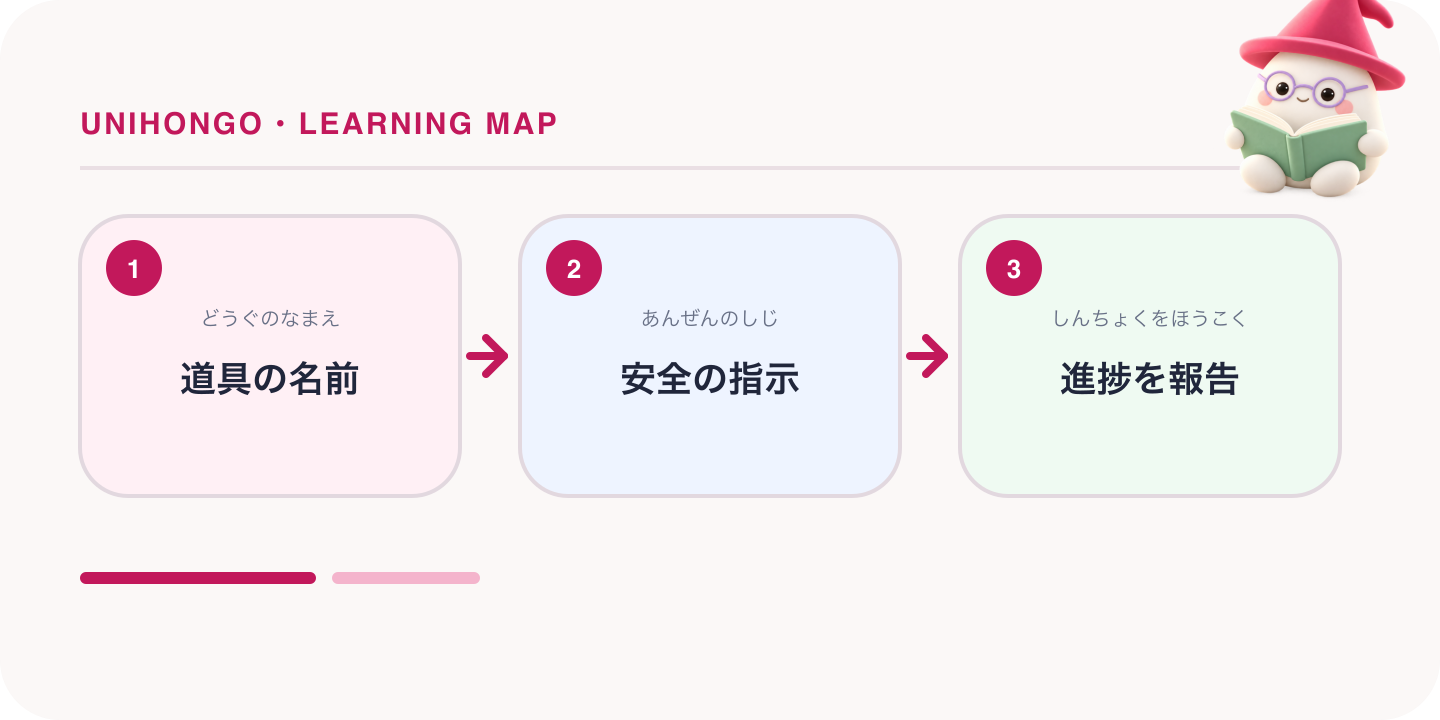
The site will teach you the words whether you like it or not, but it will teach them by embarrassment unless you get ahead of it. Spend the first week on reflexes only: the danger words and the call-and-reply pairs, said aloud at full volume until they need no thought. In the second week add the fetch vocabulary and the asking-again phrases, and use them for real every day. From the third week, practise the hazard and injury reports, because those are the ones you hope never to need and therefore never rehearse. Keep every practice loud; a whispered abunai is a different word.
- Week one: the twelve danger words and the ten call-and-reply pairs, shouted, with the pointing gesture
- Week two: tool and material names said aloud as you touch each object, plus the four asking-again phrases used at least once a day
- Week three: three hazard reports and three injury reports rehearsed in the where, what, who order
- Week four: the assembly script and the end-of-day pairs, then record yourself and check that every reply is audible from ten metres