
The tomeji: the kanji that ends a name
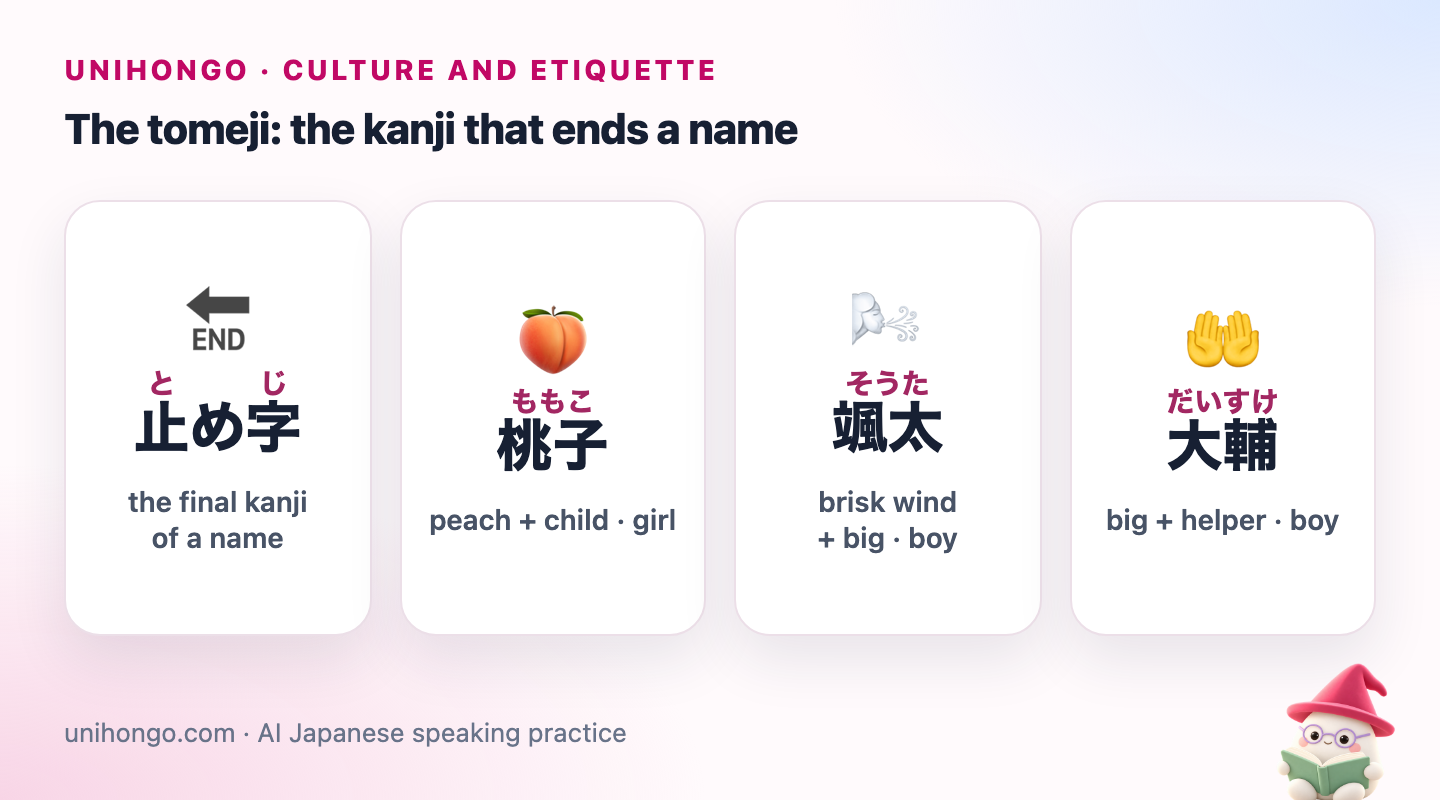
Tomeji (止め字) literally means the stopping character: the last kanji of a given name. Parents and naming books treat it as its own decision, because it sets the tone of the whole name. The three names on the cards show three classic endings: -ko for a girl, -ta and -suke for boys.
| Japanese | Romaji | Meaning |
|---|---|---|
| 止め字 | tomeji | the final kanji of a name |
| 桃子 | Momoko | peach + child · girl |
| 颯太 | Sōta | brisk wind + big · boy |
| 大輔 | Daisuke | big + helper · boy |
The first kanji usually carries the main meaning, peach, wind or big, and the ending frames it. Swap the ending and the feel changes: 颯太 Sōta sounds lively and boyish, 颯真 Sōma sounds a little more modern and cool, according to many parents' taste.
Girls' name endings
These are the endings you will meet most in girls' names, from grandmothers to toddlers. The feel column is a general impression; individual names vary.
| Japanese | Romaji | Meaning |
|---|---|---|
| 涼子 | Ryōko | cool, refreshing + child · girl |
| 直美 | Naomi | honest + beauty · girl |
| 夏実 | Natsumi | summer + fruit · girl |
| 彩花 | Ayaka | colour + flower · girl |
| 静香 | Shizuka | quiet + fragrance · girl |
| 春菜 | Haruna | spring + greens · girl |
| 綾乃 | Ayano | woven pattern + no · girl |
| 真里 | Mari | true + village · girl |
| Ending | Kanji | Meaning | General feel |
|---|---|---|---|
| -ko | 子 | child | Classic, clear; very common in older generations |
| -mi | 美 / 実 | beauty / fruit | Gentle, timeless |
| -ka | 花 / 香 / 華 / 佳 | flower / fragrance / splendour / fine | Bright, feminine |
| -na | 菜 / 奈 | greens / (sound) | Soft, popular in recent decades |
| -no | 乃 | (sound, old particle) | Elegant, classic with a modern revival |
| -ri | 莉 / 里 | jasmine / village | Light, modern |
| -e | 恵 / 江 / 絵 | blessing / inlet / picture | Classic, gentle |
Many recent girls' names end in a sound rather than a meaning. Two-kanji names ending in -na, -ri, -ka or -no became very common from the Heisei era, while -ko and -e names belong more to the Showa era. A grandmother called Setsuko and a granddaughter called Rina are a very typical pair.
Some endings, like 奈 (na) and 乃 (no), are chosen mainly for their sound. 奈 has little everyday meaning of its own, and 乃 is an old character that once worked like the particle no. Parents like them because they look graceful and let the first kanji carry the meaning.
Boys' name endings
Boys' endings often carry ideas of size, strength, reliability or brightness. Some, like -rō and -o, are classic; others, like -to and -ma, became especially common in names given from the Heisei era onwards.
| Japanese | Romaji | Meaning |
|---|---|---|
| 亮太 | Ryōta | clear, bright + big · boy |
| 圭介 | Keisuke | jewel + mediator · boy |
| 直樹 | Naoki | honest + tree · boy |
| 隼人 | Hayato | falcon + person · boy |
| 健斗 | Kento | healthy + dipper · boy |
| 拓也 | Takuya | to open up + ya · boy |
| 洋平 | Yōhei | ocean + calm · boy |
| Ending | Kanji | Meaning | General feel |
|---|---|---|---|
| -ta | 太 | big, thick | Cheerful, sturdy, boyish |
| -suke | 介 / 輔 / 助 | mediator / help / assist | Kind, reliable |
| -rō | 郎 | son | Classic, often in compounds like -tarō |
| -ki | 樹 / 輝 / 貴 | tree / shine / noble | Steady, bright |
| -to | 斗 / 人 / 翔 | dipper / person / soar | Modern, very common recently |
| -ya | 也 / 哉 | (sound, old particles) | Classic, crisp |
| -ma | 真 / 馬 | true / horse | Modern, cool |
| -hei | 平 | flat, calm | Easygoing, friendly |
Compound endings are common too. -Tarō (太郎) and -jirō (次郎) join big or second with son, as in 健太郎 Kentarō. -Nosuke (之介) adds an old particle in front of -suke, as in 龍之介 Ryūnosuke, and gives a name a slightly historical, dashing sound. -Hiko (彦) and -o (夫, 男) mark a classic, older style that you will meet among grandfathers more than toddlers.
-To is the ending people most associate with boys' names of the last twenty years or so, written 斗, 人 or 翔, and often heard in names such as Haruto or Yamato. Because it is so widespread, a nursery may have several boys whose names end in -to, each with different kanji.
One ending, several kanji
The same sound can be written with different kanji, and each one shifts the meaning. This is often how parents finally decide between two names that sound identical. Here are the three endings where the choice matters most.
| Japanese | Romaji | Meaning |
|---|---|---|
| 優花 | Yūka | kind + flower: pretty, natural · girl |
| 優香 | Yūka | kind + fragrance: subtle, graceful · girl |
| 優華 | Yūka | kind + splendour: glamorous · girl |
| 大介 | Daisuke | big + mediator: helps others · boy |
| 大輔 | Daisuke | big + support: strong helper · boy |
| 大樹 | Daiki | big + tree: steady, grounded · boy |
| 大輝 | Daiki | big + shine: bright, dazzling · boy |
Both Daisukes are common; 輔 has more strokes and is sometimes chosen for the way it looks or for its stroke count. The nuance in the glosses is the impression many people describe, not a dictionary rule, and every family will tell you its own reason.
When the ending does not tell you the gender
Endings are a strong clue, but the kanji decides. Several sounds end both girls' and boys' names, and you only know which once you see how it is written. Others, especially -ki and -ri, are increasingly used for any gender.
| Japanese | Romaji | Meaning |
|---|---|---|
| 菜緒 | Nao | greens + cord · girl |
| 拓海 | Takumi | open up + sea · boy |
| 美希 | Miki | beauty + hope · girl |
| 瑞希 | Mizuki | auspicious + hope · unisex |
| Sound | Girls' kanji | Boys' kanji |
|---|---|---|
| -o | 緒 (cord): 菜緒 Nao | 男 / 夫 (man): 和男 Kazuo |
| -mi | 美 (beauty): 直美 Naomi | 海 (sea): 拓海 Takumi |
| -ki | 希 (hope): 美希 Miki | 樹 (tree): 直樹 Naoki |
| -ya | 弥 (more and more): 沙弥 Saya | 也 / 哉: 拓也 Takuya |
Because of this, Japanese people do not rely on the ending alone when it matters, for example in business email. If you cannot tell, use the surname with -san or -sama, which is correct for everyone.
Talking about name endings
Parents, friends and teachers talk about endings openly, and asking about one is a natural, friendly question. These phrases cover explaining an ending, asking why it was chosen and commenting on the feel.
| Japanese | Romaji | Meaning |
|---|---|---|
| 止め字は「斗」にしました。 | Tomeji wa "to" ni shimashita. | We chose 斗 as the ending. |
| 「すけ」は、介護の「介」です。 | "Suke" wa, kaigo no "kai" desu. | The suke is the kai of kaigo, care. |
| 「子」がつく名前、最近また見ますね。 | "Ko" ga tsuku namae, saikin mata mimasu ne. | You see -ko names again lately. |
| 男の子らしい名前ですね。 | Otoko no ko rashii namae desu ne. | It's a nice boyish name. |
| どうして「香」にしたんですか。 | Dōshite "ka" ni shita n desu ka. | Why did you choose 香 for ka? |
Mini dialogue: a language exchange
At a language exchange, your partner Keisuke explains his name.
| Japanese | Romaji | Meaning |
|---|---|---|
| 圭介さんの「介」って、どういう意味ですか。 | Keisuke san no "suke" tte, dō iu imi desu ka. | You: What does the suke in Keisuke mean? |
| 人と人の間に立つ、という意味があるんです。 | Hito to hito no aida ni tatsu, to iu imi ga aru n desu. | Keisuke: It has the sense of standing between people. |
| だから、人を助ける人に、って。 | Dakara, hito o tasukeru hito ni, tte. | Keisuke: So, to be someone who helps others, they said. |
| 素敵ですね。「圭」は? | Suteki desu ne. "Kei" wa? | You: That's lovely. And the kei? |
| 宝石のような玉のことです。 | Hōseki no yō na tama no koto desu. | Keisuke: It means a precious jade-like stone. |
Sort the endings with Mocchi
Ask Mocchi, "Quiz me on Japanese name endings: give me a name, I tell you the ending, its kanji meaning and whether it is usually a girl's or boy's name." Mocchi runs the quiz one name at a time, explains the -o and -mi traps when you fall into them, and keeps track of the endings you miss for your next review.
Then ask Mocchi to make flashcards from the names you missed, and stack them up in Kotoba Stack, building the tower name by name with your own deck.
Mistakes learners make with name endings
- Deciding gender from the sound alone. Nao, Mizuki and Hikaru can be anyone; the kanji, or simply asking, tells you.
- Thinking -ko is only for older women. It is less common among babies than it was, but you will meet young -ko names too.
- Translating every ending literally. 奈, 乃 and 也 are mostly chosen for their sound, so 春奈 Haruna simply means spring with a graceful ending.
- Mixing up 介 and 輔. They sound the same in Daisuke but are different kanji; check before writing a card or email.
- Adding -chan or -kun based on a guess. Use the surname with -san until you know the person.