Japanese for Accompanying Spouses in Japan: Dependent Visa Life and Work
If you moved to Japan because your partner's job brought you here, you are probably on a dependent status such as kazoku taizai (家族滞在), and your days are built around paperwork, errands and a new neighbourhood rather than an office. The Japanese you need is daily-life Japanese: city hall, the clinic, the neighbour in the lift, the volunteer language class. This guide gives you those phrases and the lines for finding work when you are ready.
Japanese for Accompanying Spouses in Japan: Dependent Visa Life and Work
The accompanying spouse has the hardest and least discussed language situation in Japan. The working partner has colleagues and a routine; the spouse has an empty flat, a stack of forms and a city that does not yet know them. The good news is that the spouse also has the most contact with everyday Japanese, and that contact is the fastest route to speaking. This post follows the first months. It starts with the words of your status and the city hall procedures, then helps you build a routine out of places where Japanese is spoken slowly, such as volunteer classes and libraries. It gives the lines for meeting neighbours and turning an acquaintance into a friend, the Japanese for clinic, dental and bank appointments, honest words for the lonely stretches, and finally the vocabulary and phrases for looking for work, including the permission that dependent-status holders commonly apply for before taking a job. Immigration and insurance rules are described in general terms only and change over time; confirm your own situation with the immigration office, your city hall and official sources.
Kazoku taizai is the common dependent status; shikakugai katsudō kyoka is the permission many need before working
First weeks: tennyū todoke at city hall, residence card, insurance under a spouse's fuyō or national insurance
Routine builders: nihongo kyōshitsu volunteer classes, the library, the gym, a daily walk
Neighbours become friends through gomi questions and yokattara kondo ocha shimasen ka
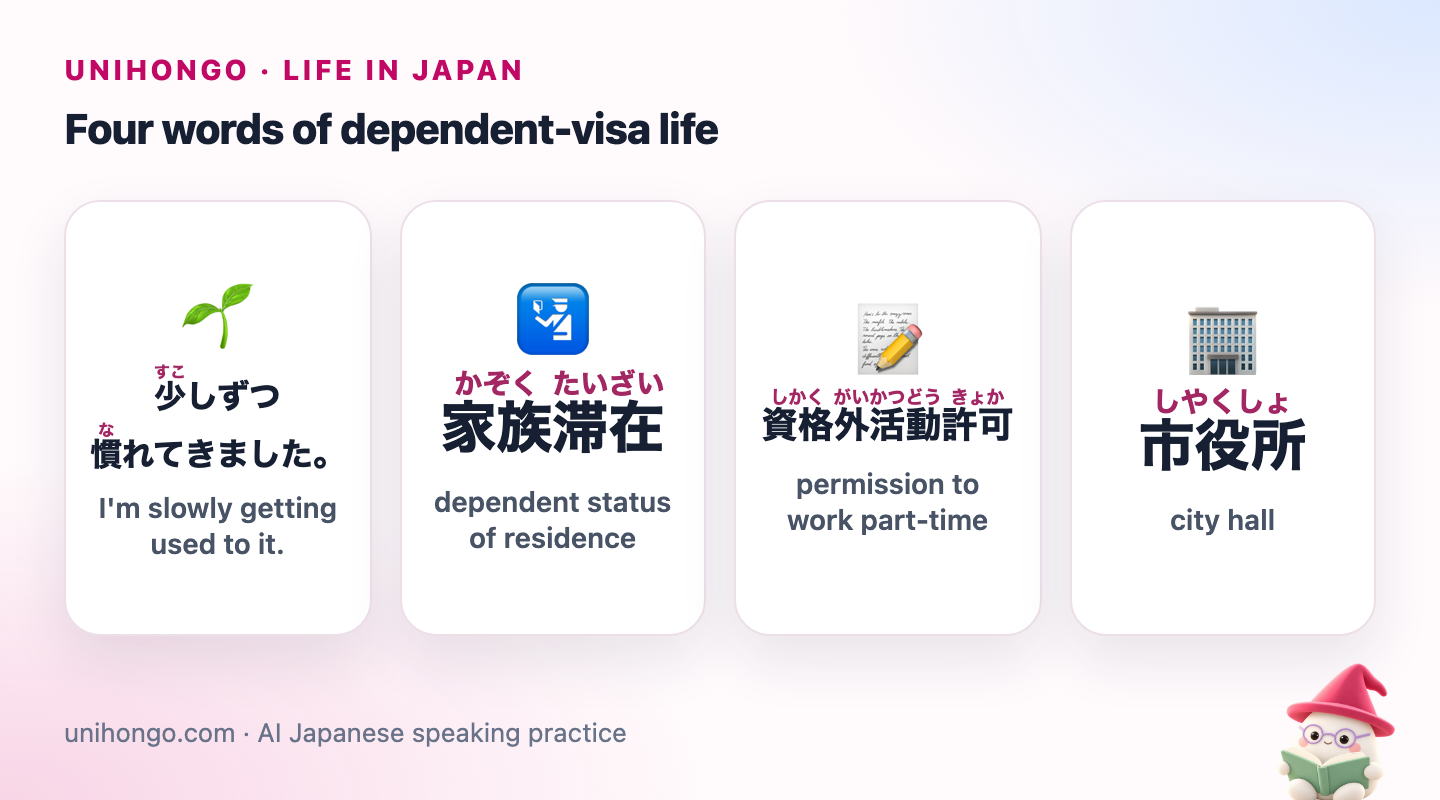
Four words of dependent-visa life
Sukoshi zutsu narete kimashita, I am slowly getting used to it, is the honest answer to the question every Japanese acquaintance will ask you, and a sentence worth owning. Kazoku taizai (家族滞在) is the dependent status most accompanying spouses hold. Shikakugai katsudō kyoka (資格外活動許可) is the permission many apply for before working part-time. Shiyakusho (市役所), city hall, is where the first weeks happen; in Tokyo's wards it is the kuyakusho (区役所).
The sentence you will say most, your status, the permission to work, and the building where it all starts.
Japanese
Romaji
Meaning
少しずつ慣れてきました。
Sukoshi zutsu narete kimashita.
I'm slowly getting used to it.
家族滞在
kazoku taizai
dependent status of residence
資格外活動許可
shikakugai katsudō kyoka
permission to work part-time
市役所
shiyakusho
city hall
The first weeks: city hall and insurance
Within days of moving in, you file a tennyū todoke (転入届), a move-in notice, at city hall, with your zairyū kādo (在留カード), the residence card issued at the airport or immigration office. Health insurance follows: a spouse whose partner is on company insurance is often added as a dependant, fuyō (扶養), through the partner's employer, while others join kokumin kenkō hoken (国民健康保険), national health insurance, at city hall. Which applies depends on the partner's job and your income; the clerk or the employer's HR will tell you. Expect the My Number notification and ask whether English guidance exists, without counting on it.
Japanese
Romaji
Meaning
転入届を出したいです。
Tennyū todoke o dashitai desu.
I'd like to register my move-in.
在留カードはこちらです。
Zairyū kādo wa kochira desu.
Here is my residence card.
夫の扶養に入っています。
Otto no fuyō ni haitte imasu.
I'm a dependant on my husband's insurance.
妻の会社の保険に入っています。
Tsuma no kaisha no hoken ni haitte imasu.
I'm on my wife's company insurance.
英語の案内はありますか。
Eigo no annai wa arimasu ka.
Is there a guide in English?
もう一度ゆっくりお願いします。
Mō ichido yukkuri onegai shimasu.
Once more, slowly please.
銀行口座を開きたいです。
Ginkō kōza o hirakitai desu.
I'd like to open a bank account.
Building a routine where Japanese is spoken slowly
Without an office, the week needs a frame, and the best frames are places where people speak to you patiently. Many municipalities have a kokusai kōryū kyōkai (国際交流協会), an international association, which runs volunteer nihongo kyōshitsu (日本語教室), often weekly. The library, toshokan, issues cards to residents and runs children's story hours. Gyms, kōminkan (公民館) community centres and a daily walk at the same hour create the small repeated encounters from which neighbourhood life is built.
Japanese
Romaji
Meaning
日本語教室はありますか。
Nihongo kyōshitsu wa arimasu ka.
Is there a Japanese class?
初心者でも大丈夫ですか。
Shoshinsha demo daijōbu desu ka.
Is it all right for beginners?
週に一回通っています。
Shū ni ikkai kayotte imasu.
I go once a week.
図書館のカードを作りたいです。
Toshokan no kādo o tsukuritai desu.
I'd like to make a library card.
ジムの見学はできますか。
Jimu no kengaku wa dekimasu ka.
Can I look around the gym?
毎朝、散歩しています。
Maiasa, sanpo shite imasu.
I take a walk every morning.
Place
Reading
What it offers a newcomer
国際交流協会
kokusai kōryū kyōkai
Volunteer Japanese classes, events, advice
公民館
kōminkan
Community centre with classes and clubs
図書館
toshokan
Free card, picture books, quiet hours
児童館
jidōkan
Children's centre; parents meet other parents
Neighbours and the road to friends
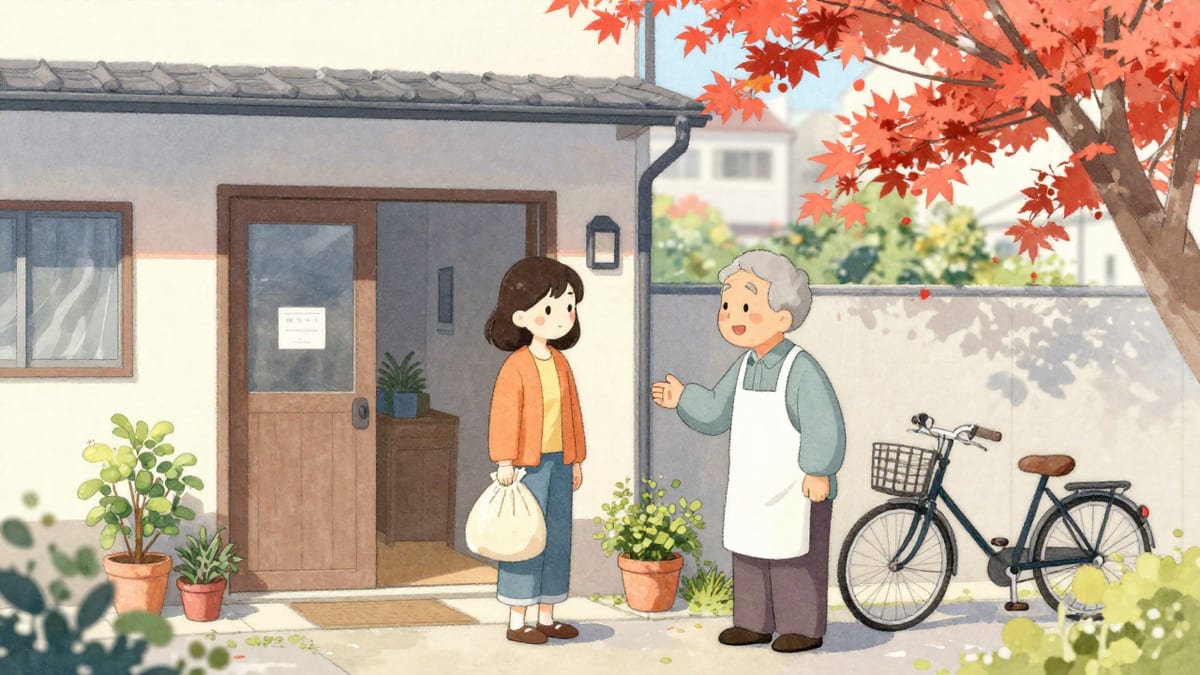
Neighbour conversations start with a self-introduction and a practical question, and rubbish is the perfect one: every newcomer needs to know the schedule, and every neighbour knows it. Say why you came, admit your Japanese is still growing, and let the conversation stay short. After a few such meetings, an invitation to tea is natural. Japanese friendships often grow by regular small contact rather than one big invitation, so the aim is to be seen, kindly, again and again.
The neighbour at the bins: a self-introduction, a practical question, and the first step toward a friend.
Japanese
Romaji
Meaning
隣に引っ越してきました。
Tonari ni hikkoshite kimashita.
I've just moved in next door.
夫の仕事で日本に来ました。
Otto no shigoto de Nihon ni kimashita.
I came to Japan for my husband's job.
日本語はまだ勉強中です。
Nihongo wa mada benkyōchū desu.
I'm still learning Japanese.
ゴミの出し方を教えてください。
Gomi no dashikata o oshiete kudasai.
Please tell me how to put out the rubbish.
よかったら、今度お茶しませんか。
Yokattara, kondo ocha shimasen ka.
If you like, shall we have tea sometime?
子どもは同じ学校ですか。
Kodomo wa onaji gakkō desu ka.
Are our children at the same school?
Appointments: clinic, dentist, bank
Appointments are where a spouse's Japanese is tested alone. Clinics ask whether it is your first visit, shoshin (初診), and for your hokenshō (保険証), insurance card, or its digital equivalent. Asking for an English-speaking doctor is fine, and the answer is often no, so have your symptom sentences ready. Dentists book cleanings, kurīningu, by appointment. For children, the city sends schedules for yobō sesshu (予防接種), vaccinations, and clinics will explain them if you ask.
Japanese
Romaji
Meaning
予約をお願いします。
Yoyaku o onegai shimasu.
I'd like to make an appointment.
初診です。保険証はあります。
Shoshin desu. Hokenshō wa arimasu.
It's my first visit. I have my insurance card.
英語が話せる先生はいますか。
Eigo ga hanaseru sensei wa imasu ka.
Is there a doctor who speaks English?
子どもの予防接種について聞きたいです。
Kodomo no yobō sesshu ni tsuite kikitai desu.
I'd like to ask about my child's vaccinations.
歯のクリーニングをお願いします。
Ha no kurīningu o onegai shimasu.
I'd like a dental cleaning.
次はいつ来ればいいですか。
Tsugi wa itsu kureba ii desu ka.
When should I come next?
The lonely stretches, and the small wins
Most accompanying spouses describe a dip a few months in, when the novelty has gone and the friends have not yet arrived. Having Japanese words for it helps, both with your partner and with the one acquaintance who asks how you really are. Sabishii toki mo arimasu, there are lonely times too, is honest without being heavy. Then there are the wins: the first friend, the first solo hospital visit, the day you realise you can speak a little. Say them aloud; narete kimashita, I have been getting used to it, is a sentence that becomes truer each time.
Japanese
Romaji
Meaning
寂しいときもあります。
Sabishii toki mo arimasu.
There are lonely moments too.
友達ができました。
Tomodachi ga dekimashita.
I've made a friend.
日本の生活に慣れてきました。
Nihon no seikatsu ni narete kimashita.
I'm getting used to life in Japan.
最近、少し話せるようになりました。
Saikin, sukoshi hanaseru yō ni narimashita.
Lately I've become able to speak a little.
今日は一人で病院に行けました。
Kyō wa hitori de byōin ni ikemashita.
Today I managed the hospital on my own.
Finding work later
When you are ready to work, the first step for most dependent-status holders is applying to immigration for shikakugai katsudō kyoka, which commonly allows part-time work within a weekly hour limit; full-time work generally means changing to a work status, which depends on the job and your qualifications. Check the current rules with the immigration office. Then the search: the public employment office, Harōwāku (ハローワーク), has offices in every city and some with foreign-language support; schools, cafés and companies with international customers often value a bilingual spouse; and remote work, zaitaku (在宅), fits the hour limit well. A rirekisho (履歴書) is the standard CV, usually in a fixed format.
Japanese
Romaji
Meaning
資格外活動許可を申請したいです。
Shikakugai katsudō kyoka o shinsei shitai desu.
I'd like to apply for permission to work.
週に20時間くらい働けます。
Shū ni nijūjikan kurai hatarakemasu.
I can work about 20 hours a week.
在宅でできる仕事を探しています。
Zaitaku de dekiru shigoto o sagashite imasu.
I'm looking for work I can do from home.
英語を教えた経験があります。
Eigo o oshieta keiken ga arimasu.
I have experience teaching English.
履歴書を持ってきました。
Rirekisho o motte kimashita.
I've brought my CV.
フルタイムで働く場合、在留資格の変更は必要ですか。
Furutaimu de hataraku baai, zairyū shikaku no henkō wa hitsuyō desu ka.
If I work full-time, do I need to change my status?
Common mistakes
Calling your own husband goshujin or your own wife okusan. Say otto and tsuma; the honorific words are for other people's spouses.
Waiting to speak until your Japanese is good. The clerk, the neighbour and the receptionist all expect simple sentences; perfection is not the price of entry.
Working before the permission is granted. Dependent status does not include work by default; apply first and confirm the limit.
Letting the partner handle every call. Each appointment you do alone is a lesson no class can give.
Treating loneliness as failure. It is the normal middle of the story, and the phrases above help you say so.
Key points
A practical way to improve
The spouse's advantage is daily real-life Japanese; the disadvantage is that each errand happens once. Speaking practice fills the gap. First, before each appointment, say your three key sentences aloud: who you are, what you need, and one question. Second, in Unihongo's immersive 3D classroom, ask your AI Sensei to play a city hall clerk while you register your move and ask about insurance, then a neighbour you meet at the bins, then a receptionist at a clinic; ask it to speak more slowly at first, then at natural speed. The Describe Symptoms at a Clinic mission is worth running before your first visit to a doctor. Third, once a week, simply tell the Sensei about your week in Japanese. The session report afterwards lists corrections and vocabulary, and watching that list grow is a real measure of settling in.
1
Choose one clear goal
Focus each session on a situation or skill you can actually use.
2
Practice actively
Say complete answers aloud instead of only reading or recognizing Japanese.
3
Review and repeat
Keep useful corrections and revisit the same skill until it feels natural.
FAQ
Frequently asked questions
What is kazoku taizai?
Kazoku taizai (家族滞在) is the dependent status of residence for the spouse or child of a foreigner who holds a work or study status in Japan. It allows you to live in Japan but not to work by default. Spouses of Japanese nationals or permanent residents hold a different status with different rules. Check the immigration office's official information for your case.
Can an accompanying spouse work in Japan?
Commonly, a dependent-status holder applies for shikakugai katsudō kyoka, permission to engage in activities outside the status, which allows part-time work up to a weekly hour limit set by the immigration office. Full-time work usually requires changing to a work status. Rules and limits change, so confirm them with immigration before accepting a job.
Where can I learn Japanese cheaply as a spouse in Japan?
Many cities have volunteer nihongo kyōshitsu run by the local international association, kokusai kōryū kyōkai, often weekly and free or very cheap. Ask at city hall or the association. They are also where many spouses make their first friends.
How do I make Japanese friends as a stay-at-home spouse?
Start with the people you see daily: neighbours, parents at the school gate, people at the class or gym. Ask practical questions such as how to put out the rubbish, and when the conversation warms, propose tea with yokattara, kondo ocha shimasen ka. Small regular contact works better in Japan than a single bold invitation.
Turn Japanese knowledge into speaking confidence
Practice with Unihongo's AI Sensei in an immersive 3D classroom, with roleplay missions, pronunciation coaching, useful feedback, and learning games that build your vocabulary while you play.