

Dō shita no and dō shimashita ka: the all-purpose question
Dō shita no is built from dō, how, and shita, the past of suru, to do, so it literally asks how did you do, and in practice it means what is wrong, what is up, or what happened. It is the question you ask when a friend goes quiet, when a child is crying, when someone is holding their arm, or when a colleague suddenly stands up from their desk. The polite version is dō shimashita ka, and the casual version among close friends is often shortened to dō shita? with rising intonation.
Because it is so general, dō shita no does not commit you to any assumption, which makes it the safest opener. Dō shita n desu ka, with n desu, signals that you have seen evidence and want the explanation; it sounds a little more engaged and is the version you hear from friendly shop staff and nurses.
| Japanese | Romaji | Meaning |
|---|---|---|
| どうしたの? | Dō shita no? | What's wrong? (casual) |
| どうしましたか。 | Dō shimashita ka. | What happened? / Is something wrong? (polite) |
| どうしたんですか。 | Dō shita n desu ka. | What happened? (polite, engaged) |
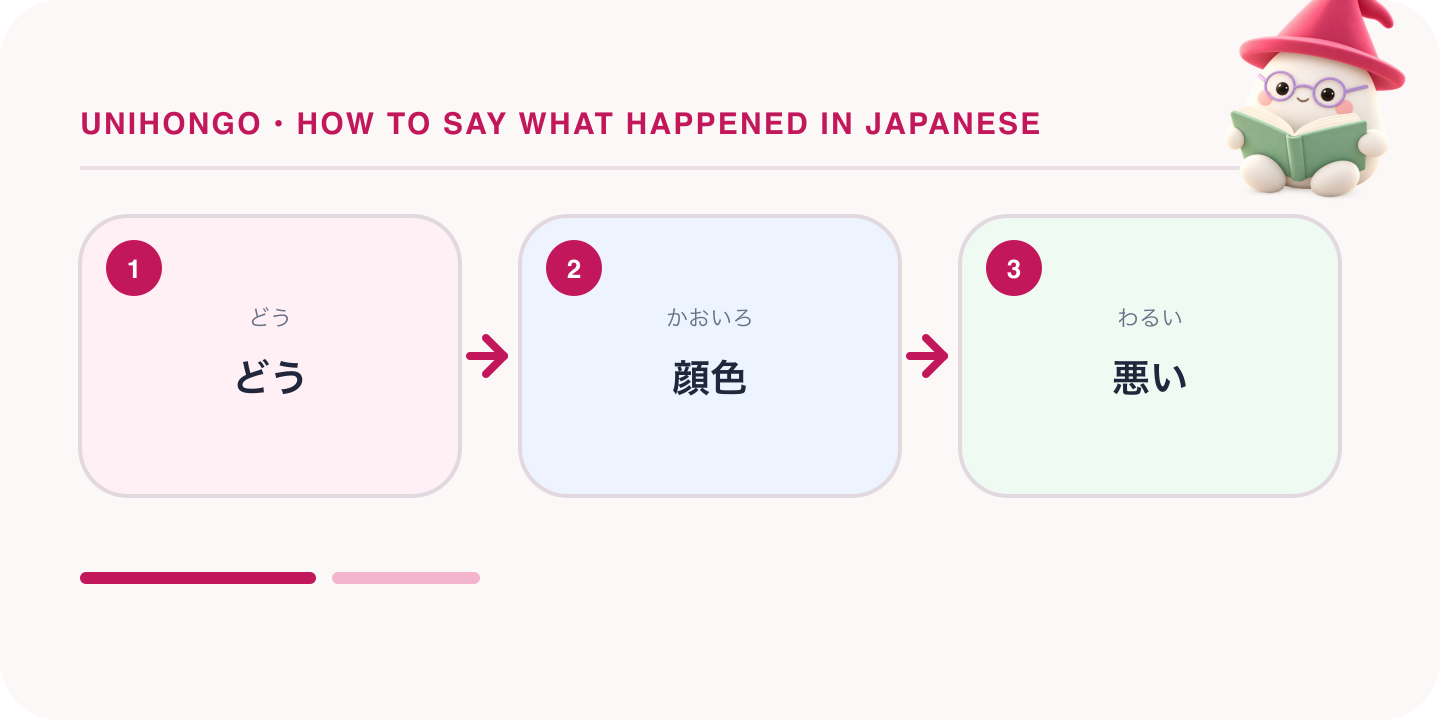
| どうした?顔色が悪いよ。 | Dō shita? Kaoiro ga warui yo. | What's up? You look pale. |
| どうしたの、急に。 | Dō shita no, kyū ni. | What's wrong, all of a sudden? |
Nani ga atta no: asking for the event
Nani ga atta no comes from nani, what, and atta, the past of aru, to exist, so it asks what was there, meaning what event took place. It is the phrase you use when the person's state clearly comes from something specific: they walk in soaked, they hang up the phone looking shaken, or they say sorry I'm late in a strained voice. Nani ga atta no invites the story rather than the mood.
The polite form is nani ga atta n desu ka, and among friends people often shorten it to nani ga atta? or even nani atta? Because it assumes an event, it can feel a little pushy if nothing has actually happened, so dō shita no is often asked first and nani ga atta no follows once the person confirms that something is wrong.
For a past event you did not witness, such as a problem in a meeting you missed, nani ga atta n desu ka is also the neutral question, close to what happened there.
| Japanese | Romaji | Meaning |
|---|---|---|
| 何があったの? | Nani ga atta no? | What happened? (casual) |
| 何があったんですか。 | Nani ga atta n desu ka. | What happened? (polite) |
| 昨日、何があったの? | Kinō, nani ga atta no? | What happened yesterday? |
| 会議で何があったんですか。 | Kaigi de nani ga atta n desu ka. | What happened in the meeting? |
| 一体何があったの? | Ittai nani ga atta no? | What on earth happened? |
Nanka atta? and other soft openers
Nanka atta? is the casual, gentle way to ask whether something is up. Nanka is the spoken form of nani ka, something, so the question is did something happen, and because it is a yes or no question it gives the other person an easy way out: iya, betsu ni, no, not really. It suits a housemate who seems off or a colleague who sighs at the next desk.
In polite speech the same softness comes from nani ka arimashita ka. Adding hanashitakunakattara ii kedo, you don't have to tell me, signals that you are offering an ear rather than demanding an account.
Daijōbu?, are you all right, often does the job of what happened on its own. Many Japanese speakers start with daijōbu and only ask dō shita no if the answer is not a clear yes.
| Japanese | Romaji | Meaning |
|---|---|---|
| なんかあった? | Nanka atta? | Did something happen? |
| 何かありましたか。 | Nani ka arimashita ka. | Did something happen? (polite) |
| 大丈夫?なんか元気ないね。 | Daijōbu? Nanka genki nai ne. | You okay? You seem a bit down. |
| 話したくなかったらいいけど、なんかあった? | Hanashitakunakattara ii kedo, nanka atta? | You don't have to tell me, but did something happen? |
| もしよかったら聞くよ。 | Moshi yokattara kiku yo. | If you like, I'll listen. |
At work: dō sareta n desu ka and keeping concern respectful
In an office, the person you are asking may be a senior, a client or a visitor, and the plain dō shita no would sound too familiar. Dō shimashita ka is fine for colleagues at your level. For seniors and clients, dō sareta n desu ka uses the respectful form sareru of suru, and it is the phrase you will hear from reception staff, hotel staff and anyone in customer service when a guest looks troubled.
Ikaga nasaimashita ka is the most formal version, used by staff to customers, and worth recognising even if you rarely say it. When a colleague comes back late or looks unwell, the natural pattern is a short polite question followed by an offer of help. Do not press for details: if the answer is chotto, a little, accept it and offer something practical, such as covering a task or letting the manager know.
| Japanese | Romaji | Meaning |
|---|---|---|
| どうされたんですか。 | Dō sareta n desu ka. | What happened? (respectful) |
| いかがなさいましたか。 | Ikaga nasaimashita ka. | Is something the matter? (very formal, staff to customer) |
| お顔の色がすぐれませんが、大丈夫ですか。 | O-kao no iro ga suguremasen ga, daijōbu desu ka. | You look unwell; are you all right? |
| 何かお手伝いできることはありますか。 | Nani ka o-tetsudai dekiru koto wa arimasu ka. | Is there anything I can help with? |
| 部長に伝えておきましょうか。 | Buchō ni tsutaete okimashō ka. | Shall I let the manager know? |
The replies you will hear, and how to give them
Once you ask, you need to understand the answer, and sooner or later you will be the one answering. Replies fall into three groups. The first says nothing is wrong: nan demo nai, betsu ni, daijōbu. The second gives the event in a short sentence, usually ending in the te form or n da to explain: densha ga tomatte, the train stopped; saifu o nakushita n da, I lost my wallet. The third declines to explain: chotto ne, chotto iroiro atte, a bit of everything has been going on.
When you reply with an event, give the fact first and the feeling second, if at all. Densha ga tomatte okurete shimatta, the train stopped and I ended up late, is a complete answer, and at work an apology often comes attached: sumimasen, chotto taichō ga warukute.
| Reply | Reading | What it tells you |
|---|---|---|
| 何でもない | Nan demo nai | It's nothing; may be true or a gentle brush-off |
| 別に | Betsu ni | Not really; casual, sometimes sulky |
| 大丈夫 | Daijōbu | I'm fine; check once more if the face says otherwise |
| ちょっとね | Chotto ne | It's something, but I'd rather not say |
| ちょっといろいろあって | Chotto iroiro atte | A lot has been going on; do not press |
| 電車が止まって | Densha ga tomatte | The train stopped (a common reason for lateness) |
| 財布をなくしたんだ | Saifu o nakushita n da | I lost my wallet; offer practical help |
| 体調が悪くて | Taichō ga warukute | I'm feeling unwell |
| 実は、聞いてほしいことがあって | Jitsu wa, kiite hoshii koto ga atte | Actually, there's something I want to tell you |
A reply ending in te or atte with nothing after it is not an unfinished sentence. The trailing form leaves the consequence unsaid, and the listener is expected to fill it in with sō ka, taihen datta ne, I see, that was rough.
Showing concern after the answer
What you say after the answer matters more than the question. Japanese conversation leans on short acknowledgements and on naming the other person's situation rather than analysing it. Taihen datta ne, that was hard, and sore wa shinpai da ne, that's worrying, show you have taken it in; taihen deshita ne is the polite form. Offer help concretely and lightly, avoid rushing to advice, and avoid a string of follow-up questions, which can feel like an interview.
| Japanese | Romaji | Meaning |
|---|---|---|
| 大変だったね。 | Taihen datta ne. | That was rough. |
| それは心配だね。 | Sore wa shinpai da ne. | That's worrying. |
| 大変でしたね。 | Taihen deshita ne. | That must have been hard. (polite) |
| 何かできることある? | Nani ka dekiru koto aru? | Is there anything I can do? |
| 無理しないでね。 | Muri shinaide ne. | Don't push yourself. |
| 話してくれてありがとう。 | Hanashite kurete arigatō. | Thanks for telling me. |
Asking what happened in text messages
In messages, the questions get shorter and the punctuation does the work of tone. どうしたの? and なんかあった? with a question mark are normal between friends, and 大丈夫? on its own is probably the most common of all. When someone posts a cryptic line such as 最悪, worst, or はぁ, sigh, the natural reply is どうした? or 何があった?
In work chat, keep the polite forms: どうしましたか? or 何かありましたか? If the person seems upset in a group chat, ask in a private message instead. A short offer, 聞くよ, I'll listen, or 電話しようか?, shall I call, turns the question into support.
- 大丈夫? is often the first message, before any question
- どうしたの? and なんかあった? suit friends; keep 何があったんですか? for colleagues
- A cryptic post such as 最悪 usually invites どうした?
- Move to a private message if the person seems upset in a group
- Follow with 聞くよ or 電話しようか? to show you mean it
Common mistakes: dō desu ka and other mix-ups
The biggest trap is dō desu ka, how is it, which learners reach for because it also starts with dō. Dō desu ka asks for an evaluation or an opinion: shigoto wa dō desu ka, how is work; kore wa dō desu ka, how about this one. Said to someone in distress it sounds detached, as if you are asking them to rate their day. Keep dō shita no for concern.
A second trap is over-formality with friends. Dō sareta n desu ka to a close friend sounds like a receptionist. Match the form to the relationship, and remember that a warm daijōbu? often does more than any of the longer questions. Finally, to ask how a story ended rather than what started it, use dō natta, what became of it.
| Japanese | Romaji | Meaning |
|---|---|---|
| 仕事はどうですか。 | Shigoto wa dō desu ka. | How is work? (not: what happened at work?) |
| 仕事で何かあったんですか。 | Shigoto de nani ka atta n desu ka. | Did something happen at work? |
| この部屋、どうしたの? | Kono heya, dō shita no? | What happened to this room? |
| その後、どうなった? | Sono ato, dō natta? | What happened after that? / How did it turn out? |
| 結局どうなりましたか。 | Kekkyoku dō narimashita ka. | How did it turn out in the end? |