
Use Mocchi's Pitch Curve as a Japanese Listening Guide

A pitch curve can help you notice the movement of a Japanese phrase, but it is a guide to compare with listening rather than a complete definition of natural speech. Ask Mocchi for focused practice and make one deliberate adjustment in a short line.

Mocchi connects a short Japanese phrase to a model pitch contour and a learner's listening comparison
What you need to know

Use Mocchi's Pitch Curve as a Japanese Listening Guide

Pitch is about relative height, not simply loudness. A learner can see a rising or falling line and still need to connect it to the sounds, word, and phrase. Start with a clear model and a manageable target. Mocchi's pronunciation activity can provide a curve and feedback according to the available mode. Keep the dialect or reference model in mind, and do not assume that one graphic captures every acceptable realization of Japanese across speakers and contexts.

Listen to the phrase before interpreting the curve.

Separate pitch height from loudness.

Keep the word and surrounding phrase in context.

Use actual feedback without treating the graphic as a verdict.

Begin with the sound rather than the picture

Listen to the supplied phrase and identify the part whose movement is difficult to hear or reproduce. Tell Mocchi what you notice before asking for a broad explanation of accent. A curve becomes more useful when it answers a listening question you have, rather than becoming a shape you try to copy without connecting it to the spoken line.

Keep the phrase short and vocabulary familiar. If the word meaning and grammar are unknown, attention may be divided before you can compare pitch. You can increase complexity after the first contrast is clear.

Keep a word contrast inside its reference context

Words such as 箸 and 橋 are often used to introduce a Tokyo-style pitch contrast, but the surrounding phrase and reference model still matter. Read a short sentence and listen rather than relying only on the shared spelling はし. Ask Mocchi to explain the target in plain high-and-low terms without pretending that spelling alone determines the pronunciation.
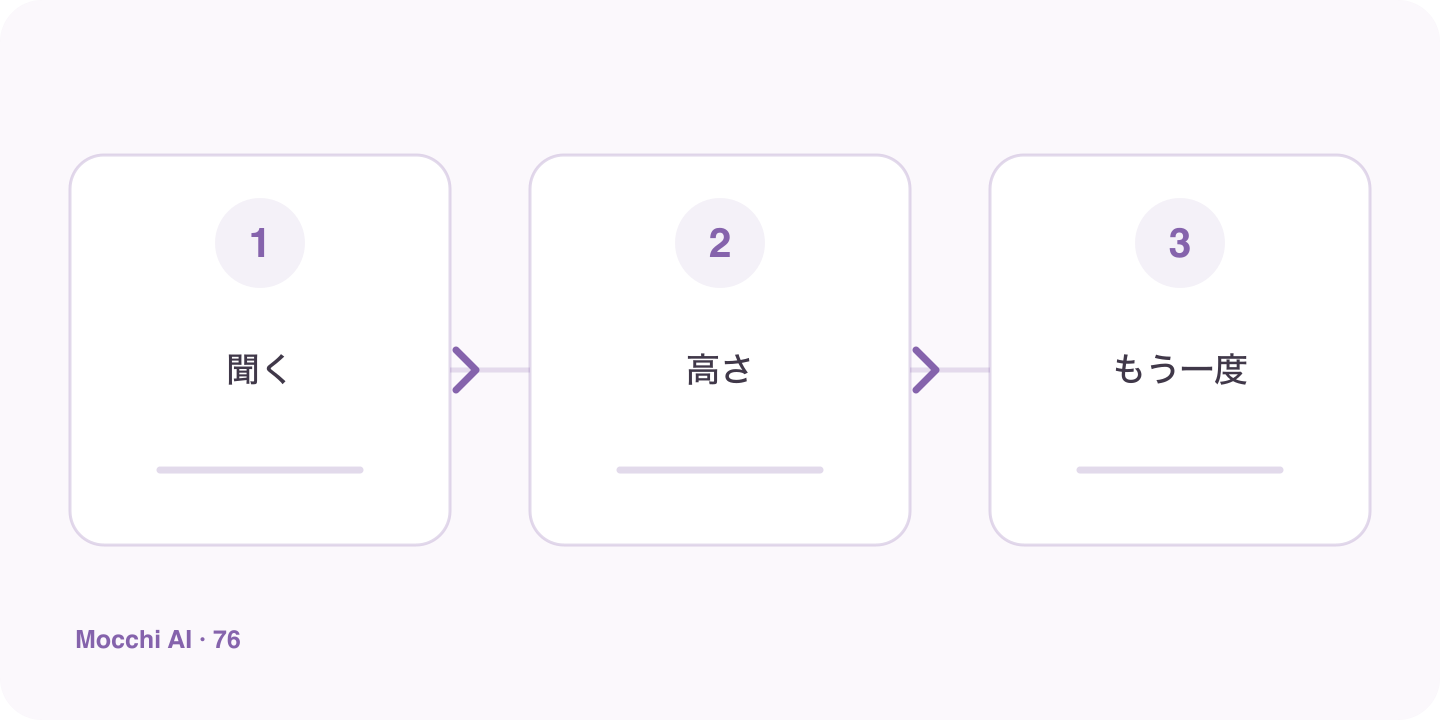
A model phrase, a pitch comparison, and a fresh spoken attempt form a focused pronunciation loop
Use the curve to support listening; pitch, word meaning, phrasing, and recording conditions all need context.
JapaneseRomajiMeaning
箸を使います。Hashi o tsukaimasu.I use chopsticks.
橋を渡ります。Hashi o watarimasu.I cross the bridge.

Compare one section under stable conditions

Use similar microphone placement and a quiet environment when comparing attempts. Choose one part of the line, listen again, and make a deliberate change. A curve can be affected by the recording, so an unexpected shape should prompt listening and a controlled retry rather than an immediate conclusion that your pronunciation has become worse.

Use reference tools for uncertain word patterns

When you want to check an accent pattern, consult an appropriate reference such as the Online Japanese Accent Dictionary and read its explanations of the available features. Distinguish a dictionary entry or predicted phrase contour from a universal rule for every spoken context. Mocchi can help you formulate the question and practice the target, while the source clarifies what its representation actually means.

Return the focus to an understandable phrase

After the comparison, say the phrase again while keeping its meaning in mind. If the graphic improves but the phrase becomes strained or difficult to understand, simplify and listen again. A useful personal routine balances the visual feedback with a new spoken attempt and a concrete next target. The aim is more controlled communication, not a perfectly traced line detached from Japanese you can use.

Key points

A practical way to improve

Ask Mocchi for pitch-focused pronunciation practice. Listen to the supplied line, make an attempt, and compare the reported curve with what you hear. Choose one section to adjust rather than changing the whole phrase at once. Then try another short line or return later under similar recording conditions. If a word's accent pattern is uncertain, consult an appropriate accent reference instead of guessing from spelling.

  1. 1

    Choose one clear goal

    Focus each session on a situation or skill you can actually use.

  2. 2

    Practice actively

    Say complete answers aloud instead of only reading or recognizing Japanese.

  3. 3

    Review and repeat

    Keep useful corrections and revisit the same skill until it feels natural.

FAQ

Frequently asked questions

Is pitch the same as speaking louder?

No. Pitch concerns relative sound height, while loudness is another dimension. Listen to the model and avoid trying to reproduce a contour only by stressing a word more strongly.

Does every Japanese speaker use one identical accent pattern?

No. Region, speaker, word form, and context can matter. Know the reference variety being practiced and avoid interpreting one model as the only possible Japanese pronunciation everywhere.

What if I see a curve but no graded score?

Use the mode the activity actually provides. A melody or curve-based exercise can support listening and repetition, but do not interpret it as a reported graded result when no score was supplied.

Let the curve sharpen your listening

Use Mocchi for a short comparison that keeps the phrase and the actual recording in view.