
The school morning in four lines
Every school morning in Japan has the same little script. The child says itte kimasu (literally, I'll go and come back) at the door; the parent answers itte rasshai (go and come back), often adding ki o tsukete ne, be careful. Then the child sets off along the tsūgakuro, the school route, often to meet the neighbourhood group.
In the afternoon the script reverses: tadaima (I'm home) and okaeri (welcome back). These four exchanges are so automatic that adults use them with coworkers too, for example when someone leaves the office on an errand.
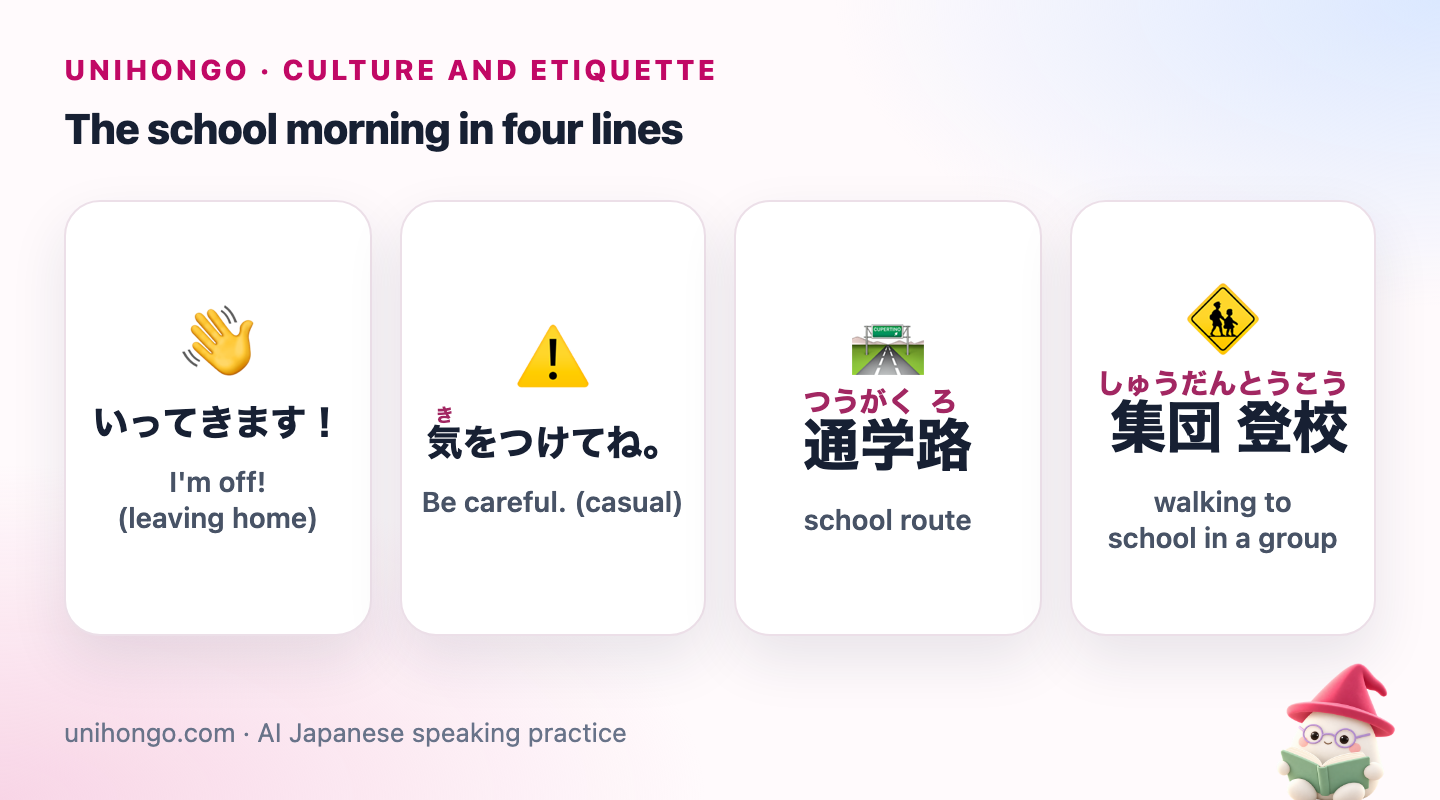
| Japanese | Romaji | Meaning |
|---|---|---|
| いってきます! | Itte kimasu! | I'm off! (leaving home) |
| 気をつけてね。 | Ki o tsukete ne. | Be careful. (casual) |
| 通学路 | tsūgakuro | school route |
| 集団登校 | shūdan tōkō | walking to school in a group |
| いってらっしゃい。 | Itte rasshai. | See you later. (to someone leaving) |
| ただいま。 | Tadaima. | I'm home. |
| おかえり。 | Okaeri. | Welcome back. (casual) |
How the system supports children
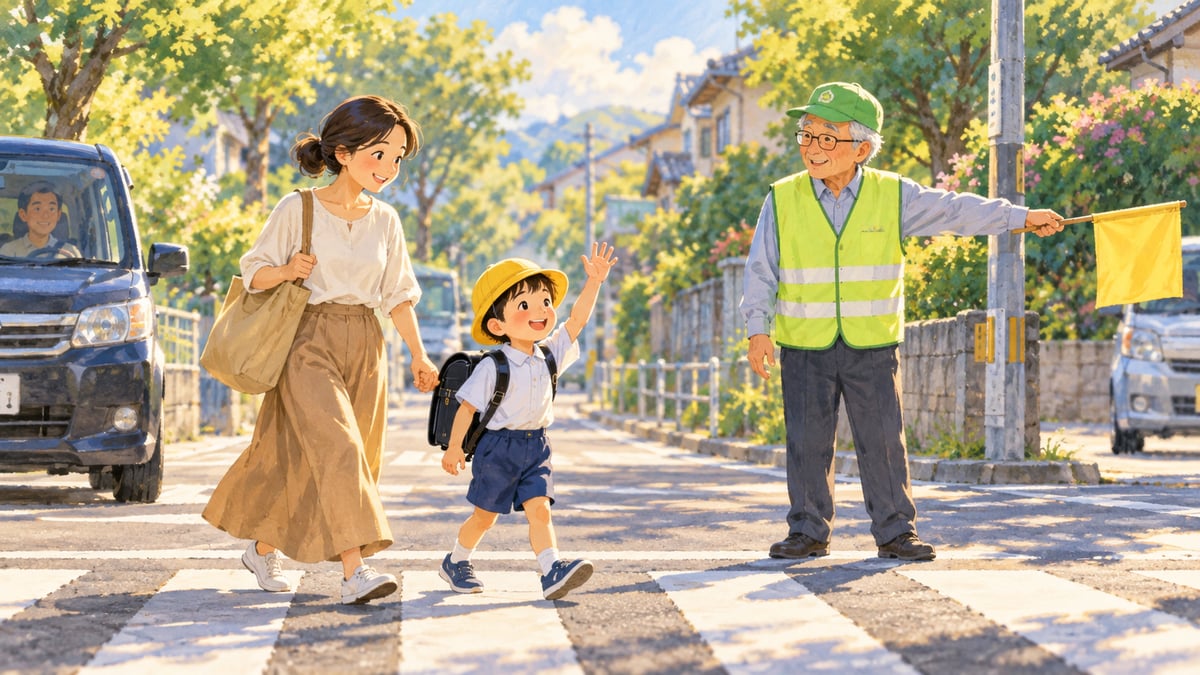
Children walking alone is not just a matter of trust; it is supported by quite a lot of quiet organisation. Each elementary school usually sets recommended school routes, chosen to avoid the most dangerous roads. In many areas, children from the same block form a group, a han, and walk together with an older pupil in front. Parents, retired neighbours and volunteers often stand at crossings with yellow flags in the morning. Shops and homes may display a kodomo 110-ban sign, meaning children can run there for help.
Children are also made easy to see. First-year pupils often wear yellow hats or yellow covers on their randoseru backpacks, and drivers in Japan are taught to take particular care around children. None of this guarantees safety, but it makes the walk to school a shared responsibility.
| Japanese | Romaji | Meaning |
|---|---|---|
| 見守りボランティア | mimamori borantia | volunteers who watch over children |
| ランドセル | randoseru | square school backpack |
| 黄色い帽子 | kiiroi bōshi | yellow hat |
| 班長 | hanchō | group leader |
| Support | Japanese | What it does |
|---|---|---|
| Planned school routes | 通学路 (tsūgakuro) | Routes chosen by schools to avoid dangerous roads |
| Group walking | 集団登校 (shūdan tōkō) | Neighbourhood children walk together, older ones leading |
| Crossing volunteers | 見守り (mimamori) | Adults watching over children at crossings |
| Help points | こども110番の家 (kodomo hyakutōban no ie) | Homes and shops where children can ask for help |
| Personal alarm | 防犯ブザー (bōhan buzā) | A loud alarm children carry on their bag |
Why many families encourage it
The reasons people give are a mix of the practical and the cultural, and they differ by family. Many elementary schools are close enough to walk to, because children usually attend the public school of their area. Residential streets are often narrow and slow, and public transport is widely used. Many parents also value jiritsu, independence, and believe children grow by doing things on their own, a little at a time.
There is a famous television expression of this idea: a long-running programme called Hajimete no Otsukai, which means my first errand, in which very young children run a small errand alone while a hidden crew follows them. It is heart-warming, and the children are closely watched by adults the whole time, so it is not a guide to real parenting, but it shows how warmly many people view small steps of independence.
At the same time, opinions are changing. Some parents walk with their children for years, some areas have cut group walking, and families talk openly about worries over traffic and strangers.
| Japanese | Romaji | Meaning |
|---|---|---|
| 自立 | jiritsu | independence |
| 一人でできるようになった。 | Hitori de dekiru yō ni natta. | She can do it on her own now. |
| はじめてのおつかい | hajimete no otsukai | a child's first errand |
| やっぱり心配です。 | Yappari shinpai desu. | I still worry, though. |
The safety rules children learn
Children in Japan learn a set of short safety rules at home, at nursery and in school. Some are taught as slogans or catchy rhymes that vary from place to place. The rules are simple: look both ways, raise a hand when crossing, do not go with people you do not know, do not stop off on the way, and shout and run if someone frightens you.
| Japanese | Romaji | Meaning |
|---|---|---|
| 右見て、左見て、もう一度右。 | Migi mite, hidari mite, mō ichido migi. | Look right, look left, then right again. |
| 手を挙げて渡ろう。 | Te o agete watarō. | Raise your hand and cross. |
| 知らない人について行かない。 | Shiranai hito ni tsuite ikanai. | Don't go with people you don't know. |
| 寄り道しないでね。 | Yorimichi shinaide ne. | Don't stop off anywhere on the way. (casual) |
| 車に気をつけて。 | Kuruma ni ki o tsukete. | Watch out for cars. |
| 困ったら、大きな声で助けを呼んでね。 | Komattara, ōkina koe de tasuke o yonde ne. | If you're in trouble, shout loudly for help. |
Children on trains and buses
In big cities, some children travel to private elementary schools by train, often alone or with a friend, wearing a school uniform and with a transport card on a cord. Fellow passengers generally leave them alone and keep a quiet eye on them. If a child on a train seems confused or upset, the station staff are the right people to involve.
| Japanese | Romaji | Meaning |
|---|---|---|
| 駅員さんに聞いてみよう。 | Ekiin san ni kiite miyō. | Let's ask the station staff. |
| 一人で電車に乗れるの?すごいね。 | Hitori de densha ni noreru no? Sugoi ne. | You can ride the train by yourself? Amazing. (to a child) |
What visitors should know
| Japanese | Romaji | Meaning |
|---|---|---|
| どうしたの?大丈夫? | Dō shita no? Daijōbu? | What's wrong? Are you OK? (to a child) |
| お家の人はどこかな? | Ouchi no hito wa doko ka na? | Where are your family, I wonder? (gentle, to a child) |
| 一緒に交番に行こうか。 | Issho ni kōban ni ikō ka. | Shall we go to the police box together? |
| すみません、この子が迷子みたいなんですが。 | Sumimasen, kono ko ga maigo mitai na n desu ga. | Excuse me, this child seems to be lost. |
- Do not photograph children walking to school. Parents and schools are protective, and you would not want strangers photographing your children either.
- Do not offer sweets or a lift. Children are taught to avoid exactly that, and it will frighten them.
- Give children room on narrow pavements and drive slowly near school routes in the morning and afternoon.
- If a child seems lost or hurt, crouch down, speak gently and ask a nearby adult, shop staff or a koban for help rather than taking the child anywhere alone.
- If you live in Japan with children, ask the school about the routes, group walking and volunteer rotas: many parents take turns at crossings.
- Do not assume a child alone needs rescuing. Most are simply on their usual way to school or home, and a friendly nod is enough.
Mini dialogue: a first-year's first morning
| Japanese | Romaji | Meaning |
|---|---|---|
| ハンカチ持った? | Hankachi motta? | Mother: Have you got your handkerchief? |
| 持った!いってきます! | Motta! Itte kimasu! | Child: Got it! I'm off! |
| いってらっしゃい。車に気をつけてね。 | Itte rasshai. Kuruma ni ki o tsukete ne. | Mother: Have a good day. Watch out for cars. |
| おはよう。今日から一緒に行こうね。 | Ohayō. Kyō kara issho ni ikō ne. | Older pupil: Morning. Let's walk together from today. |
| うん! | Un! | Child: OK! |
Notice how short and warm every line is. Parents speak casually to their children, and older pupils speak casually to younger ones. You would use the polite forms, such as itte rasshai mase, only in shops or very formal settings.
Practise the morning script with Mocchi
Ask Mocchi to quiz you with tiny home scenes: you are leaving for work, your partner comes home, a child sets off for school, and you choose the right line each time. Mocchi explains why itte kimasu fits one moment and itte rasshai the other, and keeps a note of the pairs you mix up so a later /review brings them back.
Then type /pronounce for a short practice in the chat: itte and rasshai both have a small tsu, a tiny pause that changes the word if you skip it. Add the lines to your flashcards and run them through Vocabulary Dash for a quick, playful repeat.