
The words of congratulation
At a Japanese wedding you will say congratulations many times: to the couple, at the reception desk and to the families. These four lines are the core. All of them are polite and suit anyone at the wedding, whether you are a close friend or a colleague you rarely talk to.
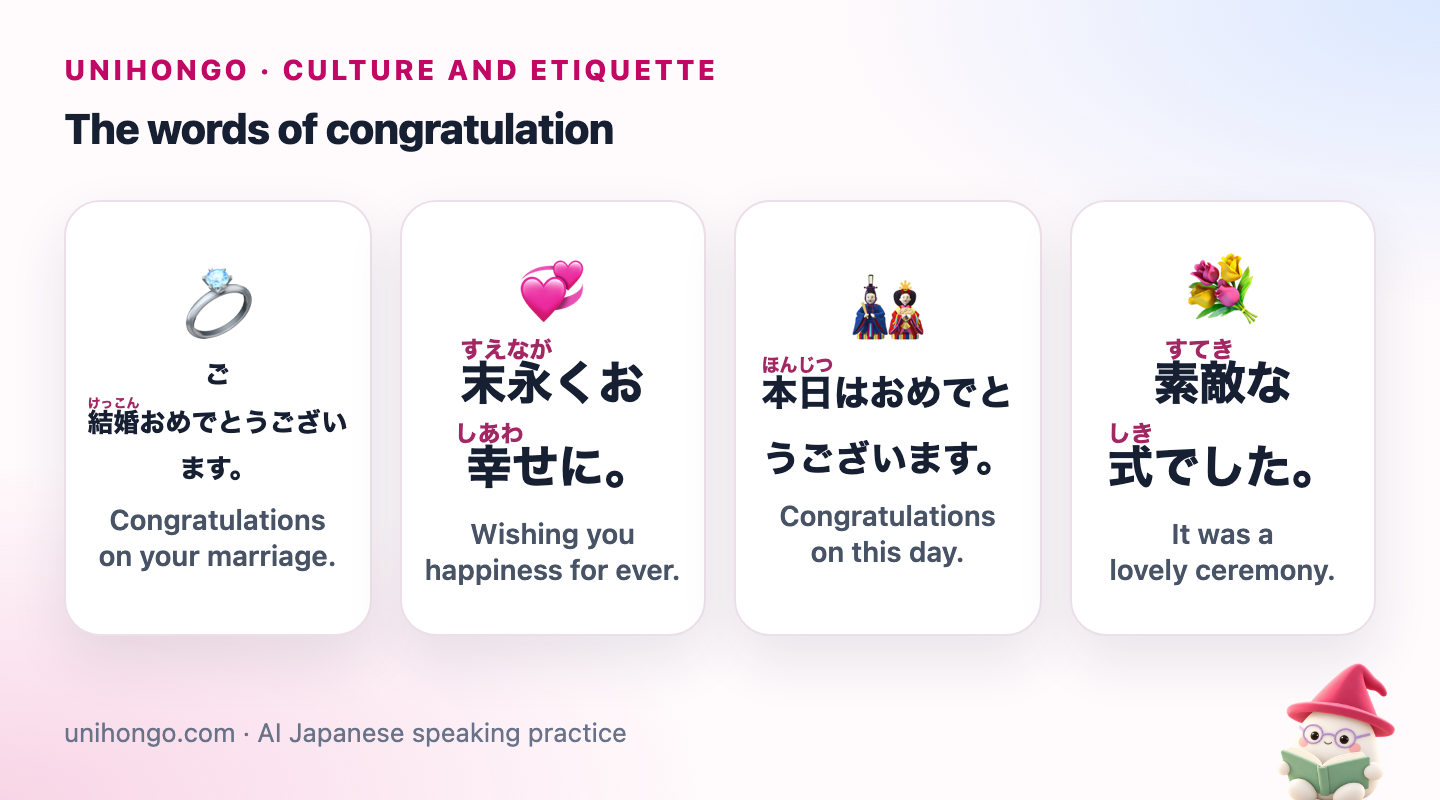
| Japanese | Romaji | Meaning |
|---|---|---|
| ご結婚おめでとうございます。 | Go-kekkon omedetō gozaimasu. | Congratulations on your marriage. |
| 末永くお幸せに。 | Suenagaku oshiawase ni. | Wishing you happiness for ever. |
| 本日はおめでとうございます。 | Honjitsu wa omedetō gozaimasu. | Congratulations on this day. |
| 素敵な式でした。 | Suteki na shiki deshita. | It was a lovely ceremony. |
| お招きいただきありがとうございます。 | Omaneki itadaki arigatō gozaimasu. | Thank you for inviting me. |
| お二人の幸せを心よりお祈りしております。 | Ofutari no shiawase o kokoro yori oinori shite orimasu. | I sincerely wish you both happiness (formal, written or in a speech). |
Replying to the invitation
Wedding invitations (shōtaijō, 招待状) usually come with a reply postcard, the henshin hagaki (返信はがき). Reply soon; within about a week is commonly recommended. There is a small ritual: the card is printed with honorifics such as ご出席 (go-shusseki, your attendance) and ご住所 (your address), and as the guest you cross out the honorific part referring to yourself with two neat lines, then circle 出席 (attending). Many people also add a short message.
If you cannot attend, reply politely without giving a negative reason in detail. Ainiku, yondokoro nai yōji ga arimashite (unfortunately, I have an unavoidable commitment) is a classic, discreet formula.
| Japanese | Romaji | Meaning |
|---|---|---|
| ご結婚おめでとうございます。喜んで出席させていただきます。 | Go-kekkon omedetō gozaimasu. Yorokonde shusseki sasete itadakimasu. | Congratulations on your marriage. I will be delighted to attend. |
| あいにく、よんどころない用事がありまして。 | Ainiku, yondokoro nai yōji ga arimashite. | Unfortunately, I have an unavoidable commitment. |
| お招きいただき、ありがとうございました。 | Omaneki itadaki, arigatō gozaimashita. | Thank you very much for the invitation. |
Goshūgi: the gift money
Wedding guests in Japan usually give money rather than presents. This is goshūgi (ご祝儀). It goes in a special envelope, the shūgibukuro (祝儀袋), decorated with a cord tied in a knot that cannot be undone, musubikiri (結び切り), because a wedding should happen only once. Envelopes with a bow that can be retied are for celebrations that can repeat, such as births, and are not used for weddings.
Use new, crisp notes, called shinsatsu (新札), which you can get at a bank counter. For a friend or coworker attending the reception, 30,000 yen is commonly given; family and senior guests often give more. Odd amounts are generally preferred because they cannot be split in two, and amounts linked with four (shi, which sounds like death) and nine (ku, which sounds like suffering) are avoided. Some regions hold weddings with a fixed participation fee instead, so if you are unsure, ask a Japanese friend who knows the couple.
Carry the envelope wrapped in a cloth called a fukusa (袱紗) and hand it over at the reception desk, turned so the receiver can read it.
| Japanese | Romaji | Meaning |
|---|---|---|
| 心ばかりのお祝いです。 | Kokorobakari no oiwai desu. | This is a small token of celebration. |
| 新札に両替してもらえますか。 | Shinsatsu ni ryōgae shite moraemasu ka. | Could you change this into new notes? (at a bank) |
| ご祝儀はいくらぐらいが普通ですか。 | Goshūgi wa ikura gurai ga futsū desu ka. | How much goshūgi is usual? (to a friend) |
The reception: from the desk to the toast
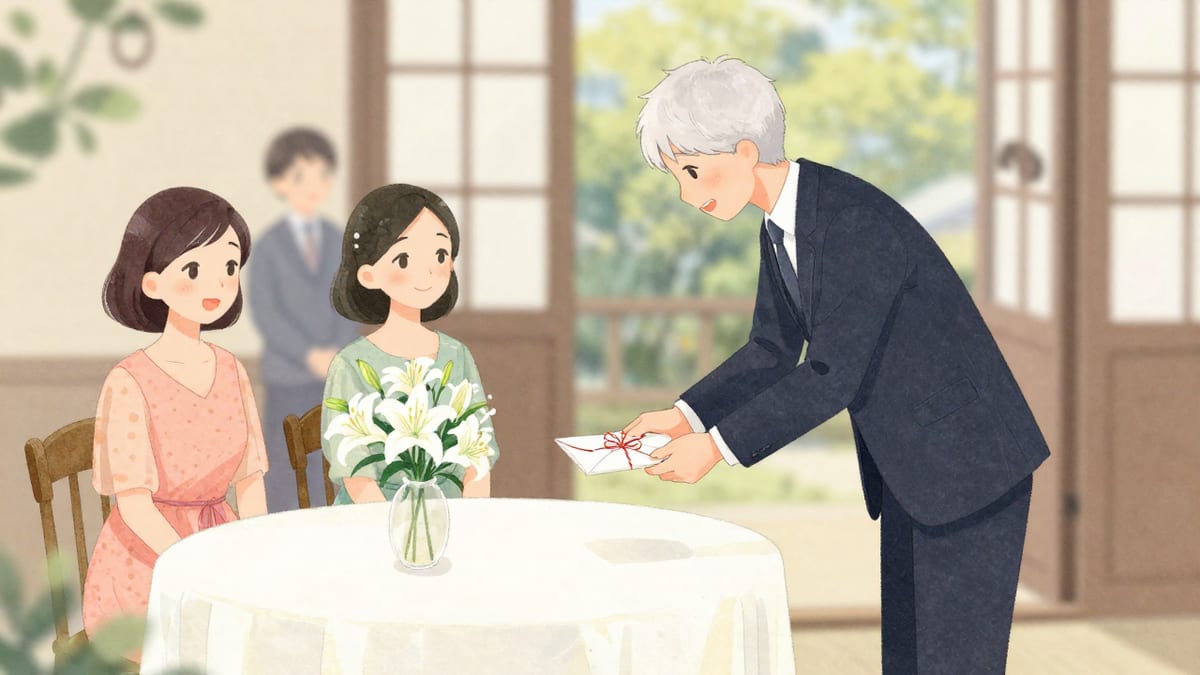
Most of the day happens at the reception, the hirōen (披露宴). At the entrance, friends of the couple staff a reception desk, the uketsuke (受付). You greet them, say whose guest you are, hand over your goshūgi and sign the guest book, the hōmeichō (芳名帳). Then you find your seat from the seating chart.
The programme usually includes speeches from senior guests, a toast called kanpai, the cake cutting, letters to parents, and gifts for guests to take home, the hikidemono (引き出物). Applaud, raise your glass when everyone does, and keep your phone on silent.
| Japanese | Romaji | Meaning |
|---|---|---|
| 本日はおめでとうございます。 | Honjitsu wa omedetō gozaimasu. | Guest: Congratulations on this day. |
| 新婦の友人のマリアです。 | Shinpu no yūjin no Maria desu. | Guest: I'm Maria, a friend of the bride. |
| ありがとうございます。こちらにご記帳をお願いします。 | Arigatō gozaimasu. Kochira ni go-kichō o onegai shimasu. | Desk: Thank you. Please sign here. |
| 乾杯! | Kanpai! | Cheers! |
Dress code
- White is the bride's colour. Guests generally avoid white or very pale outfits.
- For women, an all-black outfit can look like mourning, so many add colour with a shawl, a corsage or accessories; customs are relaxing, but this is still common advice.
- Bare shoulders are commonly covered during the ceremony.
- Men usually wear a dark suit with a white or light tie; a black tie is for funerals.
- Many guides advise against fur and animal-print items, which some people associate with killing at a celebration.
Imikotoba: words to avoid in a speech
Imikotoba (忌み言葉) are words people avoid at celebrations because their meaning suggests bad luck. At weddings, the words to avoid are those of parting, breaking and ending, and also repeated words, which hint at a second marriage. They are avoided in speeches, toasts and written messages, not in ordinary small talk at the table.
| Japanese | Romaji | Meaning |
|---|---|---|
| 結びに、お二人の末永いお幸せをお祈りします。 | Musubi ni, ofutari no suenagai oshiawase o oinori shimasu. | In closing, I wish you both lasting happiness. |
| そろそろお開きの時間です。 | Sorosoro ohiraki no jikan desu. | It's nearly time for the party to close. |
| Avoid | Why | Say instead |
|---|---|---|
| wakareru (to separate) | Suggests divorce | Leave it out, or rephrase |
| kireru, kiru (to cut) | Suggests a broken bond | kēki nyūtō for the cake cutting |
| owaru (to end) | Suggests the marriage ending | ohiraki ni naru (the party closes) |
| saigo ni (lastly) | Sounds like an end | musubi ni (in closing) |
| tabitabi, kasanegasane | Repetition hints at remarriage | yoku, kokoro kara |
At the table: talking with other guests and the families
You will often share a table with people you do not know, grouped by how you know the couple. A simple introduction that says how you are connected is the natural start, and asking others the same question keeps the talk going. If the couple's parents come to your table, stand if others do, bow and say omedetō gozaimasu; a short thank-you for the invitation is enough.
Compliments on the day are always welcome: the bride's dress, the food, the speeches. Keep the conversation positive and avoid the imikotoba, even in small talk, if you can.
| Japanese | Romaji | Meaning |
|---|---|---|
| 新郎と同じ会社の者です。 | Shinrō to onaji kaisha no mono desu. | I work at the same company as the groom. |
| 新婦とはどういうご関係ですか。 | Shinpu to wa dō iu go-kankei desu ka. | How do you know the bride? |
| ドレス、とても素敵ですね。 | Doresu, totemo suteki desu ne. | The dress is beautiful, isn't it? |
| 本日はおめでとうございます。お招きいただきありがとうございます。 | Honjitsu wa omedetō gozaimasu. Omaneki itadaki arigatō gozaimasu. | Congratulations today, and thank you for inviting me (to a parent). |
Mono (者) in onaji kaisha no mono desu is a humble word for a person, used about yourself. It sounds modest and is perfect for a formal occasion.
The nijikai after-party
Many couples' friends organise a nijikai (二次会) after the reception, often at a restaurant or bar. It is more relaxed: there may be games, prizes and plenty of casual talk with the couple. Guests commonly pay a set fee, kaihi (会費), at the door instead of giving goshūgi, and it is fine to come to the nijikai only if that was your invitation.
| Japanese | Romaji | Meaning |
|---|---|---|
| 二次会にも参加します。 | Nijikai ni mo sanka shimasu. | I'll come to the after-party too. |
| 会費はここで払いますか。 | Kaihi wa koko de haraimasu ka. | Do I pay the fee here? |
| 本当におめでとう!幸せになってね。 | Hontō ni omedetō! Shiawase ni natte ne. | Congratulations, really! Be happy, okay? (casual, to a friend) |