
Four lines for every frame
Bowling Japanese is mostly katakana, so the challenge is pronunciation, not vocabulary. Say each word with Japanese vowels and even rhythm: su-to-ra-i-ku. Oshii is native Japanese and is the most useful reaction word in any game: it means so close, what a shame.
Gātā, with a long first vowel, is how most people say gutter in conversation, even though rule books write gatā. You will hear both.
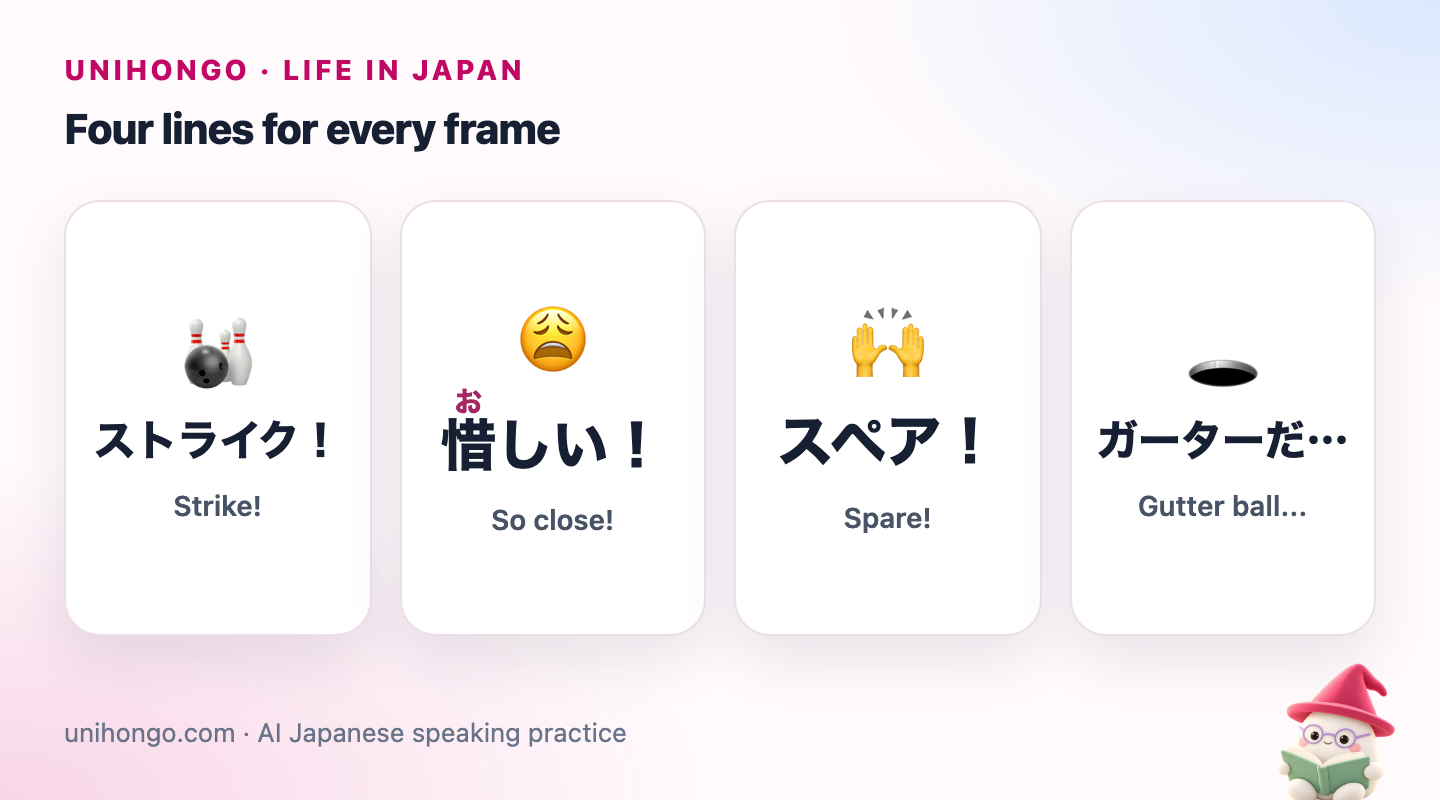
| Japanese | Romaji | Meaning |
|---|---|---|
| ストライク! | Sutoraiku! | Strike! |
| 惜しい! | Oshii! | So close! |
| スペア! | Supea! | Spare! |
| ガーターだ… | Gātā da... | Gutter ball... |
| 次、誰の番? | Tsugi, dare no ban? | Whose turn is next? |
At reception: games, people and shoes
Reception asks the same questions everywhere: how many people, how many games, and whether you are a member. You fill in names for the scoreboard, often on a tablet or a slip, and nicknames are fine. Shoe sizes in Japan are in centimetres, in half sizes: 24.5 is nijūyon-ten-go. Ball weights are usually shown in pounds.
| Japanese | Romaji | Meaning |
|---|---|---|
| 二ゲームでお願いします。 | Ni-gēmu de onegai shimasu. | Two games, please. |
| 四人です。 | Yonin desu. | Four people. |
| 靴のサイズは26です。 | Kutsu no saizu wa nijūroku desu. | My shoe size is 26. |
| 24.5センチはありますか。 | Nijūyon-ten-go senchi wa arimasu ka. | Do you have 24.5 centimetres? |
| 会員じゃないです。 | Kaiin ja nai desu. | I'm not a member. |
| 軽いボールはどこですか。 | Karui bōru wa doko desu ka. | Where are the lighter balls? |
Staff may ask kaiin-shō wa omochi desu ka, do you have a membership card? Iie, motte imasen is a fine answer. They may also explain how to use the lane controls; ask setsumei o mō ichido onegai shimasu if you did not catch it.
Bowling vocabulary
Most terms are borrowed from English, sometimes with a Japanese twist. The table lists what you will hear around the lanes and see on the screen.
Scores are said as plain numbers with the counter ten (点): hyakuten, hyaku-gojutten. A perfect game of 300 is pāfekuto. Average players often say their aim is to break a hundred, hyakuten o koeru, which makes it a good target for a first game in Japan.
| Word in romaji | Meaning | Note |
|---|---|---|
| sutoraiku | Strike | All pins on the first ball |
| supea | Spare | All pins with two balls |
| gātā / gatā | Gutter ball | Conversation vs rule book |
| daburu | Two strikes in a row | From double |
| tākī | Three strikes in a row | From turkey |
| supuritto | Split | Pins left far apart |
| rēn | Lane | Your lane number is on the slip |
| sukoa | Score | Ima nanten? asks the current score |
Friendly teasing and keeping score
Friends in Japan tease each other during games, and it is a sign of closeness. The language is casual and light; avoid anything that sounds like a real insult. Keep the polite forms for people you have just met, and switch to casual when your friends do.
| Japanese | Romaji | Meaning |
|---|---|---|
| 今の、まぐれでしょ。 | Ima no, magure desho. | That was a fluke, right? (teasing) |
| 次は負けないよ。 | Tsugi wa makenai yo. | I won't lose next time. |
| 今、何点? | Ima, nanten? | What's the score now? |
| 百点超えた! | Hyakuten koeta! | I passed a hundred! |
| 負けた人がジュースおごりね。 | Maketa hito ga jūsu ogori ne. | Loser buys the drinks, OK? |
| ナイス!今のはうまい! | Naisu! Ima no wa umai! | Nice! That was good! |
At the batting cage
Batting centres, battingu sentā, have cages arranged by pitch speed, shown in kilometres per hour, and by batter's side. You buy tokens, a prepaid card or games at a machine, choose a cage, put on a helmet and wait for the light. Beginners usually start around eighty or ninety kilometres per hour. At Round1, batting is often part of Spocha, where you pay for time and can move between activities.
| Japanese | Romaji | Meaning |
|---|---|---|
| 何キロにする? | Nan kiro ni suru? | What speed are you going for? |
| 百キロから始めます。 | Hyakkiro kara hajimemasu. | I'll start at 100 km/h. |
| 速すぎて見えない! | Hayasugite mienai! | Too fast, I can't even see it! |
| 空振りした… | Karaburi shita... | I swung and missed... |
| 当たった! | Atatta! | I hit it! |
| ホームラン! | Hōmuran! | Home run! |
Many batting centres have a home run target high on the back net. Hitting it may earn a small prize; ask staff hōmuran no keihin wa nan desu ka if you see one. Right-handed batters use migi-daseki and left-handed batters hidari-daseki.
In Spocha you will also hear the names of the other activities, mostly loanwords: basuketto (basketball), futtosaru (futsal), rōrā sukēto (roller skating) and so on. Staff may ask for your wristband or remind you of the time limit with nokori jikan, time remaining. If you are with a group, decide on a meeting time and place before splitting up, because the area is large and noisy: jā, kuji ni koko de, see you here at nine.
Scenario: a bowling game with Japanese friends
It is Friday night. You and three friends from your language exchange have rented two lanes for two games. Everyone is talking at once, the screen plays an animation for every strike, and your coworker has just thrown two gutters in a row. This is the casual Japanese of friends having fun, full of short reactions and teasing.
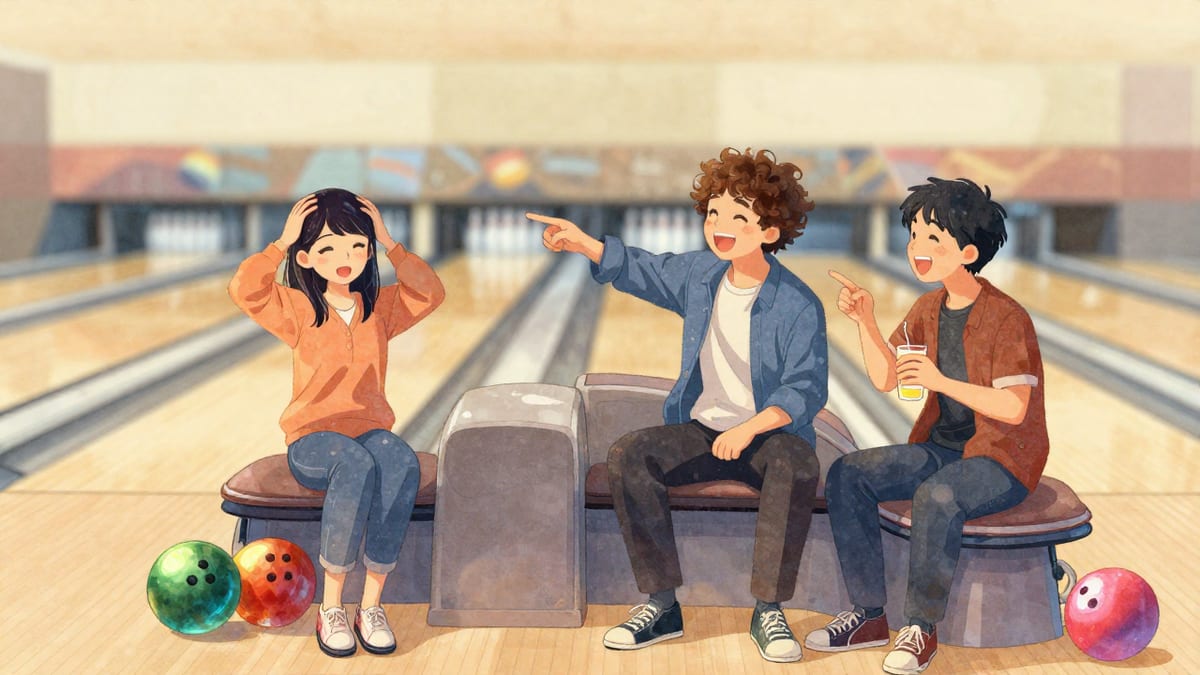
| Japanese | Romaji | Meaning |
|---|---|---|
| 友達:次、誰の番? | Tomodachi: Tsugi, dare no ban? | Friend: Whose turn is it? |
| あなた:私!見てて。 | Anata: Watashi! Mitete. | You: Me! Watch this. |
| 友達:あー、惜しい!一本残った。 | Tomodachi: Ā, oshii! Ippon nokotta. | Friend: Ah, so close! One pin left. |
| あなた:よし、スペア取るよ。 | Anata: Yoshi, supea toru yo. | You: Right, I'm getting the spare. |
| 友達:ナイススペア! | Tomodachi: Naisu supea! | Friend: Nice spare! |
| 友達:次はスポッチャも行こうよ。 | Tomodachi: Tsugi wa Supotcha mo ikō yo. | Friend: Let's do Spocha next time too. |
Pins are counted with hon: ippon, nihon, sanbon. Ippon nokotta, one pin is left, is a sentence you will hear constantly.
Planning the night out
A night at Round1 usually starts in a group chat or at the end of a class or shift. Friends suggest a time and place, decide between bowling, karaoke and Spocha, and often combine several. Casual invitations use the negative question, ikanai?, won't you go?, or the volitional ikō, let's go. Meeting points are often a station exit or the front of the building.
Because Round1 branches are open late, many groups go after dinner. Plans also change on the spot: if there is a wait for lanes, someone will suggest karaoke instead, and if the group is big, Spocha lets everyone try different things at once.
| Japanese | Romaji | Meaning |
|---|---|---|
| 今度、ラウンドワン行かない? | Kondo, Raundo Wan ikanai? | Want to go to Round1 sometime? |
| ボウリングのあと、カラオケも行こうよ。 | Bōringu no ato, karaoke mo ikō yo. | After bowling, let's do karaoke too. |
| 何時にどこ集合? | Nanji ni doko shūgō? | What time and where are we meeting? |
| 駅の北口に七時でどう? | Eki no kitaguchi ni shichiji de dō? | How about the station's north exit at seven? |
| ボウリング、ほとんどやったことないんだ。 | Bōringu, hotondo yatta koto nai n da. | I've hardly ever been bowling. |
| 大丈夫、みんな下手だから。 | Daijōbu, minna heta da kara. | Don't worry, we're all bad. |
Minna heta da kara, we're all bad at it, is a typical kind reply to someone who is nervous. It lowers the pressure and makes the evening about fun rather than scores.
If you are the one inviting, check who is coming and agree on a plan for paying. Splitting costs evenly, warikan, is the default among friends, and settling up at the end with a quick hitori ikura? (how much each?) keeps things simple.
Common mistakes
- Saying shoe sizes in US or UK numbers. Use centimetres, like nijūroku or nijūyon-ten-go.
- Pronouncing katakana words the English way. Japanese ears hear sutoraiku more easily than strike.
- Teasing someone you have just met. Wait until the group is joking with you first.
- Forgetting the counter for pins: ippon, not ichi pin.