
Four lines for a bin-less street
When you are holding an empty bottle and there is no bin in sight, these are the four lines you need: asking where a bin is, deciding to take it home, and reading the two labels you will see most often.
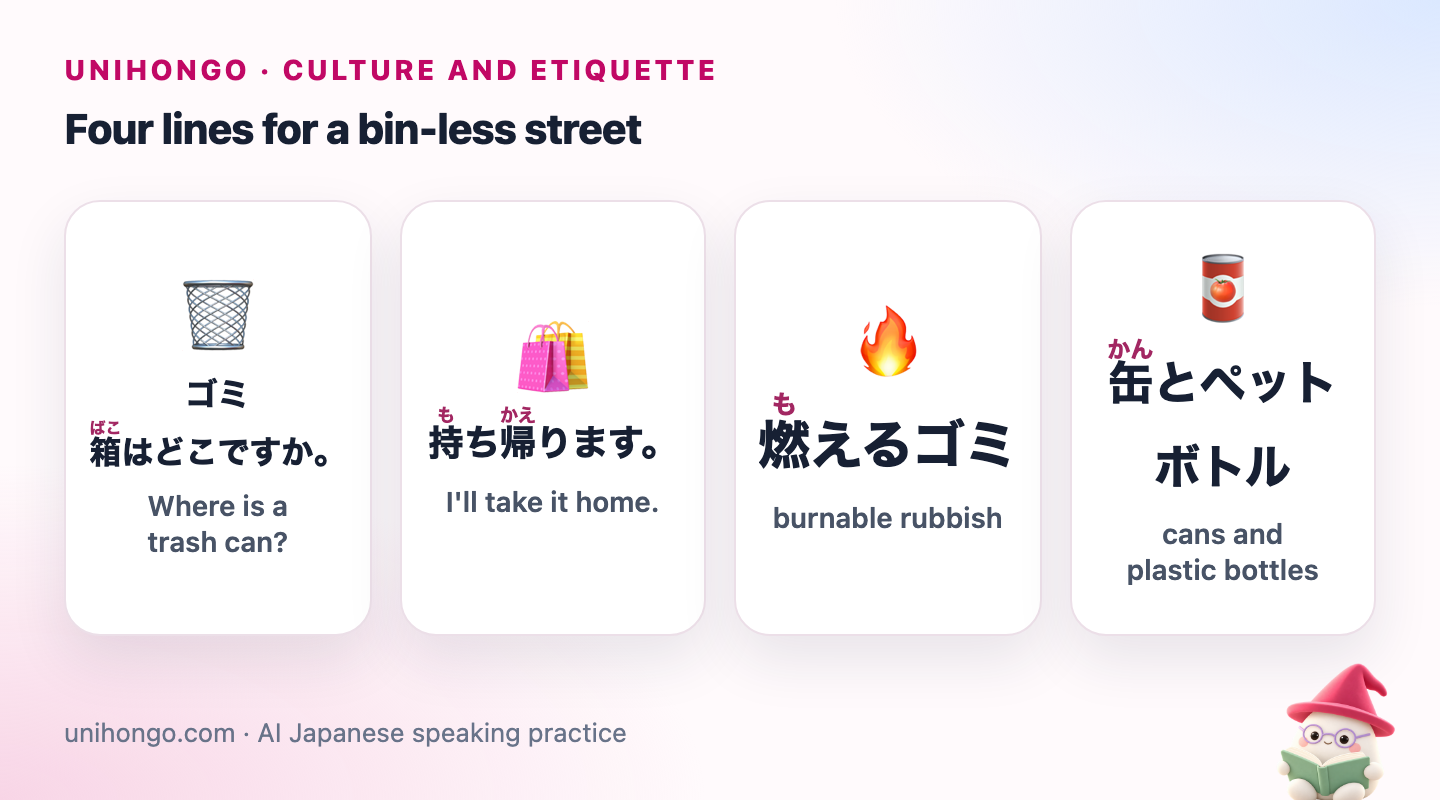
| Japanese | Romaji | Meaning |
|---|---|---|
| ゴミ箱はどこですか。 | Gomibako wa doko desu ka. | Where is a trash can? |
| 持ち帰ります。 | Mochikaerimasu. | I'll take it home. |
| 燃えるゴミ | moeru gomi | burnable rubbish |
| 缶とペットボトル | kan to petto botoru | cans and plastic bottles |
Gomi is rubbish or trash, and gomibako is literally a rubbish box. In writing you will also see the formal pairs kanen gomi (可燃ゴミ) for burnable and funen gomi (不燃ゴミ) for non-burnable rubbish; they mean the same as moeru gomi and moenai gomi.
Reason 1: security after 1995
In March 1995, members of a cult released sarin gas on several Tokyo subway trains, killing and injuring many people. Afterwards, railway companies and public places across Japan removed many bins or sealed them, because a bin is an easy place to hide something dangerous. Bins were removed again in many places during later international events and periods of high alert.
When bins did come back, many were redesigned with see-through bags or clear panels, so the contents are visible. That is why the bins you find in stations often look like transparent boxes with small, labelled openings. The exact number of bins today varies a lot from one railway company and one station to another.
| Japanese | Romaji | Meaning |
|---|---|---|
| 駅のゴミ箱は透明なものが多いです。 | Eki no gomibako wa tōmei na mono ga ōi desu. | Many station bins are see-through. |
| ホームにゴミ箱がありますよ。 | Hōmu ni gomibako ga arimasu yo. | There's a bin on the platform. |
| 改札の近くにありました。 | Kaisatsu no chikaku ni arimashita. | There was one near the ticket gates. |
Reason 2: sorting, cost and the take-home habit
Rubbish in Japan is sorted carefully, and every city has its own rules. A public bin therefore needs several sections, and someone has to empty and often re-sort them. For towns and businesses, that costs money and labour, especially in tourist areas where visitors may not understand the categories.
At the same time, the habit of gomi wa mochikaeri, taking your rubbish home, is deeply rooted. Children learn it on school trips, and hikers, picnickers and festival goers are often asked to do the same. Because people carry their rubbish home, there is little pressure to install more bins, and because there are few bins, people carry their rubbish home. Eating while walking is also less common than in many countries, so there is less street rubbish in the first place, though this varies by area.
| Japanese | Romaji | Meaning |
|---|---|---|
| ゴミは持ち帰りましょう。 | Gomi wa mochikaerimashō. | Please take your rubbish home. (common notice) |
| ゴミの分別が細かいですね。 | Gomi no bunbetsu ga komakai desu ne. | Rubbish sorting is very detailed, isn't it? |
| ゴミ袋を持ってきました。 | Gomibukuro o motte kimashita. | I brought a rubbish bag. |
Where you can still find a bin
Bins are rare on the street, not absent. These are the places where you are most likely to find one, roughly in order of reliability. Availability differs by city and by store, so treat this as a guide rather than a promise.
| Place | What the bins are for | Good manners |
|---|---|---|
| Convenience stores | Rubbish from things bought there | Use them for your own purchases only |
| Next to vending machines | Bottles and cans only | Do not put paper cups or food in them |
| Station platforms and concourses | Sorted: cans, bottles, paper, other | Read the labels and sort |
| Shopping centres and food courts | Trays and packaging from the food court | Return trays and sort cups |
| Parks and tourist sites | Varies; often none | Be ready to carry it home |
Your hotel is always an option. Hotel rooms have bins, and many hotels accept rubbish you bring back from a day out. Asking at the front desk is fine if you have a lot.
Reading sorted bins
Public bins often come in a row with several openings. The categories differ, but these labels cover most of what you will see. Plastic bottles often have a separate slot for caps, because caps and labels are recycled differently from the bottle itself.
| Japanese | Romaji | Meaning |
|---|---|---|
| 燃えないゴミ | moenai gomi | non-burnable rubbish |
| びん | bin | glass bottles |
| ペットボトル | petto botoru | PET plastic bottles |
| キャップ | kyappu | bottle caps |
| 紙コップ | kamikoppu | paper cups |
| その他 | sono ta | other |
| 資源ゴミ | shigen gomi | recyclables |
Be careful with the word bin. In Japanese, bin (びん, 瓶) means a glass bottle, not a rubbish bin. If you ask for a bin in English-flavoured Japanese, people may think you want a bottle.
Asking at a shop or station
If you really need to throw something away, asking staff is completely fine. Keep it short, polite and specific about what you have.
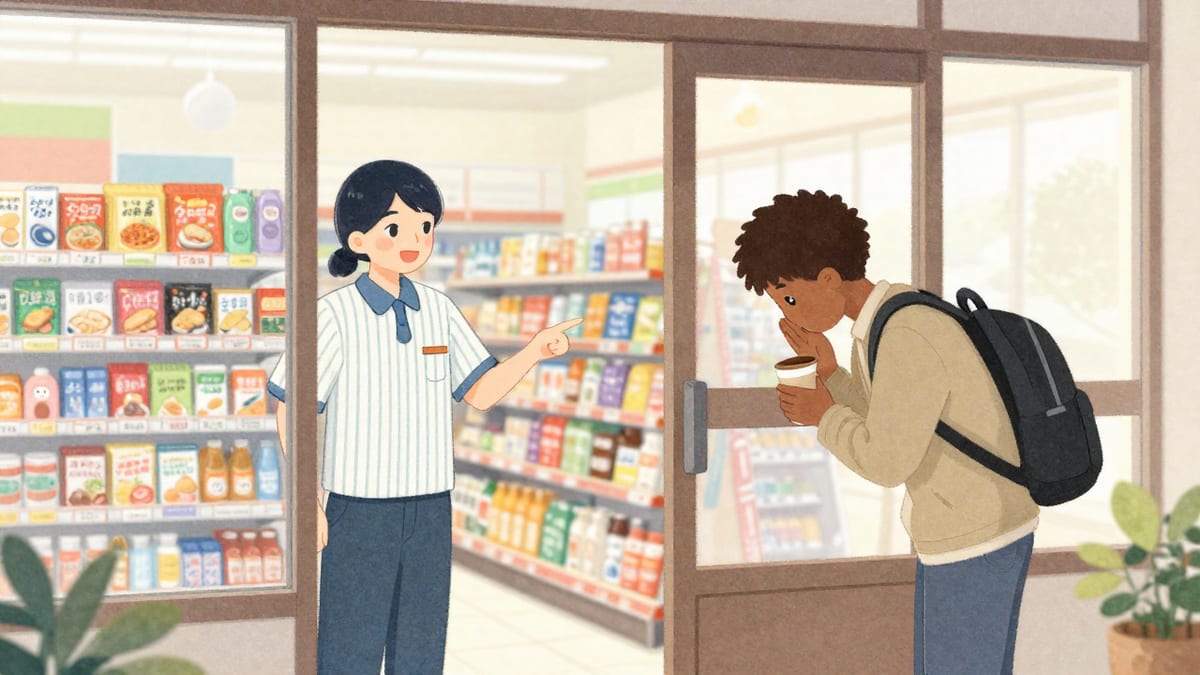
| Japanese | Romaji | Meaning |
|---|---|---|
| すみません、ゴミを捨ててもいいですか。 | Sumimasen, gomi o sutete mo ii desu ka. | Excuse me, may I throw this away? |
| これ、ここで買ったものです。 | Kore, koko de katta mono desu. | I bought this here. |
| こちらでお預かりします。 | Kochira de oazukari shimasu. | Clerk: We'll take it for you. |
| ゴミ箱は入口の横にあります。 | Gomibako wa iriguchi no yoko ni arimasu. | Clerk: The bin is next to the entrance. |
| この辺にゴミ箱はありますか。 | Kono hen ni gomibako wa arimasu ka. | Is there a bin around here? |
| ないので、持って帰ります。 | Nai node, motte kaerimasu. | There isn't one, so I'll take it home. |
Common visitor mistakes
- Putting paper cups, food or wrappers in the bottle box next to a vending machine. Those boxes are only for drink bottles and cans.
- Leaving rubbish on a bench, a wall or a vending machine because there is no bin. It is seen as bad manners.
- Dumping a whole day's rubbish in a convenience store bin. Use it for things you bought there.
- Ignoring the categories at a station. Take a moment to sort; the labels usually have pictures as well.
- Saying bin to mean a rubbish bin. In Japanese, bin is a glass bottle; say gomibako.
Sort these labels in your sleep with Mocchi
- Type /create-flashcards bin labels: moeru gomi, moenai gomi, kan, bin, petto botoru, shigen gomi. Mocchi makes a card for each and lets you pick a photo, so each word is tied to a real image of a bottle, a can or a paper cup.
- Run /review-flashcards for a few days. Mocchi brings back the labels you get wrong sooner, so the confusing pair moenai gomi and shigen gomi gets extra turns.
- Use the same deck in Mocchi Flight, guiding Mocchi through the right word gates, for a quick round when you have a spare moment on the train.
What a visitor should do
- Carry a small plastic or cloth bag for rubbish when you go out for the day.
- Finish drinks near the vending machine and use its bottle box.
- Use convenience store bins for things you bought there.
- Sort your rubbish at stations, following the labels and pictures.
- When in doubt, take it back to your hotel; that is what most residents would do.