

Three spellings that do not match their sounds
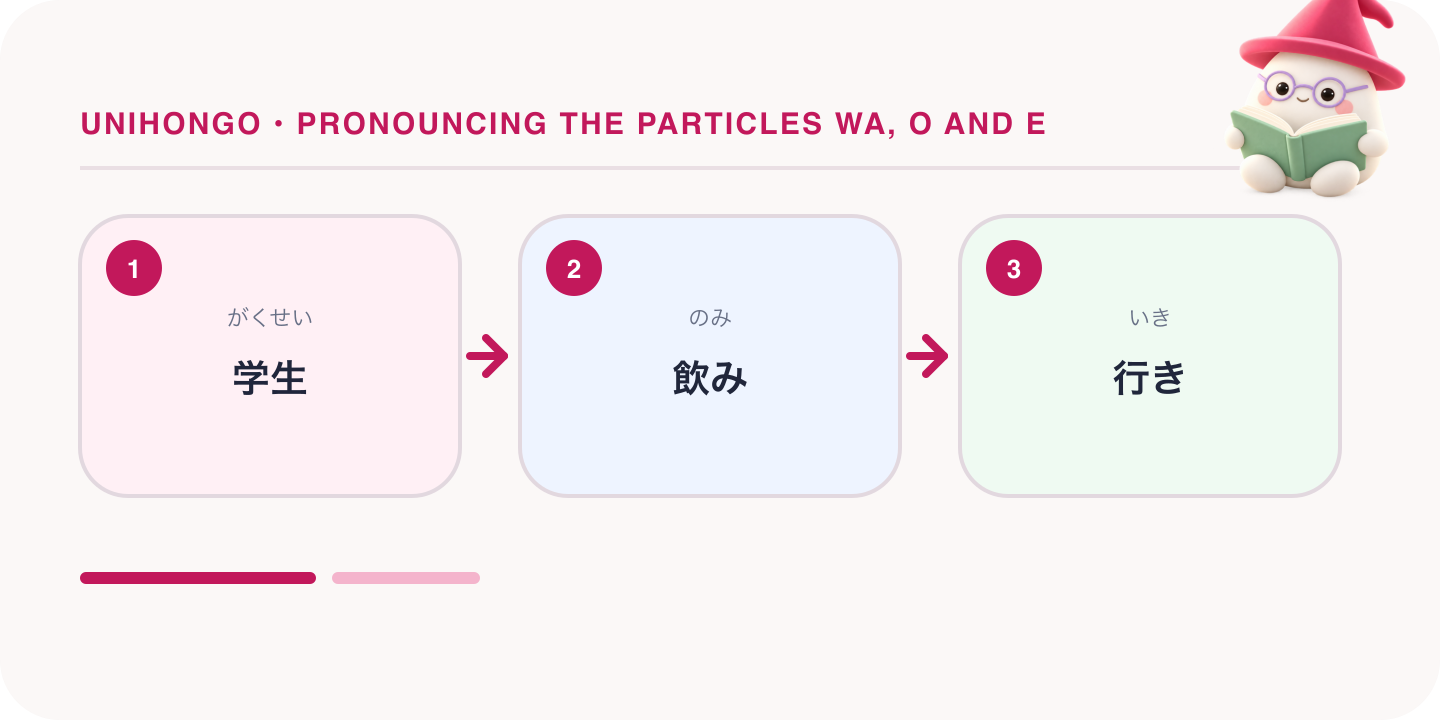
Modern kana spelling matches pronunciation almost perfectly, with three famous exceptions, and all three are particles. The topic particle is written は but said wa. The object particle is written を but said o. The direction particle is written へ but said e. The spelling reform of 1946 modernised most words but left these particles as they were, partly because they are so frequent, and partly because a は in the middle of a line signals a grammatical boundary at a glance.
The rule is narrow. Only the particles are affected. The same kana inside an ordinary word keeps its normal sound: はな is hana, へや is heya. Konnichiwa is spelled こんにちは because it began life as a phrase ending in the topic particle, and the same goes for konbanwa. When you see は or へ, ask whether it is doing a grammatical job; if so, say wa or e.
| Japanese | Romaji | Meaning |
|---|---|---|
| 私は学生です。 | Watashi wa gakusei desu. | I am a student. |
| 水を飲みます。 | Mizu o nomimasu. | I drink water. |
| 駅へ行きます。 | Eki e ikimasu. | I'm going to the station. |
| こんにちは、田中です。 | Konnichiwa, Tanaka desu. | Hello, this is Tanaka. |
| 部屋は二階です。 | Heya wa nikai desu. | The room is on the second floor. |
Linking the particle to the word before it
Japanese speakers do not hear watashi and wa as two words. They hear watashiwa, one phrase, in the same way an English speaker hears going to as gonna. The particle has no meaning on its own, so it has no reason to stand apart. Physically this means no gap, no fresh breath and no reset of the voice between the noun and the particle. The final vowel of the noun flows straight into the particle.
Practise by writing the noun and particle as one romaji word: watashiwa, mizuo, ekie. Say each as a single unit with the stress-free, even timing of any Japanese word. Then, and only then, add the verb. When the noun ends in a vowel that is similar to the particle, the join is especially smooth: eki e almost becomes ekie with a slightly long e; kōhī o keeps both vowels but with no break.
If you need to pause to think, pause after the particle. That is where native speakers put their hesitations too, often stretching the particle a little: watashi waa, ano, and then the rest.
| Japanese | Romaji | Meaning |
|---|---|---|
| コーヒーを二つお願いします。 | Kōhī o futatsu onegai shimasu. | Two coffees, please. |
| この店は安いです。 | Kono mise wa yasui desu. | This shop is cheap. |
| 東京へ帰ります。 | Tōkyō e kaerimasu. | I'm going back to Tokyo. |
| 映画を見ました。 | Eiga o mimashita. | I watched a film. |
| 今日は暑いですね。 | Kyō wa atsui desu ne. | It's hot today, isn't it? |
Never stress a particle
English speakers carry a strong instinct to stress function words when they matter, as in I DID go. That instinct transfers straight onto Japanese particles, so learners hit wa hard to mark the topic and lean on o as if the object needed underlining. In Japanese, a stressed particle sounds like emphatic contrast at best and like shouting at worst. The particle should be quieter and shorter than the word it follows, never louder.
Volume and length are the two things to control. Keep the particle at the same or slightly lower volume than the noun, and keep it to exactly one mora. A loud, long particle sounds like arguing.
Contrast does exist in Japanese, but it is expressed by choosing wa in place of ga or o, not by stressing it. Kōhī wa nomimasu, with the particle unstressed, already means as for coffee, I do drink it, with an implication that something else is different. The grammar carries the contrast so the voice does not have to.
| Japanese | Romaji | Meaning |
|---|---|---|
| ビールは飲みません。 | Bīru wa nomimasen. | I don't drink beer (but I might drink other things). |
| 肉は食べますが、魚は食べません。 | Niku wa tabemasu ga, sakana wa tabemasen. | I eat meat, but I don't eat fish. |
| 日本語を勉強しています。 | Nihongo o benkyō shite imasu. | I'm studying Japanese. |
| 学校へは自転車で行きます。 | Gakkō e wa jitensha de ikimasu. | To school, I go by bicycle. |
How pitch carries across the join
Because a particle belongs to the previous word, it takes its pitch from that word. There are three cases. After an unaccented word, the particle stays high: sakana wa is low-high-high-high, and the wa simply continues the plateau. After a word accented on its final mora, the particle is where the fall happens: hashi wa, meaning the bridge, is low-high-low, and the wa is the first low mora. After a word accented earlier, the pitch has already fallen and the particle stays low: a↓me wa, rain, is high-low-low.
This is why the particle cannot have a pitch of its own. If you give wa a fresh rise, you create a word boundary the listener does not expect, and the sentence stutters. The table below shows common words with their particle attached, so you can practise the three shapes side by side.
| Word and particle | Reading | Pitch across the join |
|---|---|---|
| 魚は | sakana wa | L-H-H, then wa stays H (unaccented word) |
| 水を | mizu o | L-H, then o stays H (unaccented word) |
| 学校へ | gakkō e | L-H-H-H, then e stays H (unaccented word) |
| 橋は | hashi wa | L-H, then wa drops to L (final accent) |
| 花を | hana o | L-H, then o drops to L (final accent) |
| 男を | otoko o | L-H-H, then o drops to L (final accent) |
| 雨は | ame wa | H-L, wa stays L (early accent) |
| 駅へ | eki e | H-L, e stays L (early accent) |
| 東京へ | Tōkyō e | L-H-H-H, then e stays H (unaccented word) |
| 私は | watashi wa | L-H-H, then wa stays H (unaccented word) |
Drills from single phrases to full sentences
Build up in three stages. First, say noun-plus-particle units in isolation, ten in a row, as single words: watashiwa, mizuo, ekie, kōhīo, gakkōe. Second, add a verb so that each unit is followed by a second phrase: watashi wa nomimasu. Third, chain three units in one sentence and keep the joins tight while the sentence gets longer. The sentences below are ordered from short to long for that reason.
At the third stage, notice where you breathe. A native speaker breathes after a particle, never in the middle of a noun-particle unit. Mark the sentence with slashes after each particle and breathe only at the slashes.
| Japanese | Romaji | Meaning |
|---|---|---|
| 私はお茶を飲みます。 | Watashi wa ocha o nomimasu. | I drink tea. |
| 母は毎朝公園へ行きます。 | Haha wa maiasa kōen e ikimasu. | My mother goes to the park every morning. |
| 週末は友達と映画を見ました。 | Shūmatsu wa tomodachi to eiga o mimashita. | At the weekend I watched a film with a friend. |
| この道をまっすぐ行くと、駅へ出ます。 | Kono michi o massugu iku to, eki e demasu. | If you go straight along this road, you come out at the station. |
| 私は来年、日本へ行って、日本語を勉強したいです。 | Watashi wa rainen, Nihon e itte, Nihongo o benkyō shitai desu. | Next year I want to go to Japan and study Japanese. |
Common mistakes by first language
The particles are the same three sounds for everyone, but the habits that damage them differ. Find your own pattern in the list and work on that one first.
- English speakers: stressing wa and o like emphatic function words. Fix: make the particle quieter and shorter than the noun.
- English speakers: reading は as ha and へ as he when speaking from text. Fix: circle every particle in a text and say its sound before you read the sentence.
- Spanish and Italian speakers: turning o into a rounded, strong wo or lengthening it to oo. Fix: o is one short mora, identical to the o in oto.
- French speakers: putting a rising tone on every particle as if it ended a question. Fix: the particle continues the noun's pitch and never rises on its own.
- Chinese speakers: giving each particle its own tone, which creates a word boundary. Fix: think of noun plus particle as one word with one melody.
- Korean speakers: attaching the particle correctly but dropping its vowel to a whisper, especially o. Fix: the vowel is short but fully voiced.
- Everyone: pausing before particles while searching for the next word. Fix: pause after the particle instead, where Japanese speakers pause.
The quickest overall fix is to learn every new noun together with a particle, as a pair, so that the linked form is the one stored in your memory rather than the noun alone.
A self-check routine with the AI Sensei
Particle habits are almost impossible to hear in yourself in real time, because your attention is on the grammar. Use the AI Sensei as an outside ear. First, read the linked pairs aloud, ten in a row. Second, tell the Sensei about your day in five sentences, each with at least one wa, o or e. Third, ask the Sensei to repeat any sentence where you paused before a particle or stressed one. Fourth, read the feedback after the conversation and mark the particles that were flagged.
| Japanese | Romaji | Meaning |
|---|---|---|
| 助詞の発音を直してください。 | Joshi no hatsuon o naoshite kudasai. | Please correct my pronunciation of the particles. |
| 「は」を強く言いすぎていますか。 | 'Wa' o tsuyoku iisugite imasu ka. | Am I saying wa too strongly? |
| 途中で止まらないで言ってみます。 | Tochū de tomaranaide itte mimasu. | I'll try saying it without stopping in the middle. |
| 今の文をもう一度言ってください。 | Ima no bun o mō ichido itte kudasai. | Please say that sentence again. |
| 自然に聞こえましたか。 | Shizen ni kikoemashita ka. | Did that sound natural? |
When a sentence still sounds choppy
If a sentence still sounds like a word list, take out the verb and say only the noun-particle units, then rejoin them. Check for three things: a gap before the particle, a stress on the particle, and a rise in pitch on the particle. Any one of them breaks the flow. Then restore the verb and say the whole sentence in one breath, even if slightly too fast; speed forces the joins closed.
| Japanese | Romaji | Meaning |
|---|---|---|
| 一息で言ってみます。 | Hitoiki de itte mimasu. | I'll try saying it in one breath. |
| まだ少し不自然ですか。 | Mada sukoshi fushizen desu ka. | Is it still a little unnatural? |
| ゆっくりでも、止まらずに言います。 | Yukkuri demo, tomarazu ni iimasu. | Even if slowly, I'll say it without stopping. |