
Four kinds of light in four names
Each of these names uses a different kanji of light. Together they show how much variety one simple theme can have.
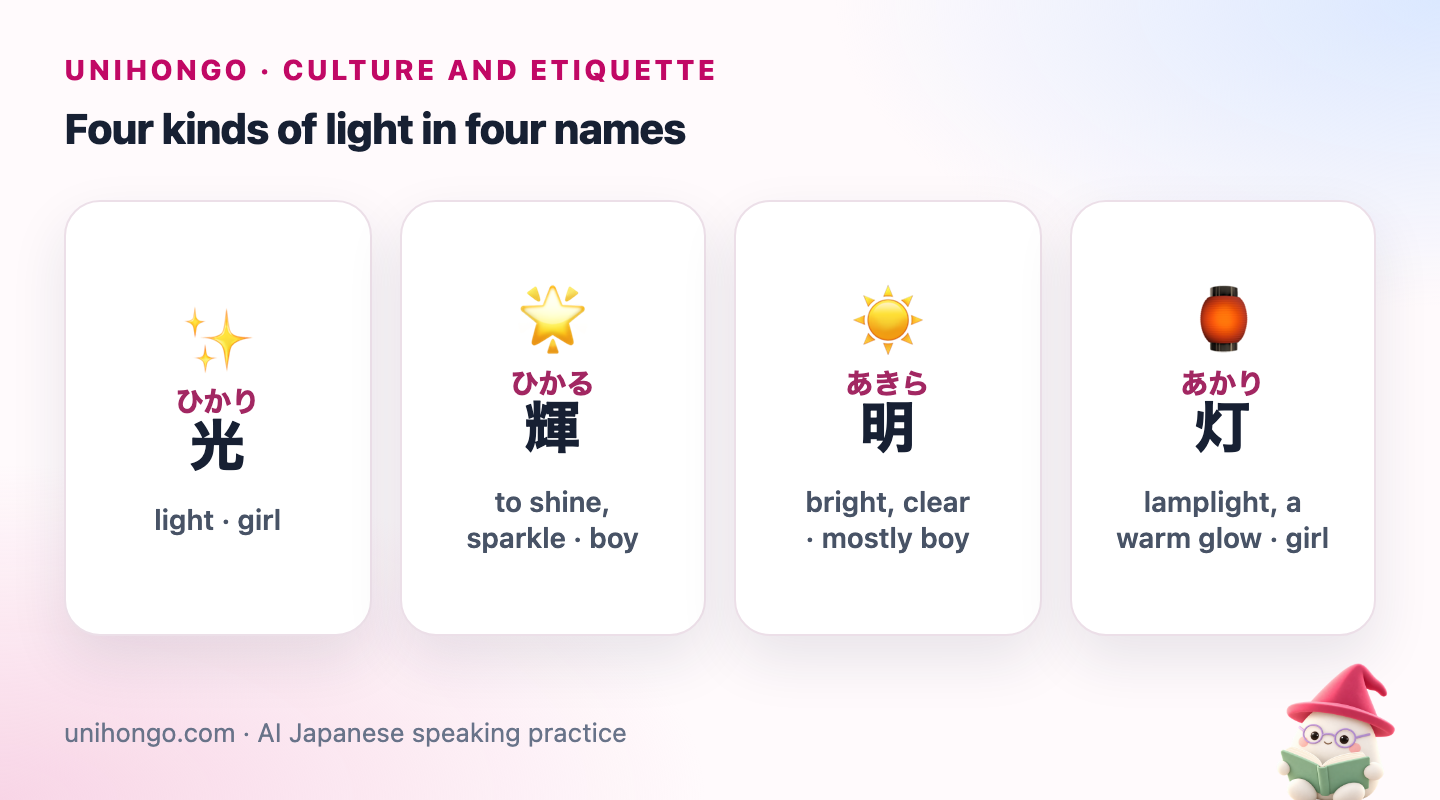
| Japanese | Romaji | Meaning |
|---|---|---|
| 光 | Hikari | light · girl |
| 輝 | Hikaru | to shine, sparkle · boy |
| 明 | Akira | bright, clear · mostly boy |
| 灯 | Akari | lamplight, a warm glow · girl |
Akari, 灯, is the light of a lamp or lantern, the warm glow in a window at night. Parents who choose it often talk about a child who brings warmth to the family. The kanji is built from 火, fire, and 丁, and you will see it in 灯台 (tōdai, lighthouse).
Choosing between the light kanji
The table compares the light kanji you meet most in names. The everyday word in the third column is the best way to feel the difference.
| Japanese | Romaji | Meaning |
|---|---|---|
| 光る | hikaru | to shine, glow |
| 輝く | kagayaku | to shine, sparkle |
| 明るい | akarui | bright; cheerful |
| 照らす | terasu | to shine on, light up |
| Kanji | Core image | Everyday word |
|---|---|---|
| 光 | Light itself, rays of light | 光 (hikari, light) |
| 輝 | Sparkle, brilliance | 輝く (kagayaku, to shine) |
| 明 | Bright, clear, also clever | 明るい (akarui, bright, cheerful) |
| 灯 | Lamplight, a warm glow | 灯台 (tōdai, lighthouse) |
| 陽 | Sunshine, warmth | 太陽 (taiyō, the sun) |
| 晃 | Dazzling light | Mostly in names |
Akarui is the key word here. It describes a bright room and also a cheerful person, and Akarui hito, a cheerful person, is one of the warmest compliments you can give. Many parents hope a light name will help the child grow into exactly that.
The opposite is worth knowing too. Kurai, dark, describes a gloomy room and also a gloomy, withdrawn person, so a light name is, in a sense, a wish against that. You will hear both words constantly in everyday conversation: Akarui heya, a bright room; akarui seikaku, a cheerful personality; kurai nyūsu, depressing news. Learning them as a pair makes the meaning of light names feel natural rather than translated.
Light names for girls
| Japanese | Romaji | Meaning |
|---|---|---|
| 明里 | Akari | bright + home village · girl |
| 蛍 | Hotaru | firefly · girl |
| 照美 | Terumi | shine + beauty · girl |
| 光莉 | Hikari | light + jasmine · girl |
| 明日香 | Asuka | tomorrow + fragrance · girl |
| 陽菜 | Hina | sunshine + greens · girl |
Hotaru, firefly, is a small, soft light associated with early summer evenings near clean streams. Asuka uses 明日, tomorrow, literally the bright day, with 香, fragrance. Terumi feels a little more classic than Akari or Hikari.
Girls' light names often pair a light kanji with a soft second kanji such as 莉, 里 or 菜, which makes the name gentle as well as bright. Akari in particular has many spellings: 明里, 灯, 朱莉 (vermilion and jasmine), あかり in hiragana. Only some of them are about light at all, so as always, ask before you assume.
Light names for boys and any gender
| Japanese | Romaji | Meaning |
|---|---|---|
| 大輝 | Daiki | great brightness · boy |
| 光希 | Kōki | light + hope · boy |
| 光太郎 | Kōtarō | light + big + son · boy |
| 晃 | Akira | dazzling light · boy |
| 旭 | Asahi | the rising sun · boy |
| 光 | Hikaru | to shine · unisex |
光希 is a good example of reading by gender: as Kōki it is usually a boy's name, and as Mitsuki it is usually a girl's name. In boy names 光 is often read kō, in girl names more often hikari or mitsu. Asahi, the rising sun, can also be written 朝陽, morning sunshine.
Explaining a light name at a party
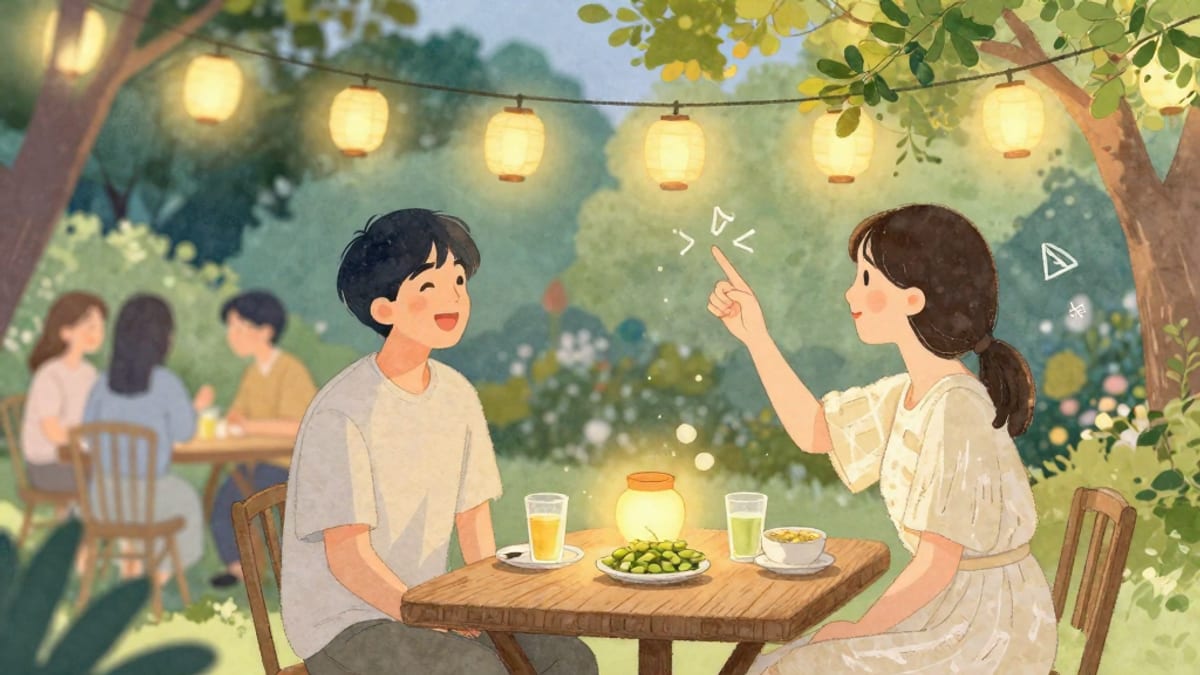
Light names are easy to explain because the kanji appear in familiar words. Point to the word, then add the wish behind it.
| Japanese | Romaji | Meaning |
|---|---|---|
| 光という一文字です。 | Hikari to iu hitomoji desu. | It's the single kanji for light. |
| 光という字に、希望の「希」です。 | Hikari to iu ji ni, kibō no "ki" desu. | The kanji for light, plus the ki of kibō. |
| 明るい子になるようにって。 | Akarui ko ni naru yō ni tte. | They hoped I'd grow up cheerful. |
| ぴったりの名前ですね。 | Pittari no namae desu ne. | That name suits you perfectly. |
The second line explains 光希, which could be Kōki or Mitsuki; naming a familiar word such as kibō, hope, is the usual way to pin down a kanji. Pittari, perfect fit, is a friendly compliment when a name matches someone's personality.
Mini dialogue: a new colleague called Akari
| Japanese | Romaji | Meaning |
|---|---|---|
| 今日から入りました、山本あかりです。 | Kyō kara hairimashita, Yamamoto Akari desu. | Akari: I'm Akari Yamamoto, I started today. |
| あかりさんって、どんな字ですか。 | Akari san tte, donna ji desu ka. | You: Akari, which kanji is that? |
| 灯台の「灯」です。 | Tōdai no "tō" desu. | Akari: The 灯 of tōdai, lighthouse. |
| 温かい感じがしますね。 | Atatakai kanji ga shimasu ne. | You: It has a warm feel to it. |
| ありがとうございます。よく言われます。 | Arigatō gozaimasu. Yoku iwaremasu. | Akari: Thank you. People often say that. |
Writing the light kanji
The light kanji are worth writing by hand a few times, because their shapes are easy to confuse at small sizes. 光 has 6 strokes: the three short strokes at the top come first, then the long horizontal line, then the two legs below. 明 has 8 strokes and is simply 日, sun, beside 月, moon, which makes it easy to remember as a bright kanji. 灯 has 6 strokes: the fire radical 火 on the left, then 丁. 輝 is the hardest, with 15 strokes: 光 on the left and 軍 on the right.
Once you can recognise them, you will see these kanji everywhere in daily life, not only in names. 明 alone appears in dozens of common words.
| Japanese | Romaji | Meaning |
|---|---|---|
| 明日 | ashita | tomorrow |
| 説明 | setsumei | explanation |
| 日光 | nikkō | sunlight |
| 電灯 | dentō | electric light |
| 光景 | kōkei | a scene, a sight |
A short light-kanji routine with Mocchi
- Type /kanji 輝 and then /kanji 灯. Mocchi shows the meanings, readings and everyday words, so you can see why 灯台 is a lighthouse.
- Ask: Make flashcards for the light names Hikari, Akari, Daiki, Kōki and Asahi. Pick a photo for each, a lantern for Akari or a sunrise for Asahi.
- Play Mocchi Flight with that deck: guide Mocchi through the gate with the right name.
- Later, ask Mocchi: Which light names did I get wrong this week? It remembers, and quizzes you on those first.
Mistakes to avoid with light names
- Calling every 光 Hikari. It may be Hikaru, Kō or Mitsu in a longer name.
- Confusing 明 in Akira with 明 in Mei. The same kanji gives a boy's name and a girl's name.
- Translating akarui only as bright. For a person it means cheerful and outgoing, which is often the whole point of the name.
- Thinking 観光 (kankō, sightseeing) has anything to do with light names. The 光 there means the sights of a place, a different sense.
- Choosing 煌 or other rare light kanji for a character without checking. Some are allowed in names but feel flashy to Japanese readers.