
Higasa, amagasa and the verb sasu
Kasa (傘) is the general word for umbrella. Add hi (日, sun) and it becomes higasa, a sun umbrella; add ame (雨, rain) and it becomes amagasa, a rain umbrella. In both words the k of kasa turns into g, a sound change called rendaku that happens in many compound words.
The verb matters as much as the noun. In English you hold or use an umbrella, but in Japanese you sasu it: kasa o sasu means to put up and hold an umbrella over your head. To open it, you can say hiraku; to close it, tatamu or tojiru.
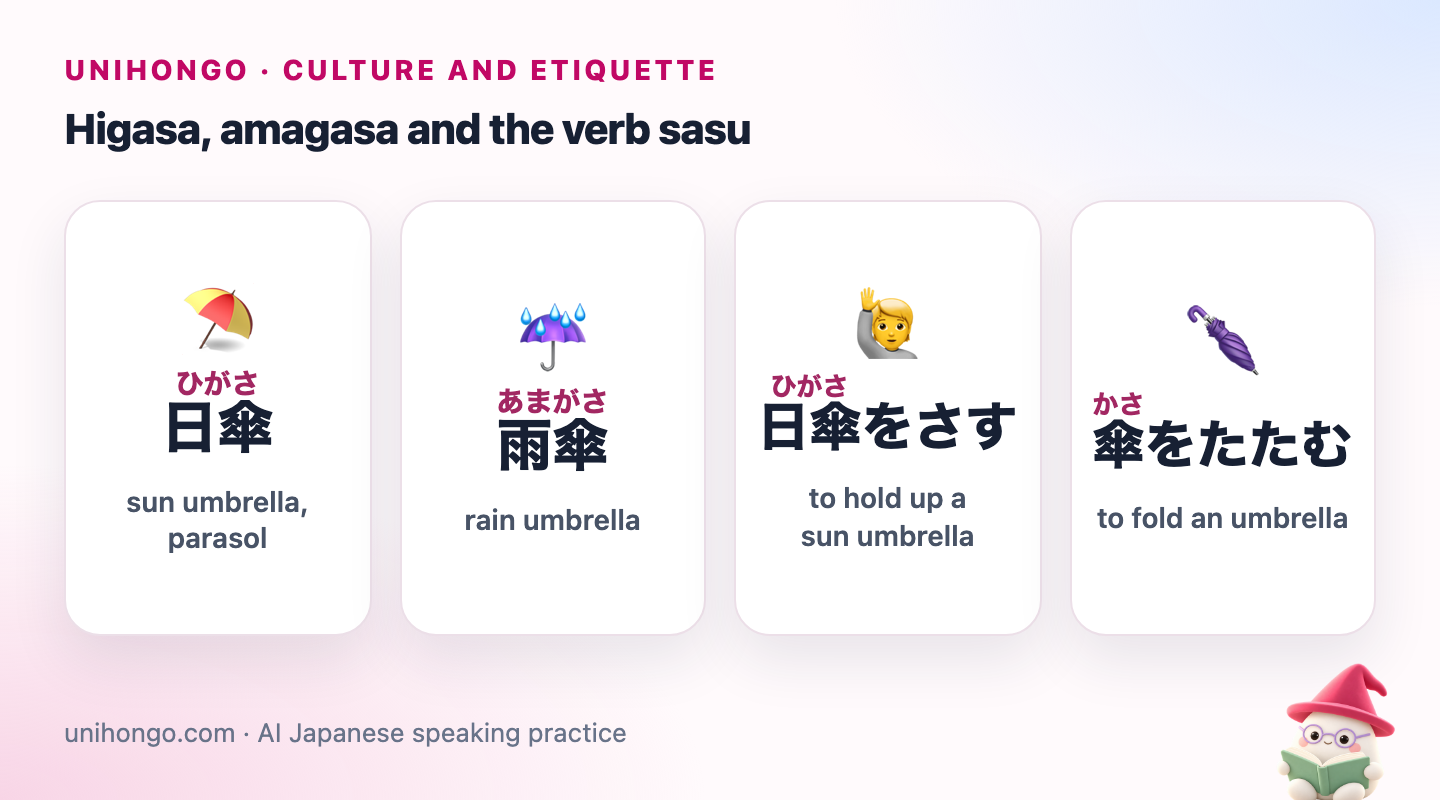
| Japanese | Romaji | Meaning |
|---|---|---|
| 日傘 | higasa | sun umbrella, parasol |
| 雨傘 | amagasa | rain umbrella |
| 日傘をさす | higasa o sasu | to hold up a sun umbrella |
| 傘をたたむ | kasa o tatamu | to fold an umbrella |
| 折りたたみ傘 | oritatami gasa | folding umbrella |
Why so many people carry one
There is no single reason, and people will give you different answers. Here are the ones you hear most often.
| Japanese | Romaji | Meaning |
|---|---|---|
| 日差しが強いですね。 | Hizashi ga tsuyoi desu ne. | The sun is strong, isn't it? |
| 日焼けしたくないんです。 | Hiyake shitaku nai n desu. | I don't want to get a tan or sunburn. |
| 紫外線が気になる。 | Shigaisen ga ki ni naru. | I'm worried about UV rays. (casual) |
| 熱中症に気をつけてください。 | Netchūshō ni ki o tsukete kudasai. | Please be careful of heatstroke. |
| Reason | What people say | Notes |
|---|---|---|
| Heat | The shade makes walking far cooler | Japanese summers are hot and humid in most regions |
| UV rays | To avoid sunburn and protect the skin | Many use sunscreen and arm covers as well |
| Skin care | To prevent dark spots and skin ageing | Skin-care culture is strong in Japan |
| Beauty ideals | Fair skin is admired by many | A long tradition, though tastes are changing |
| Heatstroke | To reduce the risk on very hot days | Public advice has promoted them for everyone |
Tastes and habits vary: some people love a summer tan, some never carry an umbrella, and use is more common in big cities than among people who drive everywhere. But in a hot city you will rarely be the only person under a parasol.
The summer skin-care vocabulary around it
Sun umbrellas come with a whole family of summer words. Hiyake covers both a tan and sunburn, so context tells you which. Hiyakedome is sunscreen, literally tan-stopper. Arm covers, called āmu kabā, are thin sleeves people slip on when cycling or driving. You will also see words like bihaku (skin-whitening, used for skin-care products) on shop shelves.
| Japanese | Romaji | Meaning |
|---|---|---|
| 日焼け止め | hiyakedome | sunscreen |
| 日焼け | hiyake | a tan; sunburn |
| 紫外線 | shigaisen | ultraviolet rays |
| アームカバー | āmu kabā | arm covers (loanword) |
| 帽子 | bōshi | hat, cap |
| 日焼け止めを塗る | hiyakedome o nuru | to put on sunscreen |
| 日陰 | hikage | shade |
| 日陰で休もう。 | Hikage de yasumō. | Let's rest in the shade. (casual) |
Other ways people beat the summer sun
The sun umbrella is one item in a whole summer kit. On trains and pavements you will see folding fans (sensu), flat round fans (uchiwa), often handed out free at events, and small battery-powered hand fans. People carry a towel or handkerchief for sweat, a bottle of tea or water, and on the hottest days sweets or tablets with salt. Shops sell cooling sheets, sprays and neck rings with the word reikan, a cool feeling.
These items are also a good way into small talk. Commenting on the heat and on someone's fan or umbrella is a natural, friendly opener with neighbours and coworkers, and the replies are short and predictable, which makes them ideal practice.
| Japanese | Romaji | Meaning |
|---|---|---|
| 扇子 | sensu | folding fan |
| うちわ | uchiwa | flat round fan |
| ハンディファン | handi fan | hand-held electric fan (loanword) |
| こまめに水分をとってね。 | Komame ni suibun o totte ne. | Drink little and often. (casual) |
| その扇子、すてきですね。 | Sono sensu, suteki desu ne. | That folding fan is lovely. |
| 今日も蒸し暑いですね。 | Kyō mo mushiatsui desu ne. | Hot and humid again today, isn't it? |
Buying a sun umbrella
Department stores, variety shops, drugstores and convenience stores all sell sun umbrellas in summer. Labels and staff will mention a few key features: how much UV the fabric cuts, whether it is light-blocking (shakō), whether it keeps out heat (shanetsu), and whether it can be used in the rain (seiu ken'yō). Folding models fit in a bag, which is useful because summer showers are common.
For a visitor, a sun-and-rain folding umbrella is the most practical choice. The rainy season, tsuyu, runs roughly from June into July in much of the country, and summer afternoons can bring sudden heavy downpours. One light umbrella that works in both conditions saves you from buying a cheap plastic umbrella every time the sky changes.
| Japanese | Romaji | Meaning |
|---|---|---|
| 日傘を探しているんですが。 | Higasa o sagashite iru n desu ga. | I'm looking for a sun umbrella. |
| 雨の日にも使えますか。 | Ame no hi ni mo tsukaemasu ka. | Can I use it on rainy days too? |
| もっと軽いのはありますか。 | Motto karui no wa arimasu ka. | Do you have a lighter one? |
| こちらは晴雨兼用で、折りたたみです。 | Kochira wa seiu ken'yō de, oritatami desu. | Staff: This one is for sun and rain, and it folds. |
| 男性用もありますか。 | Dansei yō mo arimasu ka. | Do you have ones for men too? |
| Label | Reading | Meaning |
|---|---|---|
| UVカット | yū bui katto | Blocks UV rays |
| 遮光 | shakō | Blocks light |
| 遮熱 | shanetsu | Blocks heat |
| 晴雨兼用 | seiu ken'yō | For sun and rain |
| 軽量 | keiryō | Lightweight |
Umbrella manners in crowds
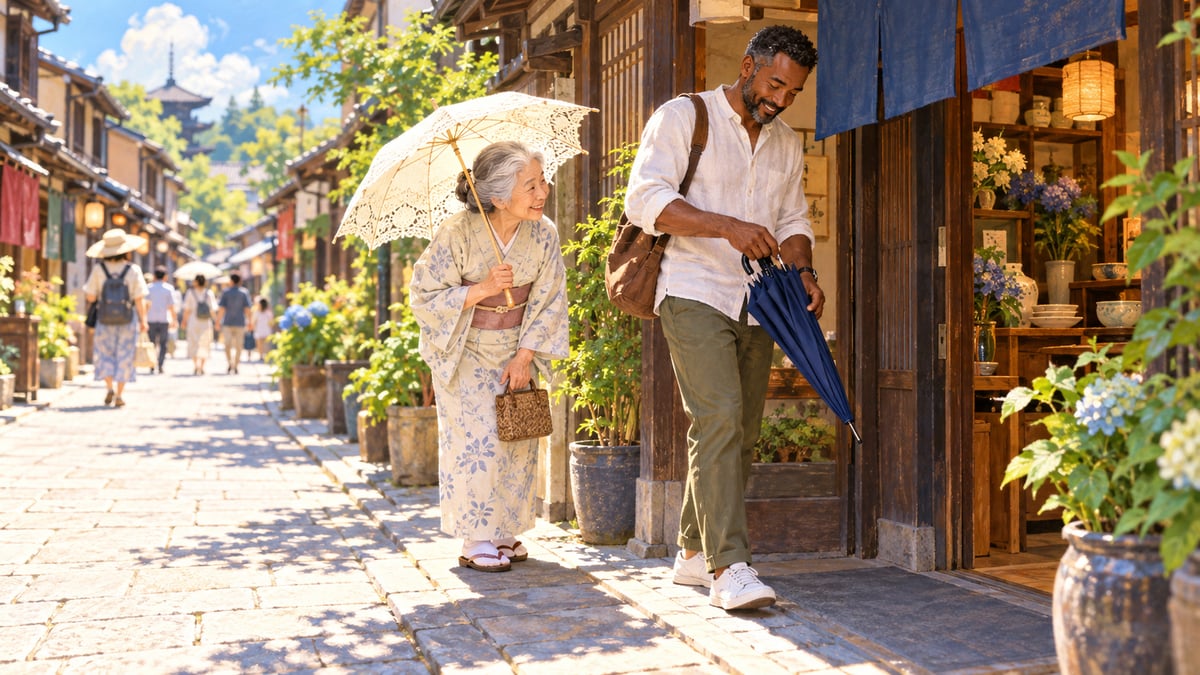
Umbrella etiquette in Japan is about keeping your umbrella out of other people's space. On a narrow pavement, tilt it away from people you pass or raise it above their heads. In a dense crowd, many people simply close it. Fold it before you go into a shop, a station or a train, and carry it pointing down, never horizontally under your arm, where the tip can hit someone behind you.
Some shops provide umbrella stands, kasatate, at the entrance, mostly for rain umbrellas. A sun umbrella is usually small enough to fold and keep with you, and it is wise to keep it, because an expensive parasol left in a stand can easily be taken by mistake.
| Japanese | Romaji | Meaning |
|---|---|---|
| 傘、気をつけて。 | Kasa, ki o tsukete. | Careful with the umbrella. (casual) |
| すみません、当たりましたか。 | Sumimasen, atarimashita ka. | Sorry, did it hit you? |
| 傘立てはありますか。 | Kasatate wa arimasu ka. | Is there an umbrella stand? |
| 人が多いから、たたもうか。 | Hito ga ōi kara, tatamō ka. | It's crowded, shall we fold them? (casual) |
Mini dialogue: a hot afternoon walk
| Japanese | Romaji | Meaning |
|---|---|---|
| 暑いね。日傘、入る? | Atsui ne. Higasa, hairu? | Friend: It's hot. Want to come under my umbrella? |
| いいの?ありがとう。全然違うね。 | Ii no? Arigatō. Zenzen chigau ne. | You: Are you sure? Thanks. It makes a huge difference. |
| でしょう。日陰だと涼しいよ。 | Deshō. Hikage da to suzushii yo. | Friend: Right? It's cooler in the shade. |
| 私も一本買おうかな。 | Watashi mo ippon kaō ka na. | You: Maybe I'll buy one too. |
| 晴雨兼用がおすすめだよ。 | Seiu ken'yō ga osusume da yo. | Friend: I'd recommend a sun-and-rain one. |
Common learner mistakes
- Saying kasa o motsu when you mean walking under it. Use kasa o sasu.
- Saying higasa with a k sound, hikasa. The compound changes to higasa.
- Thinking parasols are only for women. Men use them too, and more so every summer.
- Opening an umbrella inside a shop or station. Fold it before you enter.
- Assuming hiyake always means sunburn. It also means a tan, so add hirihiri suru (it stings) if it hurts.
- Leaving an umbrella open to dry in a doorway or on a station floor, where people trip over it. Shake it off outside and fold it.
- Using the word parasoru in conversation. It exists, but higasa is the everyday word, and shops label them that way.
Keep the umbrella words in your pocket with Mocchi
Type /kanji 傘 into Mocchi to see the meaning, readings and common words, then /create-flashcards higasa, amagasa, sasu, tatamu, hiyakedome, hikage, seiu ken'yō to build a small summer deck with a photo for each card. Mocchi keeps track of which words you miss and slips them into your next /review, so the deck grows with you through the season.
On a quick break, play Mocchi Flight with that same deck: you guide Mocchi through the gate with the right word, a fast way to make the umbrella verbs automatic.