

Aisle signs and store sections
Home centers are organised by type of product, and the hanging signs above each aisle, tsūro, use short kanji labels. Larger stores sometimes put heavy building materials in a separate building, shizaikan, and garden goods outside or in a covered garden area. Many stores also number their aisles, which helps when staff tell you where something is.
Learning the section names is the fastest way to navigate. Even if you cannot read every product label, you can find the right aisle and then compare items by picture and size.
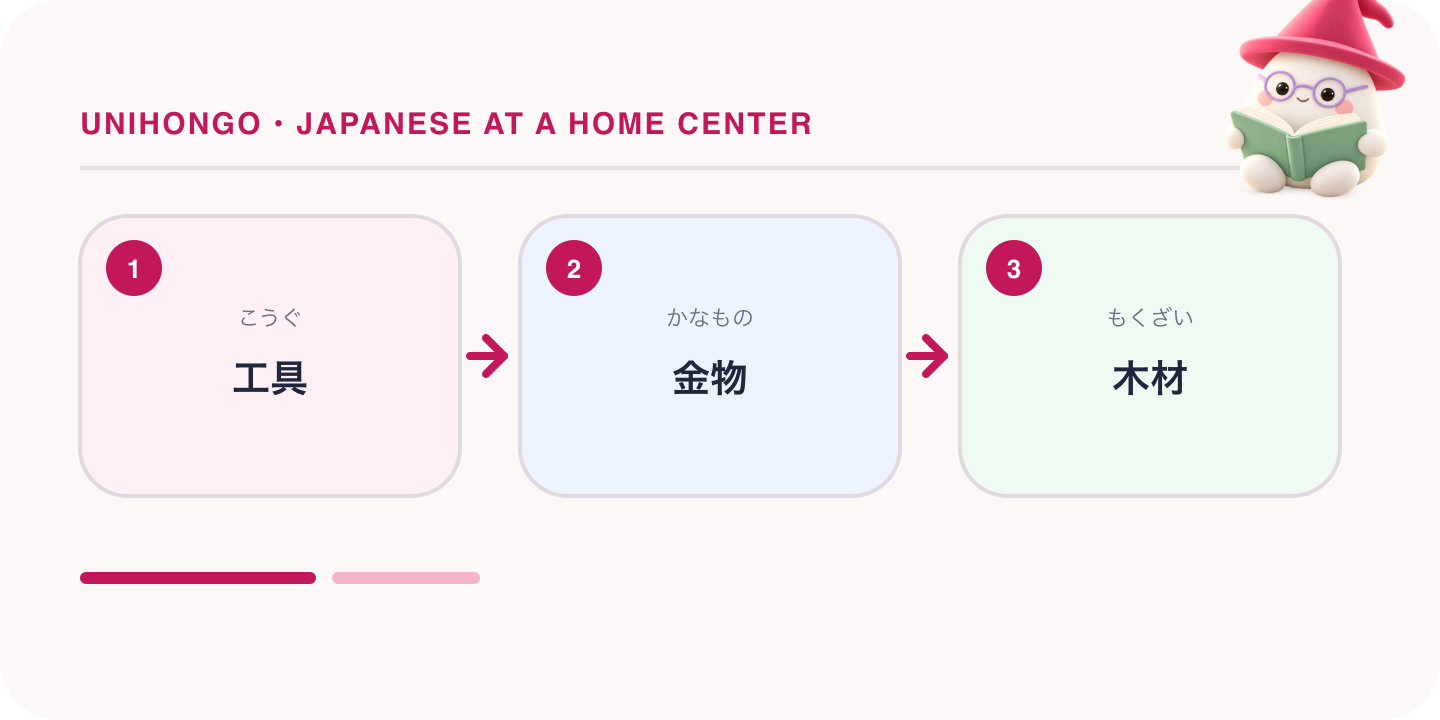
| Sign | Reading | What you find there |
|---|---|---|
| 工具 | kōgu | Tools |
| 金物 | kanamono | Hardware: screws, hinges, brackets |
| 木材 | mokuzai | Timber |
| 塗料 | toryō | Paint |
| 電材 | densai | Electrical parts |
| 照明 | shōmei | Lighting |
| 収納 | shūnō | Storage |
| 日用品 | nichiyōhin | Daily goods |
| 園芸 | engei | Gardening |
| 資材館 | shizaikan | Building materials hall |
Asking staff for help
Staff usually wear store aprons or uniforms and are used to questions. Start with sumimasen and name the item. If you do not know the word, a photo on your phone is the easiest approach, and describing what the item does also works: something to stop the door moving, something to fill a hole in the wall.
If an item is sold out or not stocked, ask about zaiko, stock, or toriyose, ordering it in. Staff may check on a handheld terminal and tell you when it will arrive.
| Japanese | Romaji | Meaning |
|---|---|---|
| すみません、ネジはどこですか。 | Sumimasen, neji wa doko desu ka. | Excuse me, where are the screws? |
| これを探しています。 | Kore o sagashite imasu. | I'm looking for this. |
| これと同じものはありますか。 | Kore to onaji mono wa arimasu ka. | Do you have the same one as this? |
| 壁に棚をつけたいんですが。 | Kabe ni tana o tsuketai n desu ga. | I'd like to put a shelf on the wall. |
| 賃貸なので、壁に穴を開けたくないです。 | Chintai na node, kabe ni ana o aketaku nai desu. | It's a rental, so I don't want to make holes in the wall. |
| 在庫はありますか。 | Zaiko wa arimasu ka. | Do you have it in stock? |
| 取り寄せできますか。 | Toriyose dekimasu ka. | Can you order it in? |
Everyday DIY vocabulary
Many tool names in Japanese are loanwords, which makes them easier to guess. Doraibā is a screwdriver, not a driver in a car, and denki doriru is an electric drill. Others are native words worth learning, such as kugi, a nail, and nokogiri, a saw.
Screws and fixings are sold by length and diameter in millimetres, and packets usually show the size clearly. If you are replacing something, bring the old part and compare it on the shelf.
| Word | Reading | Meaning |
|---|---|---|
| ネジ | neji | Screw |
| 釘 | kugi | Nail |
| ドライバー | doraibā | Screwdriver |
| 電動ドリル | dendō doriru | Electric drill |
| のこぎり | nokogiri | Saw |
| 金づち | kanazuchi | Hammer |
| 接着剤 | secchakuzai | Glue, adhesive |
| 両面テープ | ryōmen tēpu | Double-sided tape |
| 養生テープ | yōjō tēpu | Removable masking tape |
| メジャー | mejā | Tape measure |
| 軍手 | gunte | Work gloves |
Household and apartment essentials
Home centers are where many people set up a new apartment. Common purchases include curtains, which come in standard sizes that you match to the window, tsupparibō tension rods for storage, bōchū insect-repellent products, joshitsuzai moisture absorbers for cupboards during the rainy season, and cleaning supplies.
For lighting, the key is the base type of the bulb, kuchigane, and for ceiling lights, the ceiling socket that many apartments have, called hikkake shīringu. Enchō kōdo, extension cables, and tēburu tappu, power strips, are in the electrical aisle.
| Japanese | Romaji | Meaning |
|---|---|---|
| 突っ張り棒 | tsupparibō | Tension rod |
| 除湿剤 | joshitsuzai | Moisture absorber |
| 防虫剤 | bōchūzai | Insect repellent (for clothes) |
| 電球 | denkyū | Light bulb |
| 口金 | kuchigane | Bulb base |
| 延長コード | enchō kōdo | Extension cable |
| 網戸 | amido | Insect screen |
| この窓に合うカーテンはどれですか。 | Kono mado ni au kāten wa dore desu ka. | Which curtains fit this window? |
Paint, garden and pet sections
In the paint aisle, labels tell you where the paint can be used: suisei is water-based, yusei is oil-based, and okunai and okugai mean indoor and outdoor. Some stores offer chōshoku, colour mixing, where staff match a colour for you.
The garden section, engei, sells plants, soil, tsuchi, fertiliser, hiryō, and pots, hachi. Many home centers also have a pet section, petto yōhin, with food, litter and cages. Seasonal goods change often, so an aisle may hold heaters in winter and fans or mosquito products in summer.
| Japanese | Romaji | Meaning |
|---|---|---|
| 水性 | suisei | Water-based |
| 油性 | yusei | Oil-based |
| 屋内用 | okunai-yō | For indoor use |
| 屋外用 | okugai-yō | For outdoor use |
| 培養土 | baiyōdo | Potting soil |
| 肥料 | hiryō | Fertiliser |
| ベランダで育てやすい植物はありますか。 | Beranda de sodateyasui shokubutsu wa arimasu ka. | Are there plants that are easy to grow on a balcony? |
The wood cutting service
Many home centers have a cutting counter, often signed mokuzai katto or katto sābisu. You pick a board, take it to the counter, fill in or say the sizes and staff cut it on a panel saw. There is usually a fee per cut, and some stores have limits on the materials, thicknesses or kinds of cut they accept, such as only straight cuts. Rules differ, so ask before you choose the board.
Give sizes in millimetres. Tate is length or the vertical direction, yoko is width or the horizontal direction, and atsusa is thickness. Staff may ask whether you want to keep the offcut, hazai, which some stores will dispose of for you.
| Japanese | Romaji | Meaning |
|---|---|---|
| この板をカットしてもらえますか。 | Kono ita o katto shite moraemasu ka. | Could you cut this board for me? |
| 900ミリと600ミリに切ってください。 | Kyūhyaku miri to roppyaku miri ni kitte kudasai. | Please cut it into 900 mm and 600 mm. |
| 半分に切ってください。 | Hanbun ni kitte kudasai. | Please cut it in half. |
| 縦 | tate | Length, vertical direction |
| 横 | yoko | Width, horizontal direction |
| 厚さ | atsusa | Thickness |
| 端材はいりません。 | Hazai wa irimasen. | I don't need the offcut. |
| 一カットいくらですか。 | Hito-katto ikura desu ka. | How much is it per cut? |
Delivery, truck rental and other services
Large items such as furniture, timber and appliances can often be delivered, haisō, for a fee that depends on the distance and size. At the service counter you fill in your address and choose a delivery day and time slot. Some stores also offer assembly, kumitate, for furniture.
Some stores lend a small truck, usually a kei truck, so you can take large purchases home yourself. The loan is called something like keitora kashidashi. You will normally need to show a driving licence and return the truck within a set time, and conditions such as fees and distance limits depend on the store. Other common services include aikagi, key copying, and tool rental.
| Japanese | Romaji | Meaning |
|---|---|---|
| 配送をお願いしたいです。 | Haisō o onegai shitai desu. | I'd like this delivered. |
| 配送料はいくらですか。 | Haisōryō wa ikura desu ka. | How much is delivery? |
| 土曜日の午前中に届けてもらえますか。 | Doyōbi no gozenchū ni todokete moraemasu ka. | Could you deliver on Saturday morning? |
| 軽トラを借りられますか。 | Keitora o kariraremasu ka. | Can I borrow the light truck? |
| 何時間まで借りられますか。 | Nan-jikan made kariraremasu ka. | How many hours can I borrow it for? |
| 合鍵を作りたいです。 | Aikagi o tsukuritai desu. | I'd like a key copied. |
If you live in a rental, check your contract or ask your landlord before copying keys, since some leases restrict it.
At the checkout and returns
Checkout works like any Japanese shop: the cashier may ask whether you need a bag, fukuro, and whether you have a point card, pointo kādo. For long items like timber, cashiers often scan a barcode card at the checkout rather than the item itself, so pick up the card from the shelf if one is provided.
If something does not fit or is faulty, keep the receipt and ask at the service counter about henpin, a return, or kōkan, an exchange. Policies differ, and cut timber or opened items may not be returnable.
| Japanese | Romaji | Meaning |
|---|---|---|
| 袋はいりません。 | Fukuro wa irimasen. | I don't need a bag. |
| ポイントカードは持っていません。 | Pointo kādo wa motte imasen. | I don't have a point card. |
| サイズが合わなかったので、交換できますか。 | Saizu ga awanakatta node, kōkan dekimasu ka. | It didn't fit; can I exchange it? |
| 返品できますか。 | Henpin dekimasu ka. | Can I return this? |
| レシートはこちらです。 | Reshīto wa kochira desu. | Here is the receipt. |