
Four kinds of beauty in a name
Each of these girls' names uses a different beauty kanji, and each paints a different picture: a jewel's clear chime, graceful refinement, rich colour and courtly elegance.
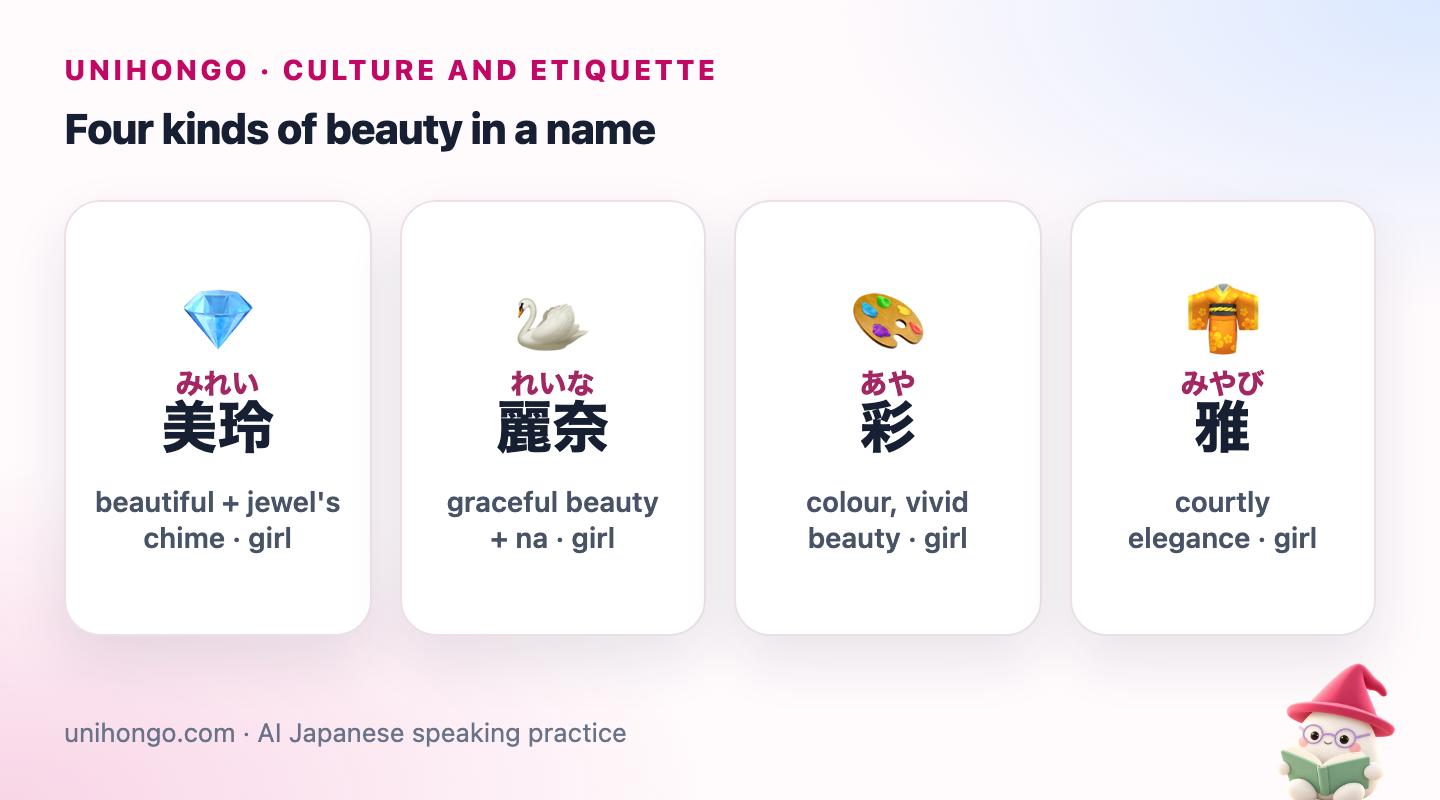
| Japanese | Romaji | Meaning |
|---|---|---|
| 美玲 | Mirei | beautiful + jewel's chime · girl |
| 麗奈 | Reina | graceful beauty + na · girl |
| 彩 | Aya | colour, vivid beauty · girl |
| 雅 | Miyabi | courtly elegance · girl |
玲 describes the clear sound of jewels touching, so 美玲 is beauty with a bright, clear ring to it. 奈 in 麗奈 is mostly chosen for its sound, na, and it is a common soft final kanji in girls' names. 彩 alone is read Aya, and the everyday verb 彩る (irodoru) means to colour or decorate.
美: beauty in general, and the -mi names
美 is one of the most common kanji in Japanese girls' names. It can come first, as in Mirei and Mikoto, or last, where it gives the -mi ending of many names. The -mi ending was especially common for women born in the mid twentieth century, so names like Naomi, Kazumi and Hiromi often belong to someone's mother or aunt. Some of them, such as Kazumi and Hiromi, have also been used for men.
| Japanese | Romaji | Meaning |
|---|---|---|
| 美琴 | Mikoto | beautiful + koto harp · girl |
| 直美 | Naomi | honest + beautiful · girl |
| 和美 | Kazumi | harmony + beautiful · mostly girl |
| 美樹 | Yoshiki | beautiful + tree · boy |
| Position | Reading | Examples |
|---|---|---|
| First kanji | mi | 美玲 Mirei, 美琴 Mikoto |
| Last kanji | mi | 直美 Naomi, 和美 Kazumi |
| In some boys' names | yoshi | 美樹 Yoshiki |
| In words, not usually names | bi | 美人 bijin, 美術 bijutsu |
Yoshi is an old reading meaning good or fine, and it is why 美 can appear in a boy's name without sounding feminine. Note that 美樹 can also be read Miki as a girl's name, so the same two kanji may belong to a man or a woman.
Beyond 美: five more beauty kanji
If you are choosing a name for a child or a character, these kanji let you be much more precise about the kind of beauty you mean. The table gives the image of each and a common everyday word.
| Japanese | Romaji | Meaning |
|---|---|---|
| 麗 | Urara | graceful, bright and lovely · girl |
| 佳奈 | Kana | fine, excellent + soft ending · girl |
| 彩花 | Ayaka | colour + flower · girl |
| 綺 | Aya | exquisite, like patterned silk · girl |
| Kanji | Image | Everyday word | Name example |
|---|---|---|---|
| 麗 | Refined, graceful loveliness | 華麗 karei, splendid | 麗 Urara |
| 綺 | Fine patterned silk, exquisite | 綺麗 kirei, pretty | 綺 Aya |
| 佳 | Fine, excellent, good | 佳作 kasaku, a fine work | 佳奈 Kana |
| 彩 | Colour, brilliance | 色彩 shikisai, colours | 彩花 Ayaka |
| 雅 | Courtly, refined elegance | 優雅 yūga, graceful | 雅 Miyabi |
Urara also echoes うららか, the word for a bright, calm spring day. Kirei, the everyday word for pretty or clean, is written 綺麗 with two beauty kanji, but most people write it in hiragana as きれい because the kanji are complicated. Aya can be written 彩, 綺, 絢 or 文, and each spelling has a different feel.
Beauty names for boys
Boys' names rarely use 美 with the mi reading, but beauty is still there. Parents choose kanji of brilliance, elegance and jewels, which feel bright and refined rather than pretty, and pair them with typical boys' endings.
| Japanese | Romaji | Meaning |
|---|---|---|
| 瑛太 | Eita | jewel's radiance + big · boy |
| 玲央 | Reo | jewel's chime + centre · boy |
| 雅也 | Masaya | elegance + classic ending · boy |
| 彩人 | Ayato | colour + person · boy |
瑛 describes the shine of a jewel, a kind of crystal clarity. Reo also sounds like Leo, so some parents like that the name works in other languages. 雅 read masa appears in many older and current boys' names, such as Masato and Masaya, and gives them a refined, cultured tone.
Beautiful names without a beauty kanji
Many of the names Japanese people describe as beautiful contain no beauty kanji at all. Their beauty comes from the image they create: music, poetry, a wide view or the light of a season. If you want a name that feels lovely without saying beautiful directly, this is often the more elegant route, and it avoids the slightly old-fashioned feel that some -mi names now have.
| Japanese | Romaji | Meaning |
|---|---|---|
| 琴音 | Kotone | the sound of the koto harp · girl |
| 詩 | Uta | poem, poetry · girl |
| 千景 | Chikage | a thousand views · girl |
| 奏太 | Sōta | playing music + big · boy |
The koto is a long, thirteen-string instrument, and its sound is often described as clear and graceful, so 琴音 suggests music rather than appearance. 千景 wishes for a life full of beautiful scenery. Names like these are easy to compliment, because you can praise the image: Ongaku mitai na namae desu ne, it's a name like music.
How to compliment a name
Complimenting someone's name is a kind, safe thing to do in Japan, and it often leads to a short story about the parents' choice. The trick is to praise the name itself, its sound or its meaning, rather than the person's looks. Saying a woman is as beautiful as her name may feel like a comment on her appearance, which can be awkward with people you do not know well.
| Japanese | Romaji | Meaning |
|---|---|---|
| 素敵なお名前ですね。 | Suteki na onamae desu ne. | What a lovely name. (polite, safe) |
| 響きがきれいですね。 | Hibiki ga kirei desu ne. | It sounds beautiful. |
| 意味も素敵ですね。 | Imi mo suteki desu ne. | The meaning is lovely too. |
| 字がきれいですね。 | Ji ga kirei desu ne. | Your handwriting is beautiful. |
| どなたがつけたんですか。 | Donata ga tsuketa n desu ka. | Who chose your name? (polite) |
Ji ga kirei normally means your handwriting is beautiful, so if you want to praise the kanji of a name, say Kanji mo kirei desu ne, the kanji are beautiful too, or Ii kanji desu ne. Donata is the polite form of dare, who, and fits a conversation with someone you have just met.
Mini dialogue: writing Miyabi at a calligraphy class
You take a weekend calligraphy class. The woman next to you is practising her own name with a brush. You speak politely because you have only just met.
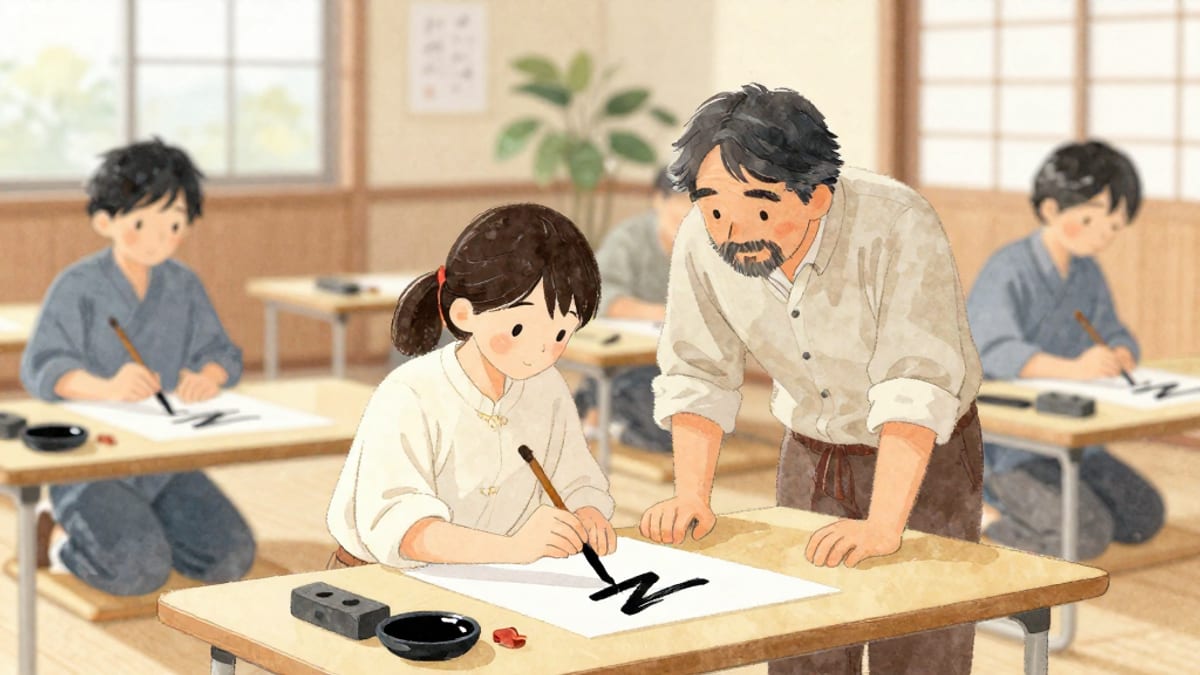
| Japanese | Romaji | Meaning |
|---|---|---|
| 何を書いているんですか。 | Nani o kaite iru n desu ka. | You: What are you writing? |
| 自分の名前です。雅です。 | Jibun no namae desu. Miyabi desu. | Classmate: My own name. I'm Miyabi. |
| 難しそうな字ですね。 | Muzukashisō na ji desu ne. | You: It looks like a hard kanji. |
| 画数が多いので、バランスが大変です。 | Kakusū ga ōi node, baransu ga taihen desu. | Classmate: It has a lot of strokes, so balance is hard. |
| でも、とてもきれいに書けていますよ。 | Demo, totemo kirei ni kakete imasu yo. | You: But you've written it beautifully. |
Kakusū means stroke count, an important word for name kanji: 雅 has 13 strokes and 麗 has 19. Kirei ni kakete imasu, you have written it beautifully, is the natural way to praise someone's brushwork, and here ji ga kirei would also be fine, because you really are talking about the writing.
Learn the beauty kanji with Mocchi and Ibuki-sensei
Start with Mocchi: type /kanji 麗 and you get its meaning, readings and common words. Then ask, How is 麗 different from 美 and 彩 in names? Mocchi explains with examples and saves what you found confusing, so a later /review brings back exactly those kanji.
For speaking, open AI Sensei, choose Ibuki-sensei and ask the Sensei to play the teacher at a calligraphy class. Say which beauty kanji you would write and why, ask about the teacher's name, and practise the compliments from this post.
Mistakes to steer clear of
- Treating all beauty kanji as the same. 雅 sounds courtly, 彩 sounds colourful and bright, and 麗 sounds formal and grand; choose the image you really want.
- Assuming 美 makes a name feminine. Read yoshi, it appears in boys' names such as 美樹 (Yoshiki).
- Saying ji ga kirei when you mean the name is beautiful. It is heard as praise of the handwriting.
- Complimenting a person's looks through their name. Praise the sound or the meaning instead.
- Choosing 麗 for a child without thinking about writing it. With 19 strokes, it takes a long time to write on every school test.