
The kanji and the original meaning
Both kanji in 忖度 are about measuring. 忖 has the heart radical and means to guess or surmise; 度 means degree or to measure, as in ondo (temperature). Together, sontaku means to measure what is in someone else's heart. In older and formal Japanese it was simply a careful word for inferring another person's feelings or intentions.
Today the word has two layers. The neutral layer is still in the dictionary. The everyday layer, since 2017, adds a critical edge: acting on the guessed wishes of someone with power, to please them or to protect yourself, without anyone giving an order. Because no order was given, nobody has to take responsibility, and that is exactly what makes the word sharp.
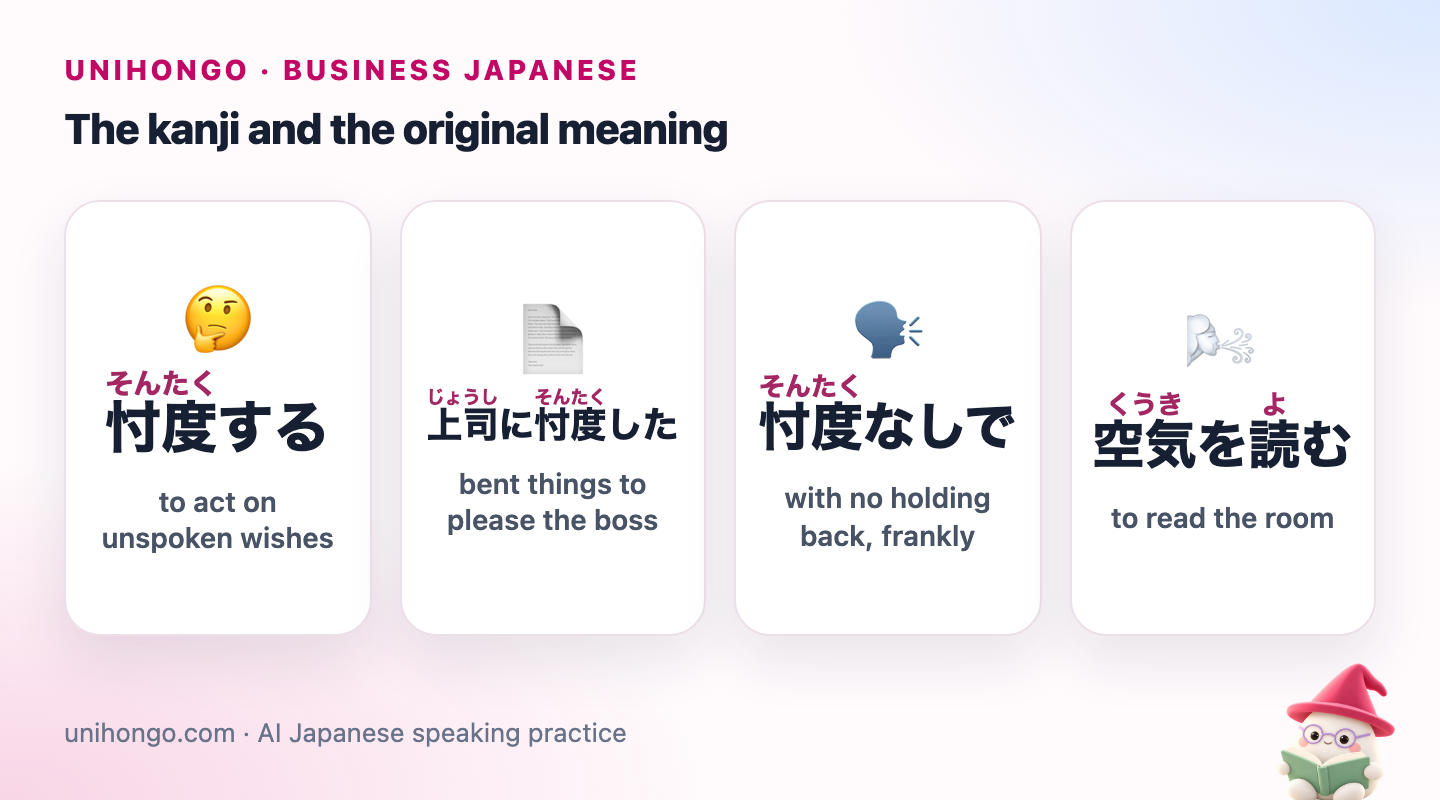
| Japanese | Romaji | Meaning |
|---|---|---|
| 忖度する | sontaku suru | to act on unspoken wishes |
| 上司に忖度した | jōshi ni sontaku shita | bent things to please the boss |
| 忖度なしで | sontaku nashi de | with no holding back, frankly |
| 空気を読む | kūki o yomu | to read the room |
The critical use: pleasing the powerful
In news and in office talk, sontaku most often describes a subordinate, an official or a company quietly favouring someone powerful: approving a plan faster, softening a report, leaving out a fact, or choosing a supplier because the director seems to like them. The person who benefits never asked; the subordinate guessed and acted.
The grammar to watch is ni: X ni sontaku suru means acting out of consideration for X. You will also hear sontaku ga hataraita, sontaku was at work, as a careful way of saying that something was influenced without proof of an order.
| Japanese | Romaji | Meaning |
|---|---|---|
| 部長に忖度して、報告を変えたらしい。 | Buchō ni sontaku shite, hōkoku o kaeta rashii. | Apparently they changed the report to please the department head. |
| 忖度が働いたのかもしれない。 | Sontaku ga hataraita no kamo shirenai. | Maybe some sontaku was at work. |
| それは忖度じゃないですか。 | Sore wa sontaku ja nai desu ka. | Isn't that just pleasing the people at the top? |
| 誰も指示していないそうです。 | Daremo shiji shite inai sō desu. | Apparently nobody gave any instructions. |
The neutral and joking uses
The original sense has not disappeared. In careful writing, aite no kimochi o sontaku suru can still mean to take the other person's feelings into account. But since most people now hear the 2017 nuance, everyday speakers often choose other words for the positive version and use sontaku with a wink.
The joking use is very common. A friend who orders the dessert you were eyeing might say sontaku shimashita, I read your mind. A junior who laughs too hard at the boss's joke gets teased for sontaku. And the phrase sontaku nashi, with no sontaku, has become popular for honest reviews, blunt rankings and frank feedback.
| Japanese | Romaji | Meaning |
|---|---|---|
| デザート、忖度して頼んでおいたよ。 | Dezāto, sontaku shite tanonde oita yo. | I read your mind and ordered dessert. (joking) |
| 忖度なしの感想を聞かせて。 | Sontaku nashi no kansō o kikasete. | Tell me what you honestly think. (casual) |
| 忖度なしでお願いします。 | Sontaku nashi de onegaishimasu. | Please be completely frank. (polite) |
| 相手の気持ちを忖度する。 | Aite no kimochi o sontaku suru. | To consider the other person's feelings. (neutral, written) |
Sontaku, kūki o yomu, sassuru and nemawashi
Japanese has several words for picking up on what is not said, and they are often confused. Kūki o yomu, reading the air, is about sensing the mood and adjusting your behaviour, usually in the moment; Unihongo has a separate guide to it. Sassuru is the neutral, everyday verb for inferring someone's feelings. Ki o kikaseru is the positive word for thoughtfully doing something helpful without being asked. Nemawashi is open, deliberate groundwork before a decision. Sontaku is the one with the power angle.
| Japanese | Romaji | Meaning |
|---|---|---|
| 空気を読んで黙っていた。 | Kūki o yonde damatte ita. | I read the room and kept quiet. |
| 気持ちを察してくれてありがとう。 | Kimochi o sasshite kurete arigatō. | Thanks for understanding how I felt. |
| 気を利かせてお茶を出してくれた。 | Ki o kikasete ocha o dashite kureta. | They thoughtfully brought tea without being asked. |
| 上司の顔色ばかりうかがっている。 | Jōshi no kaoiro bakari ukagatte iru. | He's always watching the boss's mood. |
| Expression | What it means | Tone |
|---|---|---|
| Sontaku suru (忖度する) | Act on a powerful person's unspoken wishes | Usually critical or joking |
| Kūki o yomu (空気を読む) | Sense the mood and fit in | Neutral; can imply conformity |
| Sassuru (察する) | Infer feelings or intentions | Neutral, often kind |
| Ki o kikaseru (気を利かせる) | Thoughtfully do something helpful unasked | Positive |
| Nemawashi (根回し) | Talk to people one by one before a decision | Neutral business practice |
| Kaoiro o ukagau (顔色をうかがう) | Watch someone's face to see their mood | Slightly negative: anxious, servile |
Talking about sontaku at work
As a non-native speaker in a Japanese workplace, you may want to ask for frank feedback, or gently point out that a decision seems to follow unspoken pressure. Both are possible with the right softeners. Asking for honesty is easy and friendly; questioning sontaku needs care.
In the scene below, a learner presenting a plan asks a senior colleague for an honest view, and the colleague hints at the unspoken preference of the director.

| Japanese | Romaji | Meaning |
|---|---|---|
| この案、忖度なしでどう思いますか。 | Kono an, sontaku nashi de dō omoimasu ka. | Learner: Honestly, what do you think of this plan? |
| 内容はいいと思うよ。 | Naiyō wa ii to omou yo. | Senior: I think the content is good. |
| ただ、部長はA社が好きだからね。 | Tada, buchō wa Ē-sha ga suki dakara ne. | Senior: The thing is, the department head likes Company A. |
| それは忖度したほうがいいということですか。 | Sore wa sontaku shita hō ga ii to iu koto desu ka. | Learner: Do you mean I should adjust to that? |
| いや、データで説明すれば大丈夫だよ。 | Iya, dēta de setsumei sureba daijōbu da yo. | Senior: No, if you back it up with data, you'll be fine. |
How to reply when someone mentions sontaku
Because the word can sound like an accusation, the reply depends on the tone. If a friend jokes that you are doing sontaku by laughing at the manager's joke, laugh along or deny it playfully. If someone uses it seriously about a decision you made, it is best to answer calmly with the facts: who asked for what, and why you chose it. Avoid getting defensive with the word itself.
When you are the one asking for honesty, the phrase sontaku nashi de works well with peers. With a superior, socchoku na goiken, frank opinion, is more polite and avoids the political flavour of sontaku altogether.
| Japanese | Romaji | Meaning |
|---|---|---|
| いやいや、忖度じゃないよ。 | Iya iya, sontaku ja nai yo. | No, no, I'm not sucking up. (casual, joking) |
| データを見て決めました。 | Dēta o mite kimemashita. | I decided based on the data. |
| 遠慮なく言ってください。 | Enryo naku itte kudasai. | Please don't hold back. (polite) |
| 正直に言うと、ちょっと心配です。 | Shōjiki ni iu to, chotto shinpai desu. | To be honest, I'm a little worried. |
Common mistakes
| Japanese | Romaji | Meaning |
|---|---|---|
| 気を利かせてくれてありがとう。 | Ki o kikasete kurete arigatō. | Thanks for thinking ahead for me. (casual) |
| 率直なご意見をいただけますか。 | Socchoku na goiken o itadakemasu ka. | Could I have your frank opinion? (polite) |
- Using sontaku as a compliment. Saying sontaku shite kurete arigatō to a colleague can sound like you are calling them a flatterer. Use ki o kikasete kurete arigatō.
- Saying it about yourself seriously in a meeting. Sontaku shimashita sounds like admitting to favouritism, unless it is clearly a joke.
- Treating it as identical to kūki o yomu. Reading the room is about mood; sontaku is about acting for someone above you.
- Using it with the wrong particle: it is buchō ni sontaku suru (out of regard for the department head), not buchō o sontaku suru.