
How much Japanese a founder actually needs
Be honest about your audience. If you are raising from investors who regularly back foreign founders, the meeting may be in English and your Japanese will be a courtesy that opens and closes it. If you are selling to Japanese companies, partnering with a regional firm, applying to a government or municipal programme, opening a bank account for the company or hiring your first Japanese employee, the meeting will be in Japanese and your ability to hold your own in it is part of the pitch. Most founders need the second kind of Japanese sooner than they expect.
The target is not fluency. It is to open the meeting, present the business in three or four plain sentences, follow the questions, answer the ones you can, buy time on the ones you cannot, and close with a next step, all in Japanese, with a bilingual colleague or interpreter for the detail. The lines below are the spirit of it.
| Japanese | Romaji | Meaning |
|---|---|---|
| 日本で事業を始めます。 | Nihon de jigyō o hajimemasu. | I'm starting a business in Japan. |
| 日本語はまだ勉強中ですが、頑張ります。 | Nihongo wa mada benkyōchū desu ga, ganbarimasu. | My Japanese is still a work in progress, but I'll do my best. |
| 本日はお時間をいただき、ありがとうございます。 | Honjitsu wa ojikan o itadaki, arigatō gozaimasu. | Thank you for your time today. (formal) |
The pitch in four lines
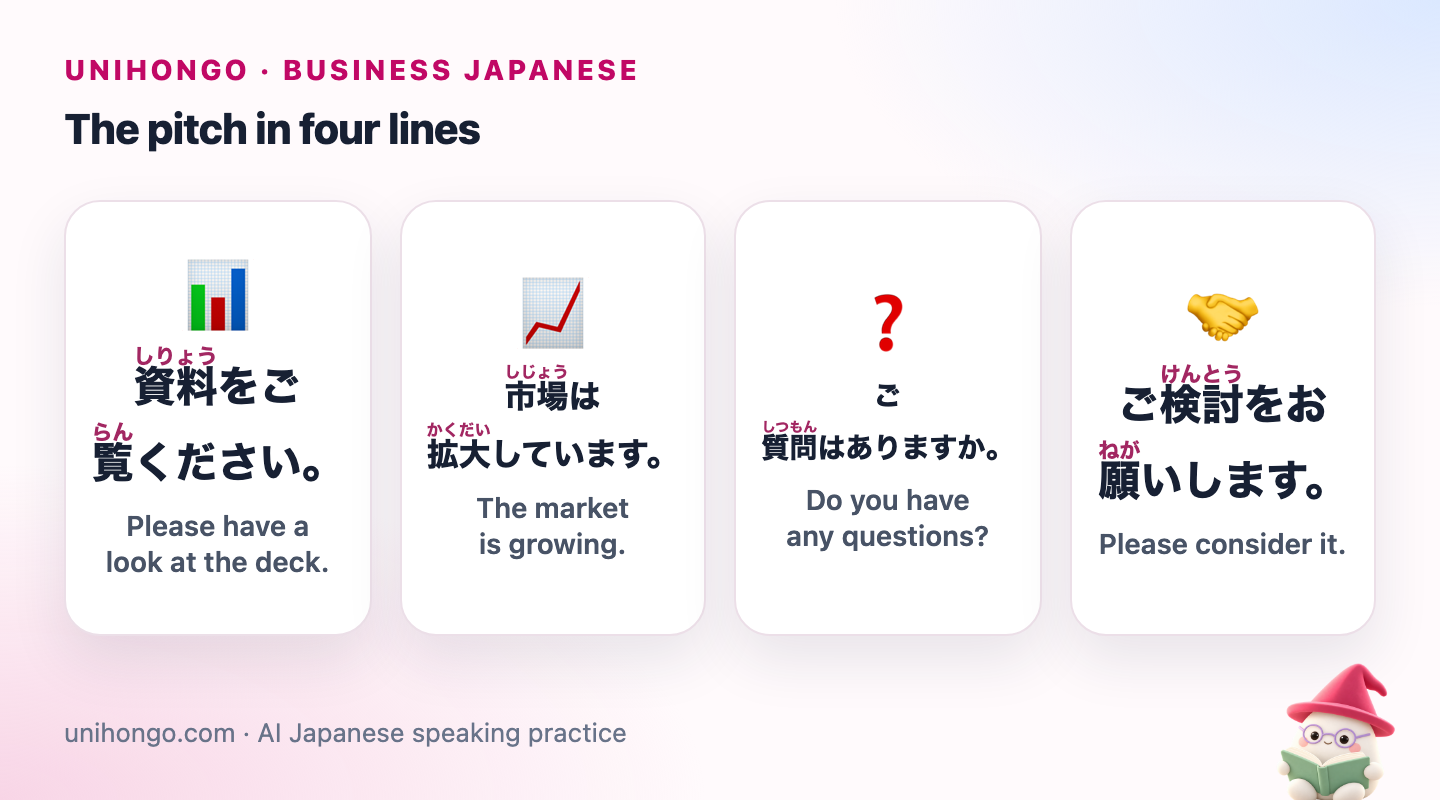
A spoken pitch in a second language should be short enough to deliver without notes and clear enough to survive your accent. Four moves cover it: direct attention to the deck, state the one fact about the market, invite questions, and ask for consideration. Everything else lives in the deck or in your answers. The picture cards give you the four lines; the vocabulary that follows is what the deck and the conversation will need.
| Japanese | Romaji | Meaning |
|---|---|---|
| 資料をご覧ください。 | Shiryō o goran kudasai. | Please have a look at the deck. |
| 市場は拡大しています。 | Shijō wa kakudai shite imasu. | The market is growing. |
| ご質問はありますか。 | Goshitsumon wa arimasu ka. | Do you have any questions? |
| ご検討をお願いします。 | Gokentō o onegai shimasu. | Please consider it. |
| 創業者 | sōgyōsha | founder |
| 投資家 | tōshika | investor |
| 資金調達 | shikin chōtatsu | fundraising |
| 売上 | uriage | revenue |
| 利益 | rieki | profit |
| 顧客 | kokyaku | customers |
| 競合 | kyōgō | competitors |
| 提携 | teikei | partnership |
| 事業計画書 | jigyō keikakusho | business plan |
The first five minutes: cards, names and seats
A first business meeting in Japan opens with a ritual that takes two minutes and sets the tone for the next hour. You exchange business cards, meishi, standing, each person offering their card with both hands and a slight bow while saying their company and name, and receiving the other's card with both hands and a moment of attention. Cards stay on the table during the meeting, arranged in front of you, and never go into a back pocket. The guest is usually shown to the seat furthest from the door; wait to be invited to sit.
Your self-introduction uses humble forms for yourself and your company. Mōsu is the humble to be called; heisha is our company; daihyō is the representative director, the usual title of a founder-CEO.
| Japanese | Romaji | Meaning |
|---|---|---|
| 株式会社ハルの代表のリーと申します。 | Kabushiki gaisha Haru no daihyō no Rī to mōshimasu. | I'm Lee, the representative director of Haru Inc. (humble) |
| 名刺を頂戴いたします。 | Meishi o chōdai itashimasu. | Thank you for your card. (humble, receiving) |
| どうぞよろしくお願いいたします。 | Dōzo yoroshiku onegai itashimasu. | I look forward to working with you. (formal) |
| おかけください。 | Okake kudasai. | Host: Please take a seat. |
| 失礼します。 | Shitsurei shimasu. | Excuse me. (as you sit, enter or leave) |
| 本日は弊社の事業についてご説明させていただきます。 | Honjitsu wa heisha no jigyō ni tsuite gosetsumei sasete itadakimasu. | Today I'd like to explain our business. (humble) |
Sasete itadakimasu, literally I humbly receive permission to do, is the standard formal way to announce what you are about to do in a meeting. It sounds heavy in English and perfectly normal in Japanese.
What investors and partners ask, and how to answer
The questions in a Japanese investor meeting are the same as anywhere: the team, the market, the competition, the numbers, the ask. What differs is that they may arrive more indirectly, and that an answer that admits uncertainty and promises a written follow-up is respected rather than penalised. Prepare one simple answer to each of the questions below, and prepare the buying-time line for everything else.
| Japanese | Romaji | Meaning |
|---|---|---|
| 御社の強みは何ですか。 | Onsha no tsuyomi wa nan desu ka. | Investor: What is your company's strength? |
| 弊社の強みは技術と日本市場への理解です。 | Heisha no tsuyomi wa gijutsu to Nihon shijō e no rikai desu. | You: Our strength is our technology and our understanding of the Japanese market. |
| 競合はどこですか。 | Kyōgō wa doko desu ka. | Investor: Who are your competitors? |
| 月の売上はいくらですか。 | Tsuki no uriage wa ikura desu ka. | Investor: What is your monthly revenue? |
| いくら調達する予定ですか。 | Ikura chōtatsu suru yotei desu ka. | Investor: How much are you planning to raise? |
| 資金は主に開発と採用に使う予定です。 | Shikin wa omo ni kaihatsu to saiyō ni tsukau yotei desu. | You: We plan to use the funds mainly for development and hiring. |
| 確認して、改めてご回答いたします。 | Kakunin shite, aratamete gokaitō itashimasu. | You: I'll confirm and get back to you with an answer. (humble) |
The last line is the most valuable sentence in the guide. Guessing a number in a second language is how founders lose trust; promising a written answer and delivering it the next morning is how they gain it.
Partners and customers: the meeting outside the startup bubble
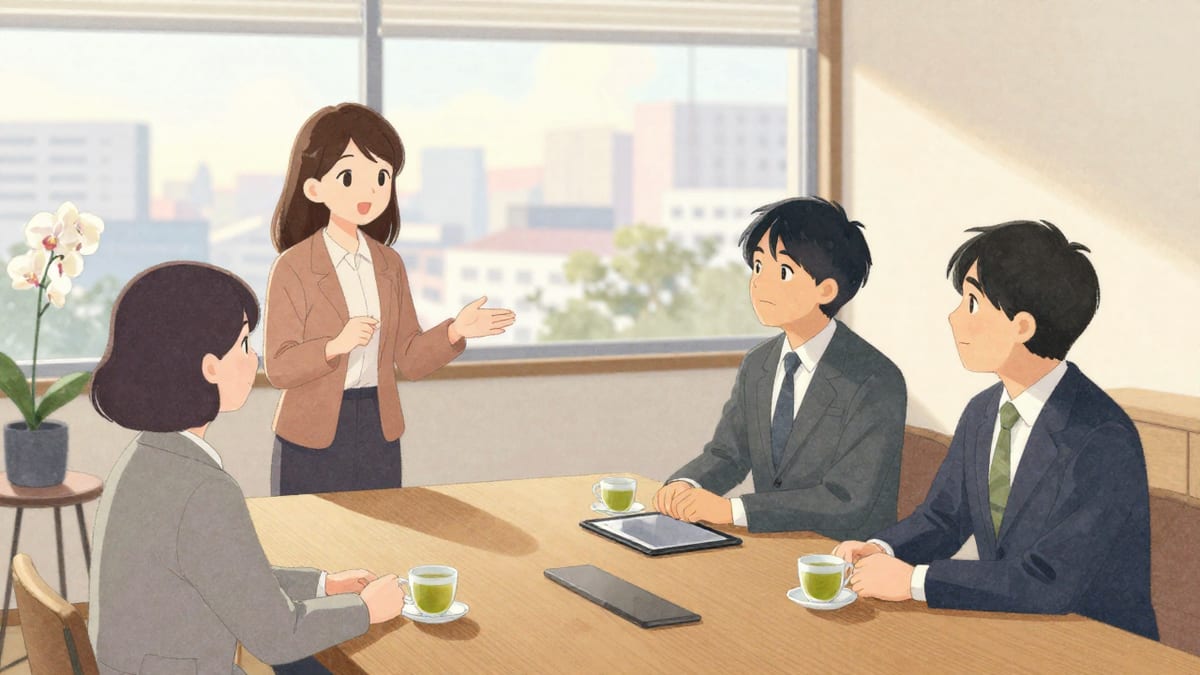
Partner and customer meetings, with a distributor, a manufacturer, a regional retailer or a corporate buyer, are where Japanese matters most, because these counterparts often do not work in English and because the relationship is being judged as much as the product. The pace is slower, the first meeting may produce no decision, and the words for proposing cooperation are deliberately soft: kangaete orimasu, we are considering, rather than we want.
| Japanese | Romaji | Meaning |
|---|---|---|
| 御社と提携できればと考えております。 | Onsha to teikei dekireba to kangaete orimasu. | We are hoping we might partner with your company. (humble, soft) |
| まずは小さく試させていただけませんか。 | Mazu wa chiisaku tamesasete itadakemasen ka. | Could we start with a small trial? |
| 導入にはどのくらいの期間がかかりますか。 | Dōnyū ni wa dono kurai no kikan ga kakarimasu ka. | Partner: How long does implementation take? |
| 約一か月です。 | Yaku ikkagetsu desu. | You: About one month. |
| 社内で検討させていただきます。 | Shanai de kentō sasete itadakimasu. | Partner: We will consider it internally. |
| 次回は来月の上旬でいかがでしょうか。 | Jikai wa raigetsu no jōjun de ikaga deshō ka. | You: How about early next month for the next meeting? |
Shanai de kentō shimasu, we will consider it internally, is a real next step in Japan, not a polite refusal. Your job is to make the next date concrete before you leave the room.
Follow-up: the next-day message
Follow up within a day, by email or the messaging tool the other side uses. The structure is fixed: thanks for the time, one sentence recalling what was discussed, the material or answer you promised, a proposed next step, and a closing formula. Here are the spoken-register equivalents, which also work when you call to confirm. Written business Japanese adds set phrases at the top and bottom; a bilingual colleague can polish those, but the content is yours.
| Japanese | Romaji | Meaning |
|---|---|---|
| 昨日はお忙しい中、ありがとうございました。 | Kinō wa oisogashii naka, arigatō gozaimashita. | Thank you for your time yesterday despite your busy schedule. |
| ご質問いただいた件について、資料をお送りします。 | Goshitsumon itadaita ken ni tsuite, shiryō o ookuri shimasu. | Regarding your question, I am sending the materials. |
| 来週、改めてお打ち合わせをお願いできますでしょうか。 | Raishū, aratamete ouchiawase o onegai dekimasu deshō ka. | Could we meet again next week? |
| ご検討のほど、よろしくお願いいたします。 | Gokentō no hodo, yoroshiku onegai itashimasu. | We would be grateful for your consideration. |
| 引き続きよろしくお願いいたします。 | Hikitsuzuki yoroshiku onegai itashimasu. | I look forward to continuing to work with you. |
Register mistakes that founders make
- Watashi no kaisha instead of heisha, and anata no kaisha instead of onsha. The humble and honorific pair is the first thing a Japanese listener notices.
- Boku or ore for I. In a business meeting it is watashi, or watakushi if you want to be very formal.
- Omoimasu for every opinion. In a formal pitch, kangaete orimasu, we consider, carries more weight for plans and intentions.
- Answering a hard question with a guess. Kakunin shite, aratamete gokaitō itashimasu, then follow up in writing.
- Treating kentō shimasu as a no. It usually means the discussion is going internal; propose a date for the next step.
- Skipping the small talk. The weather, the office, the journey: two sentences before the deck is not wasted time in Japan, it is the meeting starting.