
The four phrases of a mikoshi day
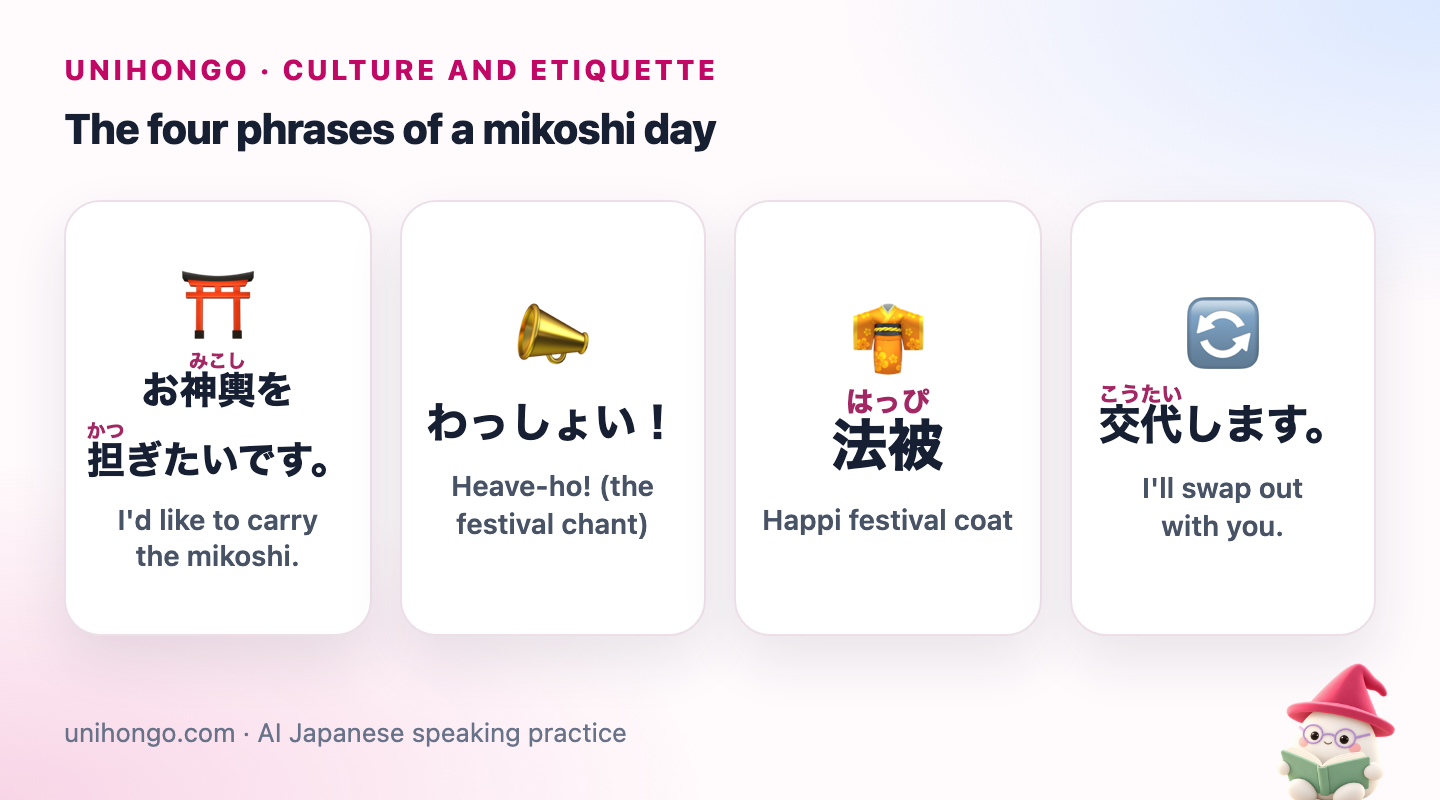
The mikoshi (神輿) is usually called omikoshi with the honorific o, and the verb for carrying it on your shoulders is katsugu (担ぐ). These four phrases follow the day from asking to join to handing your place to someone else.
| Japanese | Romaji | Meaning |
|---|---|---|
| お神輿を担ぎたいです。 | Omikoshi o katsugitai desu. | I'd like to carry the mikoshi. |
| わっしょい! | Wasshoi! | Heave-ho! (the festival chant) |
| 法被 | happi | Happi festival coat |
| 交代します。 | Kōtai shimasu. | I'll swap out with you. |
Katsugitai desu is polite and clear, the right register for talking to an organiser you do not know yet. Among carriers on the day, speech quickly becomes short and casual, and nobody expects polished sentences under a heavy pole.
How to sign up: the chōnaikai and the shrine
Most local festivals are run by the chōnaikai (町内会) or jichikai (自治会), the neighbourhood association, together with the local shrine. Notices about the festival usually appear on the association's board or in a circular passed from house to house, the kairanban (回覧板). If you are not sure who to ask, a neighbour or the shrine office is a good place to start.
Organisers want to know three things: that you live nearby or are invited by someone who does, that you will turn up on time, and that you will follow instructions. Saying it is your first time is not a problem. It is useful information, and people will often pair you with someone experienced.
| Japanese | Romaji | Meaning |
|---|---|---|
| お祭りに参加してもいいですか。 | Omatsuri ni sanka shite mo ii desu ka. | May I take part in the festival? |
| 初めてなんですが、大丈夫ですか。 | Hajimete nan desu ga, daijōbu desu ka. | It's my first time. Is that OK? |
| 何を着ればいいですか。 | Nani o kireba ii desu ka. | What should I wear? |
| 集合は何時ですか。 | Shūgō wa nanji desu ka. | What time do we gather? |
| 法被はお借りできますか。 | Happi wa okari dekimasu ka. | Could I borrow a happi? |
What to wear: happi, tabi and hachimaki
Carriers usually wear a happi (法被), a short cotton coat in the neighbourhood's colours and crest, so that everyone can see which group they belong to. Many groups add a hachimaki (鉢巻), a twisted cloth headband, or a hand towel called a tenugui (手ぬぐい). On the feet, tabi (足袋) or soft-soled jika-tabi (地下足袋) give grip on asphalt. Outfits vary widely between regions, so follow the organisers rather than a picture you found online.
| Item | What it is | Tip |
|---|---|---|
| 法被 happi | Short festival coat in the group's design | Often lent by the association |
| 鉢巻 hachimaki | Cloth headband | Ask someone to show you how to tie it |
| 足袋 tabi | Split-toed footwear | Try them on before the day |
| 手ぬぐい tenugui | Thin cotton towel | For sweat, and to cushion the shoulder |
The pole presses hard on one spot, so the next morning many carriers say kata ga itai, my shoulder hurts. A folded towel under the happi helps, if your group allows it.
The festival weekend: preparation, children and the route
A festival is more than the carry. In the days before, members of the association put up lanterns, set up a rest tent and clean the mikoshi; turning up to help with this junbi (準備), preparation, is a quiet way to show you are serious. On the day, a Shinto priest often performs a short ceremony before the deity is transferred into the mikoshi and the procession sets off.
Many neighbourhoods also have a kodomo mikoshi (子供神輿), a smaller shrine pulled or carried by children, with parents walking alongside. If you have children, this is the gentlest way for the whole family to join, and parents who walk with it often move on to the adult mikoshi the following year.
| Japanese | Romaji | Meaning |
|---|---|---|
| 準備を手伝いましょうか。 | Junbi o tetsudaimashō ka. | Shall I help with the preparation? |
| うちの子も子供神輿に参加できますか。 | Uchi no ko mo kodomo mikoshi ni sanka dekimasu ka. | Can my child join the children's mikoshi? |
| コースはどこを通りますか。 | Kōsu wa doko o tōrimasu ka. | Which way does the route go? |
Chants and calls you will hear under the poles
The mikoshi moves to a chant. Wasshoi is the best known, called by a leader and answered by everyone. Some festivals, especially in parts of Tokyo, use seiya or soiya instead, with a quicker, bouncier rhythm. The organisers, often older men with whistles or wooden clappers, give short commands: lift, stop, put your shoulder in, slow down. You do not need to understand every word, but these are the ones that keep you safe.
| Japanese | Romaji | Meaning |
|---|---|---|
| わっしょい、わっしょい! | Wasshoi, wasshoi! | Heave-ho, heave-ho! |
| せいや、せいや! | Seiya, seiya! | Heave, heave! (another chant) |
| 肩を入れて! | Kata o irete! | Organiser: Put your shoulder in! |
| 上げるよ! | Ageru yo! | Organiser: Lifting! |
| 止まります! | Tomarimasu! | Organiser: We're stopping! |
| もっと声出して! | Motto koe dashite! | Organiser: Louder! |
| ゆっくり、ゆっくり。 | Yukkuri, yukkuri. | Organiser: Slowly, slowly. |
Mini dialogue: your first turn under the mikoshi
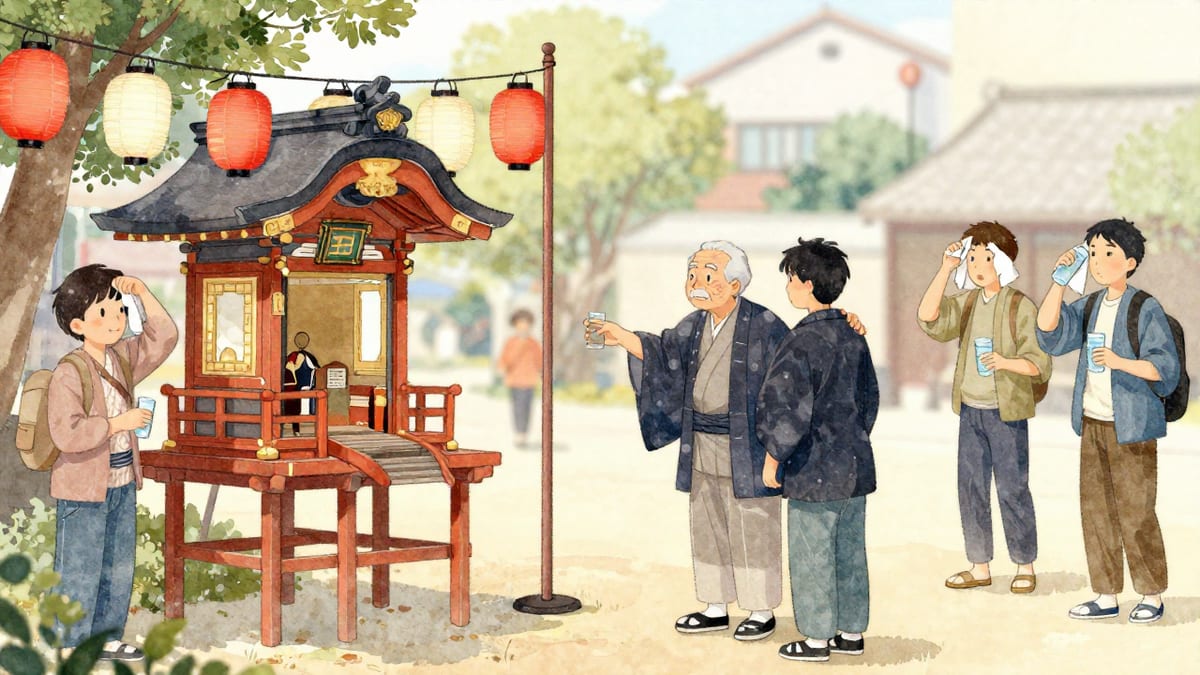
Carriers rotate constantly: the shrine is heavy, and people step in and out as it moves. Here a helper from the association shows you where to go. The language is brisk, friendly and mostly casual.
| Japanese | Romaji | Meaning |
|---|---|---|
| 次、入れる? | Tsugi, haireru? | Helper: Can you go in next? |
| はい、お願いします。 | Hai, onegai shimasu. | You: Yes, please. |
| 背の高さが合うところに入ってね。 | Se no takasa ga au tokoro ni haitte ne. | Helper: Go where the height suits you. |
| ここでいいですか。 | Koko de ii desu ka. | You: Is here all right? |
| いいよ。声出していこう! | Ii yo. Koe dashite ikō! | Helper: Good. Let's hear you! |
| 交代します! | Kōtai shimasu! | Another carrier: I'll swap in for you! |
| ありがとうございます。助かります。 | Arigatō gozaimasu. Tasukarimasu. | You: Thank you. That helps a lot. |
Height matters because the poles are level. If you are much taller than the people around you, you carry most of the weight, so helpers will move you. Tasukarimasu, that helps, is a warm way to thank someone who takes your place.
Etiquette: a sacred object, not a float
For the people carrying it, the mikoshi is the vehicle of the deity, not a decoration. Behaviour around it varies by festival, but a few habits are common. Do not climb on it, sit on it or lean things against it. Ask before taking close-up photos during rituals. Follow the timetable, because the route and rest stops are planned with the police and the shrine. Drinking customs differ widely between festivals, so take your cue from the organisers, and never carry if you feel unwell.
Rest stops, kyūkei (休憩), are a good moment to chat. Neighbours who have only nodded to you for years will ask where you are from and how you found it. Kitsui desu ne, it's tough, isn't it, is an easy line that always gets a smile.
| Japanese | Romaji | Meaning |
|---|---|---|
| 写真を撮ってもいいですか。 | Shashin o totte mo ii desu ka. | May I take a photo? |
| きついですね。 | Kitsui desu ne. | It's tough, isn't it? |
| 次の休憩はどこですか。 | Tsugi no kyūkei wa doko desu ka. | Where's the next rest stop? |
The naorai: thanks, food and friendships
When the mikoshi is safely back at the shrine or the association's storehouse, there is usually a meal or party. Strictly, naorai (直会) is the rite of sharing the food and drink offered to the deity; in many neighbourhoods the word now covers the whole after-festival gathering. This is where you say thank you, admit how tired you are, and get invited back next year.
| Japanese | Romaji | Meaning |
|---|---|---|
| お疲れさまでした! | Otsukaresama deshita! | Thanks for all your hard work! |
| 誘っていただいて、ありがとうございました。 | Sasotte itadaite, arigatō gozaimashita. | Thank you for inviting me. |
| 肩が痛いです。 | Kata ga itai desu. | My shoulder hurts. |
| 来年もぜひ参加したいです。 | Rainen mo zehi sanka shitai desu. | I'd love to take part next year too. |
- Common mistake: saying mikoshi o hakobu. Hakobu means to transport; the natural verb is katsugu.
- Common mistake: using only casual speech with older organisers. Start polite and let them relax the tone.
- Common mistake: leaving straight after the carry. Staying for the naorai, even briefly, matters to the group.