

Buying a ticket and finding the lockers
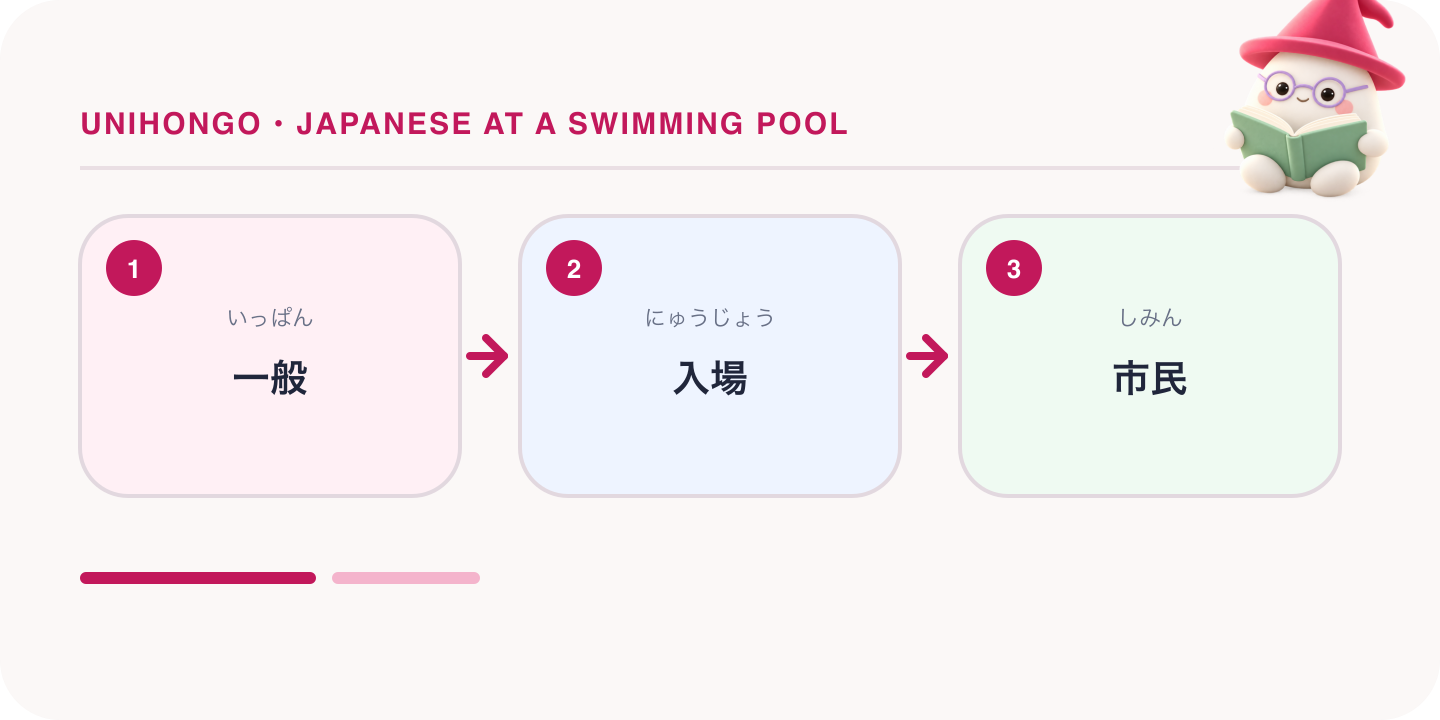
Most public pools sell tickets from a machine, kenbaiki, by the entrance, and you hand the ticket to the staff at reception, uketsuke. The buttons are sorted by adult, ippan or otona, child, kodomo, and often a resident rate, shimin, for people who live in the city, which needs proof of address. Some pools sell a session ticket, others charge for a fixed block of time, and some add a locker fee, so read the machine before you press anything.
Reception hands you a wristband, a key or a locker number and points you to the changing room, kōi-shitsu. Lockers are usually coin-return, meaning you insert a hundred-yen coin and get it back when you open the locker again, though some use the wristband. Shoes come off at the entrance to the changing area and go in a separate shoe locker, so watch for the line on the floor or the shelf of slippers.
| Japanese | Romaji | Meaning |
|---|---|---|
| 一般の入場券を一枚ください。 | Ippan no nyūjōken o ichimai kudasai. | One adult admission ticket, please. |
| 市民料金は使えますか。 | Shimin ryōkin wa tsukaemasu ka. | Can I use the resident rate? |
| 利用時間は何時間ですか。 | Riyō jikan wa nanjikan desu ka. | How many hours can I use it for? |
| ロッカーは百円が戻ってきますか。 | Rokkā wa hyaku-en ga modotte kimasu ka. | Does the locker return the hundred yen? |
| 更衣室はどちらですか。 | Kōi-shitsu wa dochira desu ka. | Which way is the changing room? |
| 水泳帽は売っていますか。 | Suiei-bō wa utte imasu ka. | Do you sell swim caps? |
The questions staff ask before you go in
Reception at a Japanese pool checks a few things every time, and the questions are short. The first is whether you have a swim cap, because you cannot enter the water without one. The second, at many facilities, is whether you have tattoos, irezumi or tatū, since policies range from a complete ban to allowing small tattoos covered with a patch. The third is what you are carrying: bottles in glass, cameras and phones are normally banned at the poolside, and some pools ask you to leave valuables at the counter or in a small valuables locker, kichōhin rokkā.
Rules on swimwear also vary. Fitted swimsuits and jammers are fine everywhere; long board shorts, cotton clothing and swimwear with metal parts are often refused. Children below a certain age must be accompanied by an adult in the water, and the age differs by city. If you are not sure whether something is allowed, ask before paying, because tickets are rarely refunded.
| Japanese | Romaji | Meaning |
|---|---|---|
| 水泳帽はお持ちですか。 | Suiei-bō wa o-mochi desu ka. | Do you have a swim cap? |
| タトゥーはございますか。 | Tatū wa gozaimasu ka. | Do you have any tattoos? |
| 小さいタトゥーがありますが、隠せば大丈夫ですか。 | Chiisai tatū ga arimasu ga, kakuseba daijōbu desu ka. | I have a small tattoo; is it all right if I cover it? |
| この水着で入れますか。 | Kono mizugi de hairemasu ka. | Can I go in with this swimwear? |
| 貴重品はどこに預けますか。 | Kichōhin wa doko ni azukemasu ka. | Where do I leave valuables? |
| ゴーグルは必要ですか。 | Gōguru wa hitsuyō desu ka. | Are goggles required? |
Showers, hair and the walk to the pool
Between the changing room and the pool there is a shower area, and the sign will tell you to rinse your whole body before entering, nyūsui mae ni shawā o abite kudasai. This is not optional. Many pools also ask you to remove make-up and sunscreen, and to tuck long hair completely into the cap.
Warm showers after swimming are usually available, but soap and shampoo are often forbidden in the poolside showers and allowed only in the changing room ones, if at all, so check the sign before you lather up.
| Japanese | Romaji | Meaning |
|---|---|---|
| 入水前にシャワーを浴びてください。 | Nyūsui mae ni shawā o abite kudasai. | Please shower before entering the water. |
| シャンプーは使えますか。 | Shanpū wa tsukaemasu ka. | Can I use shampoo? |
| 髪は帽子の中に入れてください。 | Kami wa bōshi no naka ni irete kudasai. | Please put your hair inside the cap. |
| ドライヤーはありますか。 | Doraiyā wa arimasu ka. | Is there a hair dryer? |
| 温水シャワーはどこですか。 | Onsui shawā wa doko desu ka. | Where is the warm shower? |
Lane etiquette: walking, slow and fast lanes
The lanes at a Japanese pool are labelled, and the labels matter more than in many countries. A typical twenty-five metre pool has a walking lane, hokō kōsu or wōkingu kōsu, for people doing water walking, then one or more lanes for swimming sorted by speed: yukkuri or teisoku for slow, futsū for ordinary, and hayai or kōsoku for fast. There is often a free area, furī kōsu or jiyū yūei, where people can play or practise without lengths. Some lanes are for one direction only, ippō tsūkō, and the rest are shared in a loop, anticlockwise, with the right side of the lane for going out and the same side for coming back.
The unwritten rules are firm. Do not stop in the middle of a lane; rest at the wall, in the corner, out of the way of people turning. Let faster swimmers pass by waiting at the wall rather than being overtaken mid-length. Keep to the lane that matches your speed, and move if a lifeguard asks you to. Diving is banned in almost all public pools, and so is running on the poolside.
| Japanese | Romaji | Meaning |
|---|---|---|
| このコースはゆっくり泳ぐ人用ですか。 | Kono kōsu wa yukkuri oyogu hito-yō desu ka. | Is this lane for slow swimmers? |
| ここは歩くコースです。 | Koko wa aruku kōsu desu. | This lane is for walking. |
| お先にどうぞ。 | O-saki ni dōzo. | Please go ahead of me. |
| 先に行ってもいいですか。 | Saki ni itte mo ii desu ka. | May I go ahead? |
| このコースは一方通行ですか。 | Kono kōsu wa ippō tsūkō desu ka. | Is this lane one-way? |
| 飛び込みは禁止です。 | Tobikomi wa kinshi desu. | Diving is prohibited. |
The hourly rest break and lifeguard announcements
Once every hour, usually for around ten minutes, the whistle blows and everyone leaves the water. This is the kyūkei jikan, rest time, and it is universal at Japanese public pools: lifeguards check the water, look for anything dropped and let swimmers rest. An announcement will say kyūkei ni hairimasu or pūru kara agatte kudasai, and staff walk the poolside making sure nobody stays in. Sit on the bench, stretch, drink from your bottle if drinks are allowed at the side, and wait for the second whistle.
The other announcements you hear are about the end of your paid time, riyō jikan shūryō, the closing of the pool, heikan, and occasionally about lightning or an earthquake, when everyone is asked to leave the water immediately.
| Japanese | Romaji | Meaning |
|---|---|---|
| ただいまから休憩時間です。 | Tadaima kara kyūkei jikan desu. | Rest time starts now. |
| プールから上がってください。 | Pūru kara agatte kudasai. | Please get out of the pool. |
| 休憩は何分ですか。 | Kyūkei wa nanpun desu ka. | How long is the break? |
| まもなく利用時間が終了します。 | Mamonaku riyō jikan ga shūryō shimasu. | Your time is about to end. |
| 延長はできますか。 | Enchō wa dekimasu ka. | Can I extend my time? |
Signs and words you will see at the pool
Most rules at a pool are written on boards at the entrance, by the showers and along the poolside. The words below appear in nearly every facility, and knowing the kanji shapes lets you check a rule without asking.
| Word | Reading | Meaning |
|---|---|---|
| 水泳帽 | suiei-bō | Swim cap; compulsory |
| 更衣室 | kōi-shitsu | Changing room |
| 休憩時間 | kyūkei jikan | Rest break, usually every hour |
| 監視員 | kanshi-in | Lifeguard |
| 歩行コース | hokō kōsu | Walking lane |
| 一方通行 | ippō tsūkō | One-way lane |
| 飛び込み禁止 | tobikomi kinshi | No diving |
| 入場料 | nyūjōryō | Admission fee |
| 貴重品 | kichōhin | Valuables |
| 採暖室 | saidan-shitsu | Warming room, a heated rest room |
| 水深 | suishin | Water depth |
| 本日休館 | honjitsu kyūkan | Closed today |
Etiquette that regulars follow
The rules on the boards are only half of it. The rest is the unspoken routine that regulars follow, and copying it is the fastest way to feel at home. Most of it comes down to keeping the water clean, keeping the lanes flowing and keeping the changing room dry.
- Rinse off completely before entering, including after using the toilet
- Wear your cap from the moment you leave the shower area
- Rest at the wall in the corner, never in the middle of a lane
- Wait for the whistle after the break rather than jumping in early
- Dry off before walking back into the changing room
- Keep phones and cameras in your locker; photography is banned at the poolside
- Say o-saki ni to the lane if you leave before people you have been swimming with
When something goes wrong
Small problems are common and easily fixed. If you forget your cap, ask whether reception sells or lends one before giving up; if you lose your locker key or wristband, tell staff at once, because there is usually a replacement charge and they need to open the locker for you. If you feel unwell in the water, raise a hand and the lifeguard will come; do not try to swim to the far end first.
If a lifeguard corrects you about a lane, swimwear or diving, the right response is a short apology, sumimasen, and a change of behaviour. Warnings are given politely and once, and arguing is not part of the culture. For lost property, ask at reception for otoshimono, and for a refund question, be ready to hear that tickets cannot be refunded once used.
| Japanese | Romaji | Meaning |
|---|---|---|
| 水泳帽を忘れてしまいました。借りられますか。 | Suiei-bō o wasurete shimaimashita. Kariraremasu ka. | I forgot my swim cap. Can I borrow one? |
| ロッカーの鍵をなくしてしまいました。 | Rokkā no kagi o nakushite shimaimashita. | I've lost my locker key. |
| 気分が悪いです。 | Kibun ga warui desu. | I feel unwell. |
| ゴーグルを落としたみたいです。 | Gōguru o otoshita mitai desu. | I think I dropped my goggles. |
| すみません、知りませんでした。 | Sumimasen, shirimasen deshita. | Sorry, I didn't know. |
| 落とし物はどこで聞けばいいですか。 | Otoshimono wa doko de kikeba ii desu ka. | Where should I ask about lost property? |