
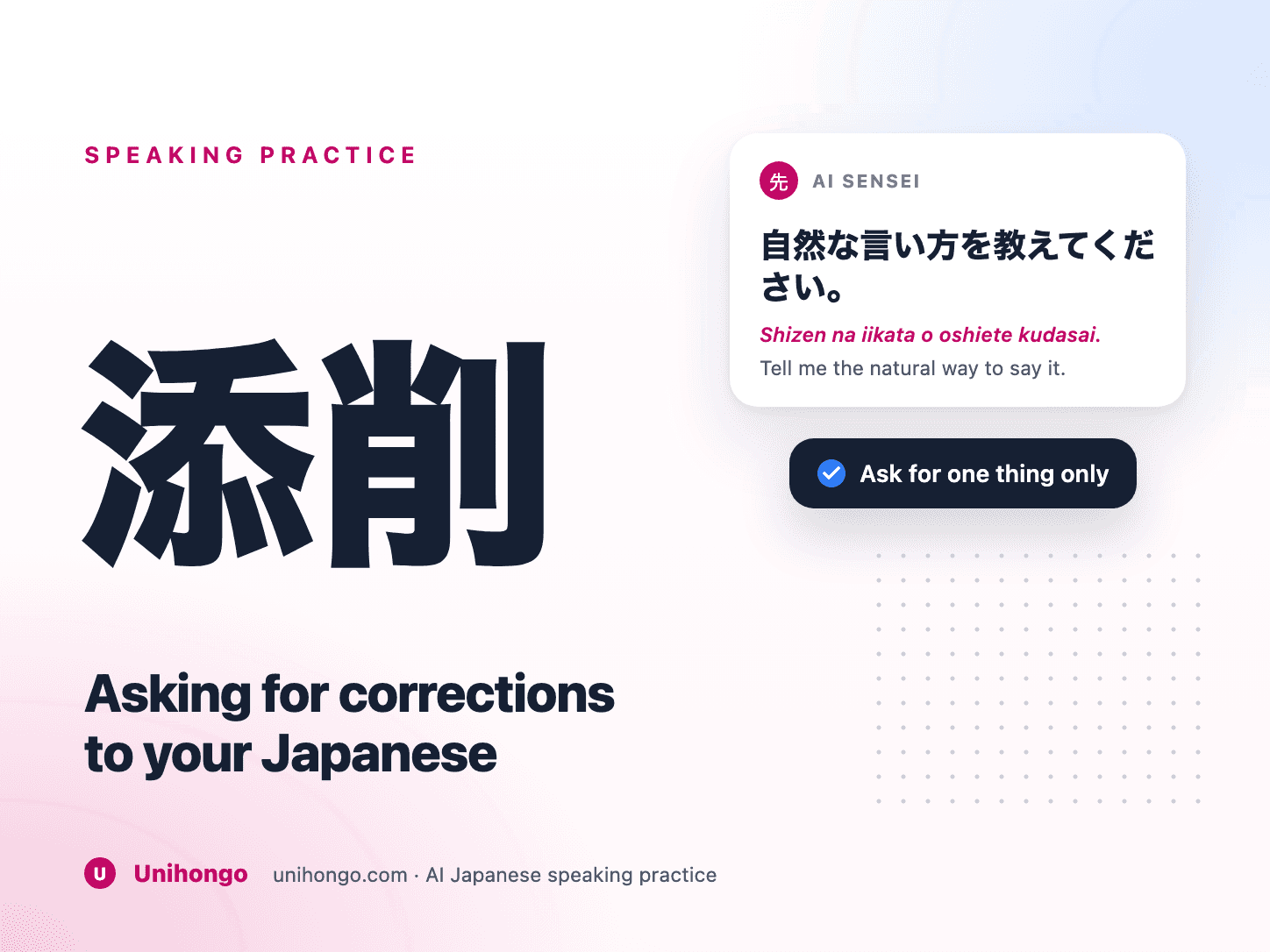
Why corrections do not arrive on their own
A Japanese speaker listening to your Japanese has several reasons not to correct it. Interrupting is impolite. The meaning was clear enough. Correcting an adult can feel patronising. And with a guest or a colleague, there is a wish not to discourage. The result is a room full of people who could help and none of them doing it.
This is why a learner can spend three years saying tanoshii deshita and never hear otherwise. The error is understood, so it is never blocked, and being understood is exactly what stops it being corrected. Asking is the only reliable route.
Ask for one thing, not everything
A request to correct everything produces either nothing, because it is too much work, or a list too long to act on. A request for one category produces corrections you will actually keep. Choose the category based on what is currently costing you most: naturalness, particles, pronunciation, or politeness level.
Naming the category also tells your partner what to ignore, which makes the task small enough that they will actually do it. That is the real function of the request.
| Japanese | Romaji | Meaning |
|---|---|---|
| 今日は、助詞だけ直してもらえますか。 | Kyō wa, joshi dake naoshite moraemasu ka. | Today, could you correct only my particles? |
| 自然かどうかだけ教えてください。 | Shizen ka dō ka dake oshiete kudasai. | Just tell me whether it sounds natural. |
| 発音が気になっています。 | Hatsuon ga ki ni natte imasu. | I am concerned about my pronunciation. |
| 敬語が正しいか見ていただけますか。 | Keigo ga tadashii ka mite itadakemasu ka. | Could you check whether my keigo is correct? |
| 文法より、言い方を直してほしいです。 | Bunpō yori, iikata o naoshite hoshii desu. | Rather than grammar, I would like my phrasing corrected. |
| 細かいところは気にしなくて大丈夫です。 | Komakai tokoro wa ki ni shinakute daijōbu desu. | You do not need to worry about small details. |
The last phrase is as important as the request itself. Telling someone what not to correct is what makes the correction task manageable.
Say when you want it
The timing changes what kind of correction is useful. Immediate correction works for pronunciation, because the sound is still in the air, and for anything that blocked meaning. End-of-conversation correction works better for grammar and word choice, because it does not interrupt the flow you are trying to build.
Written corrections afterwards are the most useful of all for anything you want to keep, because you can review them. Asking a teacher to send three corrections in a message after a lesson is a small request with a large return.
| Japanese | Romaji | Meaning |
|---|---|---|
| その場で直してもらってもいいですか。 | Sono ba de naoshite moratte mo ii desu ka. | Would you mind correcting me on the spot? |
| 最後にまとめて教えてください。 | Saigo ni matomete oshiete kudasai. | Please tell me all together at the end. |
| 会話は止めずに、後で教えてください。 | Kaiwa wa tomezu ni, ato de oshiete kudasai. | Without stopping the conversation, tell me afterwards. |
| 三つだけ、メッセージで送っていただけますか。 | Mittsu dake, messēji de okutte itadakemasu ka. | Could you send me just three, by message? |
| 今のところ、もう一度言ってみてもいいですか。 | Ima no tokoro, mō ichido itte mite mo ii desu ka. | May I try saying that part again? |
Ask for the natural version, not the error
Knowing that something was wrong is only half of a correction. What you need is the sentence a native speaker would have said, because that is what you will rehearse. A correction that only identifies the error leaves you to guess at the replacement.
The question to ask is what would you have said. It produces a complete usable sentence and it often reveals that the natural version is structured differently from the one you attempted, which is more valuable than a particle fix.
| Japanese | Romaji | Meaning |
|---|---|---|
| ネイティブなら、何て言いますか。 | Neitibu nara, nan te iimasu ka. | What would a native speaker say? |
| 自然な言い方を教えてください。 | Shizen na iikata o oshiete kudasai. | Please tell me the natural way to say it. |
| 同じ意味で、もっと短く言えますか。 | Onaji imi de, motto mijikaku iemasu ka. | Can it be said more briefly with the same meaning? |
| これは硬すぎますか。 | Kore wa katasugimasu ka. | Is this too stiff? |
| 友達に言うなら、どうなりますか。 | Tomodachi ni iu nara, dō narimasu ka. | How would it be if I said it to a friend? |
| ちょっと不自然でしたか。 | Chotto fushizen deshita ka. | Was that slightly unnatural? |
Fushizen, unnatural, is the key word. It is the category of error that nobody corrects and that most affects how fluent you sound.
Asking colleagues and friends
A colleague is not your teacher, so the request has to be small and occasional. One specific question about one sentence is easy to answer and does not create an ongoing obligation. Asking someone to generally correct your Japanese is a much larger ask and usually goes unfulfilled.
Written Japanese is the easiest thing to ask a colleague about, because checking an email costs them a minute and produces a clear answer. It is also where the corrections transfer most directly to your speech.
| Japanese | Romaji | Meaning |
|---|---|---|
| この言い方、自然ですか。 | Kono iikata, shizen desu ka. | Is this way of saying it natural? |
| ちょっとメールを見ていただけますか。一分で終わります。 | Chotto mēru o mite itadakemasu ka. Ippun de owarimasu. | Could you glance at this email? It will take a minute. |
| 失礼な感じになっていませんか。 | Shitsurei na kanji ni natte imasen ka. | Does it come across as rude at all? |
| 日本語、変なところがあったら教えてください。 | Nihongo, hen na tokoro ga attara oshiete kudasai. | If there is anything odd in my Japanese, please tell me. |
| いつもありがとうございます。助かります。 | Itsumo arigatō gozaimasu. Tasukarimasu. | Thank you as always. It really helps. |
Receiving a correction well
The response to a correction should be short, grateful, and immediately practical. Thank them, repeat the corrected version aloud, and move on. Extended apology or self-criticism makes the correction expensive for the person who gave it, and they will give fewer next time.
Repeating aloud is the part that matters. A correction you acknowledged silently is a fact you learned; a correction you said three times is a sentence you can produce.
| Japanese | Romaji | Meaning |
|---|---|---|
| ありがとうございます。もう一度言ってみます。 | Arigatō gozaimasu. Mō ichido itte mimasu. | Thank you. Let me try saying it again. |
| なるほど、そう言うんですね。 | Naruhodo, sō iu n desu ne. | I see, so that is how you say it. |
| メモします。 | Memo shimasu. | I will make a note. |
| 前も同じ間違いをしていましたか。 | Mae mo onaji machigai o shite imashita ka. | Was I making the same mistake before? |
| 助かります。また教えてください。 | Tasukarimasu. Mata oshiete kudasai. | That helps. Please tell me again another time. |
Mata oshiete kudasai is the phrase that keeps corrections coming. It tells the other person that the correction was welcome, which is the thing they were unsure about.
Where an AI tutor does what a person will not
Human partners have limits that are entirely reasonable. They will not correct the same error twelve times, they will not interrupt every sentence, and they will not tell you your phrasing is stiff when the meaning was clear. All of those are exactly what a learner needs and none of them are comfortable to ask of a friend.
This is the specific gap an AI tutor fills. It can be asked to correct one category, every time, without either party finding it awkward, and it can be asked to repeat the same correction until the habit changes. Use it for the repetitive work and use human partners for what only they can give: unpredictability, register, and the experience of a conversation with stakes.
- Ask for one category and have it applied to every sentence
- Repeat the same correction until the habit is gone, without embarrassment
- Ask what a native speaker would have said, every time
- Ask whether your register matched the situation, which people rarely volunteer
- Keep human practice for unpredictability, culture and real stakes