

Booking and the papers that arrive
Your employer either books a date for everyone or gives you a list of clinics and a deadline to book yourself, by phone or a web form, giving your company name, the type of check and a preferred date. A few weeks before, a packet arrives with the questionnaire, monshinhyō, a urine sample kit, saiyō kitto, fasting instructions, and the voucher that tells the clinic who pays.
Read the instruction sheet closely, because the fasting cut-off, the water rule and the advice on regular medicine differ by clinic. Most say to take daily medication with a little water and tell reception.
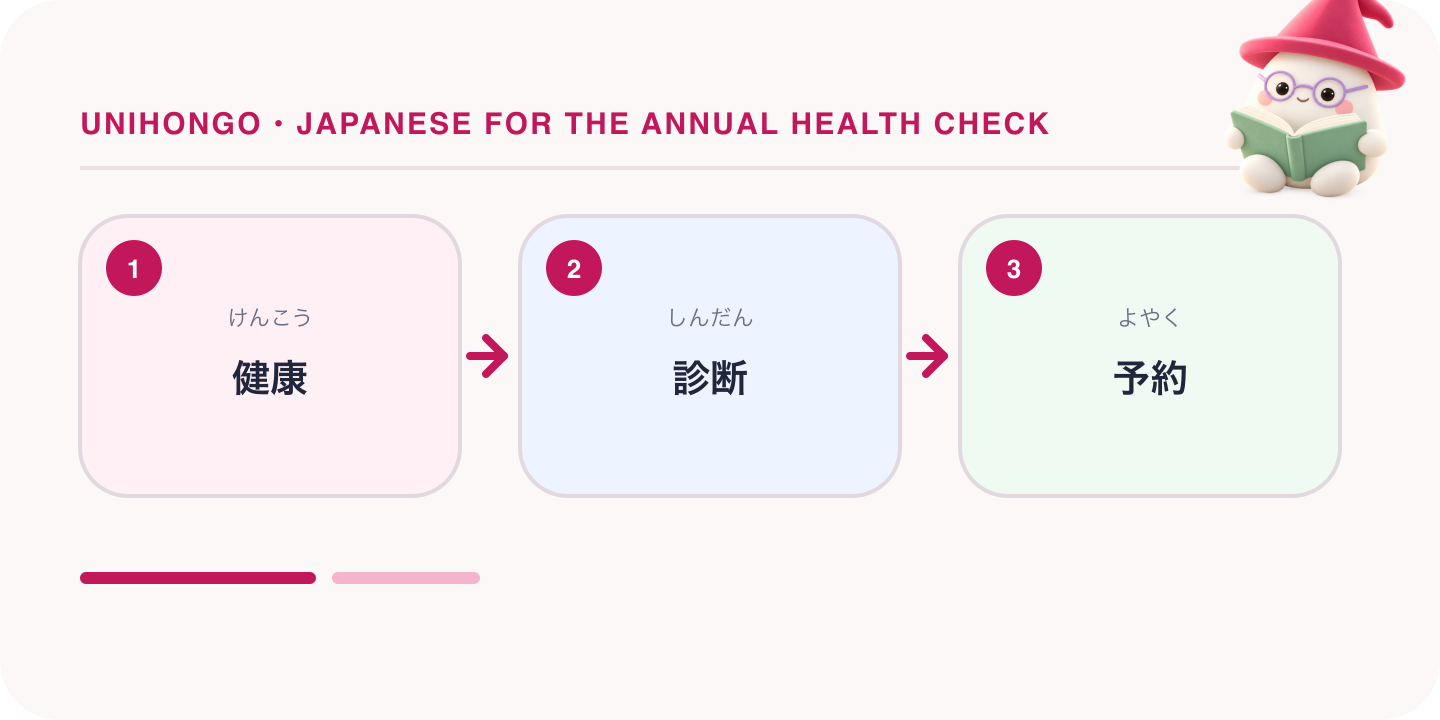
| Japanese | Romaji | Meaning |
|---|---|---|
| 健康診断の予約をしたいんですが。 | Kenkō shindan no yoyaku o shitai n desu ga. | I'd like to book a health check. |
| 会社からの案内で来ました。 | Kaisha kara no annai de kimashita. | I came with my company's referral. |
| 前の日は何時まで食べていいですか。 | Mae no hi wa nan-ji made tabete ii desu ka. | Until what time can I eat the day before? |
| 水は飲んでも大丈夫ですか。 | Mizu wa nonde mo daijōbu desu ka. | Is it fine to drink water? |
| いつも飲んでいる薬はどうすればいいですか。 | Itsumo nonde iru kusuri wa dō sureba ii desu ka. | What should I do about my regular medicine? |
| 日にちを変更したいです。 | Hinichi o henkō shitai desu. | I'd like to change the date. |
The questionnaire
The monshinhyō asks the same things every year: current symptoms, existing conditions and medication, past illnesses and surgery, family history, and lifestyle questions about smoking, drinking, exercise, sleep and eating speed. The lifestyle questions come from a standard metabolic screening form, so the wording is identical across clinics. Answer with ticks and short words.
Women are asked about pregnancy, since the x-ray is skipped if you may be pregnant, and there is often a box to opt out of individual tests such as barium; say so there and again at reception.
| Word on the form | Reading | Meaning |
|---|---|---|
| 問診票 | monshinhyō | Questionnaire |
| 自覚症状 | jikaku shōjō | Symptoms you have noticed |
| 既往歴 | kiōreki | Past illnesses |
| 服薬 | fukuyaku | Taking medication |
| 喫煙 | kitsuen | Smoking |
| 飲酒 | inshu | Drinking alcohol |
| 運動習慣 | undō shūkan | Exercise habits |
| 睡眠 | suimin | Sleep |
| 家族歴 | kazoku-reki | Family history |
| 妊娠の可能性 | ninshin no kanōsei | Possibility of pregnancy |
| 受診希望 | jushin kibō | Tests you wish to take |
| 受診しない | jushin shinai | Opt out of this test |
If a question is unclear, leave it and ask at reception; staff go through the form with you.
Reception, the gown and the number
At the clinic you hand over the questionnaire, the urine sample if you collected it at home, your health insurance card and the voucher from your employer. Reception gives you a number, a file or a barcode card, and directs you to the changing room, where you put on a kensa-gi, a check-up gown,. From here staff call your number, bangō, rather than your name.
The order of stations depends on the clinic, and a staff member points you to the next room each time.
| Japanese | Romaji | Meaning |
|---|---|---|
| 受付をお願いします。 | Uketsuke o onegai shimasu. | I'd like to check in. |
| 朝から何も食べていません。 | Asa kara nani mo tabete imasen. | I haven't eaten anything since the morning. |
| 薬は水で飲みました。 | Kusuri wa mizu de nomimashita. | I took my medicine with water. |
| 検査着に着替えてください。 | Kensa-gi ni kigaete kudasai. | Please change into the check-up gown. |
| 次はどこに行けばいいですか。 | Tsugi wa doko ni ikeba ii desu ka. | Where should I go next? |
| 番号で呼ばれますか。 | Bangō de yobaremasu ka. | Will I be called by number? |
Station by station: urine, blood, body and senses
The urine test, nyō kensa, is either the cup you filled at home or a paper cup in the toilet with a hatch to pass it through. The blood draw, saiketsu, is a few small tubes from the arm; say if you have fainted before and they will lay you down. Height and weight, shinchō and taijū, are measured together, with waist circumference, fukui, from a certain age. Blood pressure, ketsuatsu, is taken with an automatic cuff and repeated if high.
Eyesight, shiryoku, uses the Landolt ring chart: you say the direction of the gap, ue, shita, migi or hidari, or point. Hearing, chōryoku, is done in a booth: press the button while you hear the tone and release when it stops. Staff give each instruction once, quickly, so the phrases below are worth knowing in advance.
| Japanese | Romaji | Meaning |
|---|---|---|
| 採血のときに気分が悪くなったことがあります。 | Saiketsu no toki ni kibun ga waruku natta koto ga arimasu. | I have felt faint during a blood draw before. |
| どちらの腕でもいいですか。 | Dochira no ude demo ii desu ka. | Is either arm fine? |
| 靴を脱いで、こちらに乗ってください。 | Kutsu o nuide, kochira ni notte kudasai. | Take off your shoes and step on here. |
| 輪の切れている方向を答えてください。 | Wa no kirete iru hōkō o kotaete kudasai. | Say which side the ring is open on. |
| 音が聞こえたらボタンを押してください。 | Oto ga kikoetara botan o oshite kudasai. | Press the button when you hear the sound. |
| コンタクトをつけたままでいいですか。 | Kontakuto o tsuketa mama de ii desu ka. | Can I keep my contact lenses in? |
| もう一度測ってもらえますか。 | Mō ichido hakatte moraemasu ka. | Could you measure it again? |
Chest x-ray, ECG and the stomach test
The chest x-ray, kyōbu rentogen, is a standing shot: remove anything metal, press your chest to the plate, put your hands where shown, breathe in deeply and hold. The instruction is ōkiku iki o sutte, tomete kudasai, then raku ni shite kudasai, relax. The electrocardiogram, shindenzu, is done lying on your back with clips on wrists and ankles and suction cups on the chest; you simply keep still.
From an age set by the employer's plan, typically the mid-thirties or forty, a stomach test is added. The barium test, baryūmu kensa or i-tōshi, means drinking a thick white liquid and a fizzy powder, then being rotated on a tilting table while x-rays are taken, with instructions to turn, migi-muki, hidari-muki, and to hold your breath. Afterwards you get a laxative, gezai, and are told to drink plenty of water. The alternative is the gastroscopy, ikamera or i-naishikyō, a camera through the throat or nose, with a throat spray and sometimes sedation; some clinics need a separate appointment for it. Which is offered, and at what cost, depends on the clinic and your employer's plan.
| Japanese | Romaji | Meaning |
|---|---|---|
| 大きく息を吸って、止めてください。 | Ōkiku iki o sutte, tomete kudasai. | Take a deep breath and hold it. |
| 楽にしてください。 | Raku ni shite kudasai. | Relax now. |
| ネックレスを外してください。 | Nekkuresu o hazushite kudasai. | Please take off your necklace. |
| 妊娠の可能性はありますか。 | Ninshin no kanōsei wa arimasu ka. | Is there any possibility you are pregnant? |
| バリウムの代わりに胃カメラにできますか。 | Baryūmu no kawari ni ikamera ni dekimasu ka. | Can I have a gastroscopy instead of barium? |
| げっぷを我慢してください。 | Geppu o gaman shite kudasai. | Please hold in the burp. |
| 下剤は何時間後に効きますか。 | Gezai wa nan-jikan-go ni kikimasu ka. | How many hours until the laxative works? |
Kenshin versus ningen dock
The basic employer check is short and covers the legally required items. A ningen dock is a private, more thorough check that adds tests such as abdominal ultrasound, fukubu echo, more blood markers, lung function, eye pressure, and optional add-ons like a brain MRI or cancer screening. It takes half a day or more and ends with a doctor explaining the results in person. Who can take one, and who pays, depends on your employer's and insurer's rules and often on your age; the cost varies widely between centres.
- Kenshin: required by law, short, basic items, low or no cost to the employee
- Ningen dock: optional, longer, more tests, subsidised by some employers or insurers
- Both need fasting, both give a written result sheet weeks later
- Optional add-ons at either are chosen and often paid for by you when booking
- Ask your HR or health insurance society what is covered before booking
Dokku is the katakana form of dock, as in a ship going in for inspection; staff say ningen dokku or simply dokku.
Reading the results sheet
Results arrive by post or through the employer a few weeks later, on a sheet listing each test, your value, the reference range, kijunchi, and a grade. The grade phrases are standard. Ijō nashi means no abnormality. Yō keika kansatsu means observation needed: a value is slightly out of range and you should watch it, often with lifestyle advice attached. Yō saikensa means re-test needed: repeat the same test, usually after a few weeks. Yō seimitsu kensa means detailed examination needed: see a doctor for further investigation.
The grades are judgements, not diagnoses. A yō seimitsu kensa result is common and often turns out to be nothing, but employers may ask you to follow up and report back, and the occupational doctor, sangyō-i, can call you in for a talk.
| Result phrase | Reading | Meaning and what to do |
|---|---|---|
| 異常なし | ijō nashi | No abnormality; nothing to do |
| 要経過観察 | yō keika kansatsu | Observe over time; watch the value and adjust habits |
| 要再検査 | yō saikensa | Re-test needed; repeat the same test after a few weeks |
| 要精密検査 | yō seimitsu kensa | Detailed examination needed; see a doctor for further tests |
| 要治療 | yō chiryō | Treatment needed; see a doctor now |
| 治療中 | chiryō-chū | Already under treatment for this |
| 基準値 | kijunchi | Reference range |
| 所見 | shoken | Findings noted by the doctor |
Take the result sheet with you when you follow up; the doctor will want the original values. The guide to visiting a doctor on this site covers that appointment.
When something goes wrong
The usual problems are small: you ate breakfast by mistake, you could not produce a urine sample, the barium will not go down, or a result grade is unclear. For a broken fast, tell reception; the clinic may run the tests with a note, skip the stomach test, or rebook. For a missed sample, ask for a cup and drink water. For an unclear result, the clinic has a number for questions, and your employer's health staff can turn the next step into an appointment.
| Japanese | Romaji | Meaning |
|---|---|---|
| すみません、朝ご飯を食べてしまいました。 | Sumimasen, asa-gohan o tabete shimaimashita. | Sorry, I ate breakfast. |
| 尿が出ないんですが、どうすればいいですか。 | Nyō ga denai n desu ga, dō sureba ii desu ka. | I can't produce a urine sample; what should I do? |
| バリウムが飲めそうにありません。 | Baryūmu ga nomesō ni arimasen. | I don't think I can drink the barium. |
| 結果はいつ届きますか。 | Kekka wa itsu todokimasu ka. | When will the results arrive? |
| 要精密検査と書いてあるんですが、どこに行けばいいですか。 | Yō seimitsu kensa to kaite aru n desu ga, doko ni ikeba ii desu ka. | It says detailed examination needed; where should I go? |
| 英語の結果表はありますか。 | Eigo no kekka-hyō wa arimasu ka. | Is there an English version of the results? |