
Four snow and winter names
Two names from snow and two from winter: the first pair is classic for girls, the second shows how winter enters boys' names.
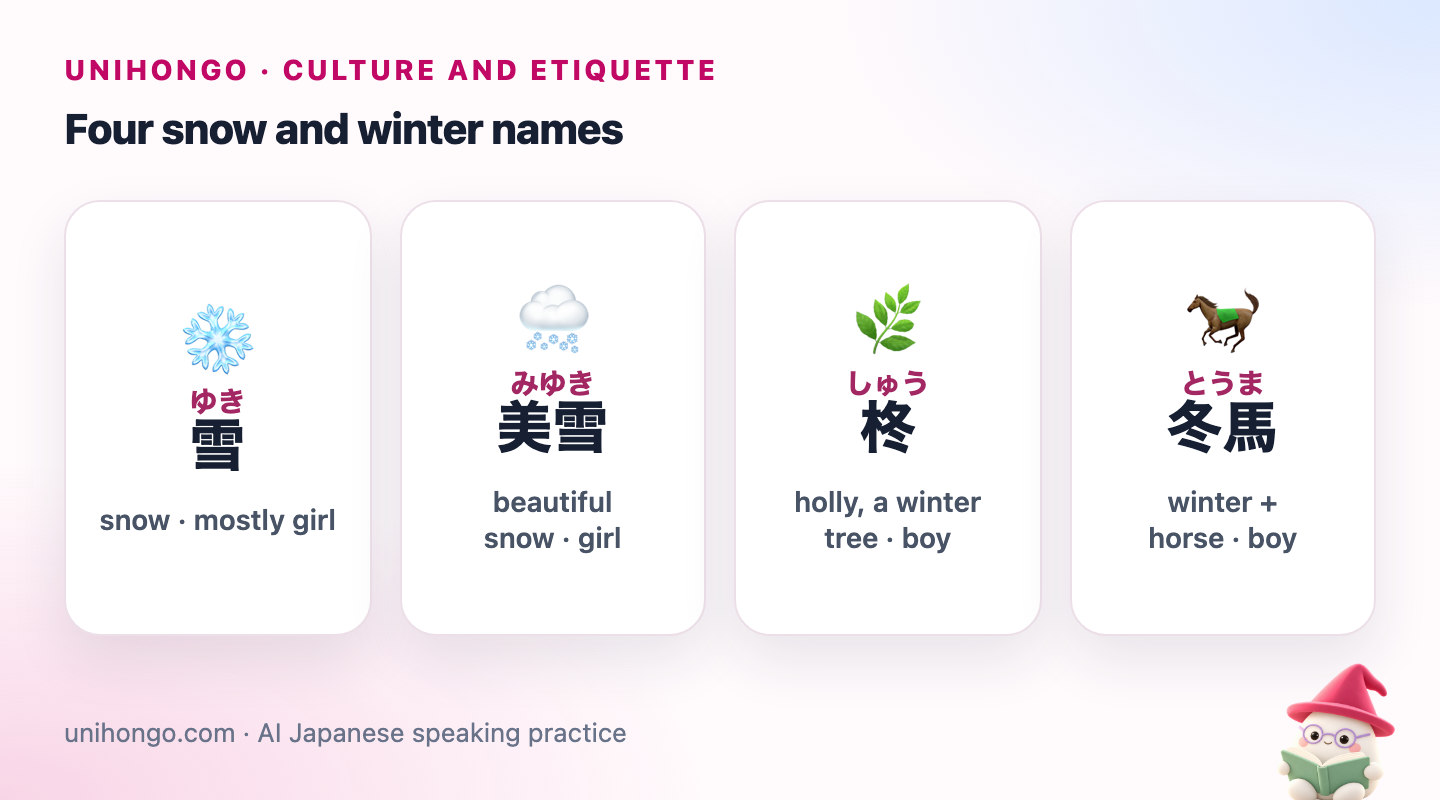
| Japanese | Romaji | Meaning |
|---|---|---|
| 雪 | Yuki | snow · mostly girl |
| 美雪 | Miyuki | beautiful snow · girl |
| 柊 | Shū | holly, a winter tree · boy |
| 冬馬 | Tōma | winter + horse · boy |
柊 is made of 木, tree, and 冬, winter: a tree that stays green and bears red berries in the cold. Its everyday reading is hiiragi, and in boys' names it is often Shū. Tōma reads 冬 as tō, its on'yomi, as in 冬至 (tōji, the winter solstice).
Names with 雪, and the Yukis who are not snow
雪 is read yuki in everyday Japanese and setsu in compound words such as 積雪 (sekisetsu, snow cover). In names it is almost always yuki. These names are mostly for girls.
| Japanese | Romaji | Meaning |
|---|---|---|
| 小雪 | Koyuki | light snow, a few flakes · girl |
| 雪乃 | Yukino | snow + a soft classical ending · girl |
| 雪菜 | Yukina | snow + greens · girl |
| 深雪 | Miyuki | deep snow · girl |
| 由紀 | Yuki | reason + record (no snow) · girl |
| 優希 | Yuki | gentle + hope (no snow) · unisex |
The last two rows matter. Yuki is a very common name sound, and it is written in many ways that have nothing to do with snow. If you tell a Yuki that her name means snow, she may smile and explain that hers is 由紀 or 優希. Always ask which kanji.
Poetic snow words used as names
Japanese has a rich vocabulary of snow, and a few poetic words have become names. They feel elegant and a little literary.
| Japanese | Romaji | Meaning |
|---|---|---|
| 六花 | Rikka | six flowers: snowflakes · girl |
| 風花 | Fūka | snow flurries on a clear day · girl |
| 真白 | Mashiro | pure white · girl |
| 白雪 | Shirayuki | white snow · girl (rare) |
風花 is read kazahana as a weather word: snowflakes blown on the wind from distant clouds, falling under a clear sky. As a name, it is usually read Fūka. Shirayuki is the Japanese name of Snow White in the fairy tale, so as a person's name it is rare.
Rikka and Fūka are good examples of names that sound modern but come from old seasonal vocabulary. Japanese poetry, especially haiku, uses seasonal words called kigo, and snow has many of them. Parents who love that tradition sometimes look there for names, which is why a name can feel both fresh and classical at the same time.
Winter kanji in names
Winter itself, 冬, is read fuyu or tō. A few other kanji carry a winter feeling through their shape or meaning. 凛 (Rin) and 冴 (Sae) have the ice radical 冫 on the left and suggest crisp, clear cold.
| Japanese | Romaji | Meaning |
|---|---|---|
| 冬美 | Fuyumi | winter + beauty · girl |
| 冬樹 | Fuyuki | winter + tree · boy |
| 凛 | Rin | crisp, dignified · mostly girl |
| 冴 | Sae | clear and cold · girl |
| Kanji | Meaning | Example names |
|---|---|---|
| 冬 | Winter | Fuyumi (冬美), Fuyuki (冬樹), Tōma (冬馬) |
| 柊 | Holly, a winter tree | Shū, Hiiragi |
| 凛 | Crisp, dignified, cold and clear | Rin |
| 冴 | Clear, cold, sharp | Sae (冴), Saeko (冴子) |
| 白 | White | Mashiro (真白) |
A related curiosity: 椿, camellia, is 木 plus 春, spring, even though the camellia blooms in winter. Kanji shapes are a lovely way into names, but do not build your own theories about them; the established explanations are enough.
Writing a winter name with a brush
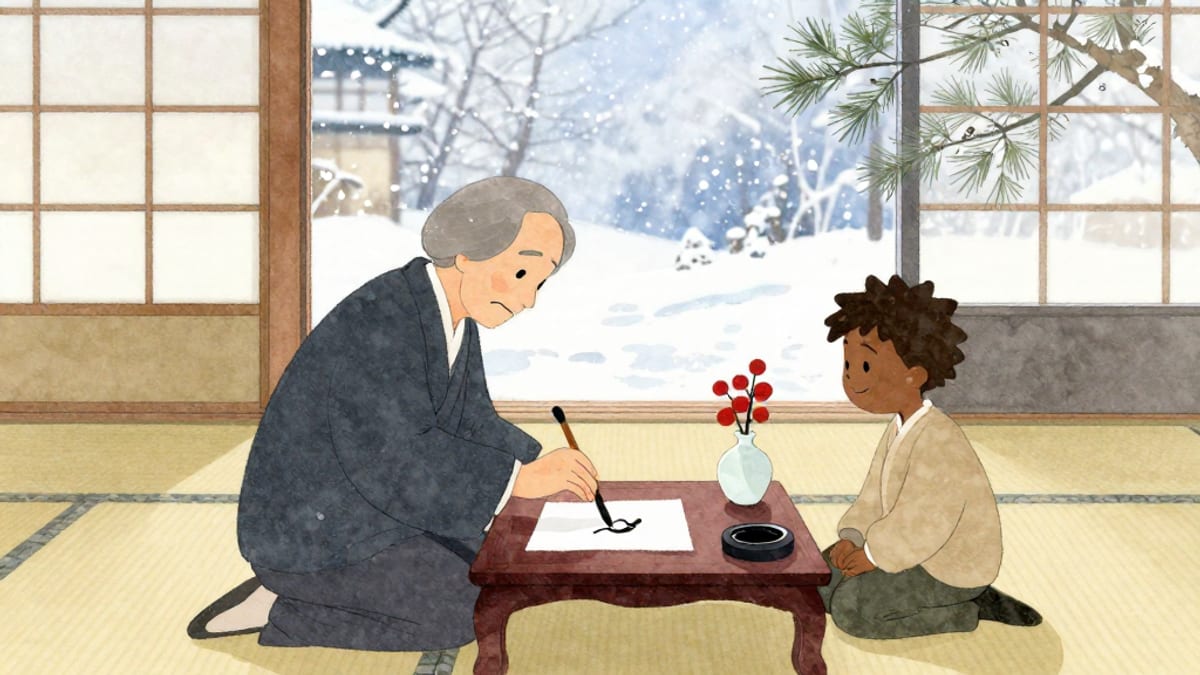
Winter is the season of kakizome, the first calligraphy of the year, and many people practise writing their own name or a seasonal kanji. 雪 is a good one to try: the top part is the rain radical, a flattened 雨, and the bottom is a shape like the katakana ヨ. Write the rain part first, from top to bottom, and keep it a little wider than the bottom.
| Japanese | Romaji | Meaning |
|---|---|---|
| 雨かんむりに、下はこうです。 | Ame kanmuri ni, shita wa kō desu. | Teacher: The rain top, and the bottom goes like this. |
| 筆の持ち方を教えてください。 | Fude no mochikata o oshiete kudasai. | Please show me how to hold the brush. |
| 自分の名前を書いてみたいです。 | Jibun no namae o kaite mitai desu. | I'd like to try writing my own name. |
| もう少しゆっくり書いてみて。 | Mō sukoshi yukkuri kaite mite. | Teacher: Try writing a little more slowly. |
Mini dialogue: a winter birthday
| Japanese | Romaji | Meaning |
|---|---|---|
| 誕生日はいつですか。 | Tanjōbi wa itsu desu ka. | You: When is your birthday? |
| 一月です。雪の日に生まれたそうです。 | Ichigatsu desu. Yuki no hi ni umareta sō desu. | Miyuki: January. I'm told I was born on a snowy day. |
| それで美雪さんなんですね。 | Sore de Miyuki san na n desu ne. | You: So that's why you're Miyuki. |
| そうなんです。冬生まれらしい名前でしょう? | Sō nan desu. Fuyu umare rashii namae deshō? | Miyuki: That's right. A real winter-baby name, isn't it? |
Snow words for winter conversations
Snow names make a good starting point for winter small talk. Japanese has many snow words, and using one or two in a conversation about someone's name, or about the weather, sounds natural and warm.
| Japanese | Romaji | Meaning |
|---|---|---|
| 初雪 | hatsuyuki | the first snow of the year |
| 粉雪 | konayuki | powder snow |
| 雪景色 | yukigeshiki | a snowy landscape |
| 吹雪 | fubuki | a snowstorm |
| 銀世界 | gin sekai | a silver world, all white |
| 冬至 | tōji | the winter solstice |
Hatsuyuki is big news in many cities, and the weather forecast reports it. Gin sekai, a silver world, describes a landscape covered in fresh snow. The winter solstice, tōji, falls around 21 or 22 December, and many families take a bath with yuzu citrus that day; customs vary by family.
Snow also appears in phrases about people. Yuki no yō ni shiroi, as white as snow, is a classic description of fair skin, though some people find comments on appearance too personal. Praising the name itself is safer.
Your winter-name practice: Mocchi first, then Yamada-sensei
Write two sentences about a snowy name, for example the one in the dialogue, and send them to Mocchi with /correct. Mocchi fixes the Japanese, explains each change and notes the slips you tend to make, so a later quiz can check them. Then ask: Which Yukis are not snow? Quiz me on 雪, 由紀 and 優希.
For speaking, open AI Sensei and ask Yamada-sensei to play a calligraphy teacher on a winter afternoon. Talk through writing 雪 and your own name, ask about brush strokes, and read the session report for the words you were missing.
Mistakes to avoid with snow and winter names
- Telling every Yuki that her name means snow. Ask first; it often does not.
- Confusing Yuki and Yūki. The long u makes a different name, often a boy's.
- Reading 冬 as fuyu in Tōma. Names use both readings.
- Giving 白雪 to a person casually. Shirayuki is lovely, but people will think of the fairy tale.
- Assuming snow names are only for winter babies. Parents choose them for purity and calm as much as for the season.