
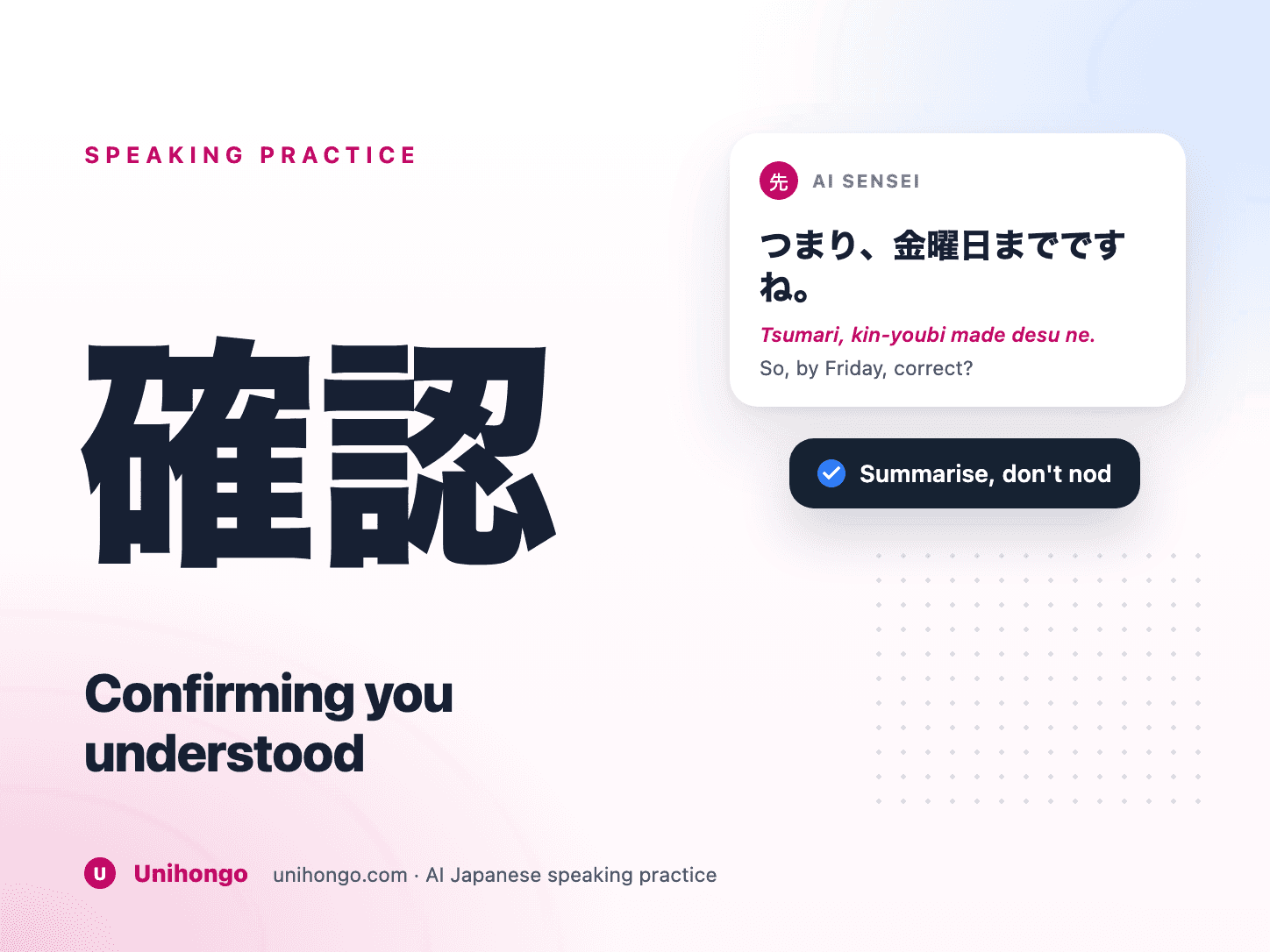
Why nodding is the expensive option
Every learner does it. The sentence was long, most of the words landed, the general shape seemed clear, and saying so felt like more trouble than it was worth. So you nod. The cost arrives later, when the thing you agreed to turns out to be a different thing, and now the conversation is about a mistake rather than about a question.
Japanese raises the stakes slightly, because requests are frequently implied. Kono shiryō, ashita made ni dekimasu ka is a question in form and an instruction in practice. Kore, chotto mite oite kudasai could mean glance at it or could mean review it properly. A confirmation that surfaces the difference takes five seconds; discovering it a day later takes considerably longer.
Summarise, do not just agree
The strongest confirmation is a short summary in your own words. It proves comprehension rather than asserting it, and it gives the other person a specific thing to correct if you got it wrong. Two phrases carry this: tsumari, meaning in other words, and to iu koto desu ne, meaning that is to say.
Keep the summary shorter than the original. A summary that repeats everything is a recording, not a check, and it does not isolate the part that might be wrong. Name the action, the object and the deadline, and stop.
| Japanese | Romaji | Meaning |
|---|---|---|
| つまり、金曜日までに送ればいいということですね。 | Tsumari, kin-yōbi made ni okureba ii to iu koto desu ne. | So in other words, I should send it by Friday. |
| 確認させてください。まず A をして、その後 B ですね。 | Kakunin sasete kudasai. Mazu A o shite, sono ato B desu ne. | Let me confirm. First A, then B, correct? |
| 私の理解では、変更は必要ないということですが。 | Watashi no rikai de wa, henkō wa hitsuyō nai to iu koto desu ga. | My understanding is that no change is needed. |
| ということは、今回は見送るということでしょうか。 | To iu koto wa, konkai wa miokuru to iu koto deshō ka. | Does that mean we are passing on it this time? |
| 念のため、もう一度整理させてください。 | Nen no tame, mō ichido seiri sasete kudasai. | Just to be safe, let me go over it once more. |
Kakunin sasete kudasai, allow me to confirm, is the phrase to over-learn. It is polite, neutral and works in every register from a lesson to a client meeting.
Confirm the parts that can go wrong
Not everything needs checking. Four things do, because they cannot be reconstructed from context if you get them wrong: what exactly is being asked, who is involved, by when, and how many or how much. Confirming those four and nothing else keeps the check short enough that it does not interrupt.
Numbers and dates deserve special care. Japanese numbers over a thousand group differently from English, man being ten thousand, and days of the month have irregular readings. Repeating a figure back digit by digit, or a date with its weekday attached, catches almost every error immediately.
| What to confirm | Phrase | Why it matters |
|---|---|---|
| The action | 何をすればいいですか Nani o sureba ii desu ka | Japanese requests are often implied |
| The person | 誰に送ればいいですか Dare ni okureba ii desu ka | Names are easily misheard |
| The deadline | いつまででしょうか Itsu made deshō ka | Made and made ni are not the same |
| The quantity | 三十個でよろしいですか Sanjukko de yoroshii desu ka | Man and sen trip up every learner |
| The priority | どちらを先にすればいいですか Dochira o saki ni sureba ii desu ka | Two tasks, one afternoon |
| The format | メールでよろしいでしょうか Mēru de yoroshii deshō ka | Avoids doing it twice |
The register scale of I understand
Japanese has several ways to say you have understood, and they are not interchangeable. Using the casual one upwards sounds breezy; using the formal one with a friend sounds like you are performing. The safe middle is wakarimashita, which fits nearly everywhere.
The two that learners misuse are ryōkai and shōchi. Ryōkai desu is peer-level and slightly military in flavour; it is common in team chat and wrong with a client. Shōchi shimashita and kashikomarimashita are humble and correct upwards, with kashikomarimashita being the strongest and the standard in service work.
| Phrase | Register | Use with |
|---|---|---|
| わかった Wakatta | Casual | Friends, family |
| わかりました Wakarimashita | Neutral polite | Almost anyone |
| 了解です Ryōkai desu | Casual work | Peers, team chat, not clients |
| 承知しました Shōchi shimashita | Humble | Managers, clients |
| かしこまりました Kashikomarimashita | Most formal | Customers, service settings |
| おっしゃる通りです Ossharu tōri desu | Agreement, humble | Confirming a senior person is right |
Admitting you are lost, at three levels
There is a difference between not catching a word, not following a sentence, and having lost the thread entirely, and each has its own repair. Naming which one it is helps the other person help you, and it takes the same amount of time as a vague apology.
The most useful move is to say what you did catch. Ato no bubun wa wakarimashita ga, saisho ga chotto tells the speaker exactly where to restart, which is much faster than asking them to repeat the whole thing.
| Japanese | Romaji | Meaning |
|---|---|---|
| すみません、今の言葉、もう一度いいですか。 | Sumimasen, ima no kotoba, mō ichido ii desu ka. | Sorry, could you repeat that word? |
| 最初の部分がちょっと聞き取れませんでした。 | Saisho no bubun ga chotto kikitoremasen deshita. | I could not quite catch the first part. |
| すみません、話が見えなくなってしまいました。 | Sumimasen, hanashi ga mienaku natte shimaimashita. | Sorry, I have lost the thread. |
| ゆっくりお願いできますか。 | Yukkuri onegai dekimasu ka. | Could you speak slowly, please? |
| どういう意味ですか。 | Dō iu imi desu ka. | What does that mean? |
| 別の言い方をしていただけますか。 | Betsu no iikata o shite itadakemasu ka. | Could you put it another way? |
Asking for a different wording rather than a repeat is often more effective. The same sentence said again is still the same sentence.
When confirming is expected, not optional
In some situations a Japanese speaker will expect you to repeat back, and skipping it looks careless rather than confident. Taking a phone message, receiving an order, accepting a delivery and being given a deadline all fall into this category, and there is a named practice for it: fukushō, repeating back.
In these settings, announce that you are confirming rather than just doing it. Fukushō sasete itadakimasu marks the repeat as procedure, which is why it does not sound like doubt.
- Phone messages: always repeat name, number and request
- Orders and quantities: repeat the number and the unit
- Deadlines: repeat the date with the weekday
- Anything involving money: repeat the figure digit by digit
- Multi-step instructions: repeat the order, not every detail
- Anything you will do alone later, with nobody to ask
Confirming without stopping the conversation
Confirmation does not have to be a full stop. In flowing conversation, the light version is an echo: repeat the key word with a rising tone and let the speaker either continue or correct. It takes one word and does not take the floor.
Save the full summary for the end of a topic or the end of the conversation. That placement is conventional, expected, and lets you catch everything at once rather than interrupting five times.
| Japanese | Romaji | Meaning |
|---|---|---|
| 金曜日ですか? | Kin-yōbi desu ka? | Friday? |
| 三十個? | Sanjukko? | Thirty? |
| 田中さんに、ですね。 | Tanaka-san ni, desu ne. | To Tanaka, right. |
| なるほど、それでですね。 | Naruhodo, sore de desu ne. | I see, and then? |
| では最後に、確認だけさせてください。 | Dewa saigo ni, kakunin dake sasete kudasai. | Then finally, let me just confirm. |