
Four lines from a race against the clock
An escape game follows a pattern: someone spots something, the team gets stuck, someone asks for help, and finally a lock opens. These four lines follow that pattern. They are casual and short, because that is how people talk with the clock running.
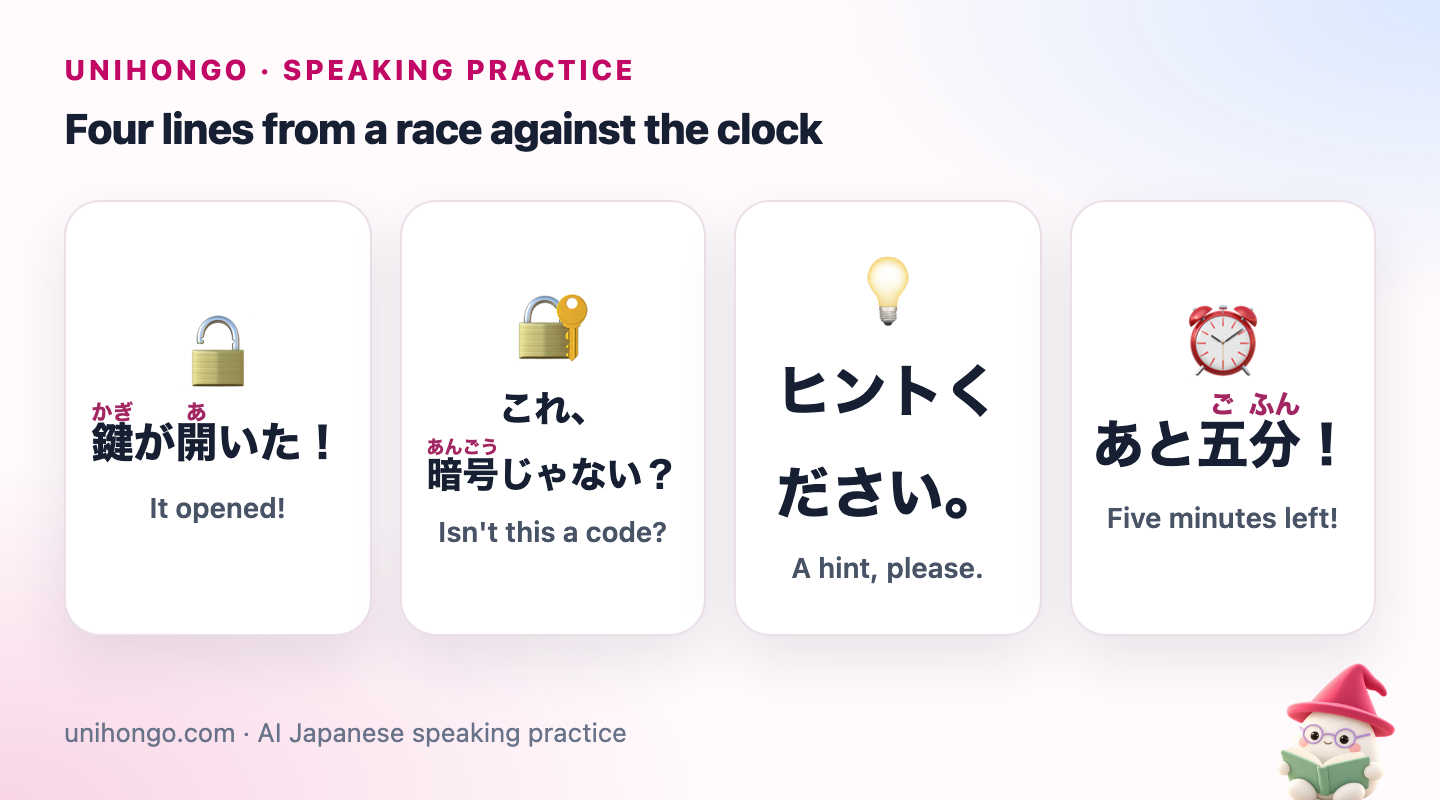
| Japanese | Romaji | Meaning |
|---|---|---|
| 鍵が開いた! | Kagi ga aita! | It opened! |
| これ、暗号じゃない? | Kore, angō janai? | Isn't this a code? |
| ヒントください。 | Hinto kudasai. | A hint, please. |
| あと五分! | Ato gofun! | Five minutes left! |
Aita is from aku (開く), to open by itself, which is why you say kagi ga aita: the lock opened. If you open it yourself, the verb is akeru: kagi o aketa. Janai? with a rising tone does not mean is not; it means isn't it?, a soft way to suggest an idea.
Puzzle vocabulary you will need
Escape games reuse a small set of nouns. Learn them before you go, and you will understand most of what your team shouts. Many come from detective stories, and some are written in kanji you will see on cards and props.
| Word | Meaning | Typical use |
|---|---|---|
| 謎 nazo | Puzzle, mystery | Kono nazo, muzukashii: this puzzle is hard |
| 暗号 angō | Code, cipher | Angō o toku: to crack a code |
| 鍵 kagi | Key, lock | Kagi ga kakatte iru: it's locked |
| 南京錠 nankinjō | Padlock | Usually with numbers or letters |
| 手がかり tegakari | Clue | Tegakari o sagasu: look for clues |
| 答え kotae | Answer | Kotae wa nan da?: what's the answer? |
| 制限時間 seigen jikan | Time limit | Often an hour |
Types of escape games in Japan
Japanese escape games come in a few formats, and the language changes a little with each. In a room-type game, rūmu-gata (ルーム型), a small team of around four to six is locked in a themed room, and you mostly talk to your own team. In a hall-type game, hōru-gata (ホール型), many teams sit at tables in a large hall, follow a story on a screen or stage, and solve puzzles on paper; you may be seated with strangers and need to introduce yourself quickly. There are also walk-around games, shūyū-gata (周遊型), where you follow clues through a town, a park or a train line at your own pace.
Popular games sell out, so most people book online in advance. If you join strangers in a hall game, the opening is simple: say your name, admit your level, and offer to help with whatever you are good at. Teams of strangers often become surprisingly close in an hour.
| Japanese | Romaji | Meaning |
|---|---|---|
| はじめまして。リナです。 | Hajimemashite. Rina desu. | Nice to meet you. I'm Rina. |
| 脱出ゲームは初めてです。 | Dasshutsu gēmu wa hajimete desu. | It's my first escape game. |
| 数字の謎は得意です。 | Sūji no nazo wa tokui desu. | I'm good at number puzzles. |
| 一緒に頑張りましょう! | Issho ni ganbarimashō! | Let's do our best together! |
Saying what you see, fast
The most useful skill in an escape room is narrating what you notice, out loud, so that others can connect it to what they found. Japanese makes this easy with kore (this), sore (that, near you) and are (that, over there), plus short descriptions. Do not worry about full sentences. A noun and a feeling, such as kono e, ayashii (this picture, suspicious), is perfectly natural.
| Japanese | Romaji | Meaning |
|---|---|---|
| これ、何だろう? | Kore, nan darō? | What could this be? |
| 数字が四つ書いてある。 | Sūji ga yottsu kaite aru. | There are four numbers written here. |
| この絵、怪しい。 | Kono e, ayashii. | This picture is suspicious. |
| 裏に何かある! | Ura ni nanika aru! | There's something on the back! |
| さっきの紙、どこ? | Sakki no kami, doko? | Where's that paper from before? |
| これ、まだ使ってないよね? | Kore, mada tsukatte nai yo ne? | We haven't used this yet, right? |
Kaite aru, it is written, describes a state you can see: someone wrote it and it is still there. Ayashii, suspicious, is the escape room's favourite adjective.
Sharing ideas and splitting up
Teams work best when people propose ideas without fear of being wrong. Japanese uses soft suggestion forms for this: -te mite (try doing), -tara? (what if you …?) and kamo (maybe). Dividing the work is just as important: someone takes the bookshelf, someone the locked box, someone the papers.
| Japanese | Romaji | Meaning |
|---|---|---|
| この番号、試してみて。 | Kono bangō, tameshite mite. | Try this number. |
| 逆から読んだら? | Gyaku kara yondara? | What if you read it backwards? |
| 違うかも。 | Chigau kamo. | Maybe not. |
| 私、こっちを調べるね。 | Watashi, kotchi o shiraberu ne. | I'll check over here. |
| わかった!ひらめいた! | Wakatta! Hirameita! | Got it! I've had an idea! |
| ちょっと貸して。 | Chotto kashite. | Let me see that for a second. |
Mini dialogue: the last puzzle, against the clock
Five minutes remain. Your team has a locked box with a four-digit padlock, a strange poem and a picture of a clock. Watch how the talk is mostly fragments, and how nobody minds.
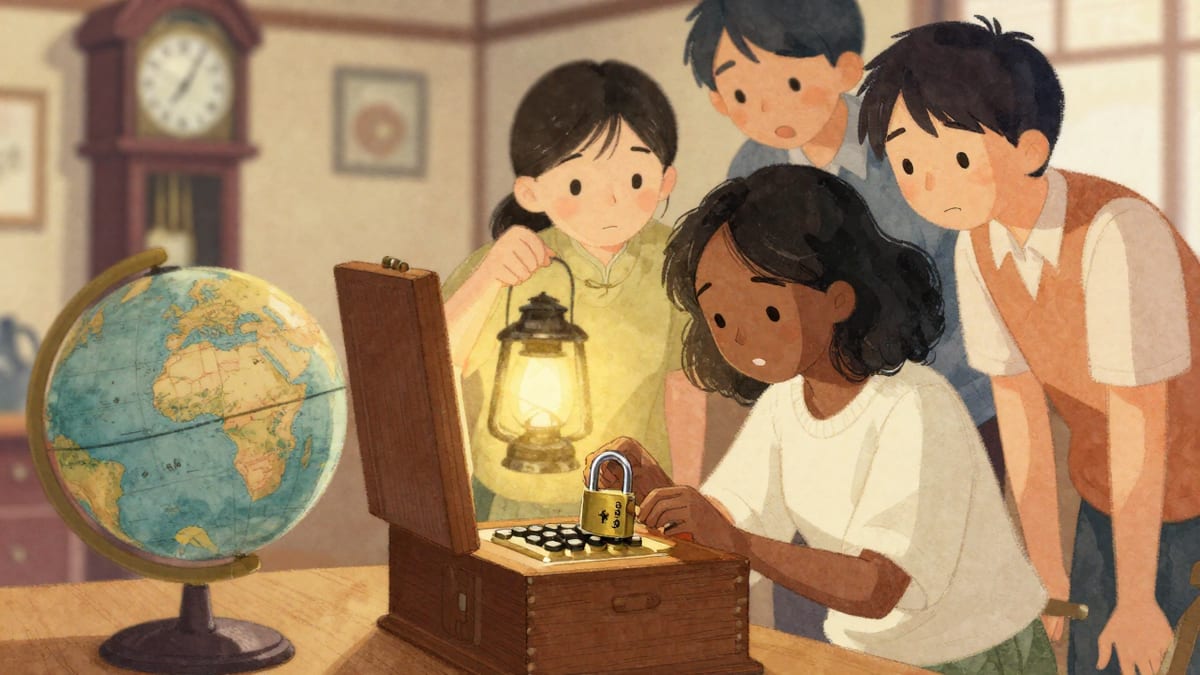
| Japanese | Romaji | Meaning |
|---|---|---|
| あと五分! | Ato gofun! | Teammate: Five minutes left! |
| この時計の針、数字じゃない? | Kono tokei no hari, sūji janai? | You: Aren't the clock hands numbers? |
| 三時十五分だから…、ゼロサンイチゴ? | Sanji jūgofun da kara..., zero san ichi go? | Teammate: It's three fifteen, so... 0-3-1-5? |
| 入れてみて! | Irete mite! | Teammate: Try it! |
| …開かない。逆は? | ...Akanai. Gyaku wa? | You: ...It won't open. Backwards? |
| 開いた! | Aita! | Everyone: It opened! |
| 脱出成功!やったー! | Dasshutsu seikō! Yattā! | Everyone: We escaped! Yes! |
Numbers on padlocks are read digit by digit: zero san ichi go. You will often hear zero rather than rei in this context, and san-ichi-go said quickly as one chunk.
Hints, staff and the end of the game
Staff introduce the story and rules at the start, often in a theatrical voice, and tell you the time limit and how hints work. Asking for a hint is normal, and good staff give a nudge rather than the answer. At the end, whether you escaped or not, staff usually explain the solutions, called kaisetsu (解説), and the team takes a photo. Not escaping is common, so do not be discouraged by a dasshutsu shippai.
| Japanese | Romaji | Meaning |
|---|---|---|
| 制限時間は六十分です。 | Seigen jikan wa rokujuppun desu. | Staff: The time limit is sixty minutes. |
| ヒント、もらう? | Hinto, morau? | Teammate: Shall we get a hint? |
| すみません、ヒントをいただけますか。 | Sumimasen, hinto o itadakemasu ka. | Excuse me, could we have a hint? |
| 惜しかったね! | Oshikatta ne! | That was so close! |
| 解説、聞きたい! | Kaisetsu, kikitai! | I want to hear the solutions! |
Why Japanese puzzles are extra hard, and common mistakes
Many Japanese escape games use wordplay: kana that read differently when rearranged, kanji split into parts, or puns based on homophones. Native speakers love this, but it is tough for learners. Tell your team early, nihongo no nazo wa nigate kamo, word puzzles in Japanese might be my weak spot, and take on the visual, numerical and physical puzzles instead. Everyone contributes something.
Wordplay is also a learning opportunity. When the staff explain the solutions at the end, ask your friends to walk you through any puzzle that relied on Japanese. You will often learn a pun, an alternative reading of a kanji or a set phrase that you will never forget, because it cost your team five minutes. Playing the same kind of game a few times also helps: designers reuse certain tricks, and after a while you start to recognise them.
- Staying silent until you are sure. Say half-formed ideas: chigau kamo kedo … (maybe wrong, but …).
- Mixing up aku and akeru. Kagi ga aita (it opened), kagi o aketa (I opened it).
- Using long polite sentences with teammates. Fragments and casual forms are normal under time pressure.
- Forgetting the staff are part of the show. Polite Japanese with them, and a thank-you at the end, goes a long way.