

How a chōrei runs
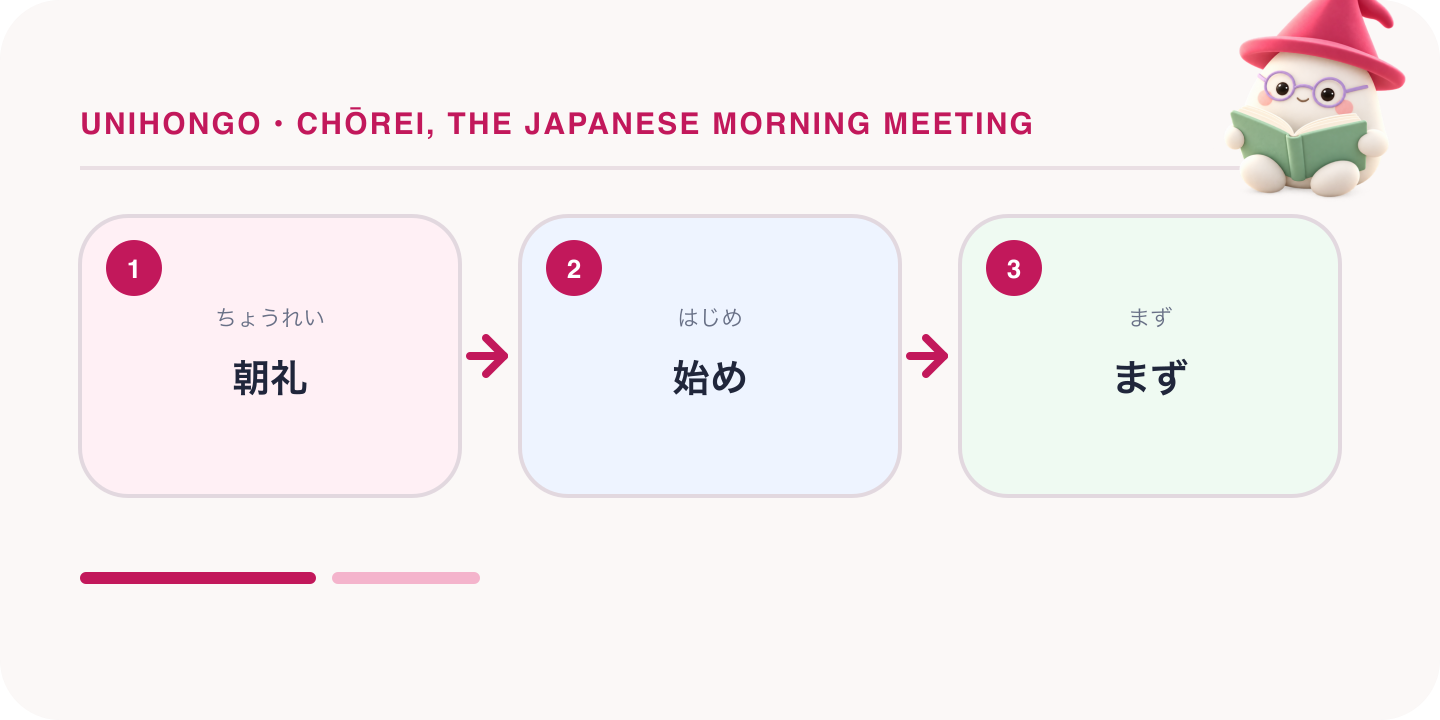
The word chōrei combines asa, morning, and rei, a bow or ceremony, and it is a ceremony in the sense that the order barely changes from day to day. A typical office version runs like this: the leader, shikai, calls everyone together with chōrei o hajimemasu; the group exchanges ohayō gozaimasu; the manager gives renraku jikō, announcements; each person gives a short report; someone reads the company creed, shaze or keiei rinen, or the day's safety slogan; and the leader closes with ijō de chōrei o owarimasu. A one-minute speech, if the company has one, usually comes between the announcements and the reports.
Timing and form differ. Some companies hold chōrei weekly rather than daily, some sit down, some stand in front of a whiteboard listing the week's targets. Shops hold it before opening, often with a practice run of the customer greeting. Ask a colleague what your workplace does, and stand where a newcomer stands: usually at the end of the line.
| Japanese | Romaji | Meaning |
|---|---|---|
| それでは、朝礼を始めます。 | Sore dewa, chōrei o hajimemasu. | Right, let's begin the morning meeting. |
| おはようございます。 | Ohayō gozaimasu. | Good morning. |
| まず、連絡事項が三点あります。 | Mazu, renraku jikō ga santen arimasu. | First, there are three announcements. |
| 次に、各自の本日の予定をお願いします。 | Tsugi ni, kakuji no honjitsu no yotei o onegai shimasu. | Next, everyone's plan for today, please. |
| 以上で朝礼を終わります。今日も一日よろしくお願いします。 | Ijō de chōrei o owarimasu. Kyō mo ichinichi yoroshiku onegai shimasu. | That ends the morning meeting. Let's have a good day. |
Listening for the announcements that concern you
The announcements are the part a learner most often misses, because they come fast and are addressed to the room. Listen for the framing words. Renraku jikō means notices; kakunin jikō means points to confirm; o-shirase is a general notice. A date followed by a name and an event, such as raishū no kayōbi, Tanaka-san ga kyūka, tells you who is off. Kyō no rainin, today's visitors, or gogo kara kaigi, a meeting from the afternoon, may concern you directly.
When an announcement mentions your name or your team, nod and, if a response is expected, say hai or wakarimashita. If you did not catch it, do not interrupt; note the keyword and ask the speaker afterwards with sakihodo no ken desu ga. Managers expect newcomers to check, and asking privately shows you were listening.
| Japanese | Romaji | Meaning |
|---|---|---|
| 来週の火曜日は、田中さんが休暇です。 | Raishū no kayōbi wa, Tanaka-san ga kyūka desu. | Next Tuesday, Tanaka is on leave. |
| 本日、十時に来客がありますので、会議室を空けておいてください。 | Honjitsu, jūji ni raikyaku ga arimasu node, kaigishitsu o akete oite kudasai. | There is a visitor at ten today, so please keep the meeting room free. |
| はい、承知しました。 | Hai, shōchi shimashita. | Yes, understood. |
| 先ほどの件ですが、もう一度教えていただけますか。 | Sakihodo no ken desu ga, mō ichido oshiete itadakemasu ka. | About what you said just now, could you tell me once more? |
Reporting your plan for the day
The individual report, yotei hōkoku, is where you speak, and it has a formula. Begin with honjitsu wa, today, then list one to three tasks in noun form or with masu verbs, with a time marker if useful: gozenchū, in the morning; gogo, afternoon; jūgoji kara, from three. End with ijō desu, that's all, and yoroshiku onegai shimasu. In a large group, add your name at the start.
Use noun forms for brevity: A-sha e hōmon, visit to A company; shiryō sakusei, preparing materials; mitsumori taiō, handling a quote. Anything that affects colleagues belongs in the report, so mention a trip out of the office, gaishutsu, an early departure, sōtai, or a request for help. If yesterday's task carried over, say kinō no tsuzuki de.
| Japanese | Romaji | Meaning |
|---|---|---|
| 本日は、午前中にA社へ訪問、午後は見積書を作成します。以上です。 | Honjitsu wa, gozenchū ni A-sha e hōmon, gogo wa mitsumorisho o sakusei shimasu. Ijō desu. | Today I'm visiting A company in the morning and preparing a quote in the afternoon. That's all. |
| 昨日の続きで、報告書をまとめます。 | Kinō no tsuzuki de, hōkokusho o matomemasu. | Continuing from yesterday, I'll finish the report. |
| 十四時から外出しますので、戻りは十七時頃です。 | Jūyoji kara gaishutsu shimasu node, modori wa jūshichiji goro desu. | I'll be out from two, back around five. |
| 本日は十六時に早退させていただきます。 | Honjitsu wa jūrokuji ni sōtai sasete itadakimasu. | I'll be leaving early today, at four. |
| 以上です。よろしくお願いします。 | Ijō desu. Yoroshiku onegai shimasu. | That's all. Thank you. |
The one-minute speech: a template
The ippun supīchi is a rota: each day, one person speaks for about a minute on a theme. Some companies set the theme, such as this week's goal or a customer story; others leave it open. The purpose is to practise speaking to a group, so nobody expects polish, but everyone notices structure. A speech that wanders past two minutes is the classic newcomer mistake.
A safe template has four moves. Open with the theme in one sentence: kyō wa shūmatsu ni itta basho ni tsuite hanashimasu. Tell one story in three or four sentences, past tense, plain facts. Draw one lesson for work: kono keiken kara, o-kyaku-sama no tachiba de kangaeru koto no taisetsu-sa o kanjimashita. Close with ijō desu. Rehearse it once with a timer; sixty seconds is about a hundred and fifty to two hundred Japanese characters spoken at a normal pace, which is shorter than most people expect.
| Japanese | Romaji | Meaning |
|---|---|---|
| 今日は、週末に行った場所について話します。 | Kyō wa, shūmatsu ni itta basho ni tsuite hanashimasu. | Today I'll talk about a place I went at the weekend. |
| 土曜日に、初めて鎌倉へ行きました。 | Doyōbi ni, hajimete Kamakura e ikimashita. | On Saturday I went to Kamakura for the first time. |
| 道に迷ったとき、お店の方がとても親切に教えてくれました。 | Michi ni mayotta toki, o-mise no kata ga totemo shinsetsu ni oshiete kuremashita. | When I got lost, a shopkeeper very kindly gave me directions. |
| この経験から、お客様の立場で考えることの大切さを感じました。 | Kono keiken kara, o-kyaku-sama no tachiba de kangaeru koto no taisetsu-sa o kanjimashita. | From this I felt how important it is to think from the customer's point of view. |
| 私も今日から、丁寧な対応を心がけたいと思います。以上です。 | Watashi mo kyō kara, teinei na taiō o kokorogaketai to omoimasu. Ijō desu. | From today I too want to be careful to respond attentively. That's all. |
Safety calls on factory floors and building sites
In factories, warehouses and on construction sites, the morning meeting is built around safety. It may be called chōrei, asa no mītingu or anzen chōrei, and it usually includes rajio taisō, the radio exercises, a check of clothing and equipment, and KY katsudō, kiken yochi katsudō, hazard prediction. The team looks at today's job, names the hazards, agrees the countermeasures and states a goal for the day, often written on a board and signed.
Two habits will be new to most learners. The first is yubisashi koshō, pointing and calling: you point at the thing you are checking and say its state aloud, such as kaidan yoshi. The second is that these calls are shouted together; a quiet reply is treated as a missing reply. Do not be embarrassed by the volume. The exact words and routine are set by each site, so follow the leader and repeat what the group repeats.
| Japanese | Romaji | Meaning |
|---|---|---|
| 今日の作業の危険ポイントは何ですか。 | Kyō no sagyō no kiken pointo wa nan desu ka. | What are the hazard points in today's work? |
| 足元注意、よし。 | Ashimoto chūi, yoshi. | Watch your footing, check. |
| ヘルメット、よし。安全帯、よし。 | Herumetto, yoshi. Anzentai, yoshi. | Helmet, check. Safety harness, check. |
| 本日の目標、無事故無災害でいこう。 | Honjitsu no mokuhyō, mujiko musaigai de ikō. | Today's goal: zero accidents, zero injuries. |
| ゼロ災でいこう、よし。 | Zerosai de ikō, yoshi. | Let's go for zero accidents, yes. |
| ご安全に。 | Go-anzen ni. | Stay safe (a site greeting). |
Replying when you are addressed
Chōrei is short on dialogue, but you will be spoken to. A manager may ask a follow-up about your plan, ask you to introduce yourself on your first day, or ask the room for a volunteer. The safe replies are hai, shōchi shimashita for instructions, hai, watashi ga taiō shimasu to take a task, and a short self-introduction for the first day: your name, where you come from, your role and yoroshiku onegai shimasu.
If you are asked something you cannot answer on the spot, say kakunin shite, ato de hōkoku shimasu, I'll check and report later. That is far better than guessing in front of the whole room, and it is what your Japanese colleagues say too.
| Japanese | Romaji | Meaning |
|---|---|---|
| はい、私が対応します。 | Hai, watashi ga taiō shimasu. | Yes, I'll handle it. |
| 本日から配属になりました、リーと申します。よろしくお願いいたします。 | Honjitsu kara haizoku ni narimashita, Rī to mōshimasu. Yoroshiku onegai itashimasu. | I've been assigned here from today. My name is Lee. I look forward to working with you. |
| 確認して、後で報告します。 | Kakunin shite, ato de hōkoku shimasu. | I'll check and report back later. |
| 申し訳ありません、もう一度お願いします。 | Mōshiwake arimasen, mō ichido onegai shimasu. | I'm sorry, could you say that again? |
Chōrei vocabulary
These words appear in the announcements, on the whiteboard and in the leader's script. The KY abbreviations are pronounced as English letters, kei wai.
| Word | Reading | Meaning |
|---|---|---|
| 朝礼 | chōrei | morning meeting or assembly |
| 終礼 | shūrei | end-of-day meeting |
| 司会 | shikai | the person leading the meeting |
| 連絡事項 | renraku jikō | announcements, notices |
| 予定報告 | yotei hōkoku | report of one's plan |
| 一分スピーチ | ippun supīchi | one-minute speech |
| 社是 | shaze | company creed or motto |
| 経営理念 | keiei rinen | management philosophy |
| 危険予知活動 | kiken yochi katsudō | hazard prediction activity, KY |
| 指差し呼称 | yubisashi koshō | pointing and calling |
| ラジオ体操 | rajio taisō | radio exercises |
| 日報 | nippō | daily written report |
Shūrei and the mistakes to avoid
Shūrei mirrors chōrei at the end of the day. Each person reports what was done with a past-tense version of the morning formula: honjitsu wa A-sha e hōmon shi, mitsumorisho o teishutsu shimashita; anything unfinished is flagged with ashita ni mochikoshimasu, carried over to tomorrow. The manager adds last notices and closes with o-tsukare-sama deshita. Not every company holds a shūrei, and many replace it with a written nippō, a daily report, submitted before you leave.
The mistakes are small and mostly about form. Arriving after the meeting has started; reading your report from your phone with your head down; giving a plan so vague, iroiro yarimasu, that nobody can act on it; a speech that runs to three minutes; and answering an instruction with a silent nod instead of hai. On a site, the extra mistake is a quiet safety call. None of these is serious once, but chōrei happens every day, so a habit is noticed within a week.
- Be in position before chōrei begins, at the newcomer's end of the line
- Say the report from memory, with two concrete tasks and ijō desu
- Keep the one-minute speech to one story and one lesson
- Answer instructions aloud with hai or shōchi shimashita
- Shout safety calls together with the group, at the group's volume
- At shūrei, report what was finished and what carries over to tomorrow
Company rules on chōrei vary widely, so ask a colleague how yours works before your first morning, then treat it as a free, low-stakes minute of public Japanese practice every working day.