

On the platform: marks, lines and doors
Every platform tells you where the doors will open. Look down and you will see painted marks, often with a car number and a door number, and lines or arrows showing where to queue. Passengers form two lines, one on each side of the door position, and leave the middle clear for people getting off. When the train arrives, both lines wait until the last person has stepped out, then board in order. Nobody rushes for a seat, and nobody pushes through the exiting crowd.
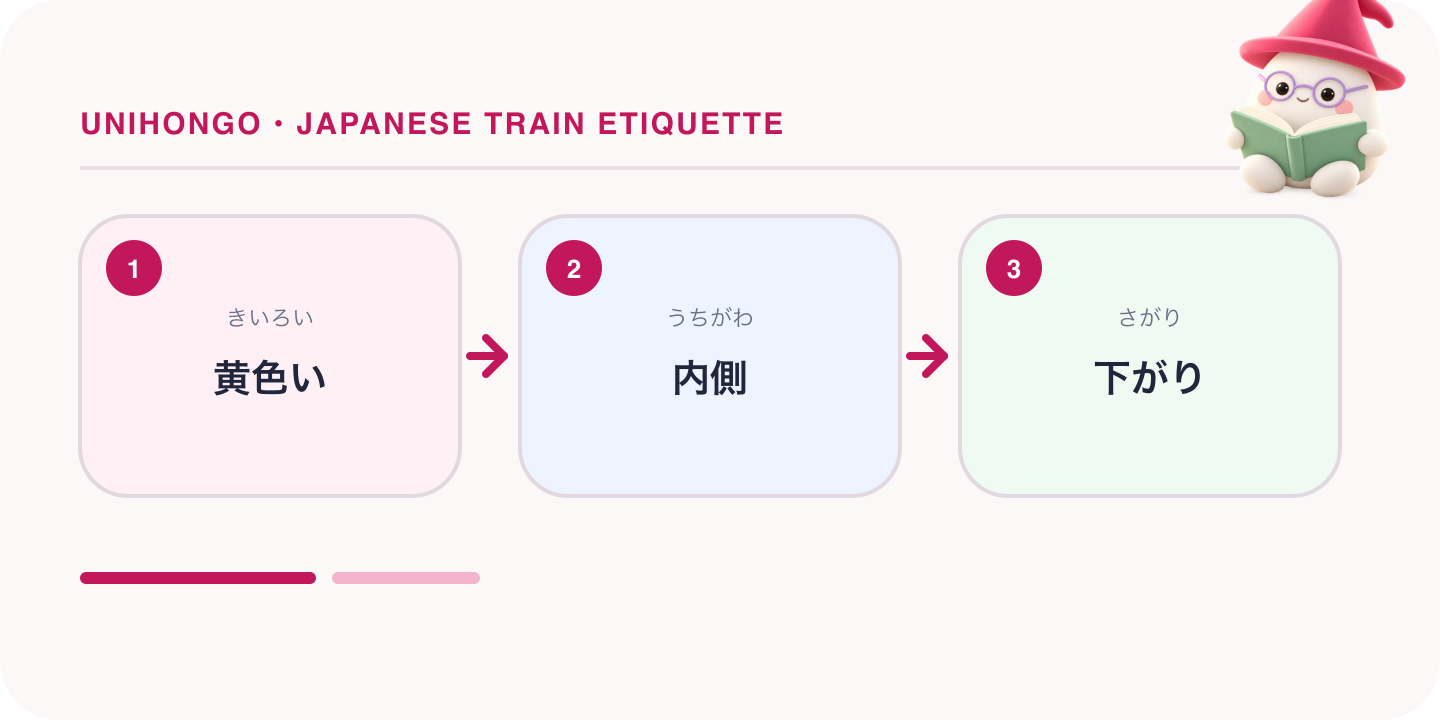
Behind the yellow tactile line is the safe zone, and the announcement kiiroi sen no uchigawa ni o-sagari kudasai, please stand behind the yellow line, plays before every arrival. If you are unsure which line to join, ask the person at the back which car it is for.
| Japanese | Romaji | Meaning |
|---|---|---|
| 黄色い線の内側にお下がりください。 | Kiiroi sen no uchigawa ni o-sagari kudasai. | Please stand behind the yellow line. |
| ここは何号車の列ですか。 | Koko wa nan-gōsha no retsu desu ka. | Which car is this line for? |
| 降りる方が先です。 | Oriru kata ga saki desu. | People getting off go first. |
| 駆け込み乗車はおやめください。 | Kakekomi jōsha wa o-yame kudasai. | Please do not rush to board a departing train. |
Inside the carriage: phones, voices and seats
The carriage is quiet, and the quiet is kept by the phone rule. Set your phone to manner mode, keep it away from your ear, and if it rings, silence it before you decide what to do. The manner announcement plays constantly: keitai denwa wa manā mōdo ni settei no ue, tsūwa wa o-hikae kudasai, please set your phone to silent and refrain from calls. Conversation is allowed, but at a level that does not carry to the next seat, and groups of foreign visitors chatting at normal volume are the most common source of frowns.
Seats follow a few conventions. Sit with your knees together and your bag on your lap, not on the seat beside you. Cross your legs only when the carriage is empty. Sleeping is completely normal and nobody will wake you unless you lean on them. To squeeze into a gap on a bench seat, a small sumimasen and a gesture will make the people either side shift.
| Japanese | Romaji | Meaning |
|---|---|---|
| 携帯電話はマナーモードに設定の上、通話はお控えください。 | Keitai denwa wa manā mōdo ni settei no ue, tsūwa wa o-hikae kudasai. | Please set phones to silent mode and refrain from calls. |
| すみません、少し詰めていただけますか。 | Sumimasen, sukoshi tsumete itadakemasu ka. | Excuse me, could you move along a little? |
| ここ、空いていますか。 | Koko, aite imasu ka. | Is this seat free? |
| 今、電車なので後でかけ直します。 | Ima, densha na no de ato de kakenaoshimasu. | I'm on the train, I'll call you back later. |
Priority seats and women-only cars
Priority seats, yūsenseki, are at the ends of most carriages, marked with a different seat colour and a sign showing an older person, a pregnant woman, a person with a stick and a parent with a baby. The pictograms are the rule: if someone matching them boards, stand up and offer the seat. Watch too for the help mark, a red badge worn by people whose condition is not visible, and the maternity badge on bags. Near the priority seats, some railways ask you to switch your phone off when the carriage is crowded; the wording varies by company.
Women-only cars, josei senyō sharyō, exist on many urban lines, usually the first or last car and usually only during the morning rush. The platform floor and the car doors are marked in pink with the hours. Boarding one as a man during those hours is an honest and common visitor mistake; if it happens, move to the next car at the following stop. Outside the marked hours it is an ordinary car.
| Japanese | Romaji | Meaning |
|---|---|---|
| どうぞ、お掛けください。 | Dōzo, o-kake kudasai. | Please, have a seat. |
| 席、譲りましょうか。 | Seki, yuzurimashō ka. | Shall I give you my seat? |
| 大丈夫です。次で降りますので。 | Daijōbu desu. Tsugi de orimasu no de. | I'm fine, I'm getting off at the next stop. |
| ここは優先席です。 | Koko wa yūsenseki desu. | These are priority seats. |
| この車両は女性専用車です。 | Kono sharyō wa josei senyō sha desu. | This car is women-only. |
Bags, eating and umbrellas
The single most repeated poster on Japanese trains is about rucksacks. Wear one on your back in a crowd and it takes the space of another person and hits everyone behind you as you turn. The expected move is to take it off and hold it in front of you, on your lap when sitting, or put it on the overhead rack. Suitcases go on the rack if small, or in the space beside the doors if large, with you holding them so they do not roll.
Eating on a commuter train looks out of place; a bottle of tea is fine, a sandwich is not. The rule flips on the shinkansen and on limited expresses with reserved seats, where an ekiben lunch box is part of the trip and the seat has a tray table for it. Wet umbrellas are furled, sleeved if the station offers plastic sleeves, and held upright against your own leg.
| Japanese | Romaji | Meaning |
|---|---|---|
| リュックは前に抱えるか、網棚にお載せください。 | Ryukku wa mae ni kakaeru ka, amidana ni o-nose kudasai. | Please hold rucksacks in front of you or put them on the rack. |
| 荷物、上に載せますね。 | Nimotsu, ue ni nosemasu ne. | I'll put my bag up on the rack. |
| 新幹線ではお弁当を食べても大丈夫です。 | Shinkansen de wa o-bentō o tabete mo daijōbu desu. | It's fine to eat a lunch box on the shinkansen. |
| 傘が当たってすみません。 | Kasa ga atatte sumimasen. | Sorry, my umbrella touched you. |
Train vocabulary
These are the words you will hear in announcements and see on signs and the monthly manner posters, which make good reading practice on a commute.
| Japanese | Romaji | Meaning |
|---|---|---|
| 次は新宿、お出口は左側です。 | Tsugi wa Shinjuku, o-de-guchi wa hidarigawa desu. | Next stop Shinjuku, doors open on the left. |
| この電車は快速です。 | Kono densha wa kaisoku desu. | This train is a rapid service. |
| 終電は何時ですか。 | Shūden wa nan-ji desu ka. | What time is the last train? |
| Word | Reading | Meaning |
|---|---|---|
| 優先席 | yūsenseki | Priority seat |
| 女性専用車 | josei senyō sha | Women-only car |
| マナーモード | manā mōdo | Silent mode on a phone |
| 網棚 | amidana | Overhead luggage rack |
| 乗り換え | norikae | Transfer to another line |
| 駆け込み乗車 | kakekomi jōsha | Rushing to board a departing train |
| ラッシュアワー | rasshu awā | Rush hour |
| 満員電車 | man'in densha | Packed train |
| 各駅停車 | kakueki teisha | Local train stopping at every station |
| 快速 | kaisoku | Rapid train that skips stations |
| 終電 | shūden | Last train of the night |
| ヘルプマーク | herupu māku | Help mark badge for hidden conditions |
Announcements follow a fixed pattern: the next station, which side the doors open, tsugi wa Shinjuku, o-de-guchi wa hidarigawa desu, and the transfers available. Once you know the pattern you can catch your station even in a crowded car where you cannot see the display.
Rush hour and getting on and off
In the morning rush, the big city lines run at a density where the rules above change shape. Queues become dense blocks, and at the busiest stations staff push the last passengers in so the doors can close. Inside, you stand where you are pushed, face the doors or the windows, keep your arms in front of you and your hands visible, and hold a strap or a pole rather than leaning on the person beside you. Nobody speaks.
Getting off is the one moment you must speak. A stop or two before yours, start moving towards the door. At the station, say orimasu, I'm getting off, and people ahead of you will step out onto the platform to let you pass. If you are near the door and not getting off, step out, stand beside the door, and get back on last. Holding your ground in the doorway while the crowd squeezes past is the mark of a newcomer.
| Japanese | Romaji | Meaning |
|---|---|---|
| 降ります。 | Orimasu. | I'm getting off. |
| すみません、通してください。 | Sumimasen, tōshite kudasai. | Excuse me, please let me through. |
| 次、降りますので。 | Tsugi, orimasu no de. | I'm getting off at the next stop (so please let me past). |
| 押さないでください。 | Osanaide kudasai. | Please don't push. |
| 足を踏んでしまってすみません。 | Ashi o funde shimatte sumimasen. | Sorry, I stepped on your foot. |
Regional and generational variation
Osaka and Tokyo differ in small ways that locals notice. Escalator standing sides are the famous example, left in Tokyo and right in Osaka, though railways in both cities now ask everyone to stand still on both sides. Kansai passengers are said to talk a little more freely, while Tokyo carriages are quieter. Rural lines are looser about eating and phones simply because there is nobody to disturb.
Generations disagree mostly about phones and seats. Older passengers may still expect phones switched off near priority seats, while younger passengers treat silent use as fine anywhere. Younger people are also more likely to stand up without a word when they see someone who needs a seat, whereas older passengers often say dōzo aloud. Neither is wrong; watch the car you are in and match it.
| Japanese | Romaji | Meaning |
|---|---|---|
| 大阪では右側に立ちます。 | Ōsaka de wa migigawa ni tachimasu. | In Osaka people stand on the right (of the escalator). |
| 田舎の電車はもっとのんびりしています。 | Inaka no densha wa motto nonbiri shite imasu. | Trains in the countryside are more relaxed. |
| 優先席付近では電源をお切りください。 | Yūsenseki fukin de wa dengen o o-kiri kudasai. | Please switch phones off near the priority seats. |
Mistakes foreigners make
| Japanese | Romaji | Meaning |
|---|---|---|
| 失礼しました。 | Shitsurei shimashita. | Sorry, excuse me (for a small offence). |
| 女性専用車だと知りませんでした。 | Josei senyō sha da to shirimasen deshita. | I didn't know this was the women-only car. |
| すみません、声が大きかったですね。 | Sumimasen, koe ga ōkikatta desu ne. | Sorry, we were being loud. |
- Talking at normal volume in a group, especially on a quiet evening train
- Wearing a rucksack on your back in a crowd or putting a bag on the seat beside you
- Boarding before people have finished getting off, or standing in the middle of the door
- Eating a meal on a commuter train, or drinking coffee that smells across the car
- Sitting in the priority seats with headphones on and not noticing who has boarded
- Boarding the women-only car during the marked hours
- Blocking the doorway at a busy stop instead of stepping off and back on
- Running to catch a closing door, which is the kakekomi jōsha the announcements warn against
When you get one of these wrong, a short sumimasen or shitsurei shimashita and an immediate fix is all that is needed. Nobody expects a visitor to know every rule; what they notice is whether you adjust once you have seen how the car works. Sleeping in your seat, by contrast, is not a mistake at all.