
Why roleplay works better than keigo tables at work
A keigo chart tells you that iu becomes ossharu for a client and mousu for yourself. It cannot tell you which one to reach for when a customer asks who you are while you are looking for a pen. Workplace Japanese is decided in seconds, with a relationship, a task, and some stress attached, so the only preparation that works is practising the decision itself in a situation that resembles the real one.
Roleplay with an AI tutor gives you that repetition without spending a colleague's patience. You can answer the same call ten times, ask for a simpler caller, or request that the tutor play a stern manager rather than a friendly one. If you still need the forms themselves, the keigo basics guide on this site explains them; this article assumes you have met them and focuses on making them usable.
Set up each roleplay with role, relationship, and stakes
The quality of a business roleplay depends on the brief you give. State three things in one sentence: who the tutor is, who you are, and what must be achieved. 'You are a client from another company calling about a delayed invoice; I am a junior staff member answering the phone; I need to take a message and promise a callback.' That single line fixes the register, the vocabulary, and the pressure.
Then set the difficulty honestly. Beginners can ask the tutor to speak slowly and keep to one request. Intermediate learners should ask for interruptions, an unexpected question, or a caller who does not spell their name. Ask the tutor to hold corrections until the end unless a mistake would cause real offence, so that you train the flow of the exchange rather than stopping after every sentence.
Common workplace situations and the register they need
Before drilling phrases, decide what level of politeness each situation calls for. The table below covers the moments professionals meet most often. Teineigo means plain desu and masu politeness. Sonkeigo raises the listener or the person you are discussing; kenjougo lowers yourself or your company. Most exchanges mix them, so the register column names the dominant one, and the model opening gives you a safe first sentence to build from.
| Situation | Register to use | Model opening phrase |
|---|---|---|
| Self-introduction on your first day | Teineigo with kenjougo verbs | Honjitsu kara osewa ni narimasu, Tanaka to moushimasu. |
| Answering an external phone call | Kenjougo for your side, sonkeigo for the caller | Hai, Unihongo no Tanaka de gozaimasu. |
| Taking a message for an absent colleague | Kenjougo | Ainiku Sato wa seki o hazushite orimasu. |
| Short update in a team meeting | Teineigo | Genzai no shinchoku o hokoku itashimasu. |
| Asking a senior colleague for help | Sonkeigo with a softener | Osore irimasu ga, sukoshi oshiete itadakemasu ka. |
| Apologising for a delay | Kenjougo, formal apology | Moushiwake gozaimasen, okurete shimaimashita. |
| Speaking to a client in person | Full sonkeigo and kenjougo | Honjitsu wa ojikan o itadaki arigatou gozaimasu. |
Notice that the register shifts with the relationship rather than the topic. The same delay is reported to a peer with sumimasen and to a client with moushiwake gozaimasen. Practising each row as a full roleplay is what turns this table into behaviour.
Phone calls: answering, holding, and taking messages
Phone calls frighten learners because there is no face to read and no time to translate. Break the call into fixed stages and rehearse each until the opening comes out before you have thought about it. Answer with your company and name, confirm the caller, and ask them to hold with shoushou omachi kudasai if you need to check anything. If the person is absent, say so humbly and offer to take a message.
Taking a message is where most roleplays pay off. Ask the tutor to give a name that is hard to catch, a number, and a callback window, and practise repeating each item back for confirmation. Kakunin shite orikaeshi gorenraku itashimasu, meaning you will check and call back, closes the loop cleanly. Then run the same call again as an internal colleague ringing from another floor, so you feel the register drop.
Meetings, requests, and apologies in short exchanges
Meeting updates are easier than they sound because they follow a shape: what you did, where it stands, what you need. Ask the tutor to play a manager who wants a sixty-second update, deliver it aloud, and then answer one follow-up question. Use shouchi itashimashita to acknowledge an instruction, and practise stating a problem before a solution so the update sounds honest rather than defensive.
Requests and apologies depend on softeners. Osore irimasu ga before a request, and a clear statement of what you will do next after an apology, matter more than perfect verb forms. You can also rehearse email phrasing aloud: read the opening of a message you need to send, such as osewa ni natte orimasu, and let the tutor respond as the recipient. Spoken written phrases are far easier to recall in conversation.
Business phrases to rehearse until they are automatic
These eight phrases cover a surprising share of daily workplace exchanges. Drill them inside roleplays rather than as a list: say each one in a phone call, a meeting, and a corridor conversation so that the phrase attaches to a situation rather than to a page.
| Japanese | Romaji | Meaning |
|---|---|---|
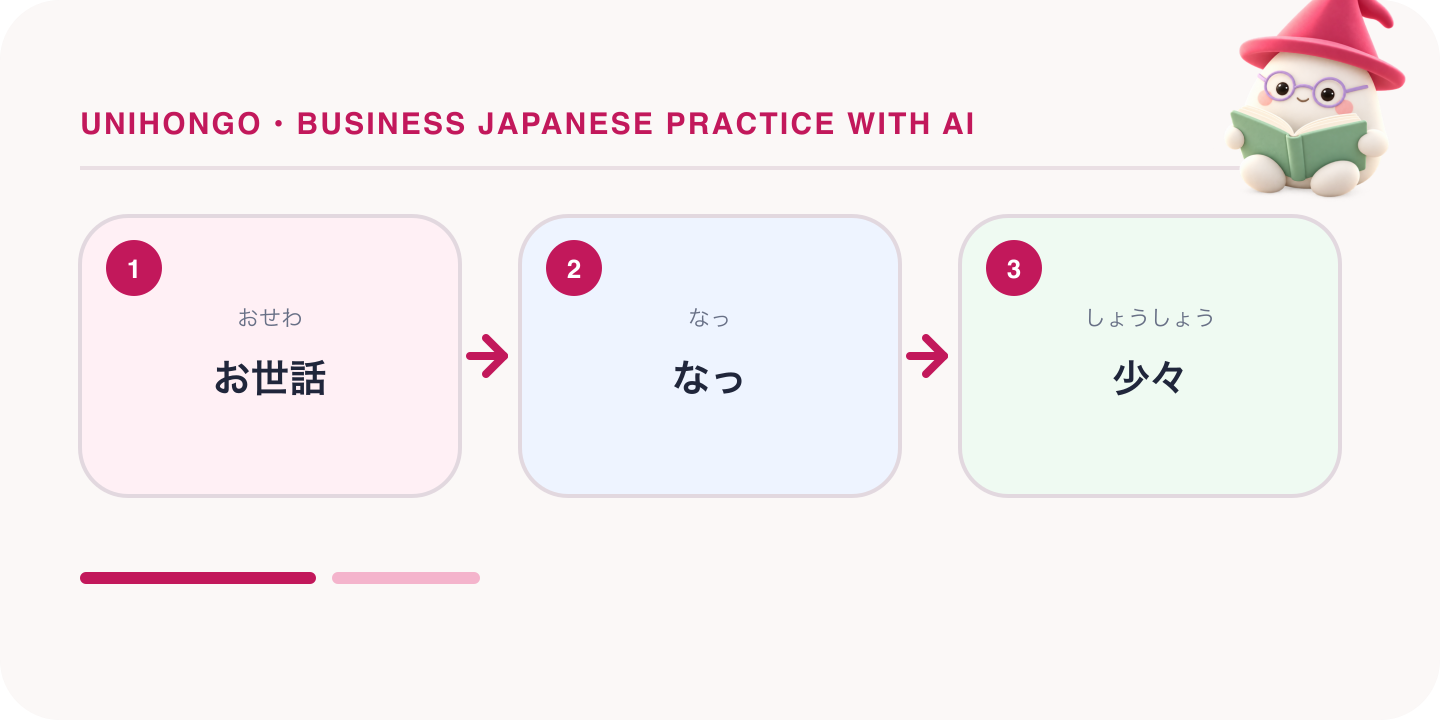
| お世話になっております。 | Osewa ni natte orimasu. | Thank you for your continued support (standard business greeting). |
| 少々お待ちください。 | Shōshō omachi kudasai. | Please hold for a moment. |
| 恐れ入りますが、もう一度お名前をお願いできますか。 | Osore irimasu ga, mō ichido onamae o onegai dekimasu ka. | I am sorry to trouble you, but could I have your name again? |
| 確認して折り返しご連絡いたします。 | Kakunin shite orikaeshi gorenraku itashimasu. | I will check and call you back. |
| 本日はお時間をいただきありがとうございます。 | Honjitsu wa ojikan o itadaki arigatō gozaimasu. | Thank you for your time today. |
| 承知いたしました。 | Shōchi itashimashita. | Understood (humble acknowledgement). |
| 申し訳ございません、遅れてしまいました。 | Mōshiwake gozaimasen, okurete shimaimashita. | I am very sorry, I am late. |
| 田中は本日休みを取っております。 | Tanaka wa honjitsu yasumi o totte orimasu. | Tanaka is off today (humble, about a colleague). |
A weekly business Japanese routine with an AI tutor
Fifteen minutes a day is enough if each day has a single situation. The routine below rotates the situations from the table so that no phrase goes a week without use, and reserves one day for repeating with harder details, which is where fluency grows.
- Monday: self-introduction and small talk with a new colleague, then the same exchange with a client.
- Tuesday: two phone calls, one external and one internal, each ending with a message taken and confirmed.
- Wednesday: a sixty-second meeting update followed by one unexpected question from the manager.
- Thursday: asking a senior colleague for help, then apologising for a delay to the same person.
- Friday: repeat the week's weakest situation with a faster, stricter counterpart and no hints.
- Weekend: review saved corrections and check any doubtful keigo with a colleague or teacher.
Unihongo supports this routine with roleplay missions such as job interviews, live conversations with an AI Sensei, and session reports that flag register mistakes. A human mentor still matters for the customs of your particular company, but daily rehearsal is what makes the polite forms appear when a real phone rings.