

The textbook question: eigo o hanasemasu ka
Eigo o hanasemasu ka is the sentence you will find in every phrasebook, and it deserves its place. Eigo is English, o marks it as the object, hanasemasu is the potential form of hanasu, to speak, and ka turns the whole thing into a question. It is polite, correct and understood everywhere, from a rural post office to a Tokyo department store.
The one thing to know about it is that it asks about ability directly, and Japanese people are often modest about ability. Someone who studied English for six years at school may still answer iie, no, because to them speaking English means speaking it fluently. That is why the gentler variations in the next section often get a more helpful response. Use eigo o hanasemasu ka when you need a clear answer, for example on the phone or when arranging something important.
Add sumimasen at the start and you have a complete, polite opener. Among friends you can drop to plain form, eigo hanaseru?, but keep desu and masu with staff, officials and anyone older.
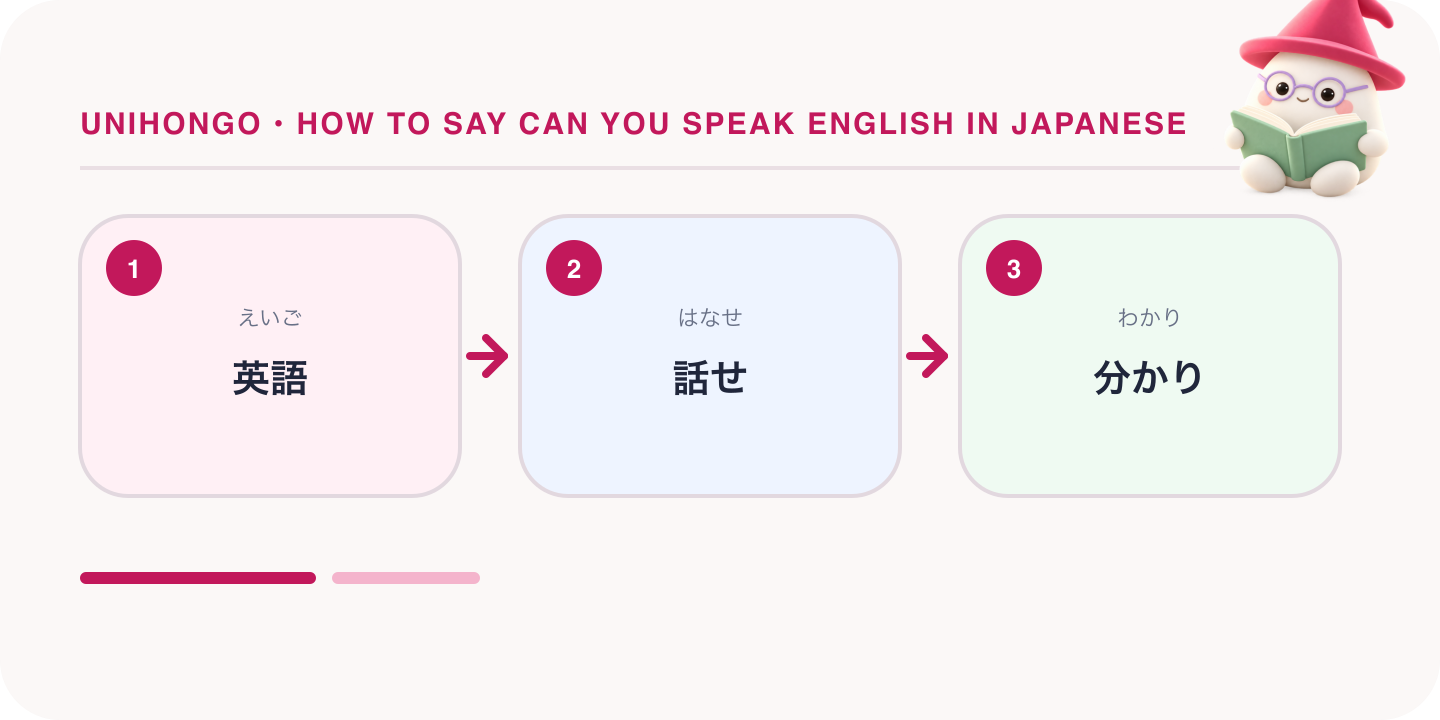
| Japanese | Romaji | Meaning |
|---|---|---|
| すみません、英語を話せますか。 | Sumimasen, eigo o hanasemasu ka. | Excuse me, can you speak English? |
| 英語は話せますか。 | Eigo wa hanasemasu ka. | Can you speak English? (slightly softer) |
| 英語が分かりますか。 | Eigo ga wakarimasu ka. | Do you understand English? |
| 少し英語で話してもいいですか。 | Sukoshi eigo de hanashite mo ii desu ka. | May I speak in English a little? |
| 日本語があまり分かりません。 | Nihongo ga amari wakarimasen. | I don't understand much Japanese. |
Softer everyday versions: daijōbu and de ii desu ka
In real life, Japanese people rarely ask each other whether they can speak a language. They ask whether it is okay to use it. That is the logic behind eigo wa daijōbu desu ka, literally is English all right, and eigo de ii desu ka, is it okay in English. Both shift the question away from the other person's ability and towards the practical matter of how you will communicate, which makes it much easier to answer with sukoshi nara, if it is a little, or with a hand gesture and a smile.
Eigo de ii desu ka is especially useful just before you start speaking. You have already said sumimasen, the person has turned to you, and you check the channel before using it. Eigo de mo ii desu ka, is English also okay, is a shade more polite, with mo suggesting you would use Japanese if you could.
Another gentle option is eigo ga wakaru hito wa imasu ka, is there someone who understands English. It lets the person in front of you hand you over to a colleague without embarrassment.
| Japanese | Romaji | Meaning |
|---|---|---|
| 英語は大丈夫ですか。 | Eigo wa daijōbu desu ka. | Is English okay? |
| 英語でいいですか。 | Eigo de ii desu ka. | Is it all right in English? |
| 英語でもいいですか。 | Eigo de mo ii desu ka. | Would English also be all right? |
| 英語が分かる人はいますか。 | Eigo ga wakaru hito wa imasu ka. | Is there someone who understands English? |
| 英語で説明してもらえますか。 | Eigo de setsumei shite moraemasu ka. | Could you explain it in English? |
| ゆっくりなら日本語でも大丈夫です。 | Yukkuri nara nihongo de mo daijōbu desu. | If it's slow, Japanese is fine too. |
Asking for English menus, maps and leaflets
Sometimes you do not need the person to speak English at all; you need a piece of paper in English. The pattern is eigo no plus the thing, plus wa arimasu ka. Eigo no menyū wa arimasu ka, do you have an English menu, is the most searched version, and it works for chizu, map; panfuretto, leaflet; annai, guide or information; and setsumeisho, instructions.
Tourist areas often have English materials tucked under the counter that staff will only produce if asked, so this question is worth asking before you struggle with a Japanese menu. If there is no English version, the next best thing is a menu with pictures, shashin-tsuki, or a recommendation, osusume, which you can then simply order by pointing.
| Japanese | Romaji | Meaning |
|---|---|---|
| 英語のメニューはありますか。 | Eigo no menyū wa arimasu ka. | Do you have an English menu? |
| 英語の地図はありますか。 | Eigo no chizu wa arimasu ka. | Do you have an English map? |
| 英語のパンフレットはありますか。 | Eigo no panfuretto wa arimasu ka. | Do you have an English leaflet? |
| 写真付きのメニューはありますか。 | Shashin-tsuki no menyū wa arimasu ka. | Do you have a menu with photos? |
| 英語の版はありますか。 | Eigo no ban wa arimasu ka. | Is there an English version? |
| おすすめはどれですか。 | Osusume wa dore desu ka. | Which one do you recommend? |
The replies you will hear
The answer to any of these questions is rarely a plain yes or no. The single most common reply is sukoshi dake, only a little, often with a thumb and forefinger held close together. It usually means the person can handle simple English if you speak slowly. Take it as a yes with conditions, not a refusal.
A confident yes sounds like hai, daijōbu desu or hai, dōzo, please go ahead. A polite no often comes wrapped in apology: sumimasen, eigo wa chotto, sorry, English is a bit, with the sentence trailing off, or eigo wa wakaranai n desu, I do not understand English. Chotto on its own, with an apologetic face, is a no. You may also hear shōshō o-machi kudasai, please wait a moment, followed by the person disappearing to find a colleague, which is one of the best outcomes.
| What you hear | Reading | What it means for you |
|---|---|---|
| 少しだけ。 | Sukoshi dake. | A little; speak slowly and keep it simple |
| はい、大丈夫です。 | Hai, daijōbu desu. | Yes, that's fine; go ahead in English |
| ちょっと… | Chotto... | A gentle no; switch to simple Japanese or gestures |
| 英語はちょっと。 | Eigo wa chotto. | English is difficult for me; a polite no |
| 少々お待ちください。 | Shōshō o-machi kudasai. | Please wait; they are fetching someone |
| 英語が分かる者を呼びます。 | Eigo ga wakaru mono o yobimasu. | I'll call someone who understands English |
| 日本語は大丈夫ですか。 | Nihongo wa daijōbu desu ka. | Is Japanese okay? Answer sukoshi dake |
| ゆっくりなら。 | Yukkuri nara. | If you speak slowly; a conditional yes |
| 翻訳アプリを使いますね。 | Hon'yaku apuri o tsukaimasu ne. | I'll use a translation app; wait and read |
Mono in eigo ga wakaru mono is a humble word for a member of staff, so the sentence means I will call a colleague who understands English. It sounds formal because the speaker is lowering their own side, not because anything is wrong.
Why leading with Japanese works better
Many visitors report that Japanese people avoid them, when what is really happening is a fear of failing at English in public. A stranger who starts speaking fast English creates a situation where the only honest answers are a fluent reply or a visible failure. A stranger who says sumimasen, eigo wa daijōbu desu ka creates a different situation: the person can say sukoshi dake, they can gesture, they can fetch someone, and none of it feels like failure.
There is a second reason. A Japanese opener signals that you will meet them halfway, and people are far more willing to try their English when they see you trying your Japanese. Even a very short exchange, sumimasen followed by the question and an arigatō gozaimasu at the end, changes the tone of everything in between.
Finally, slow, clear English after permission is granted is much more useful than fast English before it. Once someone has said sukoshi dake, use short sentences, avoid idioms, and mix in any Japanese words you know.
- Start with sumimasen, then the question in Japanese
- Wait for the answer before switching to English
- Speak slowly, in short sentences, without idioms
- Mix in simple Japanese words you know: kore, eki, ikura
- End with arigatō gozaimasu even if it did not fully work
What to do when the answer is no
A no is not the end of the conversation. Most everyday needs, directions, prices, tickets, a table for two, can be handled with a few nouns, a point and a smile, and Japanese staff are very good at guessing from context. The important thing is to stay calm and slow down rather than repeating the English louder.
Have three fallback tools ready. The first is writing: kaite kudasai, please write it, works for prices, times and platform numbers, and many staff will reach for a notepad or calculator on their own. The second is your phone: a translation app is normal in Japan now, and saying apuri de ii desu ka, is it okay with an app, lets you type your question without awkwardness. The third is pointing and naming: kore, this; sore, that; koko, here; with a question tone.
If the matter is complicated, ask eigo no annaijo wa arimasu ka, is there an English information desk. Major stations and tourist areas usually have one.
| Japanese | Romaji | Meaning |
|---|---|---|
| 書いてください。 | Kaite kudasai. | Please write it down. |
| アプリでいいですか。 | Apuri de ii desu ka. | Is it okay if I use an app? |
| これをお願いします。 | Kore o onegai shimasu. | This one, please. |
| ここに行きたいです。 | Koko ni ikitai desu. | I want to go here. (pointing at a map) |
| 英語の案内所はありますか。 | Eigo no annaijo wa arimasu ka. | Is there an English information desk? |
| ゆっくり話してもらえますか。 | Yukkuri hanashite moraemasu ka. | Could you speak slowly? |
| 大丈夫です、ありがとうございます。 | Daijōbu desu, arigatō gozaimasu. | It's fine, thank you. |
Mistakes that make the question land badly
The biggest mistake is not a grammar error but an order error: asking in English first. Do you speak English, said quickly to someone who was not expecting it, produces the freeze described above. The fix costs one sentence of Japanese.
The second mistake is sounding like a test. Eigo dekimasu ka, can you do English, is grammatical but can sound like an evaluation, and anata wa, you, at the start of any of these questions is unnecessary and a little confrontational. Leave out the pronoun; the context makes it clear who you are asking.
The third is giving up at sukoshi dake. A little is enough for most transactions. And when someone has made an effort in English, thank them in Japanese: eigo, jōzu desu ne, your English is good, is a kind way to end.
| Japanese | Romaji | Meaning |
|---|---|---|
| 英語、上手ですね。 | Eigo, jōzu desu ne. | Your English is good. |
| 助かりました。 | Tasukarimashita. | That was a real help. |
| ありがとうございました。 | Arigatō gozaimashita. | Thank you very much. (after the help) |